
Judge, 1882-07-29 · page 10 of 16
Judge — July 29, 1882 — page 10: what you’re looking at
What you’re looking at
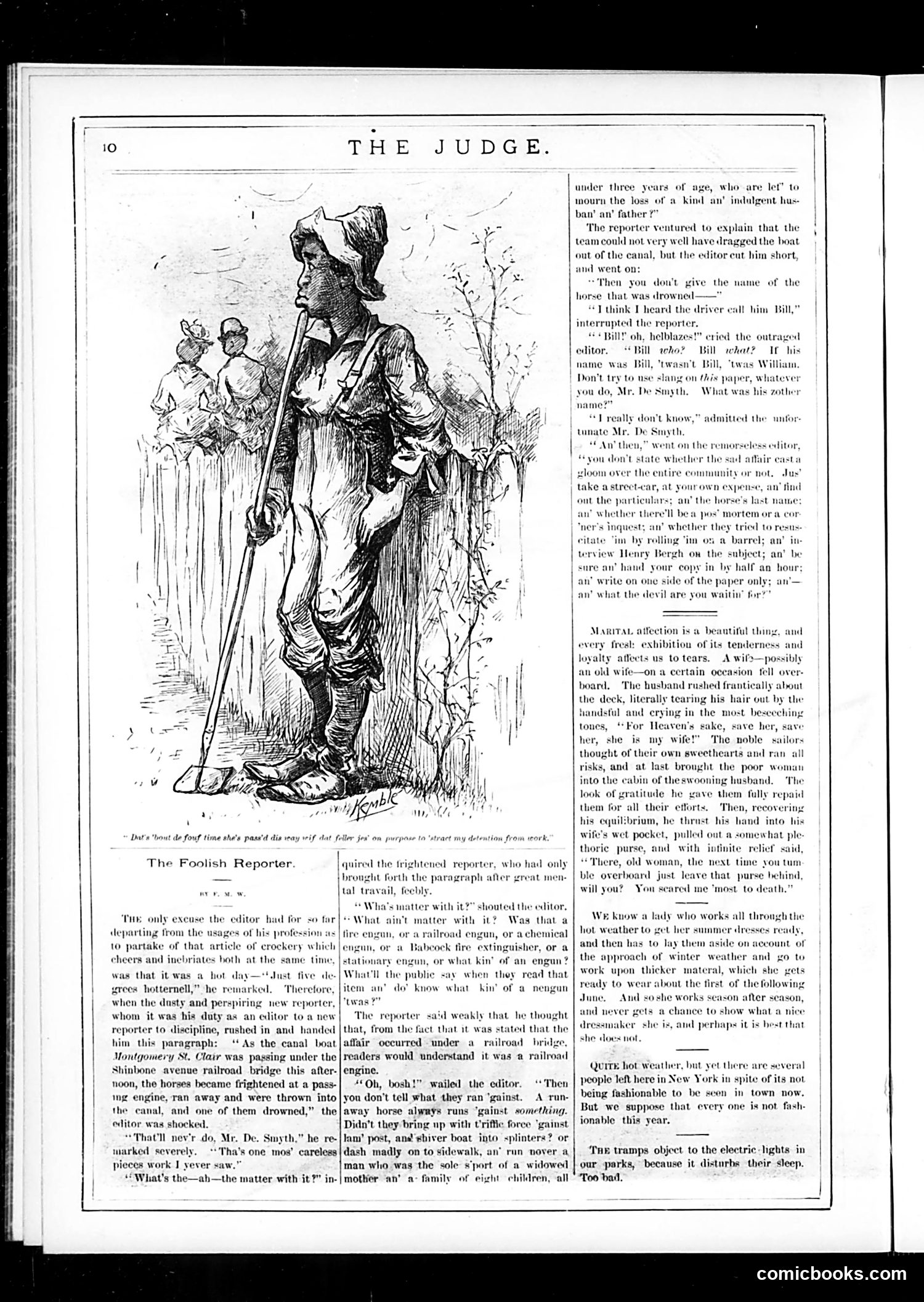
This page satirizes **editorial pedantry and overwrought journalism standards**. The main cartoon depicts an editor brutally critiquing a young reporter's simple news item about a canal-boat accident. The editor demands absurd elaborations: the horse's name, whether it hit a post or person, the widow's number of children—details irrelevant to the actual story. His nitpicking is absurd, yet presented as journalistic rigor. The accompanying anecdotes (the "Foolish Reporter" and "Marital Affection" stories) continue the theme of satirizing excessive concern with trivial details and overwrought sentimentality in newspaper writing. **The satire's target**: Editors who prioritize exhaustive (and often irrelevant) detail and melodramatic language over clear, straightforward reporting. The joke exposes how such editorial obsession produces worse journalism, not better. This reflects late 19th-century tensions between sensationalism and professional newspaper standards.
📄 Transcribed text from this page (OCR, searchable)
Machine-transcribed from the original scan — historical spelling and the odd misread are preserved.
r so far] of his profession as of crockery whieh shoth at the same time, to partak cheers and inebria was that it was a hot day— grees hotternell,” he remark when the dasty and perspiring new reporter, whom it was his duty as an editor to a new reporter to discipline, rushed in and handed him this paragraph: “As the canal boat Montgomery St. Clair was passing under the Shinbone avenue railroad bridge this after- noon, the horses became frightened at a pass- ing engine, ran away and were thrown into the canal, and one of them drowned,” the editor was shocked. “That'll nev'r do, M marked severely, pieces work I y De. Smyth,” he re- one mos’ careless h—the matter with it?” in- THE JUDG sporter, who had only graph afer r with it?” shouted the edit utter with it? Was th road engun, or achemi ck fire extinguisher, or a what kin’ of an engun? ay when they read that kin’ of a nengun t The reporter said weakly that he thought that, from the fuct that it was stated that the affair occurred under a railroad bridge, readers would understand it was a railroad engine. “Oh, bosh!” wailed the editor. ‘Then you don’t tell what they ran ‘gainst. A run- away horse always runs “gainst something. Didn't they bring up with triffic force "gainst Jam’ post, ans #biver boat into splinters? or dash madly on to sidewalk, an’ run noyer a man who was the sole s‘port of a widowed mother an’ a> family of ht ehildren, all name was I under three 3 mourn the loss ban’ an’ father? ‘The reporter ventured to explain that the team could not very well have dragged the boat out of the canal, but the editor eut him short, and went on: Then you dou't give the mune of the was drowned —" the driver call him Bill,” ed the reporter. oh, helblazes!” cried the outr: “Bill who? Bill what? n't Bill, “twas W won his paper, wl th. What was hi 3 of age, who are let? to kind an’ indulgent hus: Don't try to you do, Mr. name?” zother n't know,” admitted the untor- . De Smyth “ An’ then,” v “you don’t state whether the sad s vom over the entire community or not, Jus? take astreet-car, nton the reme editor, air east d at yourown expense, an’ tind out the particular whether th + an’ whether th Zim on an’ in an’ be hour: fection is a beautiful thin exhibition of its tender 1s to tears. A wil>—po an old wife—on a certain occasion fell board. The husband rushed franti the de handstul and ¢ “For I sake, save her, save her, she is my wife!” The noble thought of their own sweethea risks, and at last brought the poor won into the eabin of the swooning husband. look of gratitude h ct tones, el nd into his "s wet pocket, pulled out as at ple- thorie purse, and with infinite relief said, “There, old woman, the next time you tum ble overboard just leave that purse behind ared me ‘most to death,” know hot weather t and then has to Jay then the approach of winter weathe work upon thicker matera ready to we yout the th June. And sosh and never gt ow what dressmaker she is, and perhaps it is best that she does not. lady who works all through the ther summer uly, on aecount of nd go to ch she nice to QUITE hot weather, but yet there a people left here in New York in spite of its not being fashionable to be seen in town no’ But we suppose that every one is not fash- ionable this year. eral ‘Tne tramps object to the electric lights in our parks, because it disturbs their sleep. ‘Too bad. 3 at's the comicbooks.com