
A complete issue · 16 pages · 1882
Judge — June 17, 1882
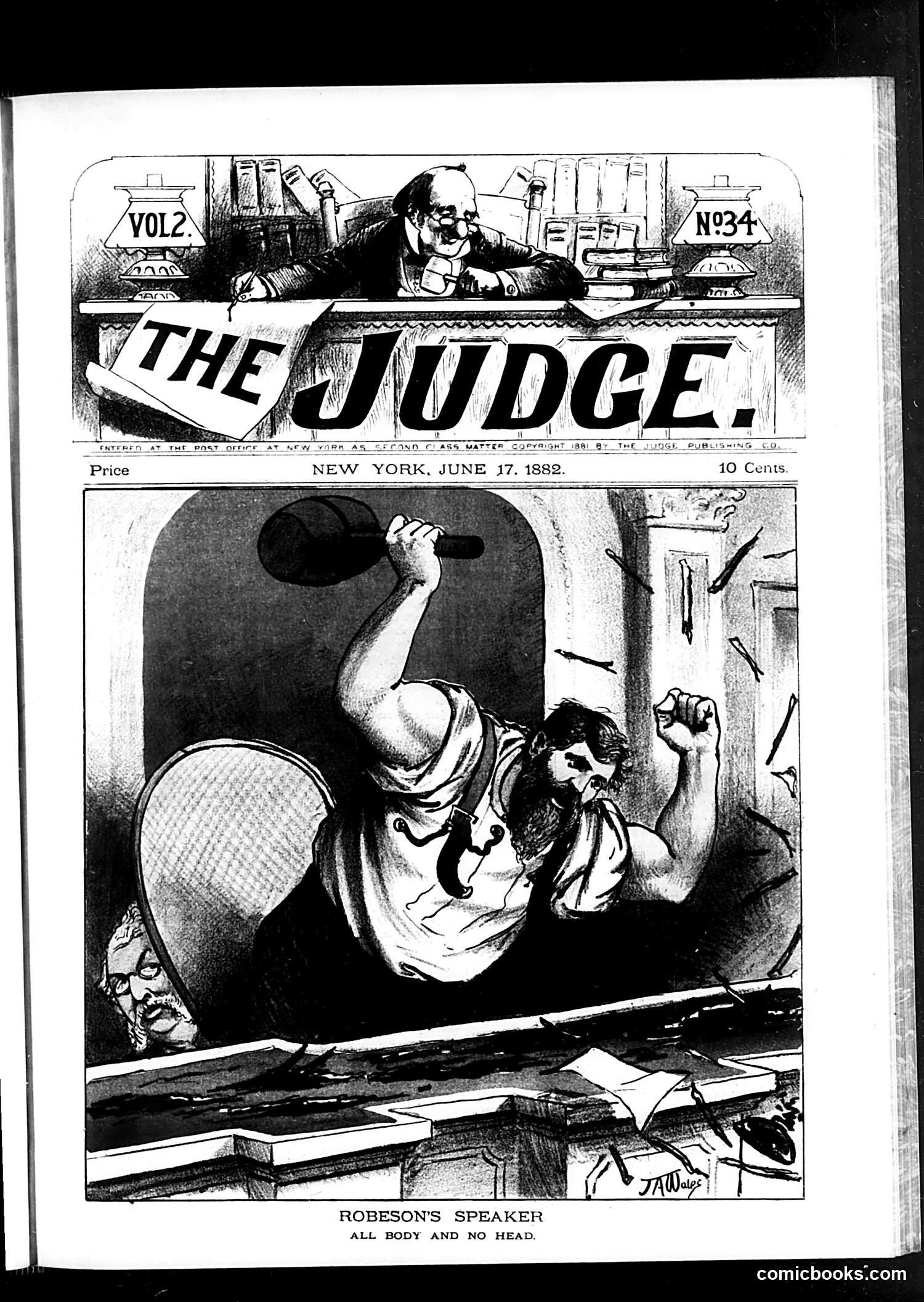
This appears to be satirizing a public speaker, likely associated with someone named Robeson. The caption "All Body and No Head" suggests the cartoon mocks the speaker's lack of intelligence or substance—depicting an exaggerated figure with an enormous body but tiny head, literally illustrating the insult. The image shows a man gesticulating wildly from what appears to be a podium or stage, with another figure nearby. The exaggeration of physical proportions was a common satirical technique in 19th-century editorial cartooning. Without additional historical documentation, I cannot definitively identify which Robeson this references or the specific speech being criticized. The satire's target and context would require further research into 1882 political or public figures named Robeson.
This page contains two distinct editorial pieces criticizing immigration and Speaker Keifer's parliamentary conduct. **"Speaker Keifer's Mallet"** ridicules House Speaker John Keifer for using physical violence (pounding his desk with a mallet) to maintain order, suggesting he should instead study tactics of New York political bosses like John Kelly and Tammany Hall figures. **"The Chinaman's Reply"** (the larger cartoon) expresses virulent anti-immigrant sentiment. The editorial argues that Polish Jews and other European immigrants are "social and political nuisances" deliberately expelled by their home countries. Using a water-pollution metaphor, the author claims immigrants will "poison our social and political well-being" like mud fouling the Mississippi River. The piece explicitly questions whether America should accept the "scum that the Old World is vomiting" into the country. This represents late-19th-century nativist ideology: xenophobic fear of non-Protestant European immigrants, particularly Jews, Italians, and Russians, portrayed as inherently inferior and corrupting to American society.
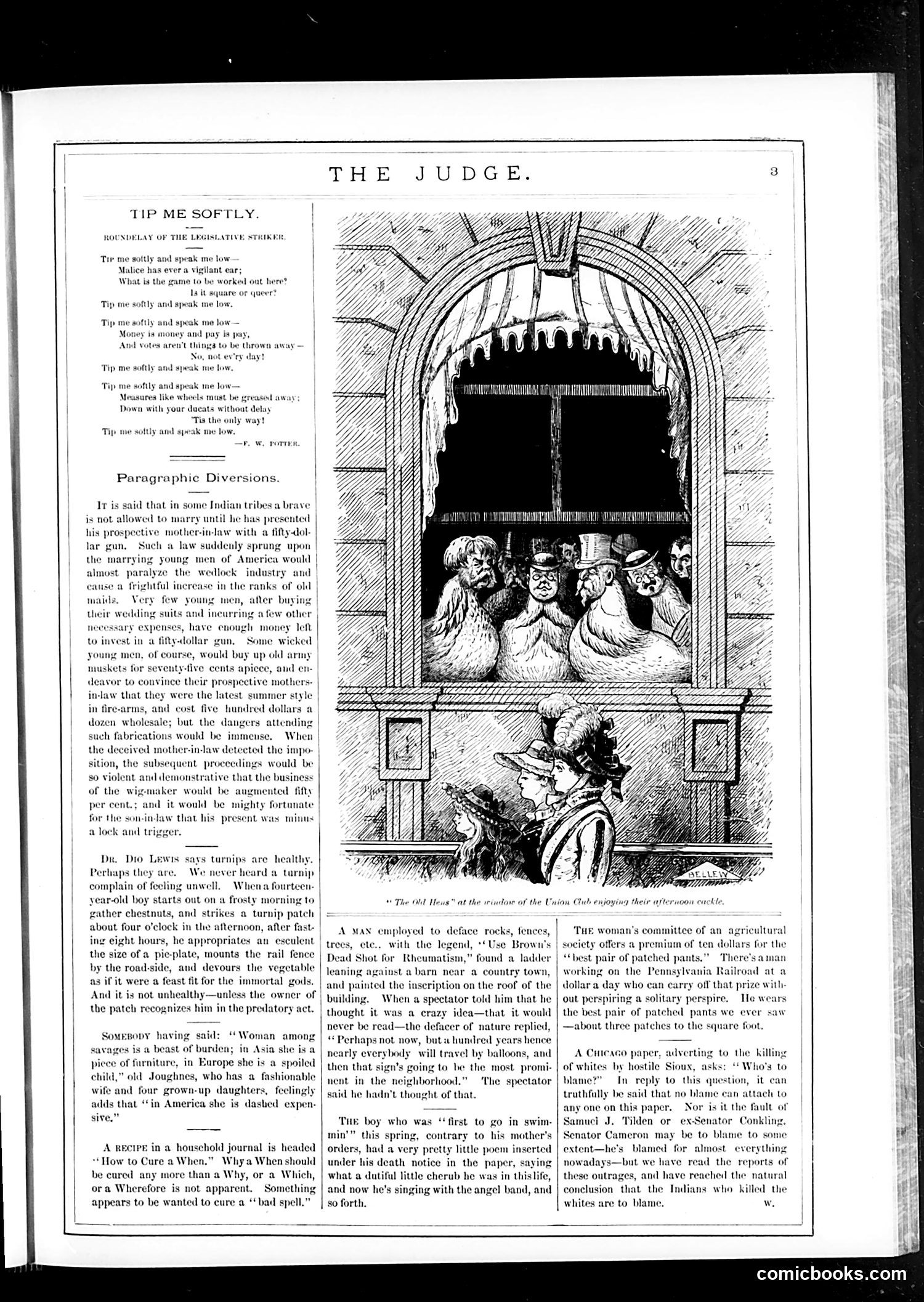
This page from Judge magazine contains multiple short satirical pieces mocking American social customs and public figures of the Gilded Age. **Main cartoon**: Shows three bearded men at a window of the Union Club enjoying "afternoon cackle" (gossip)—a visual joke about gentlemen's club culture. **Key satirical pieces**: 1. **"Tip Me Softly"**: Criticizes bribery in legislative processes, likely referencing the corrupt "legislative striker" practice where politicians demanded payments. 2. **Indian marriage customs satire**: Mocks American wealth-seeking by contrasting it with fictitious tribal dowry requirements. 3. **Various social commentary**: Attacks women's expensive tastes in America, urban legends about defacing nature (balloons reference suggests pre-Wright brothers speculation), and newspapers' mawkish death notices for children. 4. **Political barbs**: References to Samuel Tilden and Senator Conkling suggest blame-shifting among political figures—typical Judge criticism of Reconstruction-era politics. The overall tone ridicules American materialism, corruption, and social pretension characteristic of late-19th-century satire.
This page contains two satirical pieces. **"Occupations in Heaven"** is a poem mocking prominent 19th-century political figures—including James G. Blaine, John Sherman, and Boss Tweed—by imagining them continuing their corrupt practices in the afterlife. The satire suggests these men were so defined by greed and dishonesty (speculation, embezzlement, financial manipulation) that heaven itself cannot reform them. **"Walker's Combination,"** the longer narrative piece, follows a man named Walker who repeatedly pursues dubious financial schemes. His latest involved a mining investment with Colorado miners who showed him rich quartz samples. Walker was swindled—the samples weren't representative of the actual claim. The story satirizes gullible investors and the common mining-boom cons of the era, where fraudsters used impressive ore samples to lure capital. Both pieces mock American greed and financial dishonesty of the Gilded Age.
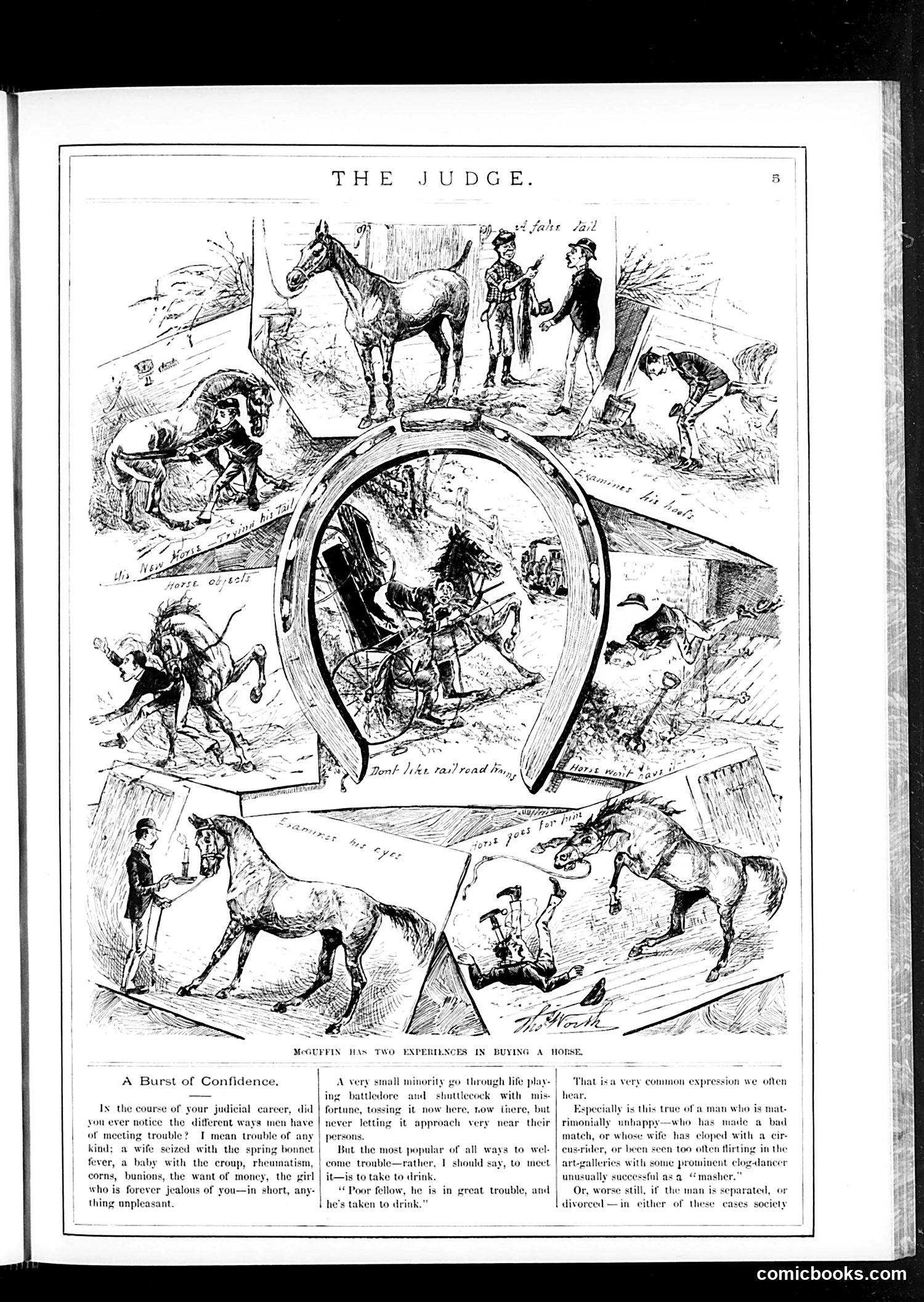
This satirical cartoon illustrates the concept of how different people encounter and handle life's troubles. The central horseshoe frame contains scenes of a man (McGuffin) dealing with a horse purchase—likely representing life's unpredictable challenges. The accompanying essay, titled "A Burst of Confidence," discusses how people respond to misfortune. It notes that while most people bounce between troubles without letting them get close, the most common coping mechanism is drinking. The piece satirizes a particular type of man—one who is "matrimonially unhappy" due to a bad marriage, infidelity, or divorce—and suggests that such a man typically "takes to drink" as his response to difficulty. The cartoon mocks both the naïveté of facing life's troubles and the era's widespread assumption that alcoholism was the gentleman's default escape from personal and social problems.
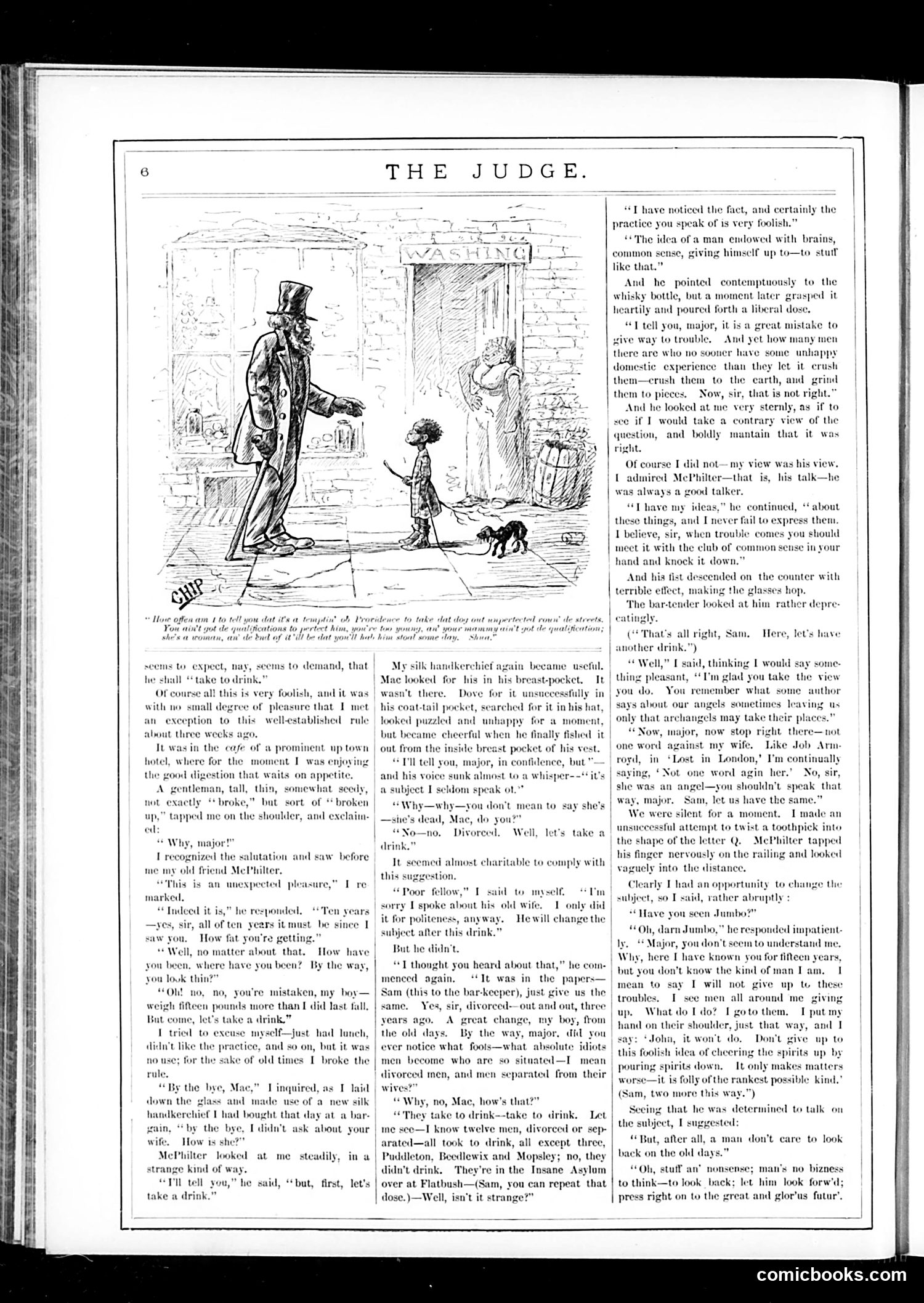
This satirical piece mocks men who blame their drinking on marital troubles. The cartoon depicts a tall, shabby gentleman (McPhilter) lecturing a narrator in a bar about the "foolishness" of men who drink after divorce or domestic problems—while simultaneously getting drunk himself. The satire's target is male hypocrisy: McPhilter pontificates about how drinking is foolish and destructive, citing examples of divorced men who take to drink (or go insane), yet he keeps ordering drinks throughout the conversation and uses his own recent divorce as justification for his behavior. The joke exposes how men rationalized alcoholism as a reasonable response to life's troubles, particularly marital failure. By having McPhilter both criticize drinking and engage in it while discussing his own failed marriage, the author ridicules the self-deception and double standards of male drinkers who saw themselves as victims rather than responsible for their choices.
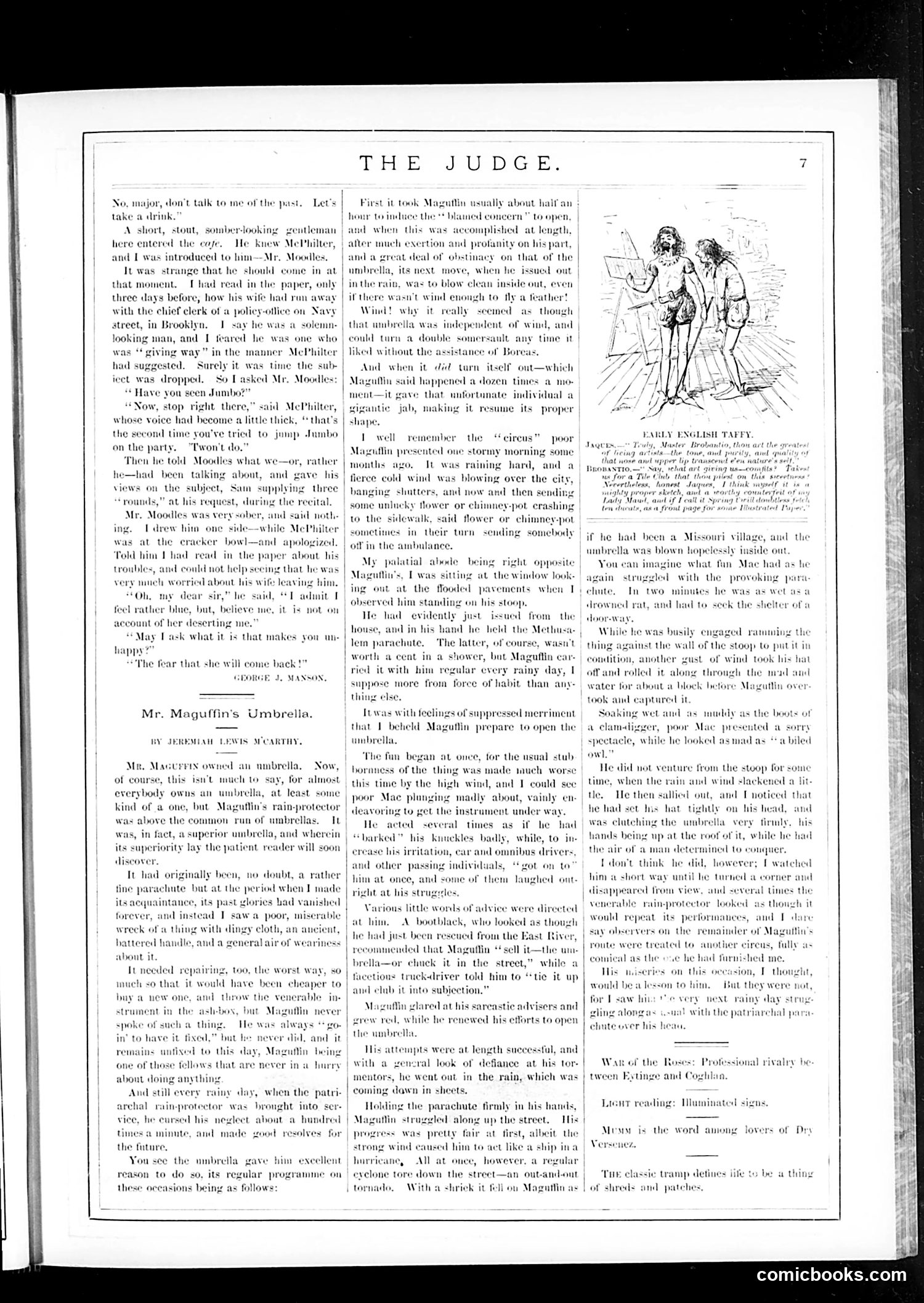
This page contains two separate satirical pieces from *Judge* magazine. The main illustrated article, "Mr. Maguffin's Umbrella" by Jeremiah Lewis McCarthy, is a humorous fictional story—not political satire. The cartoon shows a comically decrepit umbrella that behaves unpredictably in the rain. The satire targets human procrastination and vanity: Mr. Maguffin owns this obviously broken umbrella but refuses to replace it, perpetually promising to have it "fixed" but never doing so. Each rainy day, he curses the umbrella's failures (it turns inside-out, won't open properly, etc.) yet repeats his empty vow to repair it. The joke is universal rather than topical—it mocks the everyday human tendency to tolerate broken possessions and delay necessary action, all while complaining about the consequences. The umbrella serves as an extended metaphor for procrastination and self-inflicted frustration. The top section appears to be dialogue from an unrelated story involving characters named Moodles and McPhilter.
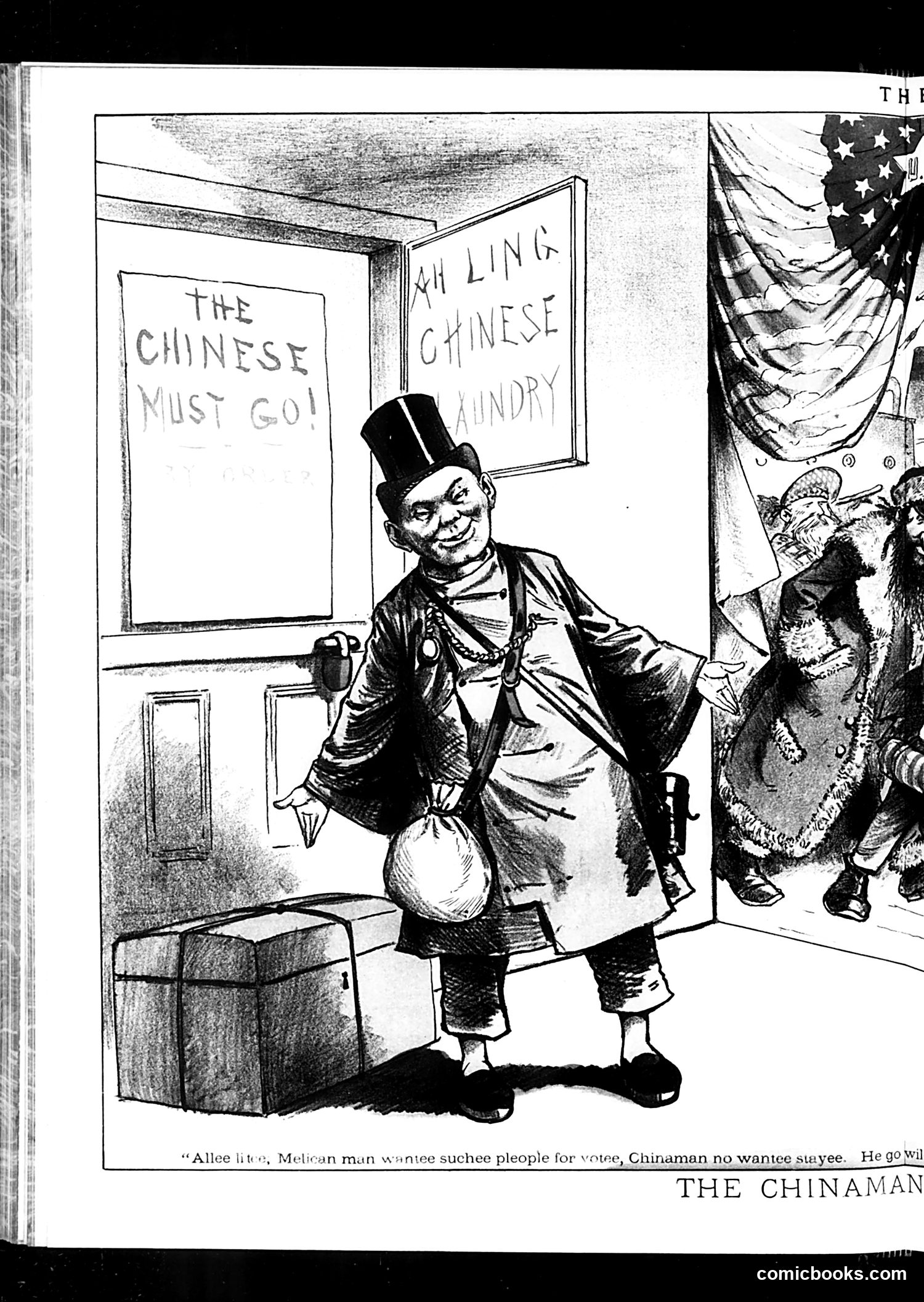
This is a racist political cartoon depicting an anti-Chinese immigrant message. The figure shown uses exaggerated "pidgin English" speech ("Allee litee," "wantee"), a common dehumanizing stereotype of the era. The cartoon references the Chinese Exclusion movement—the signs reading "THE CHINESE MUST GO!" and "SHILLING CHINESE LAUNDRY" reflect actual xenophobic campaigns. The caption suggests American politicians want Chinese people as voters but Chinese immigrants themselves wish to leave. The caricatured facial features and clothing perpetuate harmful ethnic stereotypes typical of late 19th/early 20th-century American propaganda. The American flag visible suggests this reflects contemporary anti-immigration politics and xenophobia during a period of intense Chinese exclusion in the United States.
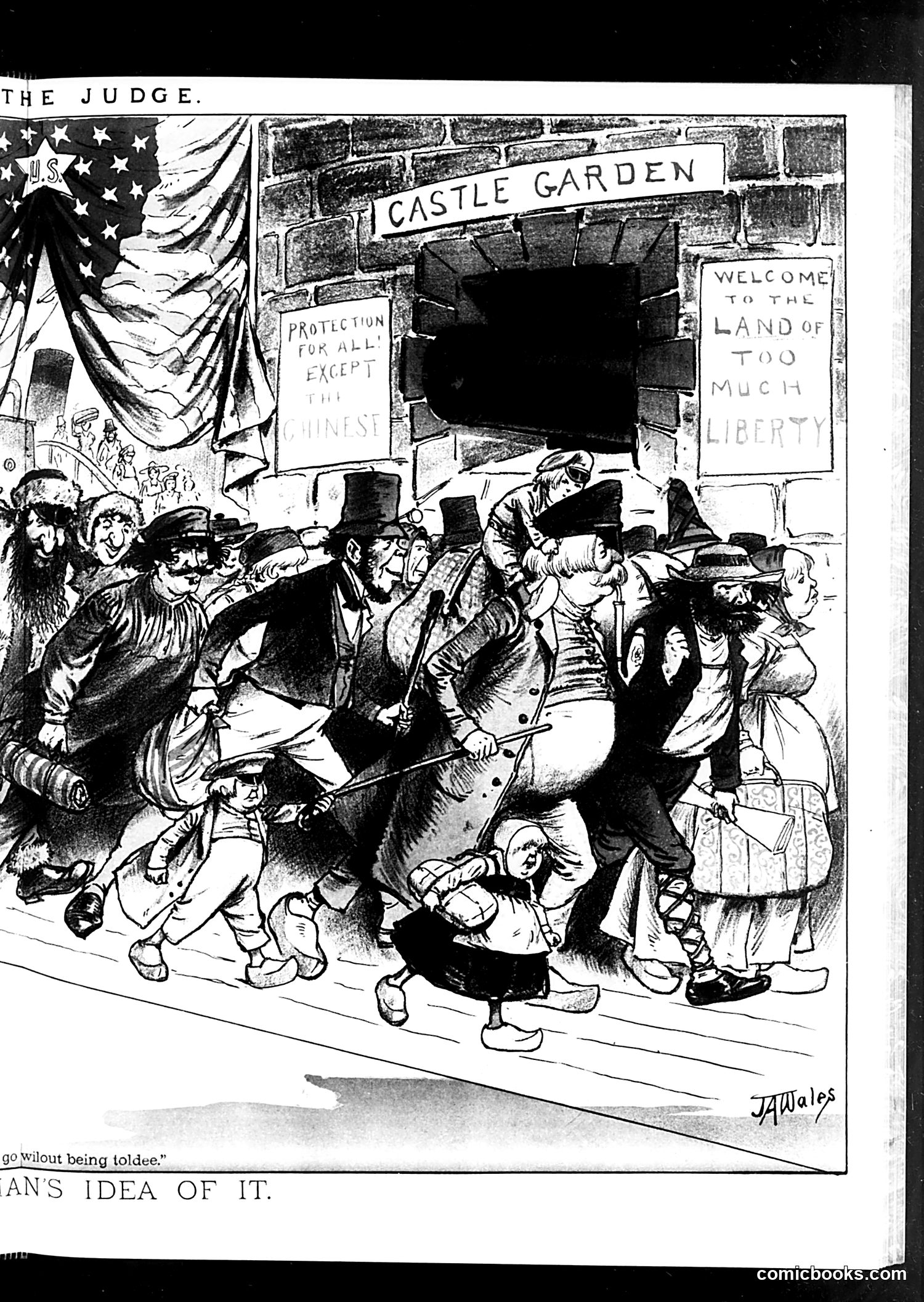
This satirical cartoon from *Judge* depicts a crowd of immigrants gathered at "Castle Garden" (the immigration processing center at Battery Park, New York) beneath an American flag. The satire targets contradictory American attitudes toward immigration. Two signs frame the scene: one reads "Protection for All Except the Chinese" and another "Welcome to the Land of Too Much Liberty"—highlighting the hypocrisy of welcoming immigrants while simultaneously implementing exclusionary policies like the Chinese Exclusion Act. The caricatured figures (appearing to represent various immigrant groups) and children suggest concerns about immigration's impact on American society. The cartoon critiques both nativist restrictions and the inadequacy of America's stated welcoming ideals, presenting a cynical view of actual immigration policy versus rhetoric. The artist is signed "JAWales."
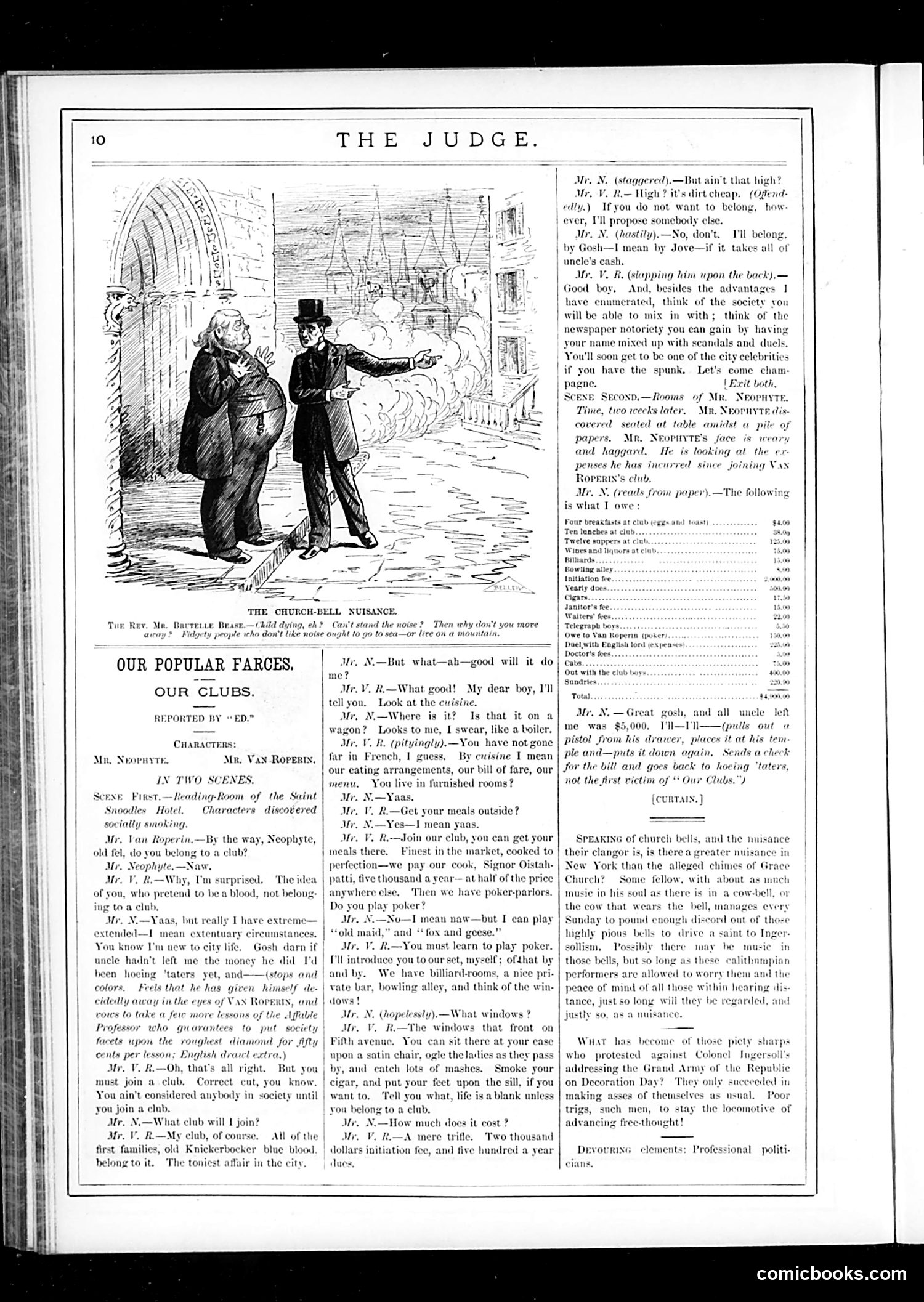
This satirical sketch mocks the pretentiousness and financial burden of exclusive gentlemen's clubs in Gilded Age America. **The Setup:** Mr. Van Roperty convinces the naive newcomer "Mr. Neophyte" that joining an elite club is essential for respectability and social advancement. Van Roperty touts lavish dining, billiard rooms, and opportunity to ogle Fifth Avenue ladies—implying the real value is shallow status-seeking and scandal. **The Punchline:** Two weeks later, Neophyte confronts a devastating bill: $4,000+ in initiation fees, meals, drinks, and miscellaneous charges. Having inherited only enough to cover part of it, he nearly commits suicide. **The Satire:** Judge ridicules both the predatory clubs that fleece members with exorbitant fees and the status-obsessed wealthy who believe such memberships essential to social standing. The sketch exposes clubs as expensive traps that trap foolish men into debt while promising ephemeral prestige. The final line—"not the first victim of 'Our Clubs'"—suggests this was a recognizable social problem of the era.
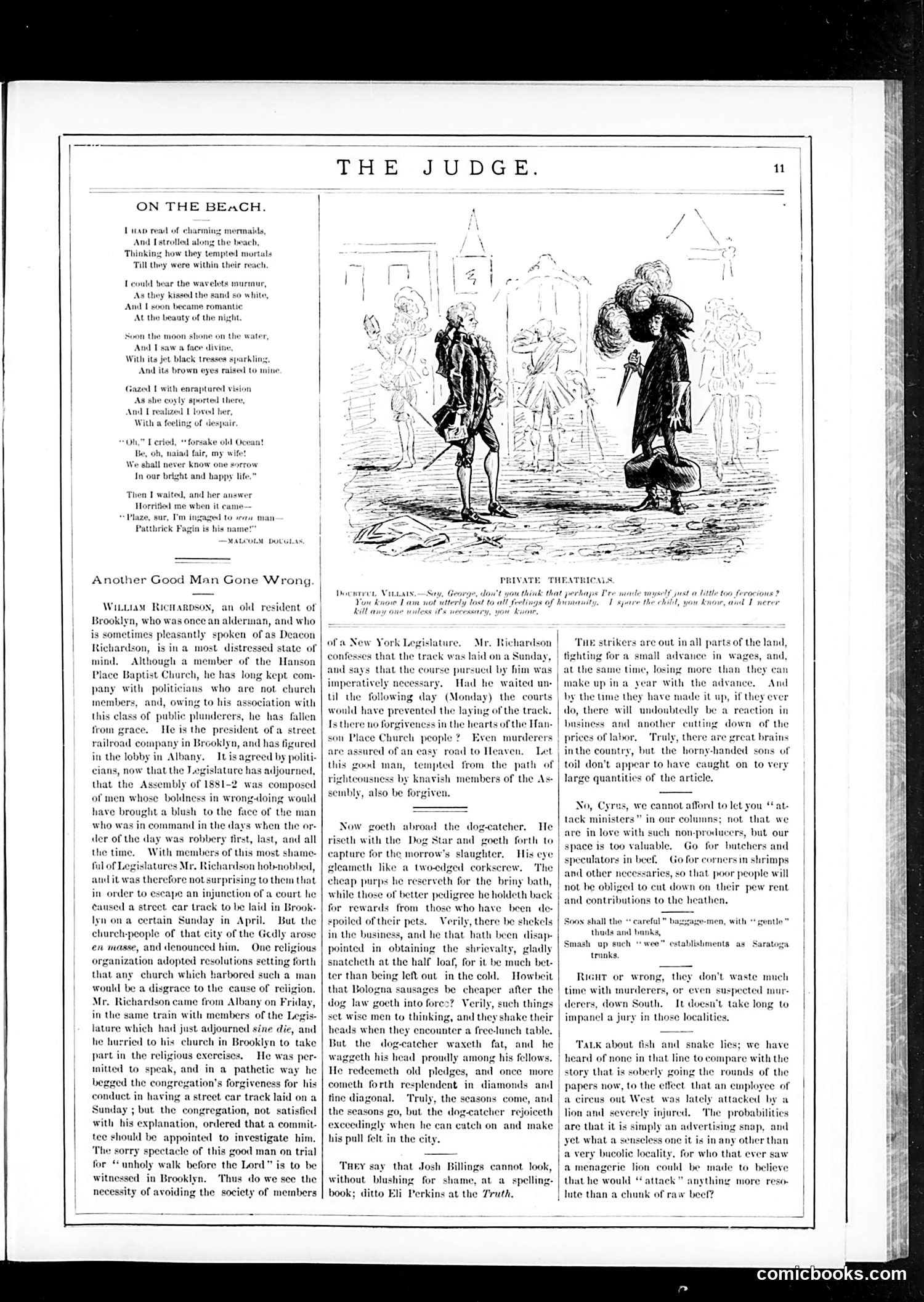
This page contains two satirical pieces from Judge magazine: **"On the Beach"** (top): A humorous poem about romantic disappointment—a man falls for a beautiful mermaid only to learn she's already engaged to "Patrick Fagin." The joke plays on the absurdity of a mermaid having terrestrial romantic commitments. **"Another Good Man Gone Wrong"** (bottom): Satirizes William Richardson, a Brooklyn alderman and Baptist church member who, despite his religious affiliation, associated with corrupt politicians and ordered a streetcar track laid on Sunday to evade court injunctions. The satire highlights the hypocrisy: Richardson claims necessity and seeks church forgiveness, but the congregation demands investigation rather than absolution. Judge mocks both Richardson's moral compromise and the church's selective application of forgiveness. **"Private Theatricals"** (right column): A brief satirical note about the hypocrisy of calling certain politicians "attack ministers" while tolerating actual corruption. The overall theme: moral compromise among ostensibly respectable figures.
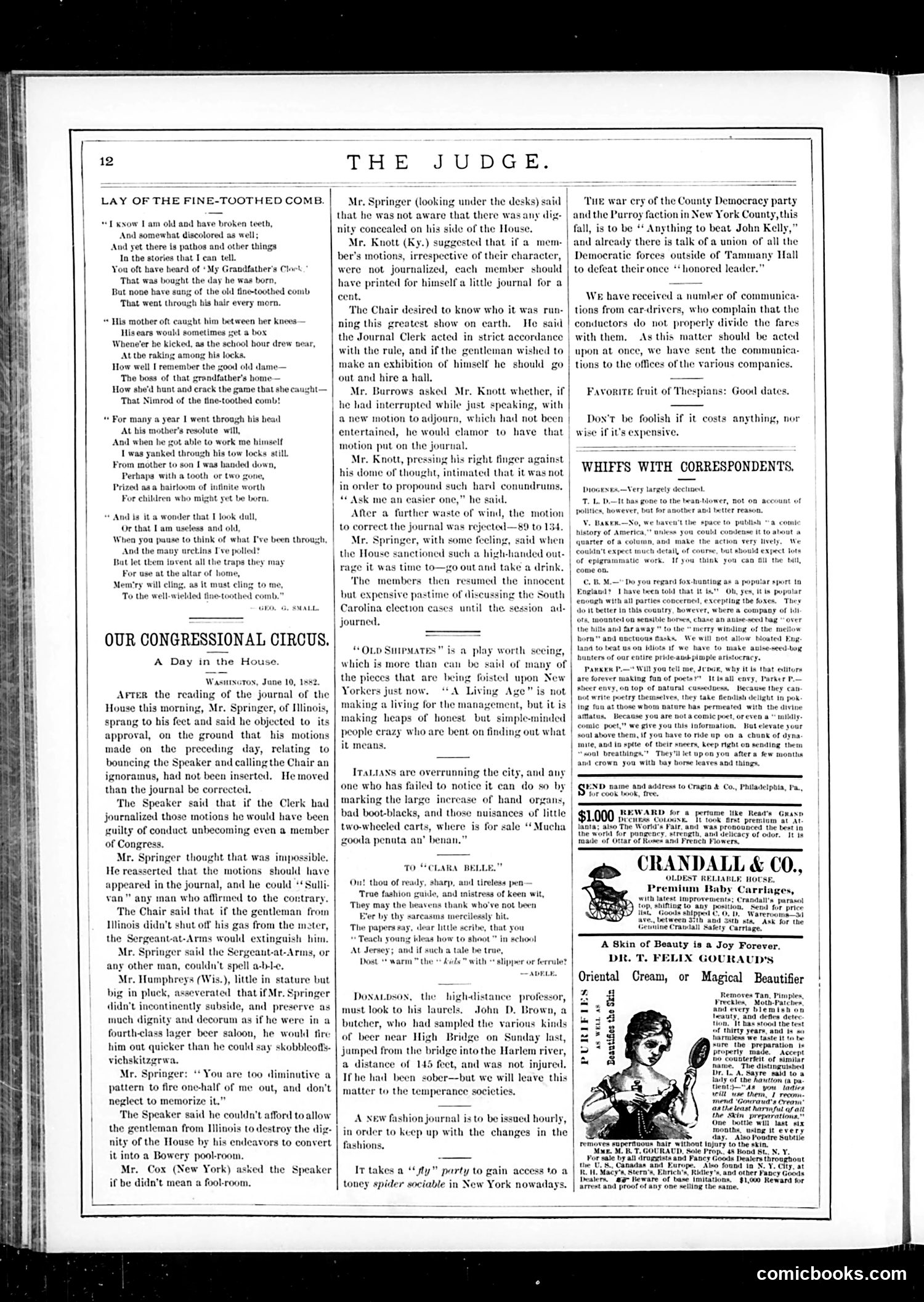
This page satirizes congressional dysfunction through a mock-heroic narrative format. The main article, "Our Congressional Circus," describes a June 1882 House session where Rep. Springer of Illinois disrupts proceedings by demanding his insulting motions from the previous day be recorded in the official journal. The satire works by: 1. **Escalating absurdity**: Rather than deny Springer's complaint, the Speaker (likely John O. Keesler) responds with increasingly insulting remarks, comparing the House to a "Bowery pool-room" and "fool-room." 2. **Name-calling as debate**: Members trade schoolyard insults ("you can't spell"), treating legislative business as personal combat rather than governance. 3. **The "circus" framing**: The title explicitly mocks Congress as entertainment rather than serious lawmaking—a commentary on partisan gridlock and theatricality in politics that remains recognizable today. The poem "Lay of the Fine-Toothed Comb" appears unrelated satirical filler content.
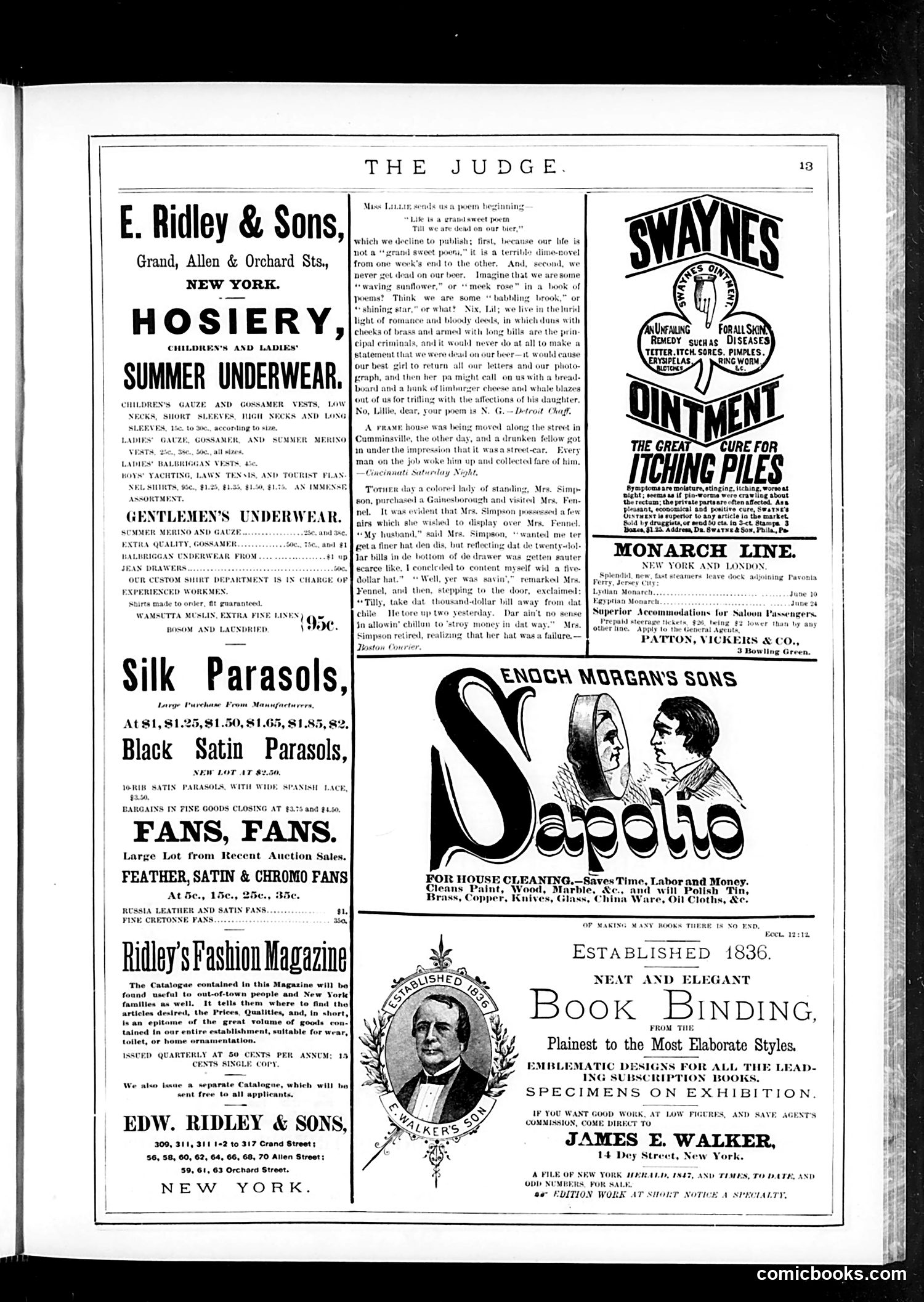
This page is primarily **advertising**, not satirical content. The dominant material consists of commercial announcements for late-19th-century retailers: **Main advertisers include:** - E. Ridley & Sons (hosiery and summer undergarments) - Silk parasols and fans - Swayne's Ointment (for piles/hemorrhoids) - Enoch Morgan's Sons Sapolio soap - Monarch Line steamships (New York-London) - James E. Walker (book binding) **The only narrative content** appears to be a brief sketch about a woman named Lillie who wrote a poem, with dialogue suggesting her boyfriend's dismissive reaction. The text references her "calling in allowin' other line" and mentions a "five dollar hat"—likely satirizing class pretensions or romantic conflict, though context is fragmentary. The page reflects Judge's business model: satirical commentary supported by period advertising. The commercial mix reveals what urban, middle-class consumers bought in this era.
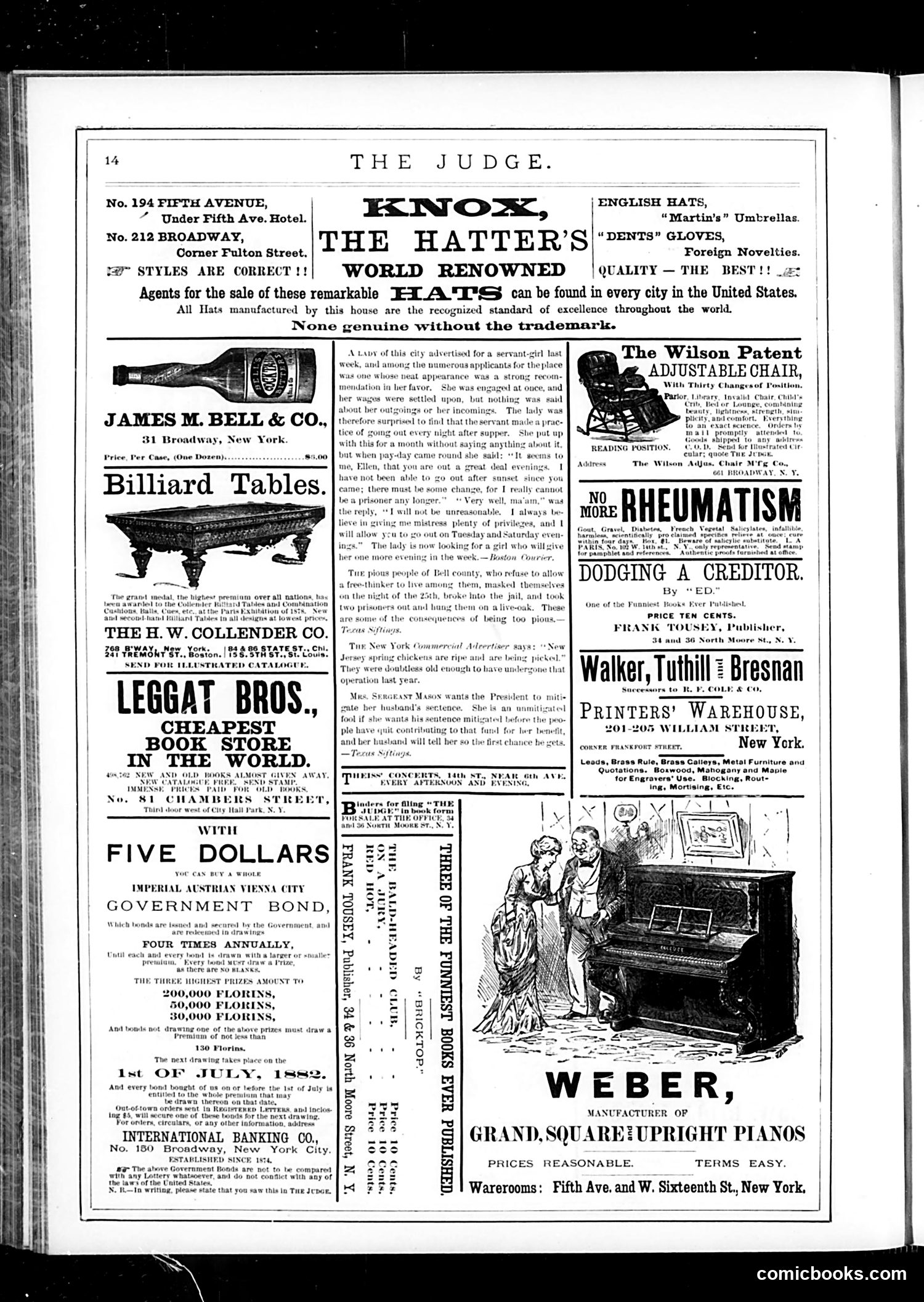
This page is primarily **advertising content** rather than editorial cartoons, typical of 19th-century magazines that relied heavily on paid advertisements for revenue. The notable visual element is a **cartoon illustration** (bottom right) showing two women at a piano, likely advertising Weber pianos. The sketch depicts genteel domestic life—a common advertising trope suggesting that piano ownership signified refinement and social status. The small narrative piece near the top ("A Lady of this city advertised for a servant-girl last week...") appears to be a humorous anecdote about class relations and servant expectations—reflecting period concerns about domestic help and changing labor dynamics. Most of the page features **legitimate advertisements** for luxury goods (Knox hats, billiard tables, pianos) and financial products (Austrian government bonds), reflecting Judge's readership of affluent, upper-class Americans. The overall impression is of a publication targeting wealthy urbanites interested in consumer goods and financial speculation.
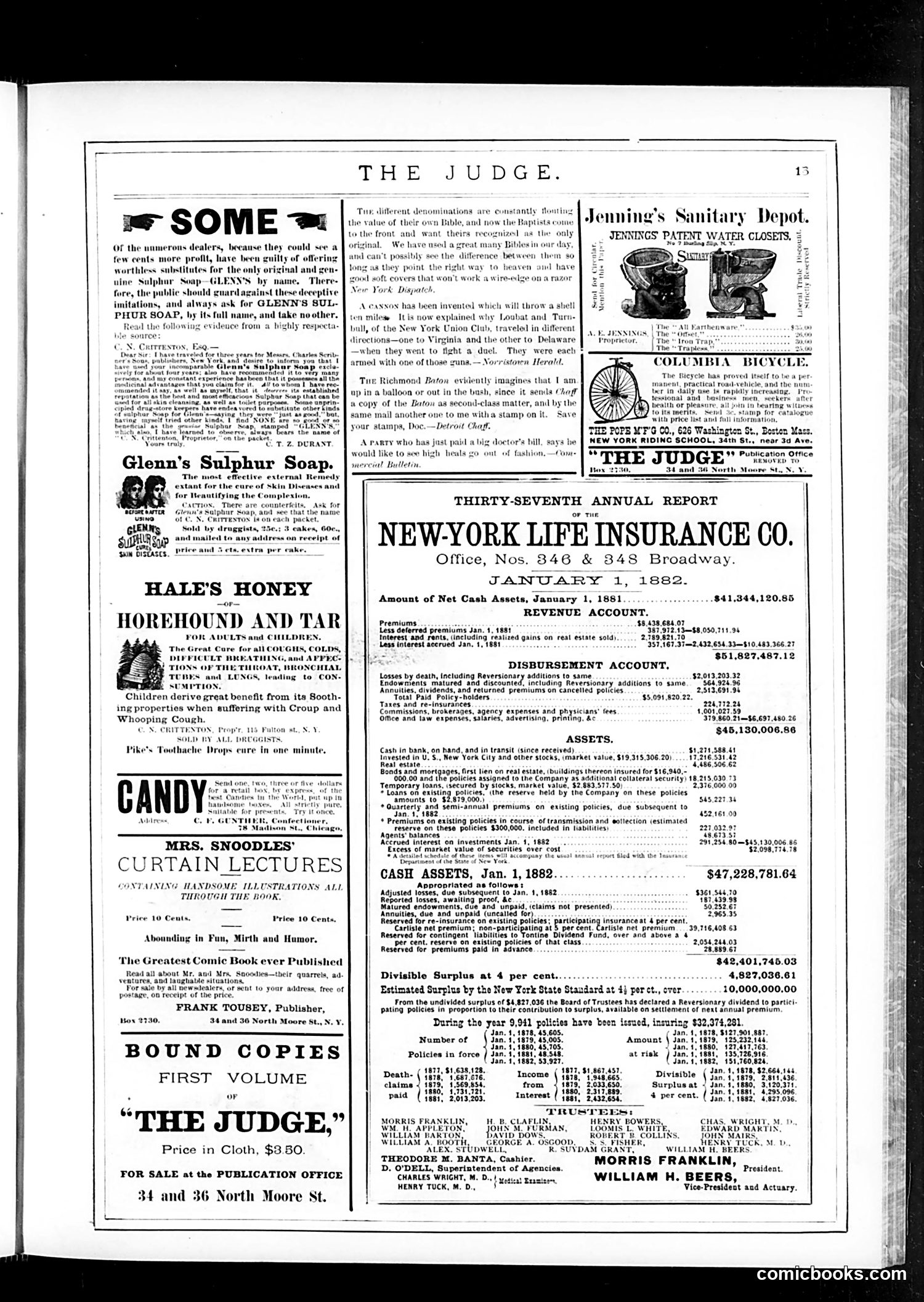
This page from *Judge* magazine (January 1, 1882) is dominated by **advertisements and financial reporting**, not political satire or comics. The visible content includes: - Multiple patent medicine ads (Glenn's Sulphur Soap, Hale's Honey) - Product advertisements (bicycles, water closets, curtain lecture books) - The **37th Annual Report of the New York Life Insurance Company**—a substantial financial statement occupying the right half of the page The only satirical editorial content visible is a brief column fragment titled "Some" discussing denominational differences over Bible versions—a lighthearted jab at religious sectarianism. A mention of "A party who has just paid a big doctor's bill" suggests mild humor about medical costs. **This is essentially a magazine back page mixing house ads with financial notices**—typical of 19th-century publications that used such pages for revenue and announcements rather than editorial content.
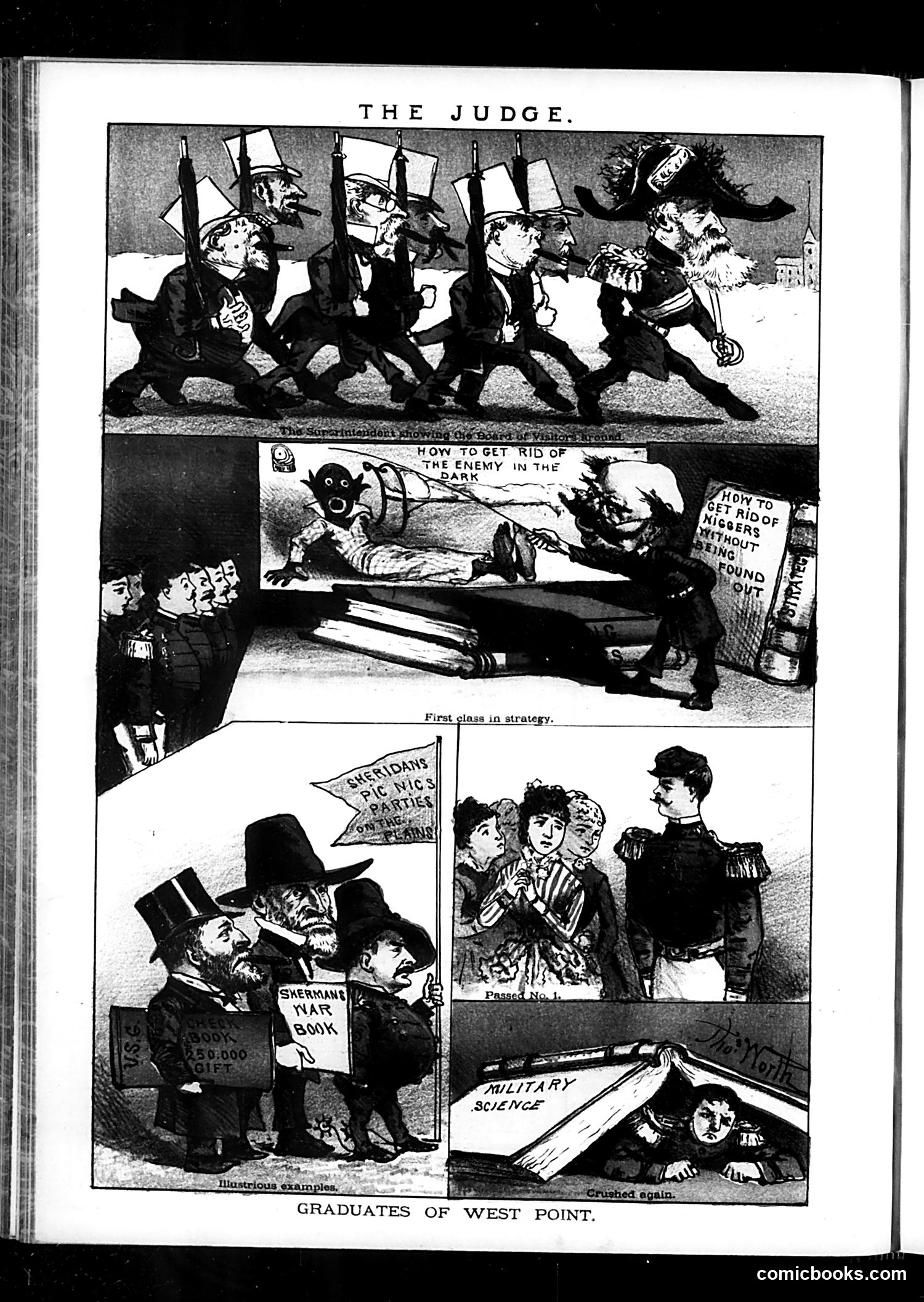
This page satirizes American military strategy during what appears to be the early 20th century. The top panel shows military figures marching with flags, likely representing Allied forces or American military leadership. The middle sections mock military incompetence through captions like "How to Get Rid of the Enemy in the Dark" and "First Class in Strategy," depicting soldiers in absurd situations—one appears trapped or defeated despite their uniforms and training. The bottom panels labeled "Illustrious Examples" and "Crushed Again" show figures holding signs about "Sherman's War Bank" and "American Pig Wigs," suggesting criticism of American military tactics, possibly referencing Civil War strategies or contemporary military blunders. The overall message criticizes West Point graduates' actual battlefield effectiveness, implying their formal training produces ineffective commanders despite impressive credentials.