
A complete issue · 16 pages · 1882
Judge — June 10, 1882
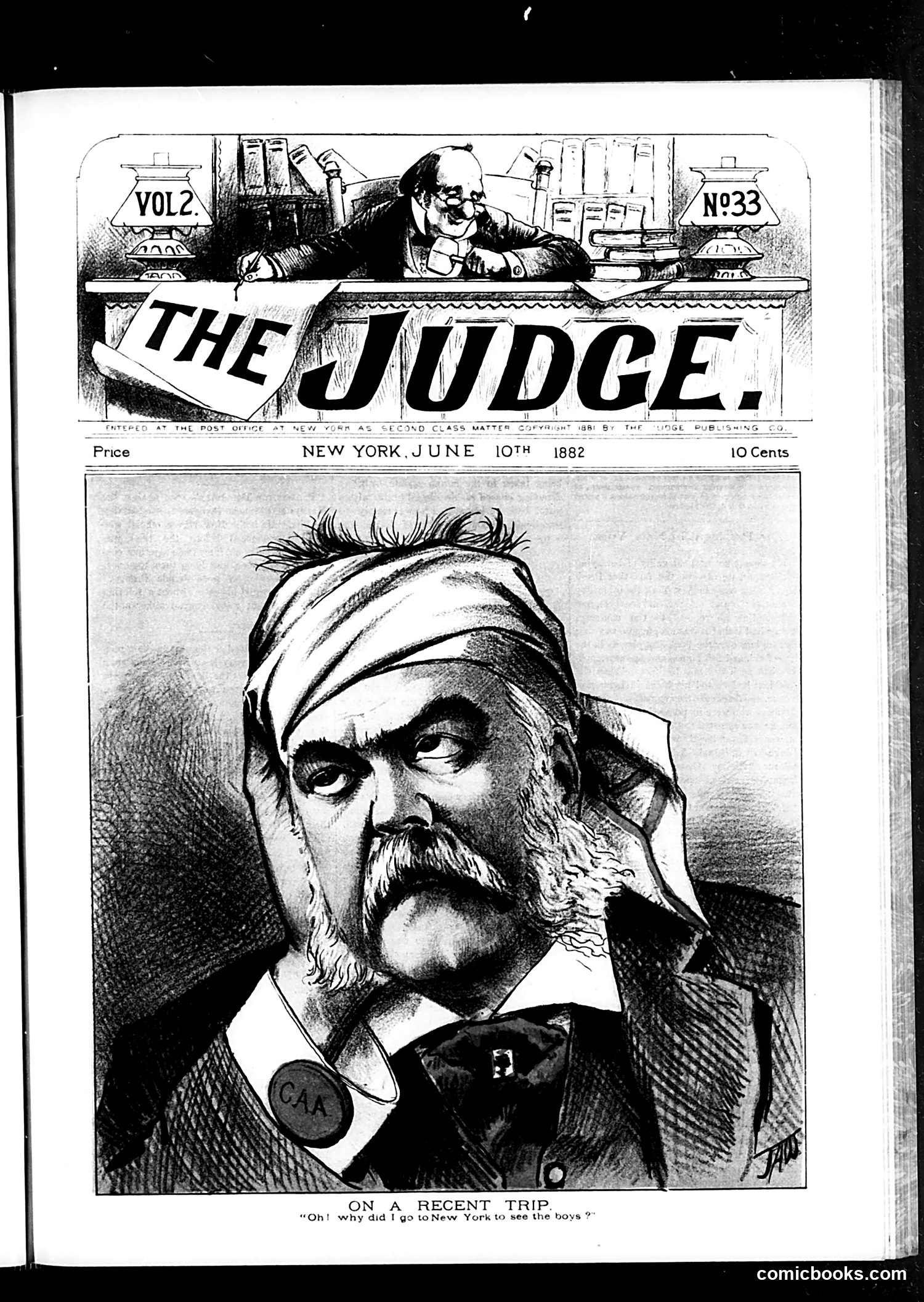
This is the cover of *Judge* magazine featuring a caricatured man with a prominent beard, headwrap, and a badge labeled "CAA" (unclear reference). The cartoon is titled "On a Recent Trip" with the caption: "Oh! why did I go to New York to see the boys?" The specific historical context—who this figure represents and what "recent trip" is referenced—is unclear from the image alone. The headwrap and facial features suggest the caricature may rely on ethnic or national stereotyping common to 1882 satirical publications. The badge and the regretful tone suggest the figure underwent some disappointing or embarrassing experience visiting New York. Without additional context about contemporary events or public figures from June 1882, the precise satirical target cannot be definitively identified.
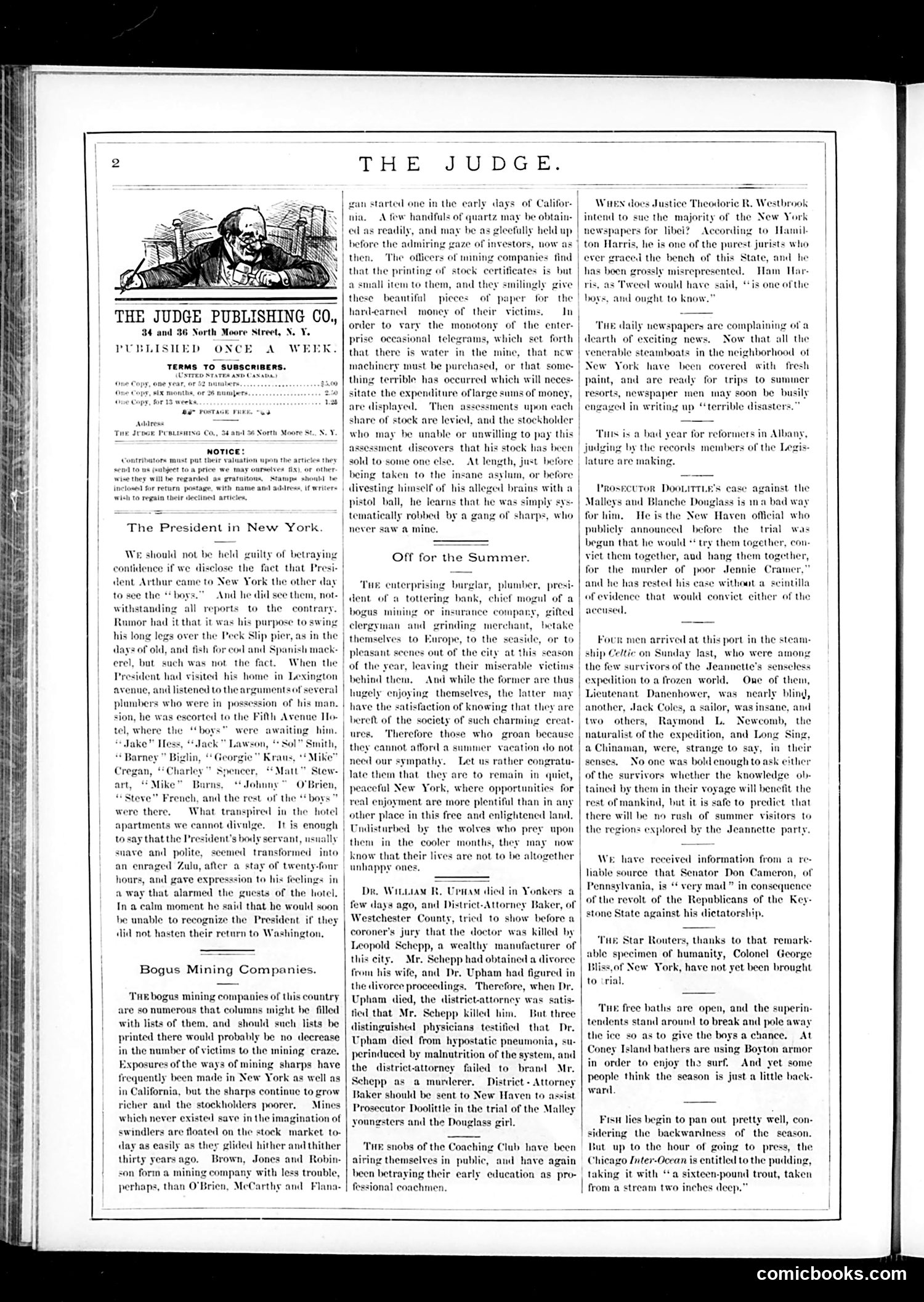
The main cartoon depicts **President Chester Arthur's visit to New York**, where he met with local political operatives nicknamed "the boys"—including figures like "Jake" Hess, "Sol" Smith, and others listed in the text. The satire mocks Arthur's transformation from a dignified president into an angry, agitated visitor after spending time with these political cronies, suggesting they corrupted or frustrated him with their scheming. The accompanying article criticizes **bogus mining companies**—fraudulent stock schemes that victimized investors throughout the 1870s-80s. The piece details how swindlers printed worthless stock certificates, extracted money from victims with false telegrams about needed machinery or water discoveries, and disappeared to Europe when exposed. The satire targets how these scams persisted despite repeated exposures. Both pieces exemplify *Judge's* role as a reformist satirical publication attacking political corruption and financial fraud of the Gilded Age.
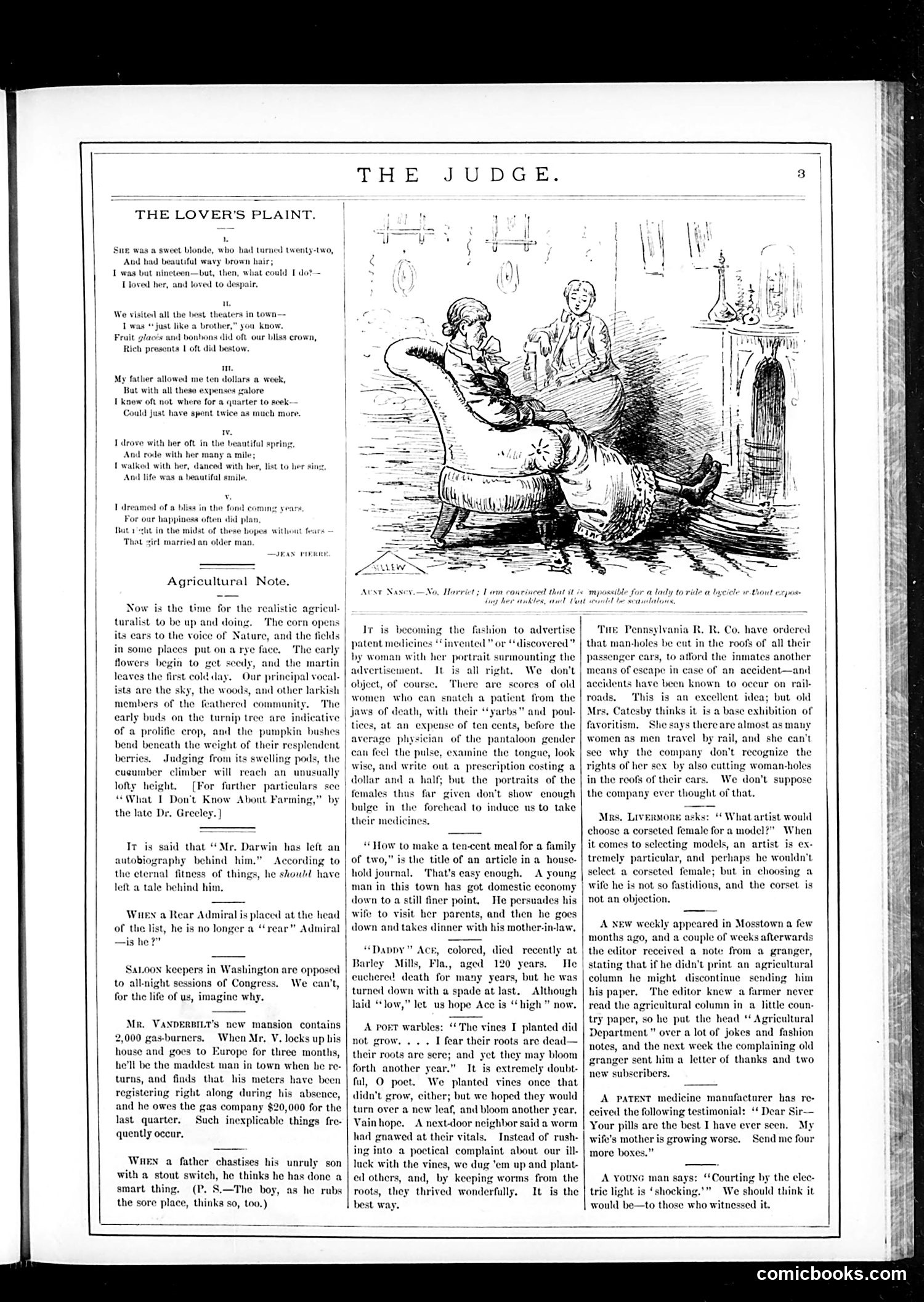
This page combines a sentimental poem with satirical commentary on courtship and economics. The central cartoon depicts a young man lamenting to an older woman (likely his mother or aunt) about losing his beloved to an older, wealthier suitor—a common Victorian romance trope. The satire targets the economic realities behind romance: the lover spent his entire ten-dollar weekly allowance on his girlfriend through theater visits, gifts, and outings, only to lose her to a man of superior financial means. The poem's melancholy tone mocks the naive romanticism of young men who believe love transcends class and wealth. The surrounding "Agricultural Note" and miscellaneous jokes are filler content typical of Judge's format—absurdist humor about farming, advertisements for patent medicines (which Judge frequently mocked), and social commentary on topics like Vanderbilt's mansion and congressional drinking habits. The overall effect satirizes both sentimental young love and the materialism that undermines it.
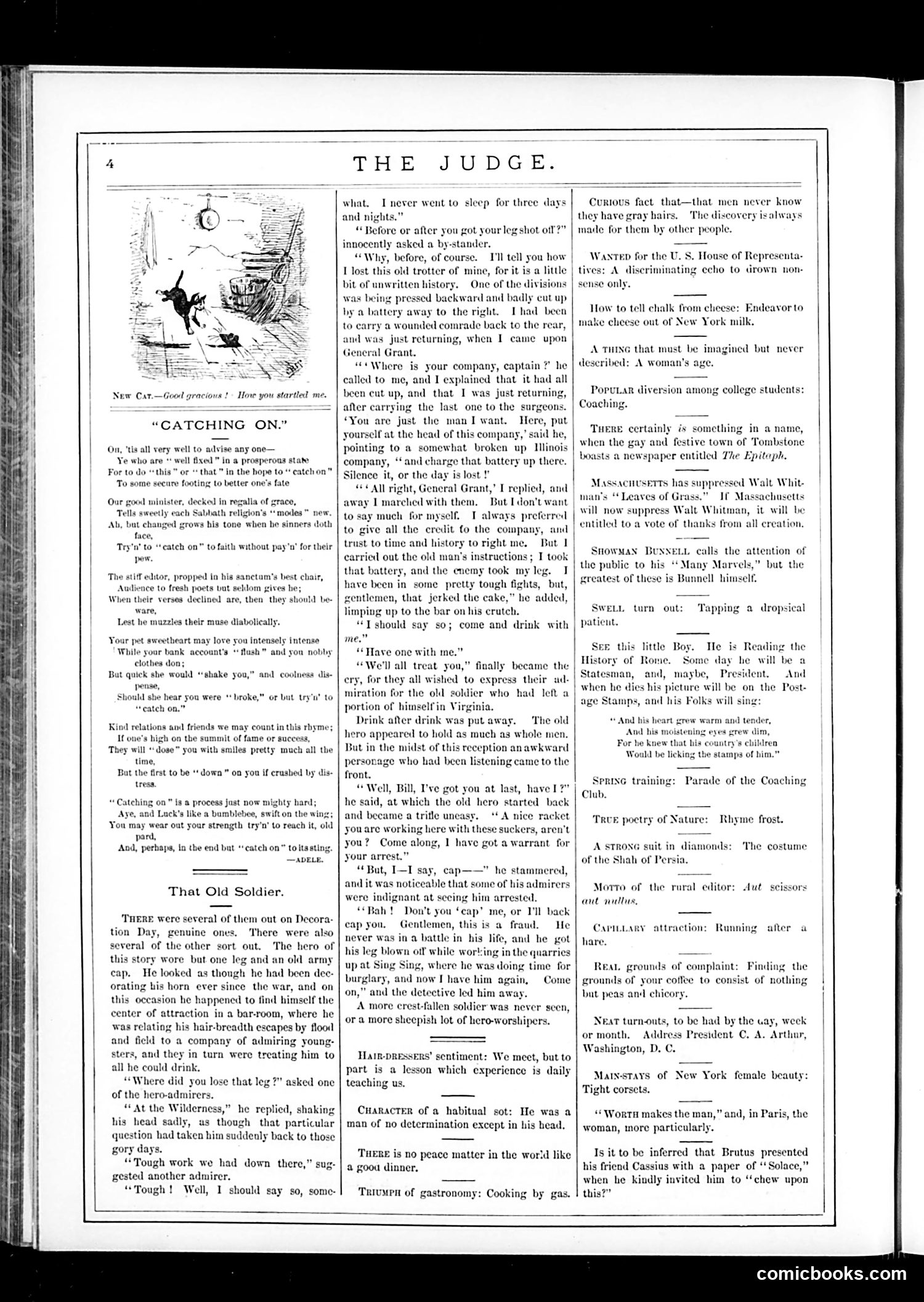
This page contains two main satirical pieces: **"Catching On"** (left): A poem mocking social climbers and opportunists trying to succeed through calculated self-presentation rather than genuine merit. It satirizes people adopting fashionable behaviors ("modes") to gain acceptance—in religion, romance, and career—while critiquing how society rewards the successful but abandons the unfortunate. **"That Old Soldier"** (right): A bar-room anecdote gently mocking a Civil War veteran's tall tale. The humor lies in a bystander's innocent but devastating question: the old soldier claims he never slept for three days *before* losing his leg, but got shot *after* returning from duty—a logical inconsistency the drunk veteran doesn't notice. The satire targets both exaggerated war stories and the eager young admirers treating veterans to drinks while listening to dubious narratives. Both pieces reflect Judge's satirical approach to American social pretension and unreliability.
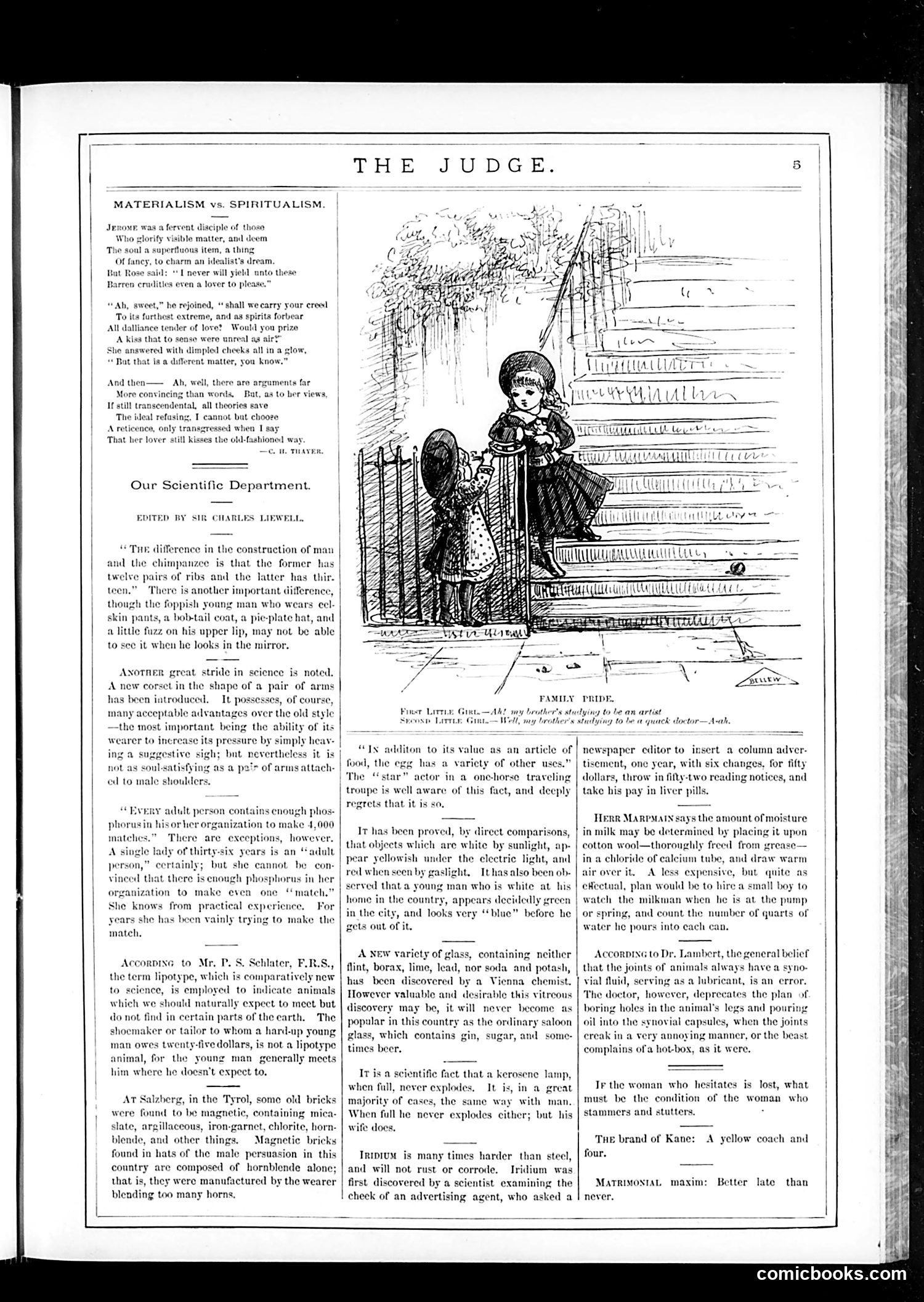
This page from Judge magazine blends satire with pseudo-scientific humor typical of the era. The main cartoon depicts two children at a mirror—illustrating the article "Materialism vs. Spiritualism," which debates whether love and human connection are merely physical or possess spiritual meaning. The poem humorously resolves this: a materialist and idealist couple argue philosophy until they kiss, suggesting physical affection transcends intellectual debate. The "Scientific Department" section parodies contemporary scientific claims with absurdist logic. Jokes target materialism by suggesting that "phosphorus in women's brains" explains why wives can't find matches, or that magnetic "hornblende" in men's hats comes from "blending too many horns" (infidelity). Other quips mock how men appear "green" in cities and "blue" before leaving—colorful metaphors for moral corruption. The satire critiques both pretentious scientism and gender stereotypes common in Gilded Age America.
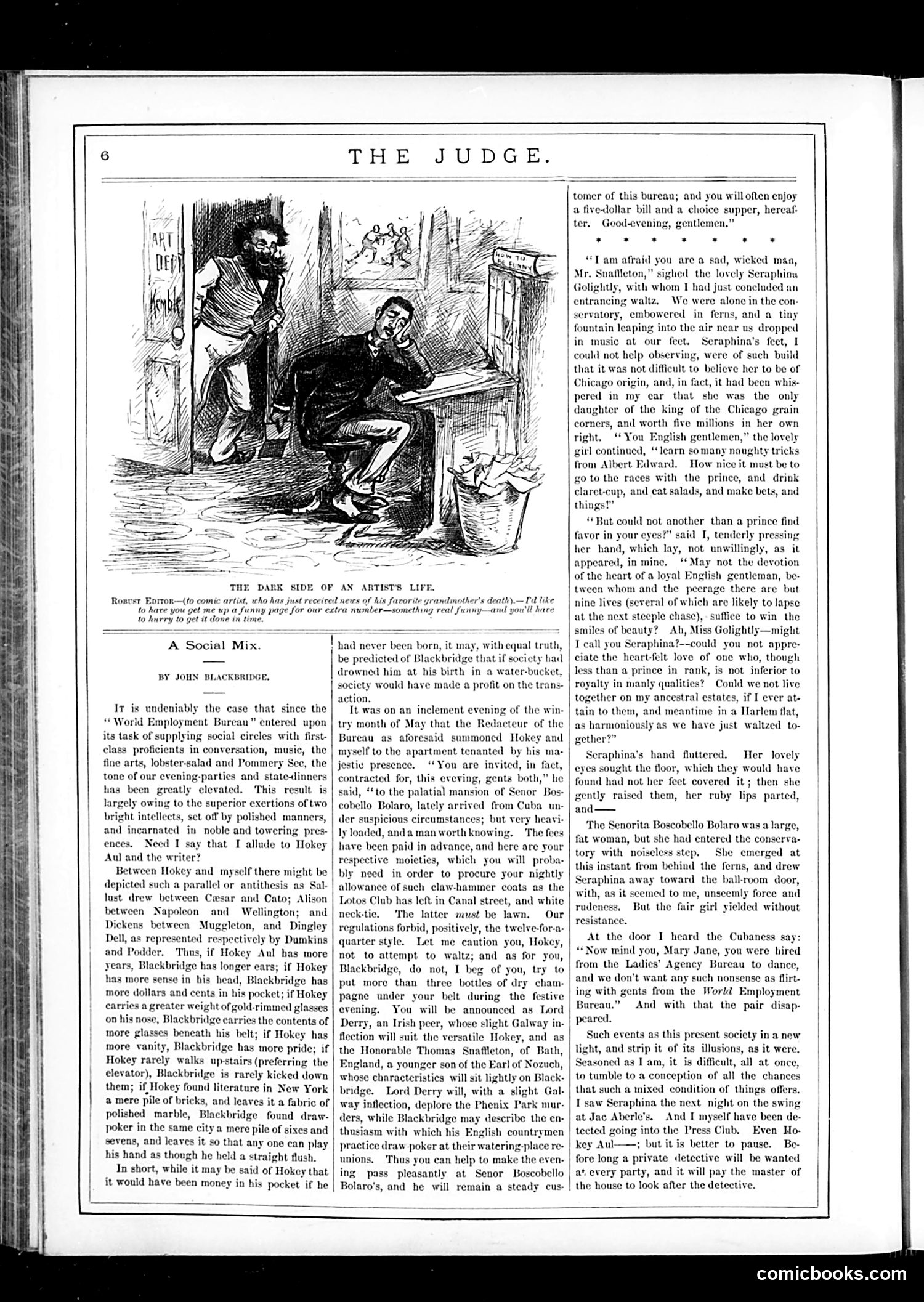
This page contains two satirical pieces from *Judge* magazine: **"The Dark Side of an Artist's Life"** (top cartoon): A editor callously demands a funny comic page from an artist who's just learned his grandmother died. It mocks workplace insensitivity and the pressure on creative workers to produce entertainment regardless of personal tragedy. **"A Social Mix"** (main article): A lengthy satire by John Blackbridge mocking the pretentiousness of New York's social-climbing elite. It describes a "World Employment Bureau" that rents out witty conversationalists to dinner parties. The narrator and his rival "Hokey Aul" are hired to pose as European nobility (an Irish peer and English nobleman) at a party thrown by a suspicious Cuban businessman named Boscobello Bolaro. The satire ridicules both the artificiality of high society and the desperation of would-be sophisticates who must literally rent personality and fake credentials to gain social acceptance. It's essentially mocking the hollow pretense of Gilded Age social climbing.
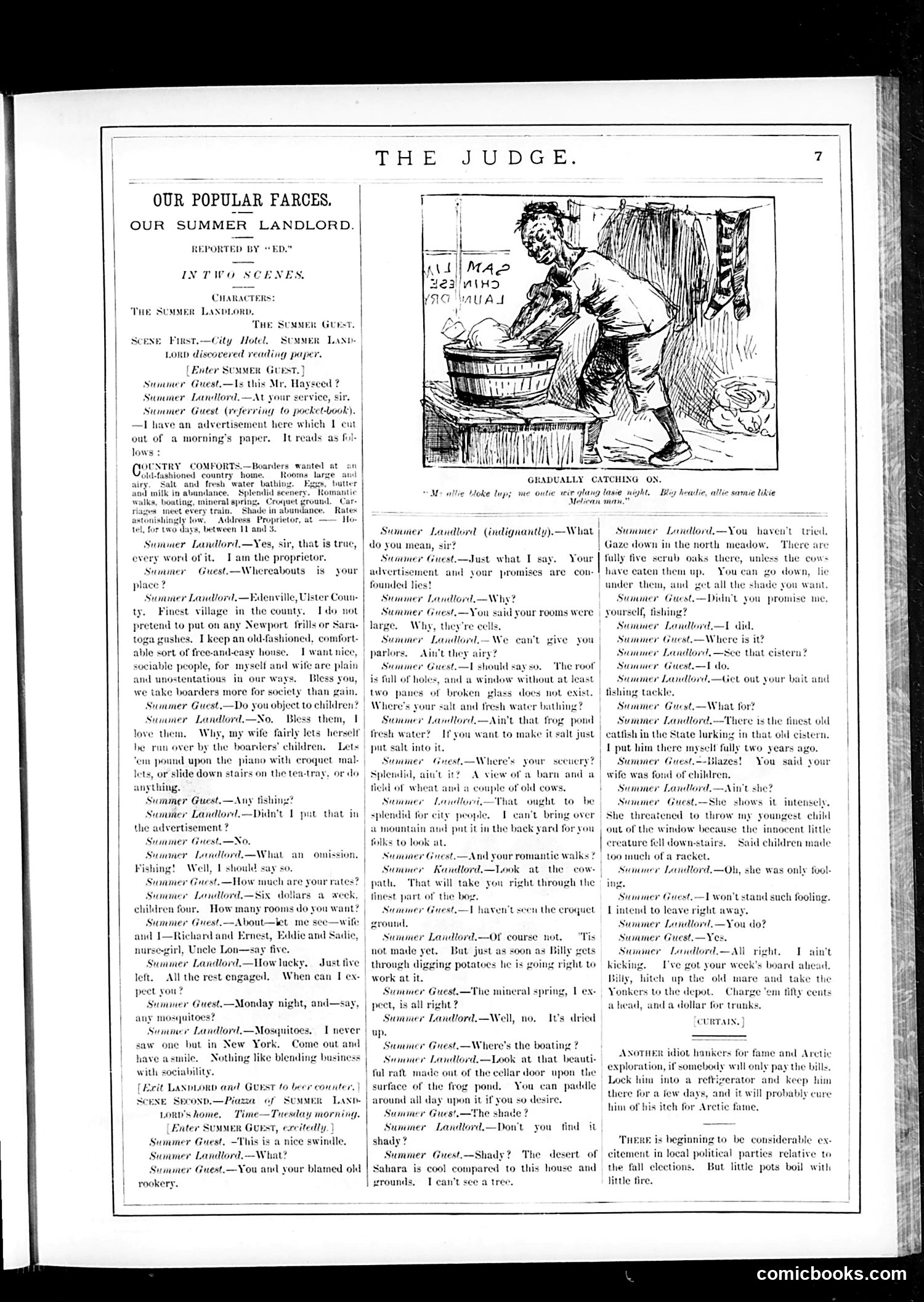
This two-scene farce satirizes the false advertising and deceptive practices of rural boarding-house operators in the Gilded Age. **The Setup:** A Summer Guest responds to an alluring advertisement for a country inn in Edenville, Ulster County, promising "country comforts"—salt and fresh water bathing, boating, mineral springs, croquet, and shade. **The Joke:** In Scene Two, the Guest discovers every advertised amenity is either nonexistent or grotesquely inadequate. The "salt and fresh water bathing" is a frog pond. The "romantic walks" lead through a bog. The promised mineral spring has dried up. The boating consists of a ramshackle raft. The rooms are dilapidated, the croquet ground unfinished, and there's no actual shade. **The Satire:** The Landlord's increasingly absurd defenses—claiming the frog pond is "cool" and the bog view "finest"—mock how proprietors brazenly misrepresented rustic accommodations to unsuspecting city visitors seeking affordable summer retreats. This reflects real consumer frustration with deceptive travel advertising of the period.
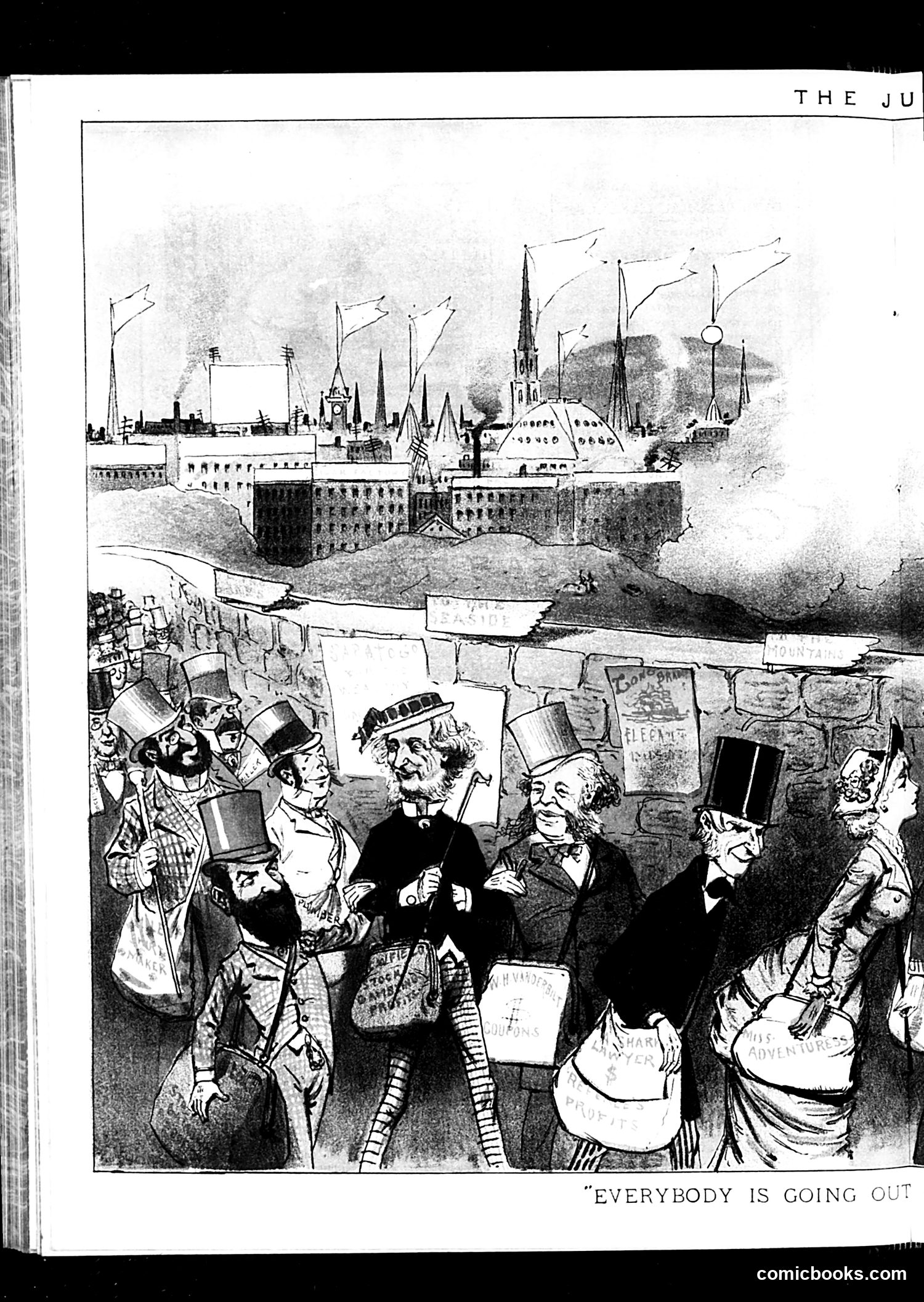
This satirical cartoon depicts a crowd of well-dressed figures in top hats and formal attire standing before a fortified cityscape, with signs visible on a wall behind them. The caption "EVERYBODY IS GOING OUT" suggests social commentary on mass exodus or departure. The caricatured figures appear to represent various social types or professions of the era. The fortified structures and flags suggest a city or nation under strain. The signs on the wall are partially legible but appear to reference establishments or notices. Without additional context about the specific Judge publication date, the precise identities of caricatured individuals remain unclear. The cartoon likely satirizes a contemporary trend—possibly emigration, business closures, or social upheaval—though the exact historical reference cannot be definitively determined from the image alone.
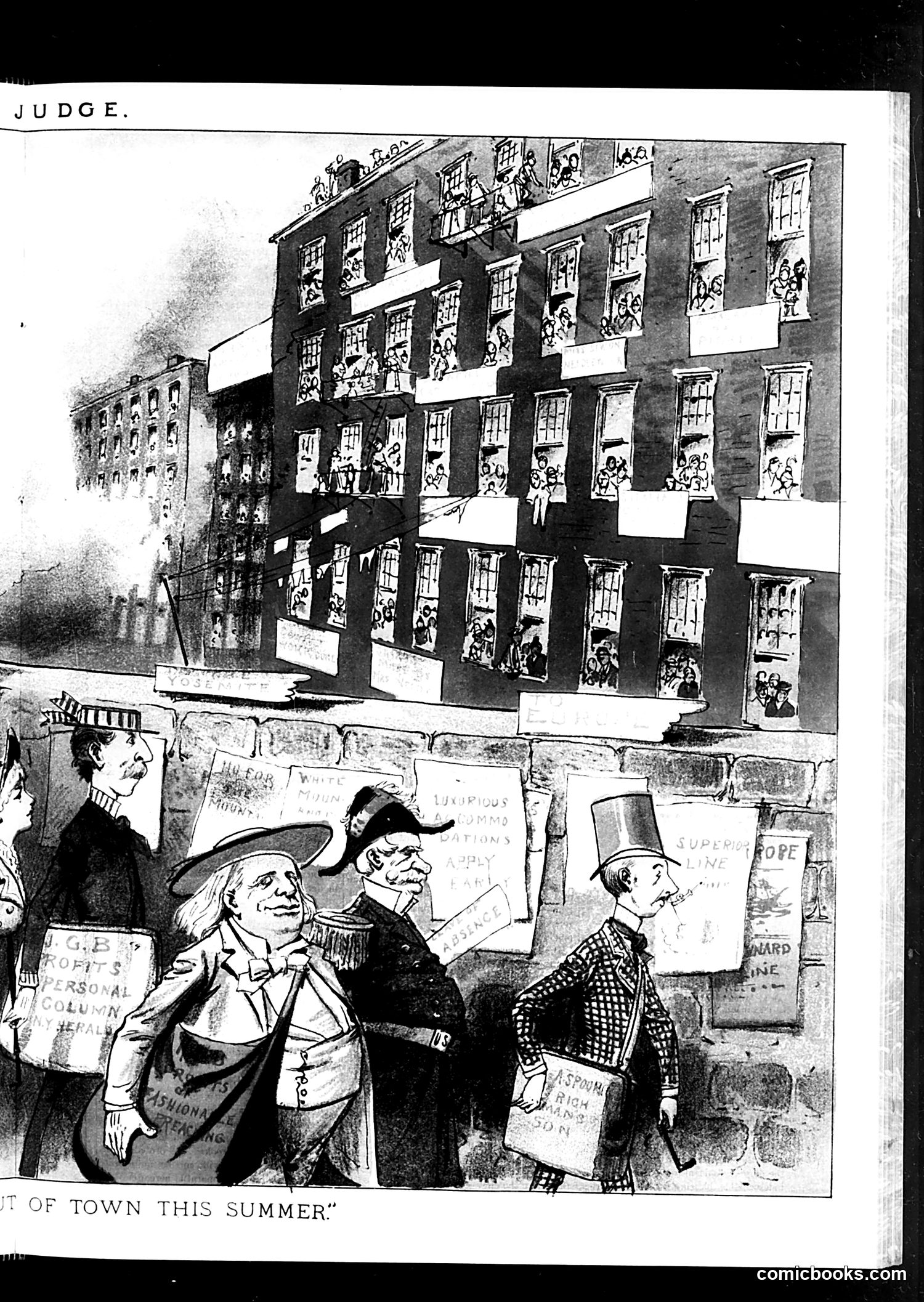
This Judge magazine cartoon satirizes summer vacation exodus from cities. The main image shows a crowded tenement building with residents visible in nearly every window, while caricatured figures below—wearing exaggerated features suggesting they represent specific political or social types—carry signs. Though the OCR text is fragmentary ("OF TOWN THIS SUMMER"), the visual message is clear: the cartoon mocks the irony of urban overcrowding during summer, likely critiquing either: 1. The hypocrisy of wealthy figures claiming to escape town while poor residents remain packed in tenements, or 2. Seasonal migration patterns and their social effects The figures' distinctive dress and caricatured faces suggest they represent recognizable contemporary types or perhaps specific politicians, but without clearer signage text, their exact identities remain unclear.
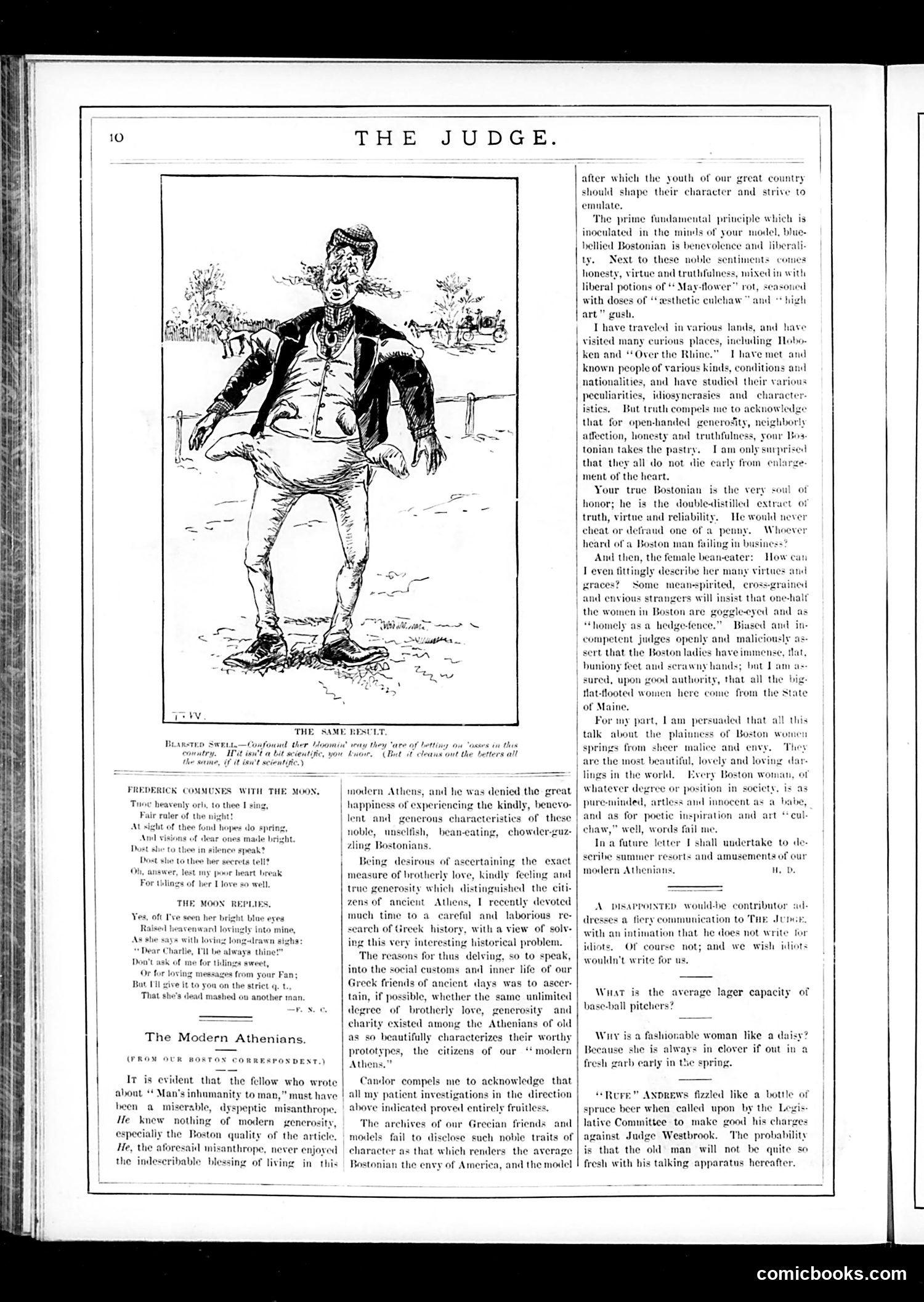
This page satirizes Bostonians' inflated self-image as paragons of virtue and generosity. The main article, "The Modern Athenians," mocks Boston's pretension to moral superiority by claiming that ancient Athens—the original source of Western civilization—lacked the "brotherly love, kindness, and generosity" that supposedly characterize modern Boston society. The author employs heavy irony: he "researched" Greek history expecting to find Athenians as virtuous as Bostonians, but found them wanting. He then catalogs exaggerated Boston virtues (honor, truthfulness, generosity) with obvious mockery, suggesting that Bostonians are actually no more virtuous than anyone else—they're simply pompous about it. The cartoon above (captioned "The Same Result") likely reinforces this mockery through visual humor, though its specific meaning is unclear without clearer context. This targets Boston's notorious cultural snobbery and self-congratulation during the Gilded Age.
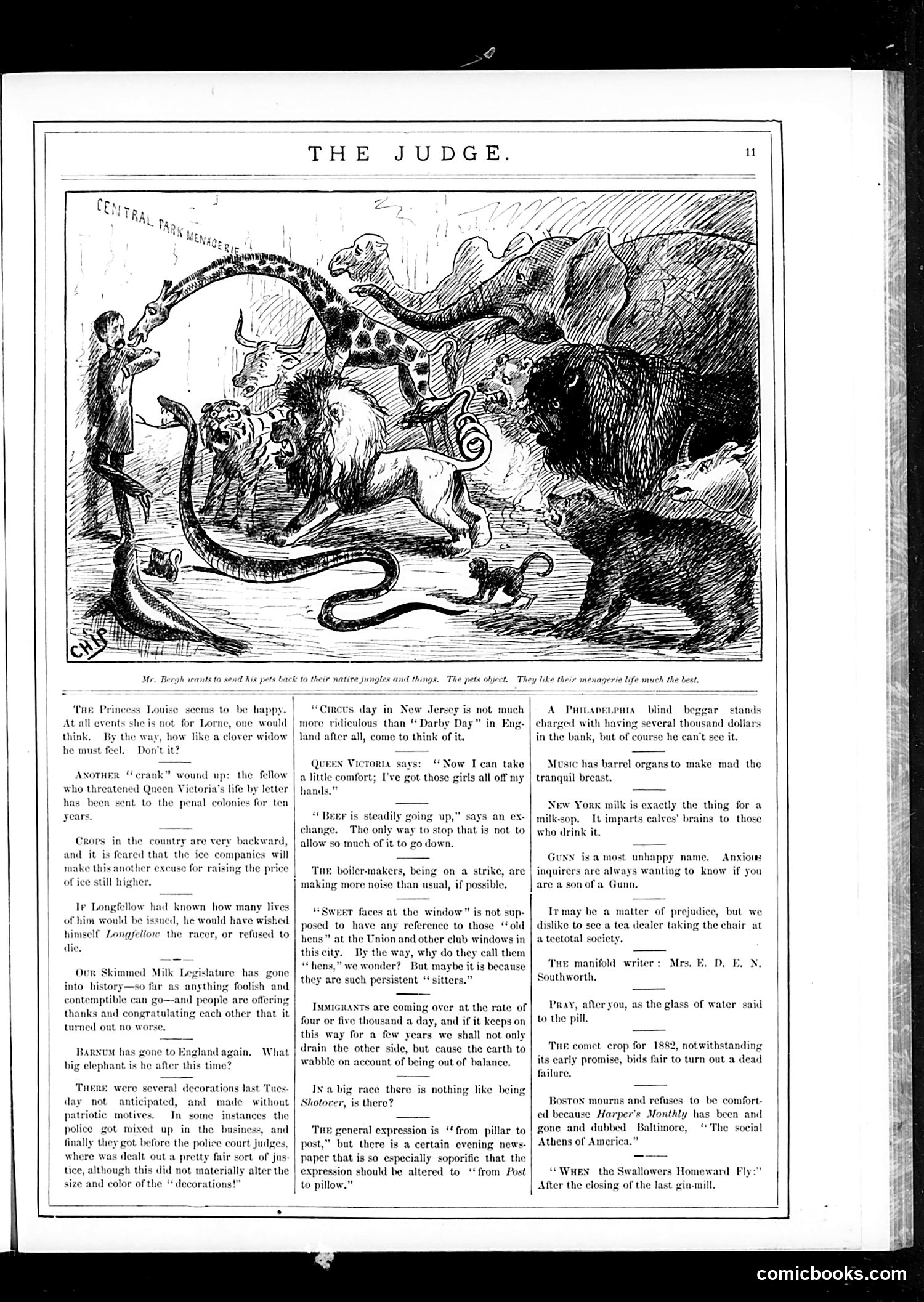
This page from *Judge* (a 19th-century American satirical magazine) combines a political cartoon with brief humorous commentary on current events. **The Main Cartoon** depicts a man (likely a politician or public figure) attempting to control a chaotic menagerie of creatures—including what appear to be devils, lions, and snakes. The caption suggests struggle with uncontrollable forces, likely representing political or social chaos the figure cannot manage. **The Text Snippets** are topical jokes addressing 1880s-era issues: - Princess Louise's marriage to the Marquis of Lorne - Immigration concerns ("four or five thousand a day") - Labor strikes (boiler-makers) - Rising beer and ice prices - Urban social life (references to "club windows," tea dealers, Baltimore society) **The Satire** mocks contemporary politics, social pretension, immigration anxieties, and labor disputes through brief, sardonic comments rather than extended arguments. The overall tone is conservative, critical of reform movements and working-class agitation. The page demonstrates *Judge*'s formula: combining visual satire with rapid-fire social commentary aimed at educated, affluent readers.
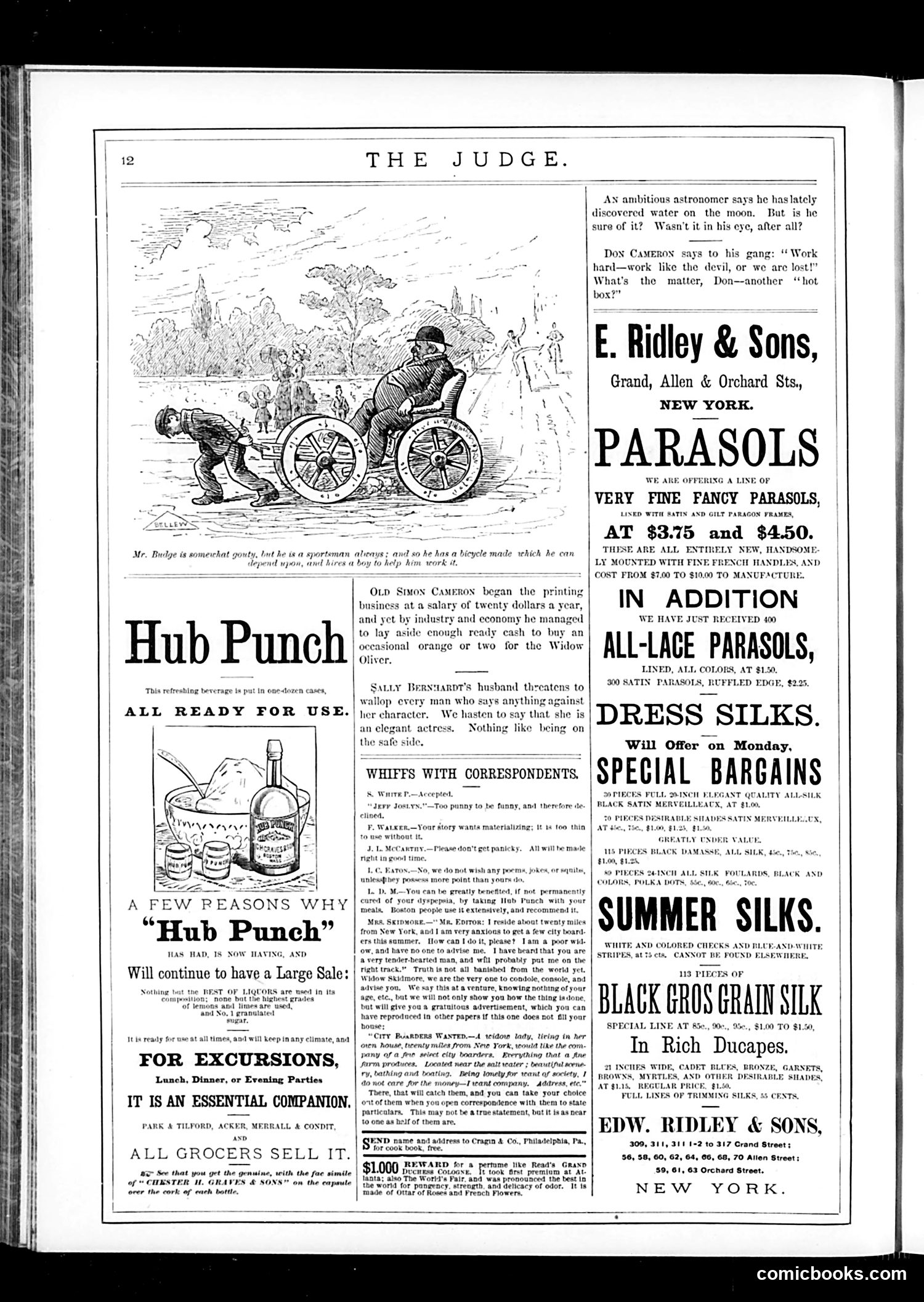
This page from Judge is primarily composed of advertisements interspersed with brief satirical commentary rather than a cohesive cartoon narrative. The main cartoon depicts a gentleman named Mr. Budge riding a bicycle powered by a boy, illustrating a joke about his laziness disguised as sportiveness. The satirical "Whiffs with Correspondents" section contains quick jabs at various figures: Old Simon Cameron, praised mockingly for his frugality; Sally Bernhardt's husband, cautioned about threatening violence over criticism of his wife; and Don Cameron, seemingly a railroad executive chastised for demanding brutal labor conditions (the "hot box" reference suggests railroad equipment failure). The page also includes advertisements for Hub Punch (a beverage), parasols, dress silks, and other retail goods typical of the era. The humor relies on recognizing contemporary figures and understanding mid-19th century social pretensions—wealth displayed through leisure, marital jealousy, and labor exploitation—with Judge's typical sardonic tone mocking hypocrisy and excess.
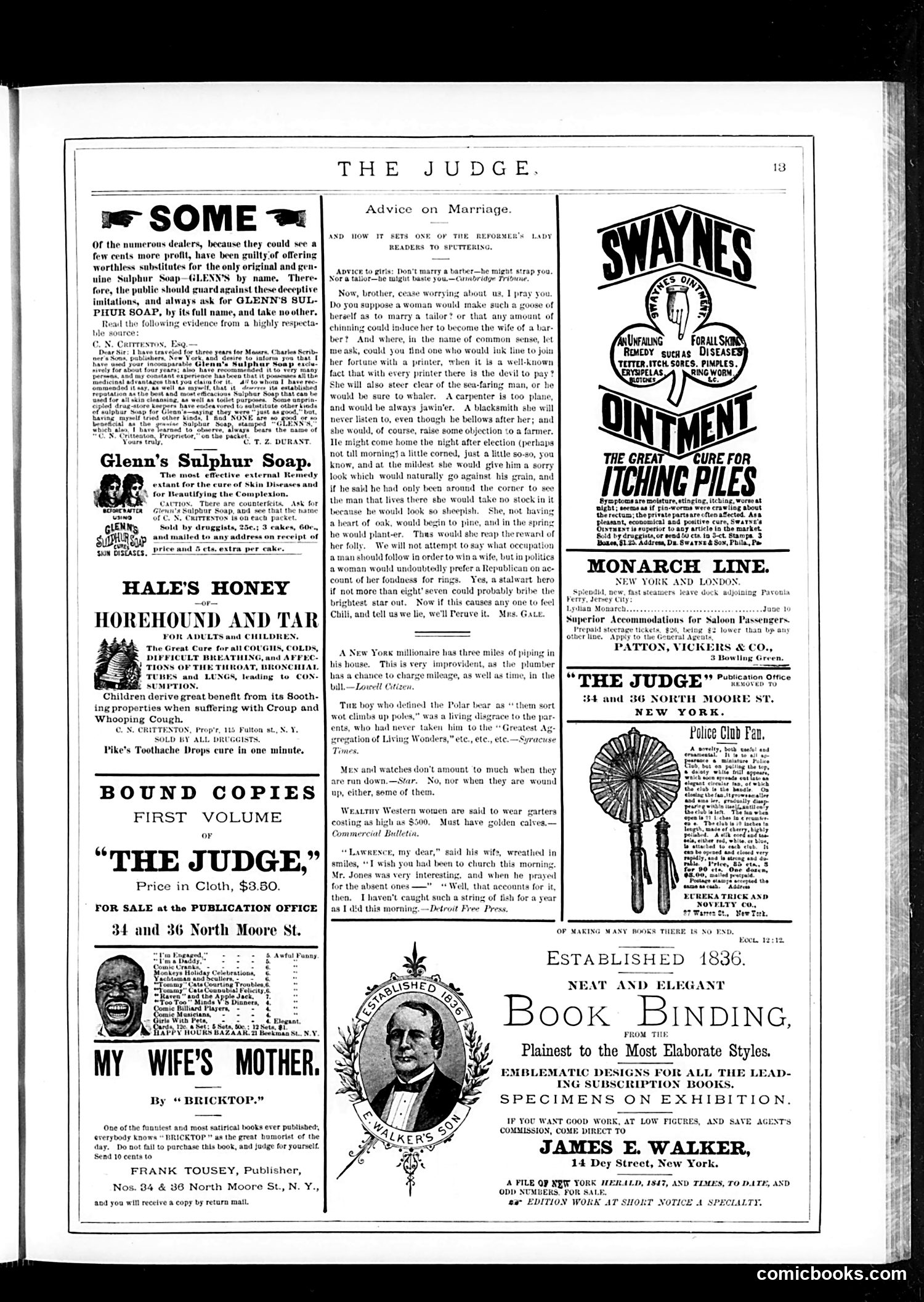
This page is primarily **advertising and miscellaneous content** rather than political cartoons. It's from *Judge*, a satirical magazine, but contains mostly product ads (Glenn's Sulphur Soap, Hale's Honey and Horehound, Pike's Toothache Drops) and book promotions. The substantive editorial content is a satirical advice column titled "Advice on Marriage" that humorously warns women against marrying men of various professions—barbers, tailors, printers, sailors, carpenters, blacksmiths, and farmers—each with punning wordplay explaining why ("a printer...has the devil to pay," a carpenter is "too plane"). The column concludes that women prefer Republican men "on account of her fondness for rings" (political patronage joke). It's genteel Victorian-era humor relying on puns and gentle social satire rather than sharp political commentary. The page also advertises bound copies of *Judge's* first volume and a humor book called "My Wife's Mother."
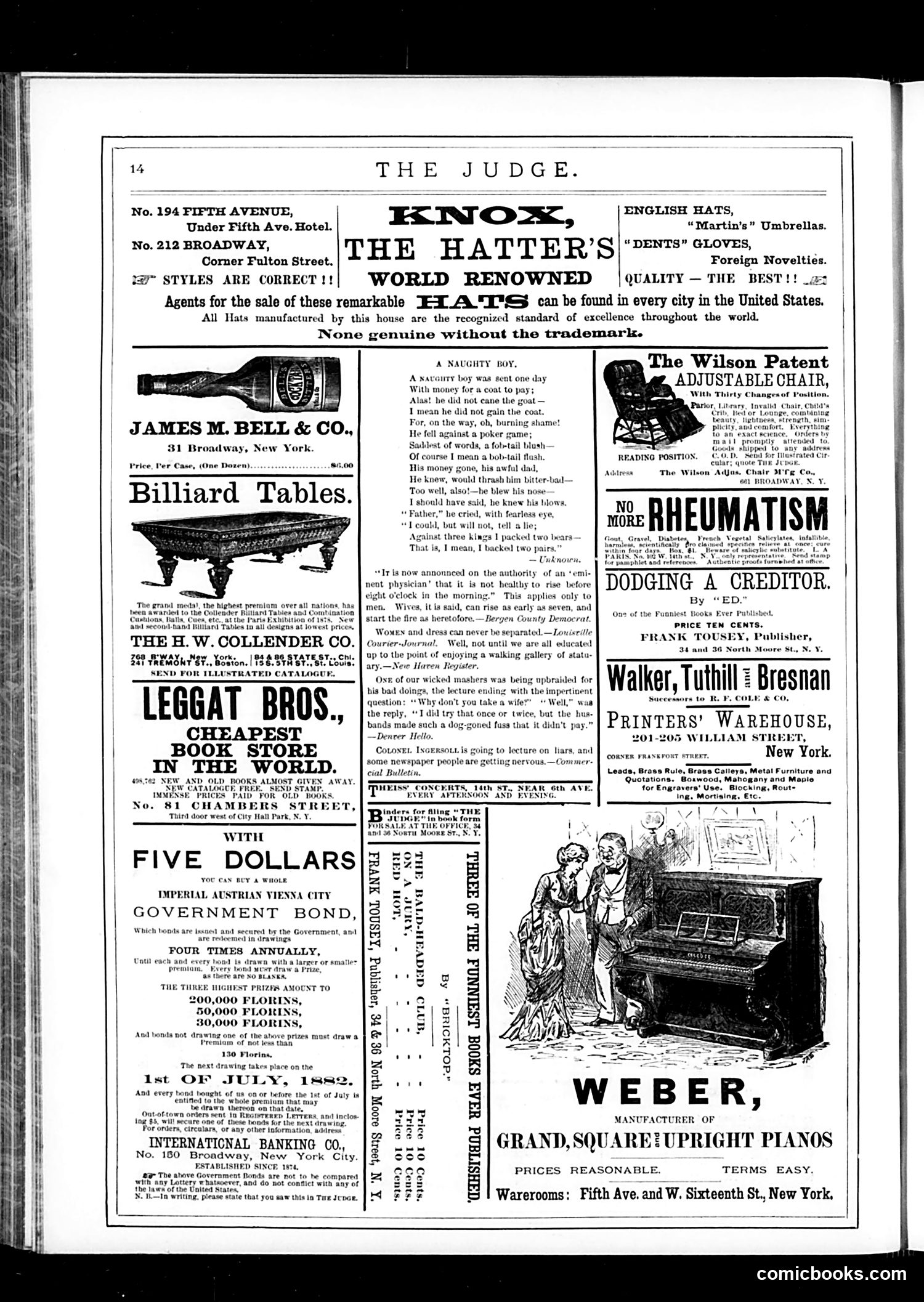
This page is primarily **advertising** with minimal editorial cartooning. The dominant content includes advertisements for Knox hats, billiard tables, Leggat Bros. books, Austrian government bonds, pianos, and office furniture. The one notable **editorial cartoon** depicts "A Naughty Boy"—a moral tale about a child sent to buy a coat who gambles away the money at poker instead. The accompanying text moralizes about his shame and impending punishment. This is standard Victorian-era cautionary humor, common in Judge magazine. A brief **humorous commentary** notes that a doctor claimed it's unhealthy to rise before eight o'clock—with the satirical jab that wives and working people obviously can't follow this advice, as they must rise early to work and maintain households. The joke mocks both medical pretension and the gap between leisured ideals and working reality. The page reflects Judge's mix of satire, advertising, and genteel humor typical of 1880s American magazines.
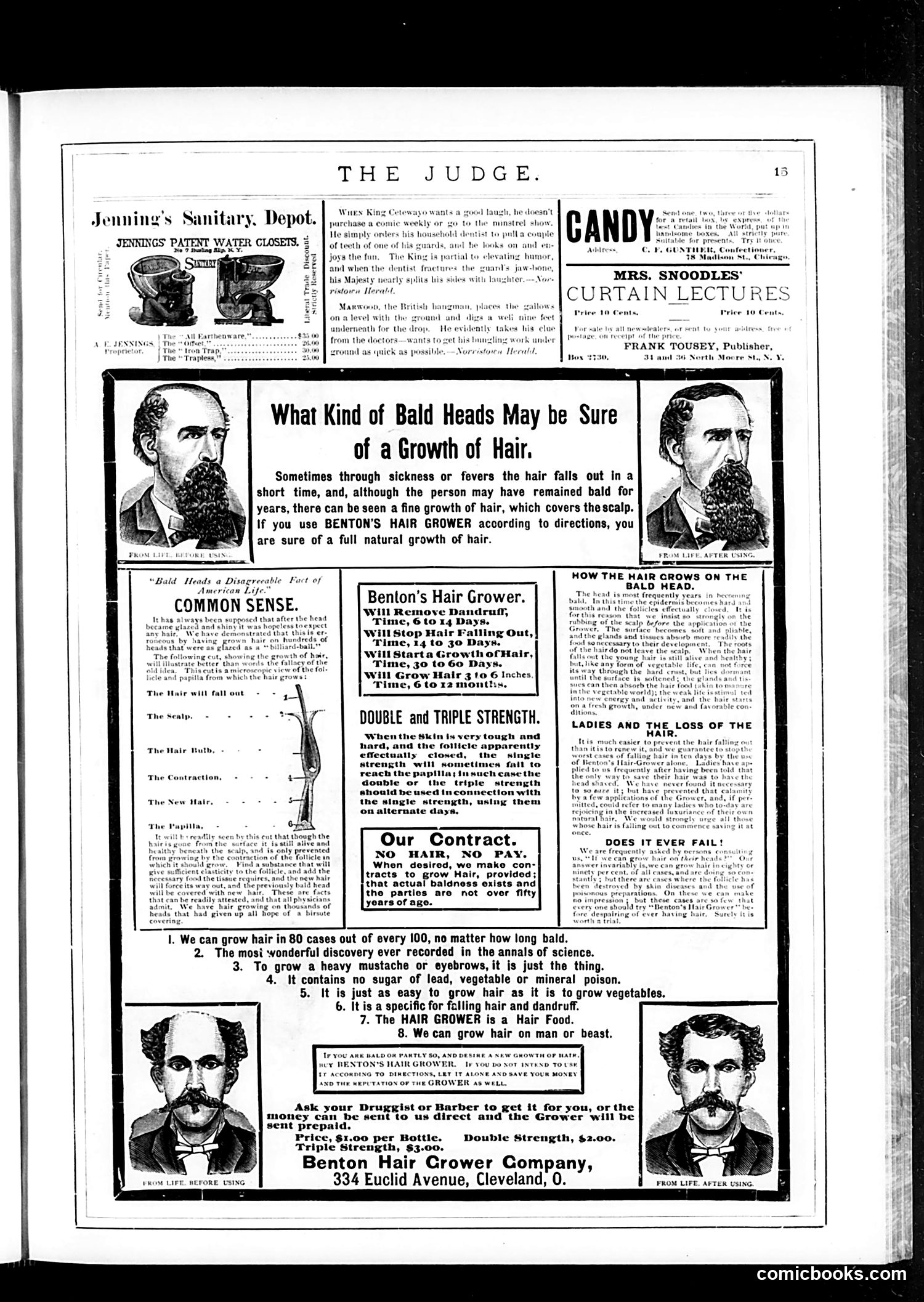
This page is primarily **advertising**, not political satire. It contains multiple commercial advertisements typical of late 19th-century magazines, with only minor editorial content at the top. The main feature is a large advertisement for **Benton's Hair Grower**, a patent medicine claiming to regrow hair on bald men. The ad uses "before and after" photographs showing men with full beards, testimonial language, and specific claims (growing hair in 30-60 days, working in 80 of 100 cases). It promises a money-back guarantee and offers three strength levels. Secondary ads include **Mrs. Snoodles' Curtain Lectures** (likely humorous essays) and **Jennings' Sanitary Depot** (bathroom fixtures). A brief editorial item jokes that King George wants to laugh but his dentist has extracted his teeth. The page reflects the era's booming patent medicine industry, which marketed dubious treatments through magazines before FDA regulations. These ads exploited common anxieties about appearance and aging.
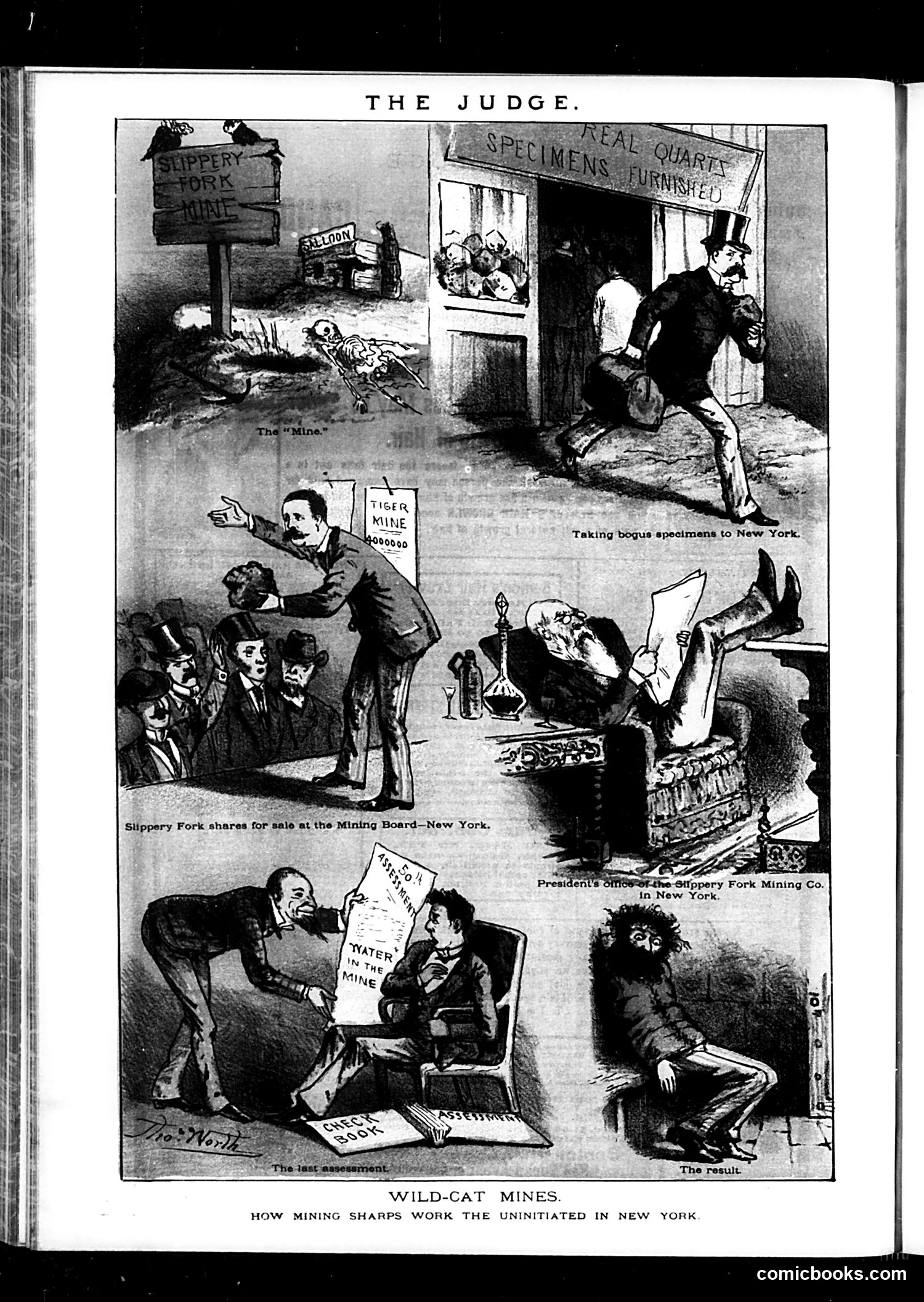
This Judge cartoon illustrates a stock-swindling scheme targeting naive investors in New York. The sequence depicts how mining "sharps" (con artists) defraud the uninitiated: 1. **The setup**: Fraudulent mines ("Slippery Fork," "Tiger Mine") are promoted with fake specimens and official-looking offices. 2. **The pitch**: Sharpsters present themselves as legitimate promoters at the Mining Board, selling shares to gullible investors. 3. **The con**: Documents labeled "Water in the Mine" expose the worthlessness of investments. 4. **The result**: A ruined investor, left destitute. The satire targets the prevalence of mining stock fraud in Gilded Age New York, where con artists exploited public enthusiasm for mining ventures and wealth-building schemes. The cartoon warns readers against such schemes through darkly humorous depiction of the swindling process.