
Judge, 1882-06-10 · page 4 of 16
Judge — June 10, 1882 — page 4: what you’re looking at
What you’re looking at
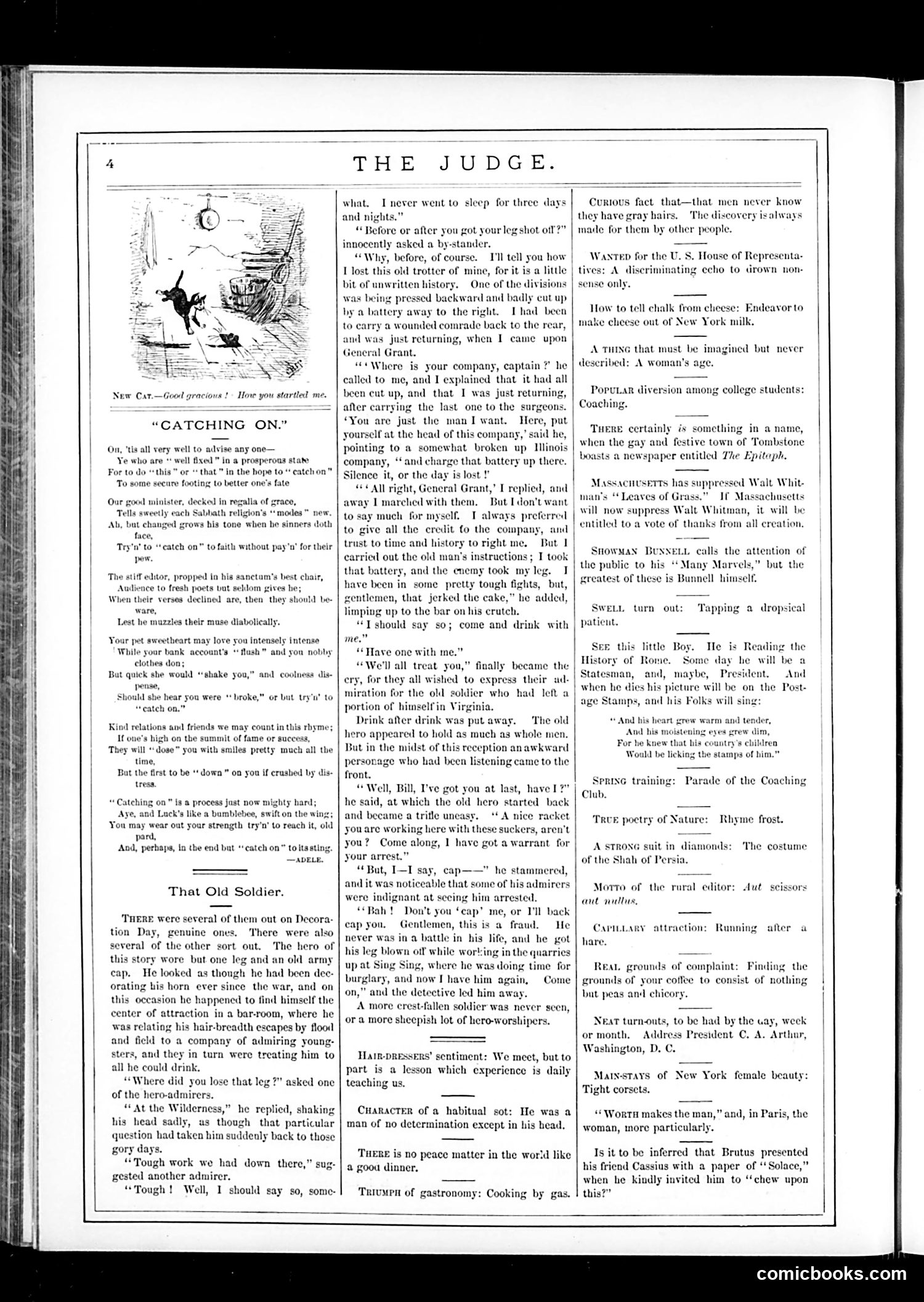
This page contains two main satirical pieces: **"Catching On"** (left): A poem mocking social climbers and opportunists trying to succeed through calculated self-presentation rather than genuine merit. It satirizes people adopting fashionable behaviors ("modes") to gain acceptance—in religion, romance, and career—while critiquing how society rewards the successful but abandons the unfortunate. **"That Old Soldier"** (right): A bar-room anecdote gently mocking a Civil War veteran's tall tale. The humor lies in a bystander's innocent but devastating question: the old soldier claims he never slept for three days *before* losing his leg, but got shot *after* returning from duty—a logical inconsistency the drunk veteran doesn't notice. The satire targets both exaggerated war stories and the eager young admirers treating veterans to drinks while listening to dubious narratives. Both pieces reflect Judge's satirical approach to American social pretension and unreliability.
📄 Transcribed text from this page (OCR, searchable)
Machine-transcribed from the original scan — historical spelling and the odd misread are preserved.
ra BE 6 Se 33 rs y New Cat—Good gracious 1» Hove you startled me. “CATCHING ON.” On, ‘tis all very Ye who are ell to advise any one— oll fixed” in a prosperous stare For to do “this” or “that” in the hope to“ catch on” To some secure footing to better one's fate Our good 1 al in regalia of grace, ach Sabbath religion's “modes * new wl grows his tone when he sinners doth Tells sweetly Ab, but chau Try'n’ to “catch on” tofaith without pay'n’ for their The stiff editor, propped in his sanctam’s best chair, Audience to fresh poets but seklom gives he; When their verses declined are, then they sh ware, Lest he muzzles their muse diabolically. Your pet sweetheart may love you intensely intense While your bank account's * flush” and you clothes don; But quick she would “shake you, pense, Should she hear you were broke,” or but try “catch on, bby and coolness dis- Kind relations and friends we may count in this rby If one’s high on the summit of fame or suce They will “dose” you with smiles pretty much all the time, But the first to be “+ down " on you if crushed by dis- tress. “ Catching on" is a process jast now mighty hand; e, and Luck’s like a bumb You may wear out your strength try'n’ to reach it, old pard, And, perhaps, in the end but bee, swifton the wing; ‘atch on” toitssting. ADELE. That Old Soldier. ‘THERE were several of them out on Decora- tion Day, genuine ones. ‘There were also several of the other sort out, The hero of this story wore but one leg and an old army cap. He looked as though he had been dee- orating bis horn ever since the war, and on this occasion he happened to find himself the center of attraction in a bar-room, where he was relating his hair-breadth escapes by flood and field to a company of admiring young- sters, and they in turn were treating him to all he could drink. “Where did you lose that leg 7” asked one of the hero-admirers. “At the Wilderness,” he replied, shaking is head sadly, us though that particular question had taken him suddenly back to those gory days. “Tough work we had down there,” sug- gested another admirer, “Tough! Well, I should say so, some- THE JUDGE. what. I never went to sleep for three days and nights.” “ Before or after you got your leg shot otf?” innocently asked a by-stander. “Why, before, of course. I'll tell you how | I lost this old trotter of mine, for it is a little | bit of unwritten history. One of the divisions | was being pressed backward and badly cut up bya away to the right. I had been to carry a wounded comrade back to the rear, and was just returning, when I came upon General Grant. “Where is your company, captain ? he called to me, and I explained that it had all been cut up, and that I was just returning, after carrsing the last one to the surgeons. | ‘You are j the man I want. Here, put yourself at the head of this company,’ said he, pointing to a somewhat broken up Ilinoi: company, ‘‘and charge that battery up there. Silence it, or the day is lost ! “¢All right, General Grant,’ I replied, and away I marched with them, But [don’t want to say much for myself. T always preferred to give all the credit fo the company, and | trust to time and history to right me. But 1 carried out the old man’s instructions ; I took that battery, and the enemy took my leg. I have been in some pretty tough fights, but, gentlemen, that jerked the cake,” he added, limping up to the bar on his crutch. “Tshould say so; come and drink with me.” “Have one with me.” | “We'll all treat you,” finally became the | , for they all wished to express their ad- | miration for the old soldier who had left a portion of himselfin Virginia. Drink after drink was put away. ‘The old hero appeared to hold as much as whole men, But in the midst of this reception an awkward personage who had been listening came to the front. “Well, Bill, I've got you at last, have I?” he said, at which the old hero started back and became a tritle uneasy. ** A nice racket you are working here with these suckers, aren't you? Come along, 1 have got a warrant for | your arrest. “But, I—I say, cap——" he stammered, and it was noticeable that some of his admirers were indignant at secing him arrested. “Bah! Don't you ‘cap’ me, or I'll back ‘ap you. Gentlemen, this is a fraud. He never was ina battle in his life, and he got his leg blown off while working in the quarries up at Sing Sing, where he was doing time for burglary, and now I have him again, on,” and the detective led him away A more crest-fallen soldier was never secn, or a more sheepish lot of hero-worshipers. Come HaIR-DRESSERS part is a le teaching us. sentiment: We meet, but to sson which experience is daily Cuaracter of a habitual sot: He was a man of no determination except in his bead. ‘THERE is no peace matter in the world like a goou dinner, | boa Curious fact that—that men never know they have gray hairs. ‘The discovery isalways maie for them by other people. ED for the U. S$, House of Representa- A discriminating echo to drown non- sense only. Way tives How to tell chalk from cheese: Endeavor to York milk. make cheese out of A TinNG that must be imagined but never described: A woman's age. Popuar diversion among college students: Coaching. Tuere certainly is something in a name, when the gay and festive town of Tombstone ts a newspaper entitled The Epitaph. Massacuvserts has suppressed Walt Whit- man’s “Leaves of Grass.” If Massachusetts will now suppress Walt Whitman, it will be entitled to a vote of thanks from all creation, SnowmaN BuNNeLL calls the attention of the public to his ‘‘ Many Marvels,” but the greatest of these is Bunnell himself. SWELL pati turn out: Tapping a dropsical See this little Boy. Me is Reading the History of Rome. Some day he will be a Statesman, and, maybe, President. And when he dies his picture will be on the Post- e Stamps, and his Folks will sins And his heart grew warm and tender, And his moi 4 grew dim, For he knew that his country’s children Would be licking the stamps of him.” Sprinc training: Parade of the Coaching Club. TRUE poctry of Nature: Rhyme frost. Th A STRONG suit in diamonds: of the Shah of Pers costume Morto of the editor: Aut scissors ant nullus, Cariutary attraction: Running after a hare. Reat grounds of complaint: Finding the grounds of your coffee to consist of nothing but peas and ehicory Neat turnouts, to be had by the way, week or month, Address President C, A. Arthur, Washington, D. C. Mars-stays of New York female beauty: Tight corsets. “ Worta makes the man,” and, in Paris, the woman, more particularly. Is it to be inferred that Brutus presented his friend Cassius with a paper of “Solace,” when he kindly invited him to “chew upon ‘Triumpn of gastronomy: Cooking by gas. this?” comicbooks.com