
A complete issue · 16 pages · 1882
Judge — June 3, 1882
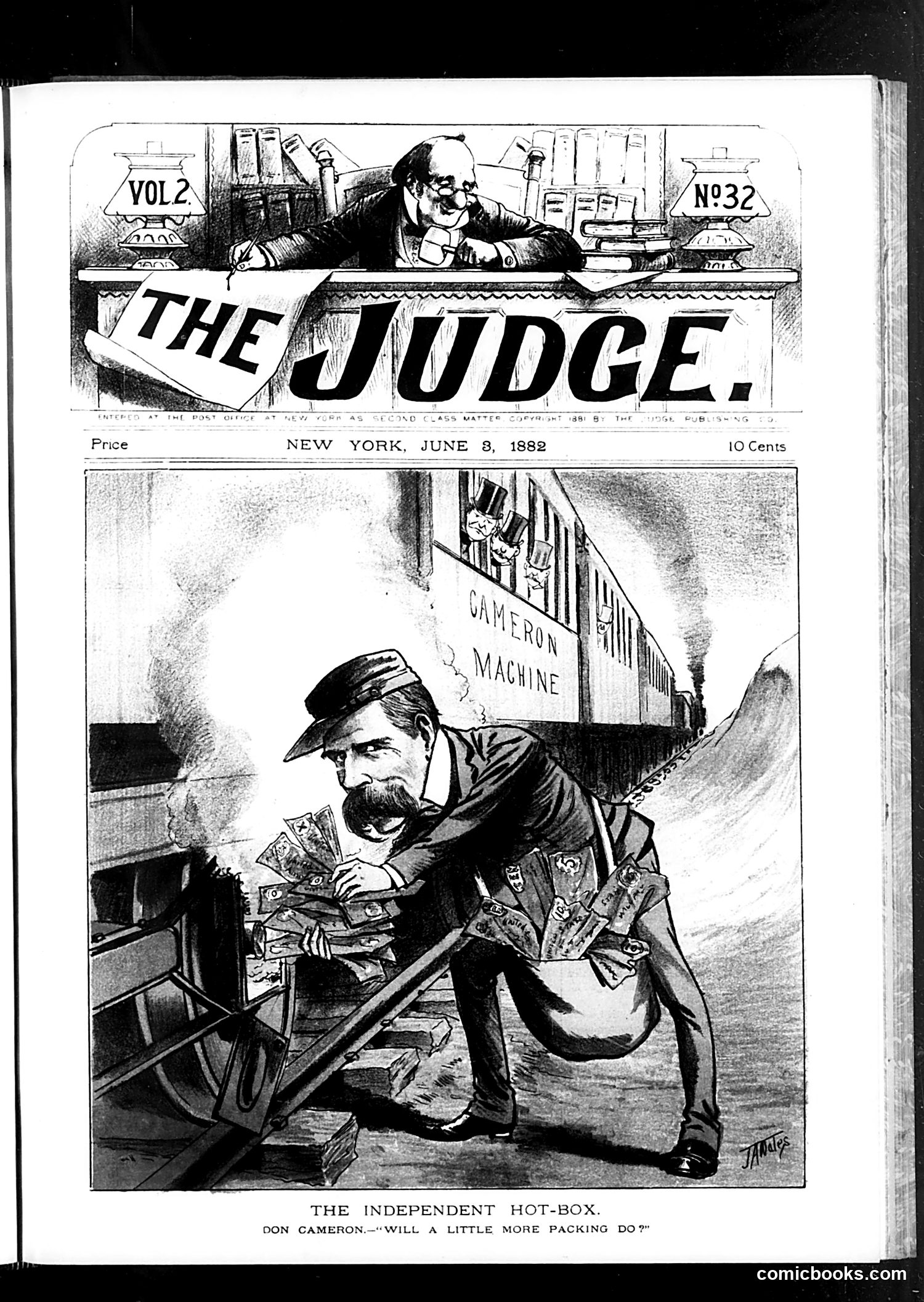
This June 8, 1882 *Judge* cartoon satirizes Don Cameron, a Republican politician and son of Secretary of War Simon Cameron. The "hot-box" is a railroad mechanical failure—a metaphor for Cameron's political troubles or corruption scandals. Cameron is depicted as a railroad worker frantically stuffing money into a damaged hot-box while asking "Will a little more packing do?"—suggesting he's attempting to cover up problems by throwing money at them. The "Cameron Machine" railroad car in the background reinforces the metaphor of his political apparatus. The satire mocks Cameron's apparent belief that financial manipulation or bribery can solve serious political or ethical issues, portraying him as incompetent and corrupt.
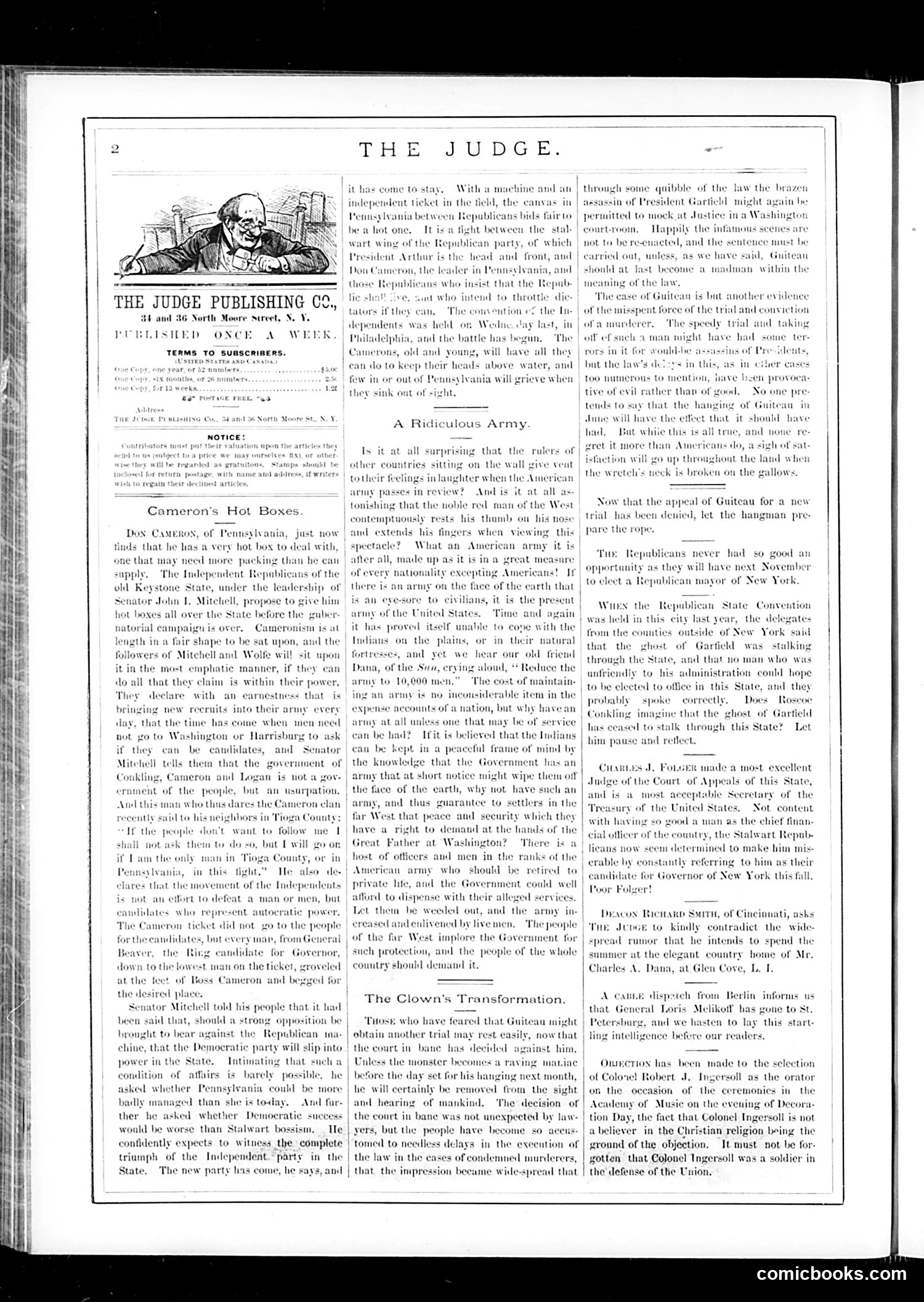
This page contains three satirical pieces targeting Republican Pennsylvania politics, circa 1882: **"Cameron's Hot Boxes"** mocks Don Cameron, the state's Republican boss, as an autocratic "hot box" (political liability). The satire criticizes Cameron's iron grip on party machinery and his suppression of Independent Republicans challenging his control. **"A Ridiculous Army"** ridicules the U.S. military as bloated and ineffective—composed of foreign nationals and misfits, commanded by excessive officers. The satire questions why maintain such an army when it inspires mockery from foreign powers and Native Americans alike. **"The Clown's Transformation"** (fragment) appears to reference Guiteau's trial following President Garfield's assassination, discussing whether a new trial might be permitted and how such proceedings would affect public perception. All three pieces reflect Judge's reformist Republican stance, attacking political bosses, government waste, and institutional failures while supporting cleaner, more merit-based governance.
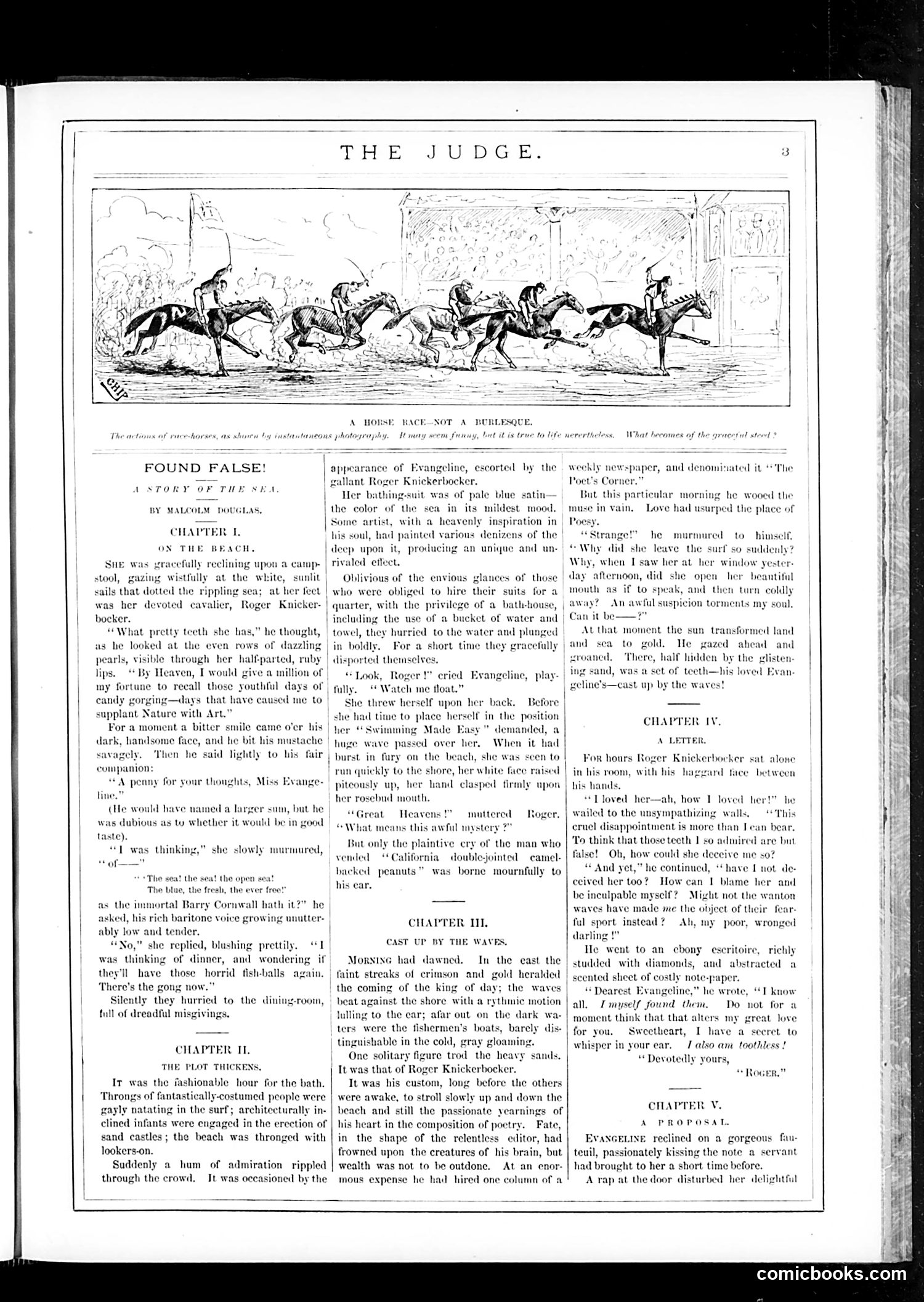
The cartoon at the top depicts a horse race, with the caption asserting it "is true to life." This appears to be satirizing the serialized story below—"Found False! A Story of the Sea" by Malcolm Douglas—as overly melodramatic and artificial compared to real life. The serial itself parodies sentimental Victorian fiction: a wealthy gentleman (Roger Knickerbocker) courts the delicate Evangeline by the seaside. The plot includes theatrical moments—her near-drowning, his romantic brooding—that strain credibility. References to "The Poet's Corner" (a newspaper feature) and the "relentless editor" suggest Judge is mocking how such contrived romantic tales were published in popular periodicals. The satire targets the gap between sentimental literature's artificiality and actual human experience, using the "true to life" horse race as ironic contrast to the overwrought narrative unfolding on the page.
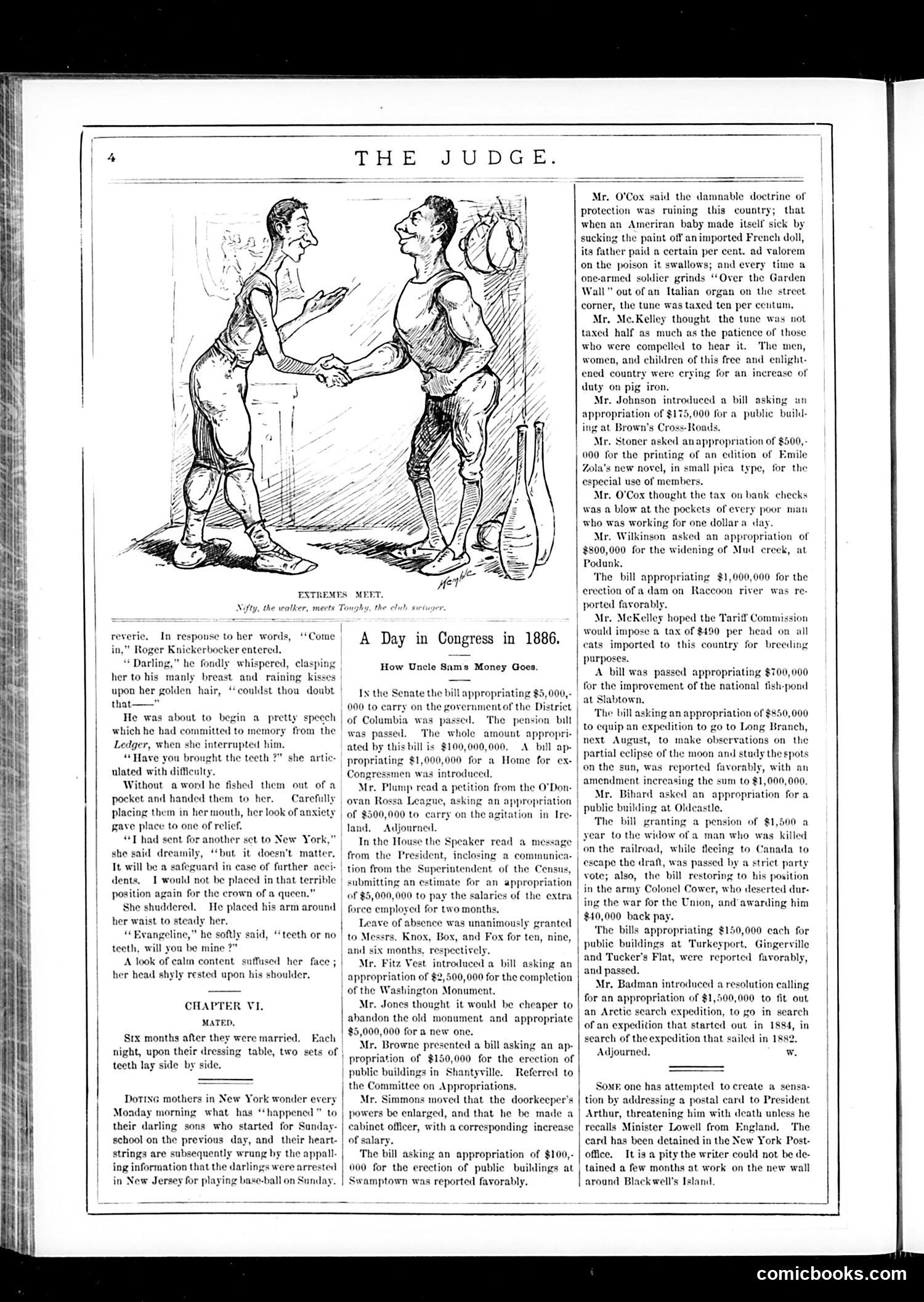
**Left cartoon:** A satirical romantic story where a man proposes to a woman—but the joke is that she wears false teeth. The humor mocks both sentimental Victorian romance literature and practical domestic realities. The caption "Extremes Meet" suggests the collision of romantic idealism with unglamorous truth. **Right section:** A scathing critique of Congressional spending excess in 1886. Judge lists absurdly wasteful appropriations: $1 million for a "Home for ex-Congressmen," $500,000 for Irish agitation, $2.5 million to *complete* the Washington Monument (already under construction), and competing proposals to either finish or abandon it entirely in favor of a $5 million replacement. The satire targets both reckless federal spending and Congressional self-dealing. Mentions of pension bills, census costs, and public building projects in obscure towns ("Shantyville," "Swamptown") ridicule the pork-barrel politics of the Gilded Age—where Congress funded pet projects while claiming fiscal responsibility. The final barb about an "Italian organ" being taxed mocks protectionist tariff policies.
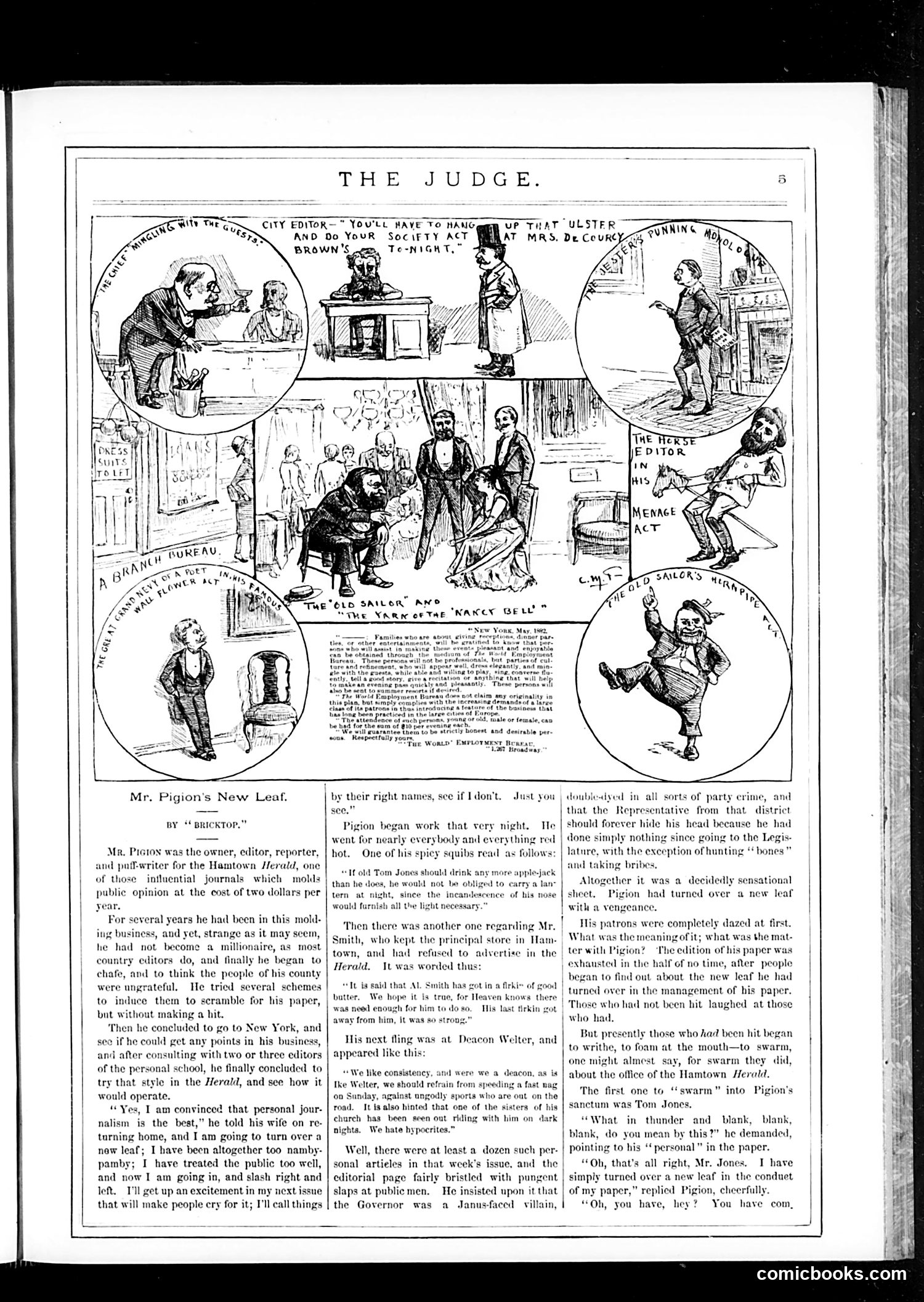
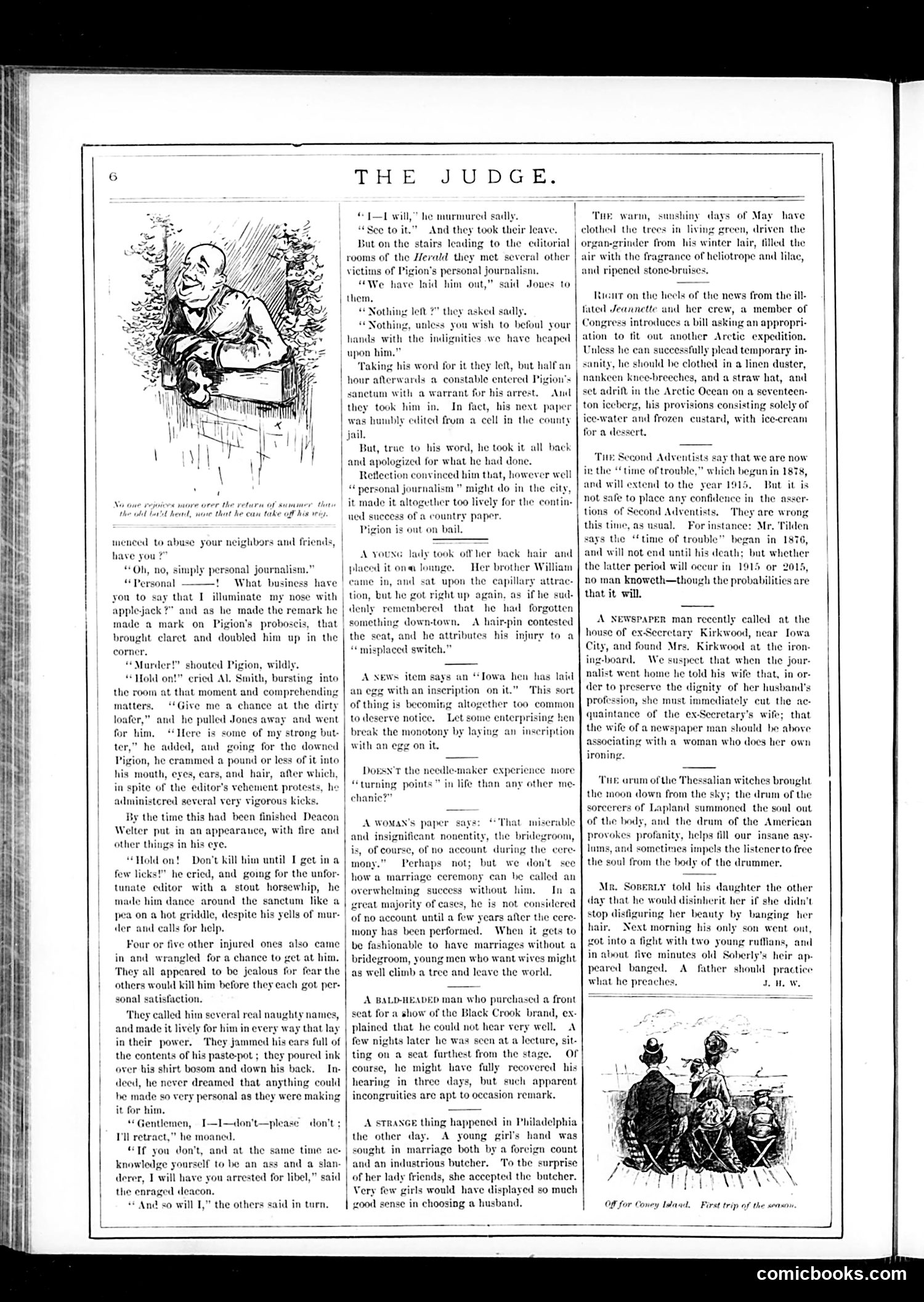
This satirical story mocks a newspaper editor who adopts "personal journalism"—a sensationalist style attacking public figures by name. Mr. Pigion, editor of the small-town Hamtown *Herald*, frustrated by lack of readership, decides to increase circulation by publishing aggressive personal attacks on local citizens: Tom Jones (a drunk), merchant Smith (who won't advertise), Deacon Welter (accused of hypocrisy), the Governor (called dishonest), and a district Representative (allegedly corrupt). The joke is that Pigion's scheme spectacularly backfires. Rather than grateful subscribers, he attracts angry mobs. His victims storm his office demanding explanations. The satire targets the emerging "yellow journalism" trend of the era—using inflammatory personal attacks and sensationalism to boost sales—suggesting it alienates readers rather than serving them.
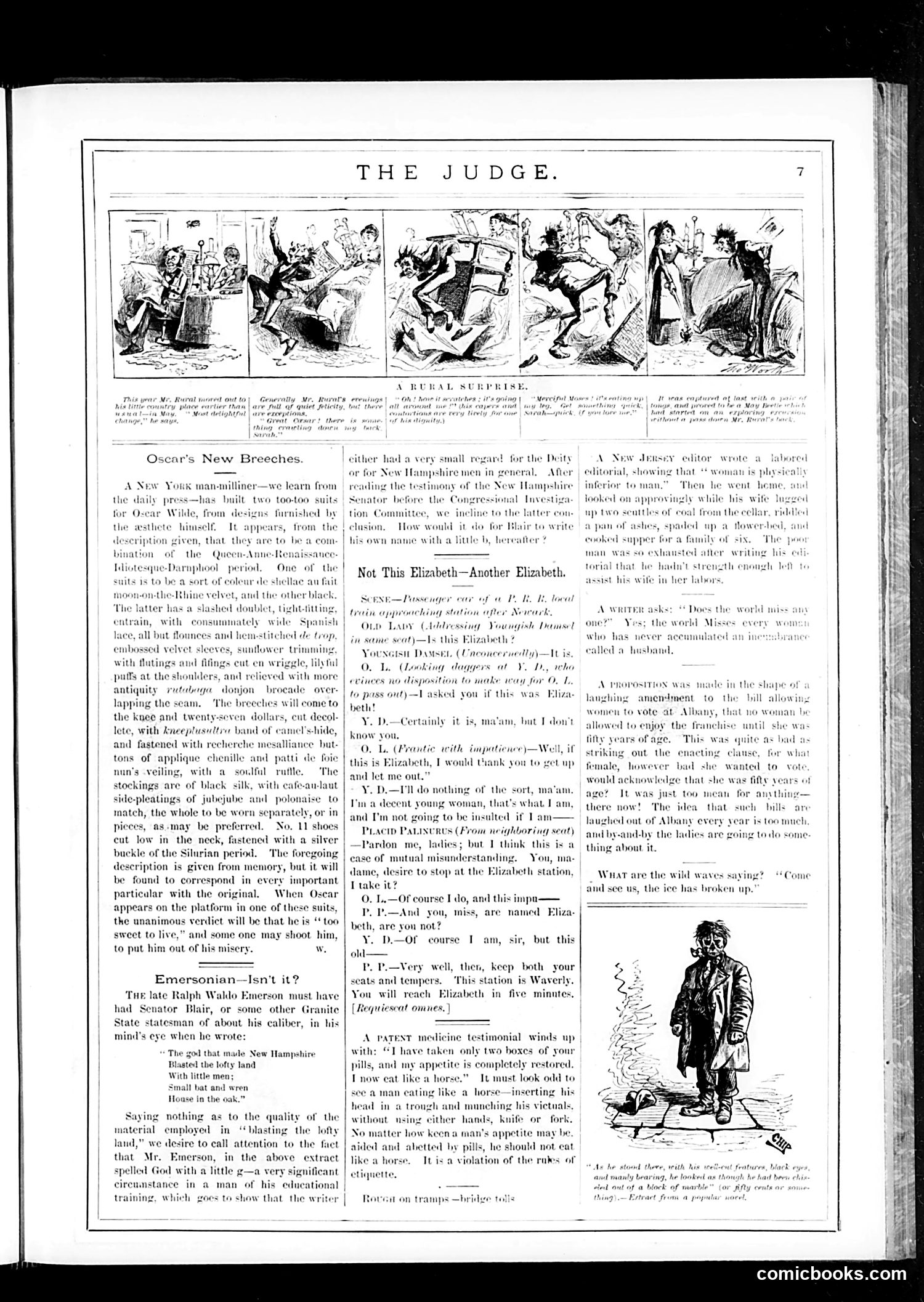
This page contains three satirical pieces typical of late 19th-century American humor: **"Oscar's New Breeches"** mocks Oscar Wilde's aesthetic movement and affected fashion sense. The elaborate, absurd description of his custom-made clothing ridicules the pretentious "art for art's sake" philosophy of aesthetes, suggesting Wilde's designs are so ridiculous someone should "shoot him...to put him out of his misery." **"Emersonian—Isn't it?"** attacks Senator Blair of New Hampshire, claiming he embodies Emerson's dismissive poem about "little men" from New Hampshire. The satire suggests Blair's mediocrity reflects poorly on his state. **"Not This Elizabeth—Another Elizabeth"** depicts a train-seat argument where an elderly woman mistakes a younger woman's identity, then refuses to move. A gentleman mediates, sarcastically wishing peace ("Requiescat omnes"—rest in peace). It's gentle social satire about public manners and stubbornness. The page reflects Judge's focus on personality-based humor, fashion criticism, and everyday social friction—rather than hard political commentary.
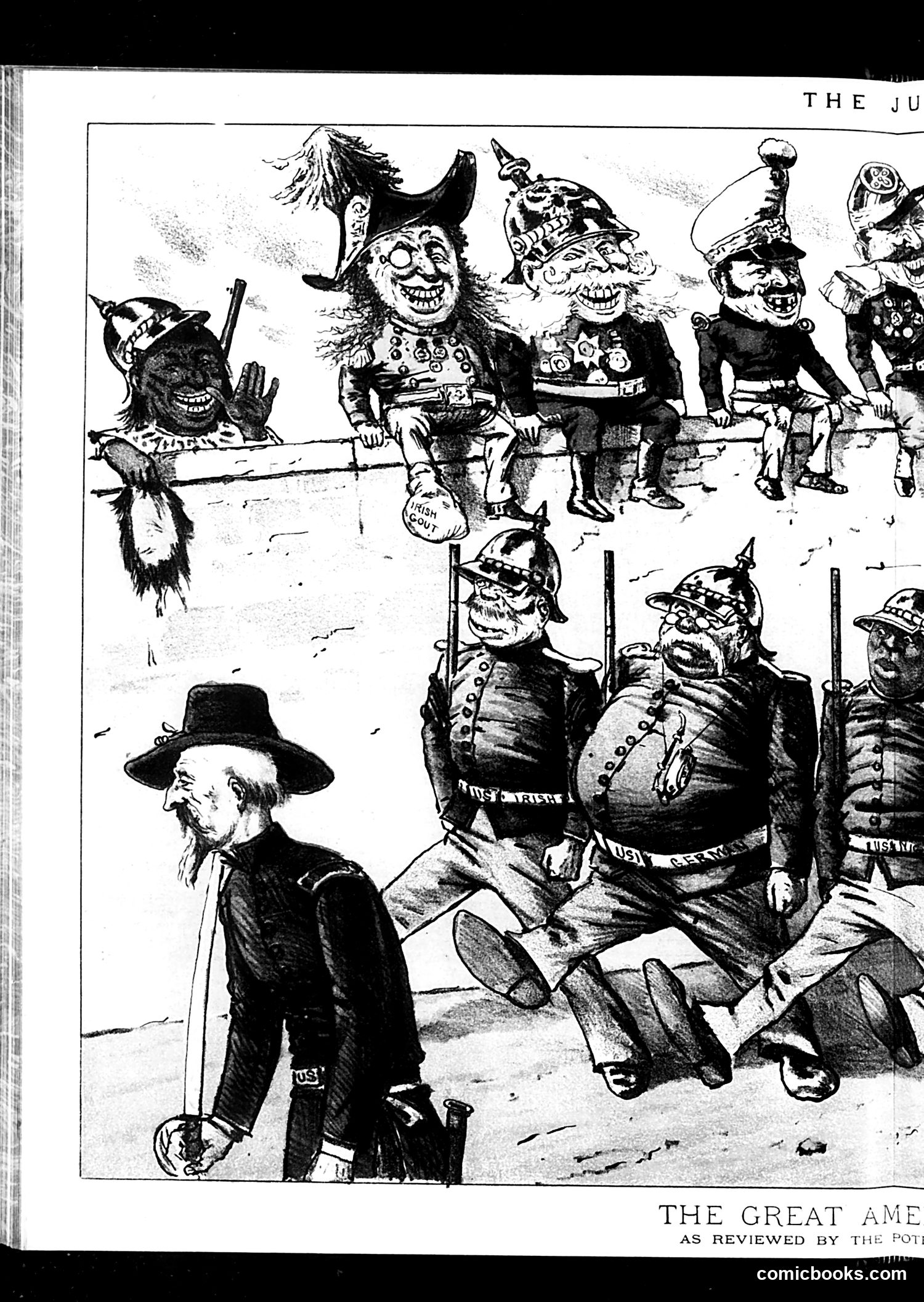
This appears to be a satirical cartoon titled "The Great Ame[rica]...As Reviewed by the Pot[?]" — likely a play on the phrase "as reviewed by the pot calling the kettle black." The cartoon depicts a well-dressed gentleman in formal attire (lower left) being confronted by caricatured German military figures wearing spiked Prussian helmets and military uniforms. The exaggerated, grotesque facial features of the German soldiers are typical of wartime propaganda caricature. The composition suggests ironic commentary: someone criticizing others while being in no position to do so. Given the German military imagery and the formal gentleman's stance, this likely critiques American foreign policy or diplomatic hypocrisy regarding Germany, possibly during or about World War I tensions. The exact historical moment remains unclear without the complete caption and date.
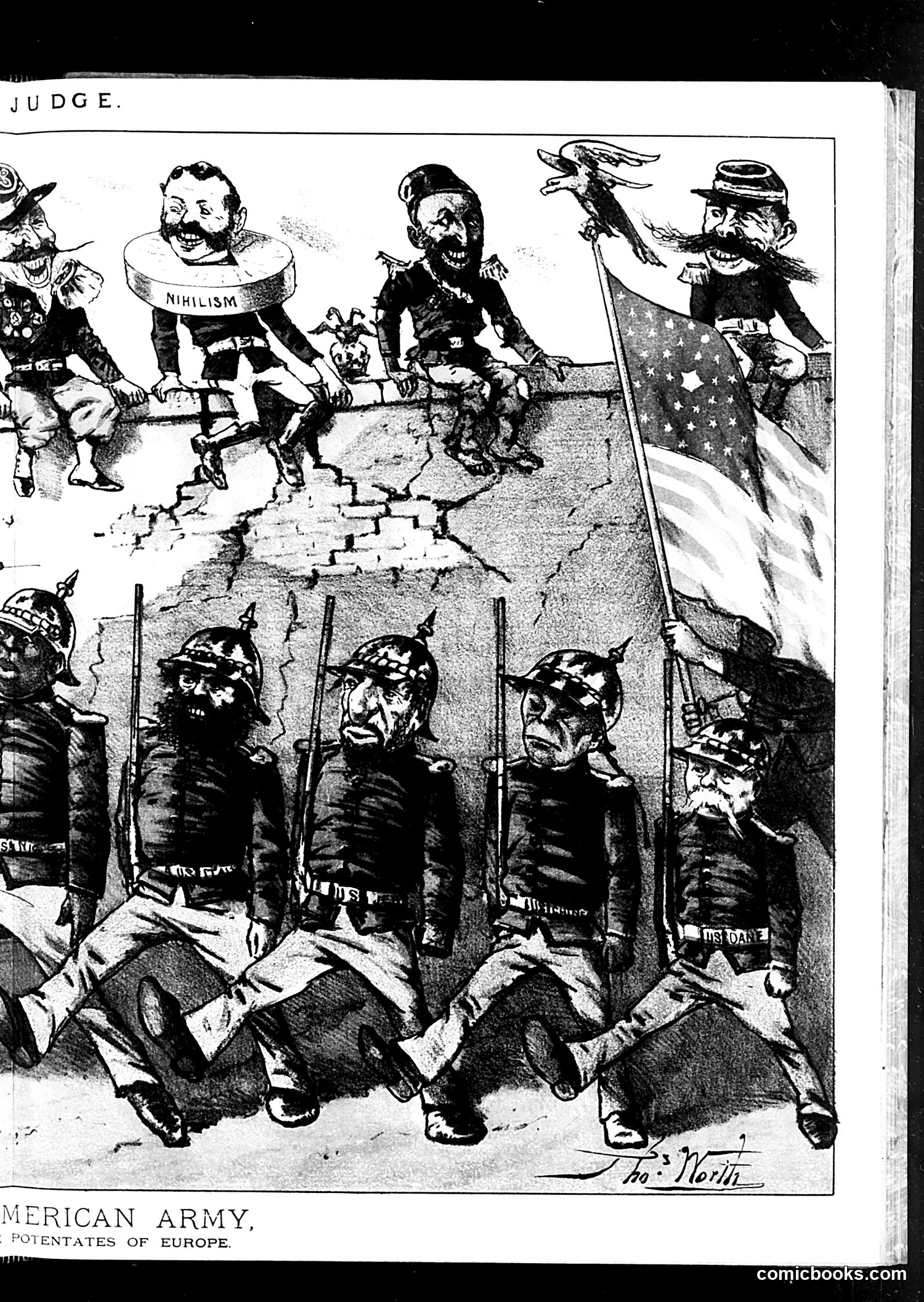
This political cartoon from *Judge* magazine satirizes American military intervention in European affairs. The image shows caricatured European leaders (top, appearing to represent various monarchs or political figures) being manipulated or directed by American military soldiers below them—depicted wearing German-style spiked helmets and carrying rifles with the American flag. The title "American Army, Potentates of Europe" suggests the satirical point: that American military power has become the true controlling force over European rulers and politics, rather than European leaders governing independently. One figure wears a collar labeled "Nihilism," indicating anxieties about radical European ideologies. This likely reflects post-World War I American military presence and diplomatic influence in European reconstruction and politics.
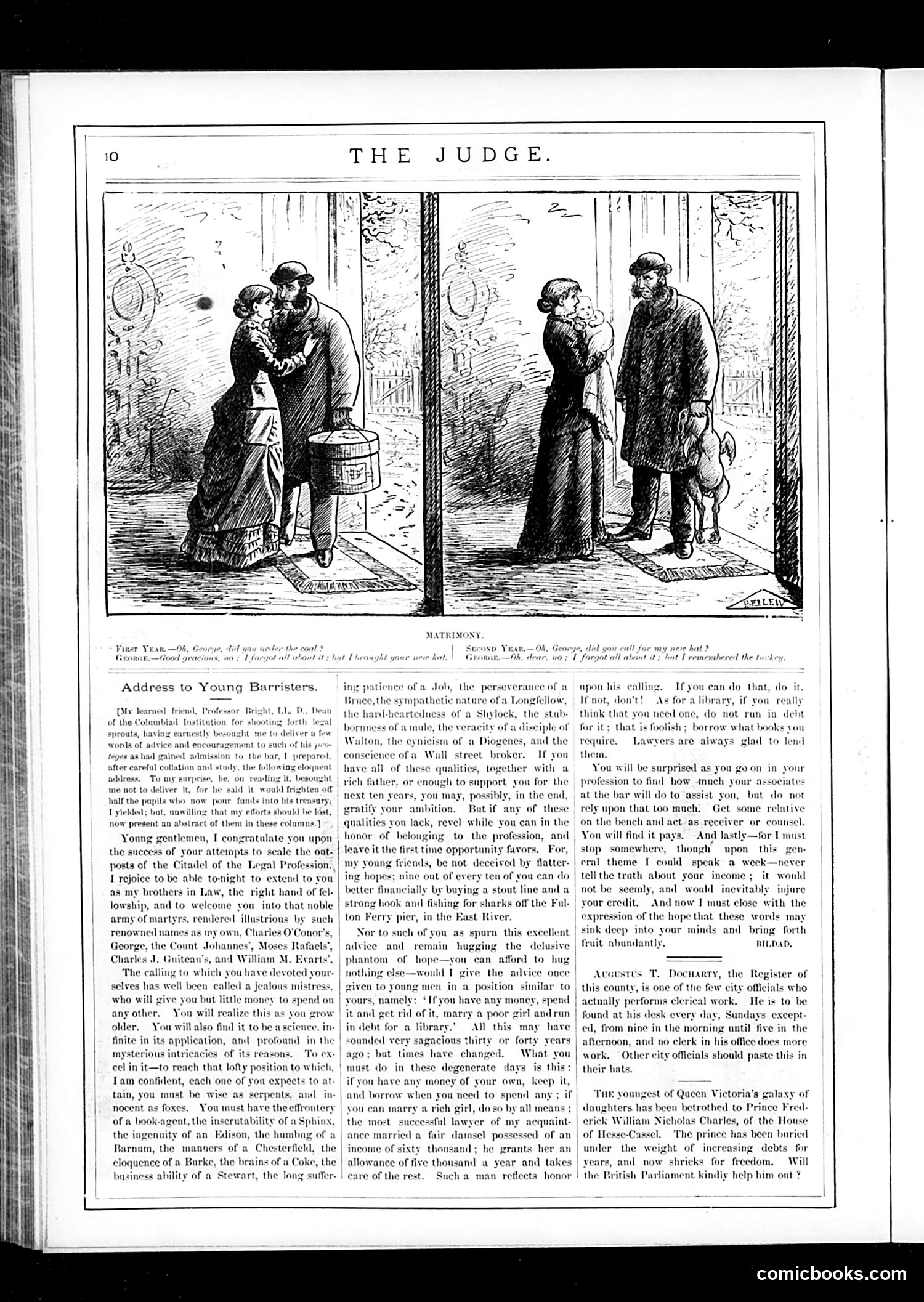
This two-panel cartoon satirizes marriage expectations versus reality for young men, particularly those entering professional careers like law (suggested by the "Address to Young Barristers" article below). **The panels show:** - **First Year**: A young man courting a woman, presenting her with flowers/gifts - **Second Year**: The same couple, now the woman ignores his hat and focus, appearing indifferent to his romantic gestures **The satire:** The accompanying captions mock how quickly marriage transforms from romantic courtship to domestic apathy. The woman's shift from attentive interest ("did you order the coat?") to dismissal ("I forgot all about it; but I remembered the turkey") illustrates the joke—that wives cease caring about husbands' concerns once married. The lengthy article below reinforces period anxieties about marriage as financially ruinous for professional men, warning young lawyers that matrimony is a "jealous mistress" requiring expensive maintenance. The cartoon visually confirms this cynical view through the woman's obvious disinterest in her husband's needs post-marriage.
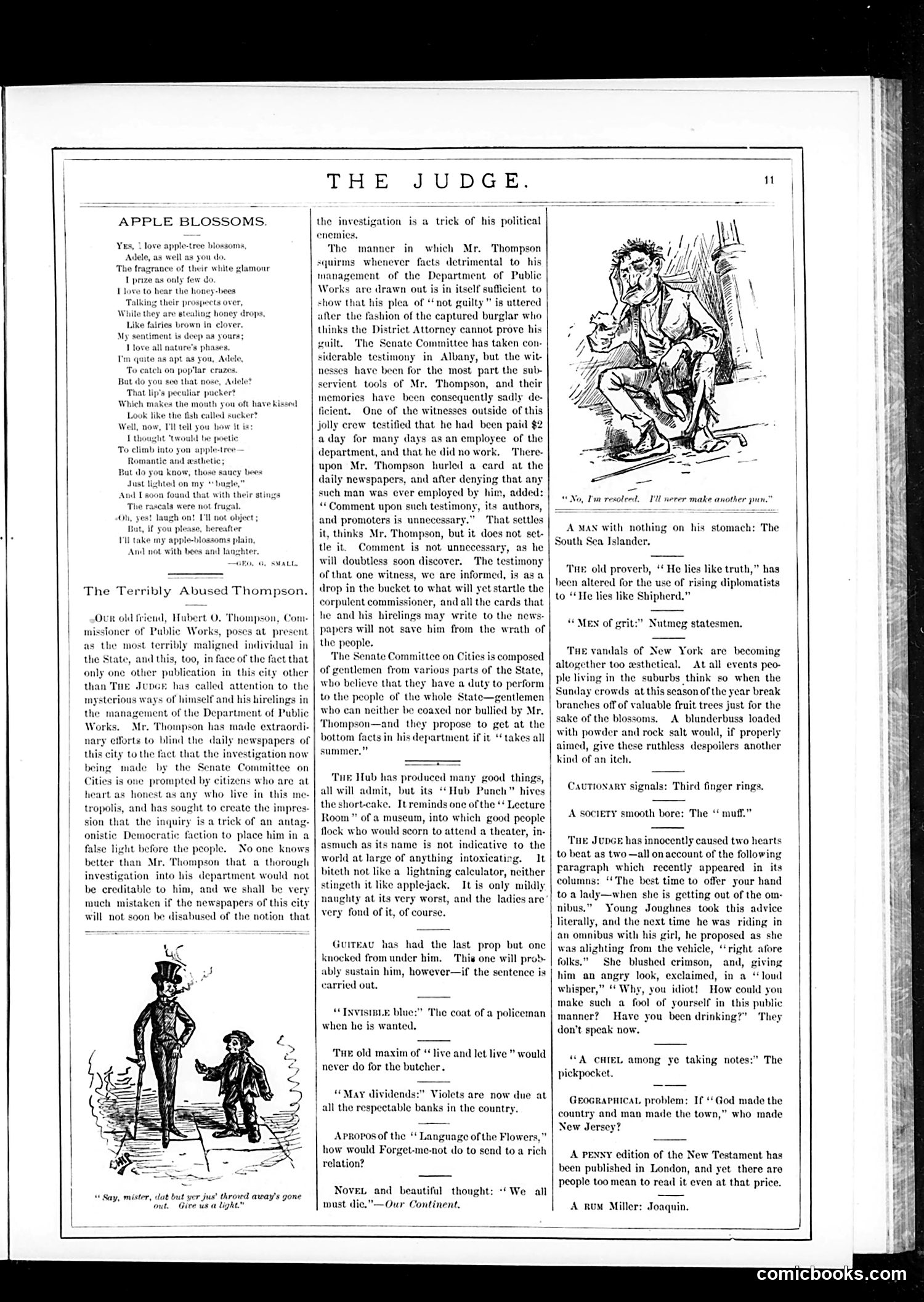
This page attacks **Hubert O. Thompson**, Commissioner of Public Works, over a corruption scandal being investigated by the New York State Senate Committee on Cities. The main article accuses Thompson of: - Mismanaging his department while denying wrongdoing - Employing workers who did no actual work (paid $2/day to do nothing) - Using the press and denial cards to dodge accountability rather than address the allegations - Acting guilty despite claiming innocence ("like a captured burglar") Judge defends the Senate investigation as legitimate civic oversight, not political persecution as Thompson claimed. The satire mocks Thompson's defensive posturing and suggests worse revelations are coming. The accompanying cartoon (top right) illustrates Thompson's corruption or defensive behavior, though specific details are unclear from the image quality. This represents typical Gilded Age muckraking journalism attacking municipal corruption and patronage networks.
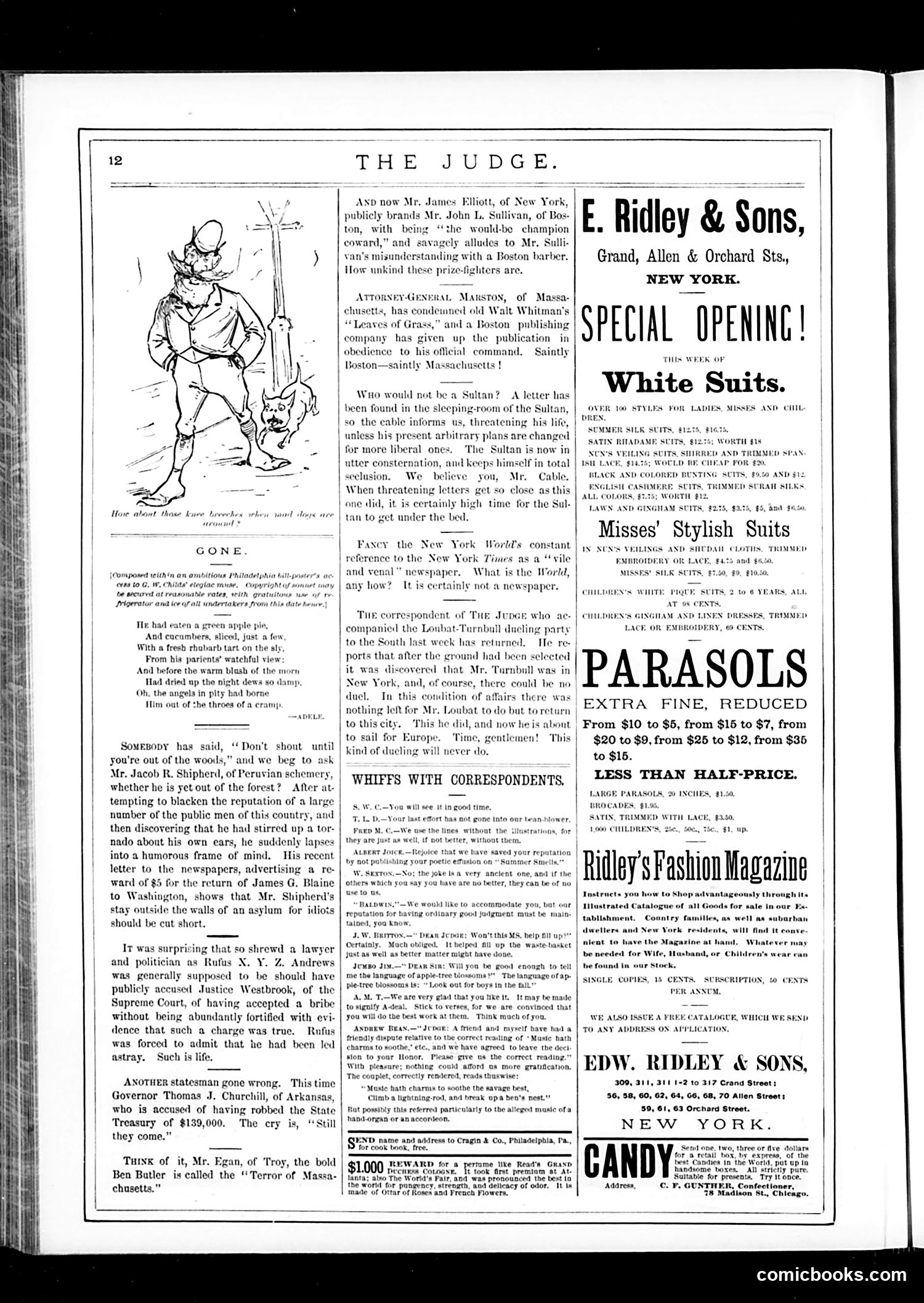
This page combines satirical commentary with advertising. The main cartoon depicts a young boy who has died from eating forbidden foods (green apple pie, cucumbers, rhubarb tart) — a darkly humorous poem mocking overly sentimental Victorian funeral literature. The "GONE" section contains brief political jabs at various figures: - **Jacob R. Shipherd**, a Peru-connected schemer who previously attacked public figures but now advertises a reward for James G. Blaine's return — Judge mocks his sudden shift to humor as evidence of mental instability - **Governor Thomas J. Churchill** of Arkansas, accused of embezzling $139,000 - **Rufus X.Y.Z. Andrew**, a lawyer who publicly accused a judge of bribery without evidence - **Prize-fighters John L. Sullivan and James Elliott**, satirized for their public feuding References to **Walt Whitman's "Leaves of Grass"** being suppressed by Massachusetts's Attorney General, and a joke about the Turkish Sultan receiving death threats, round out the political commentary. The page is otherwise dominated by **E. Ridley & Sons** advertisements for summer clothing.
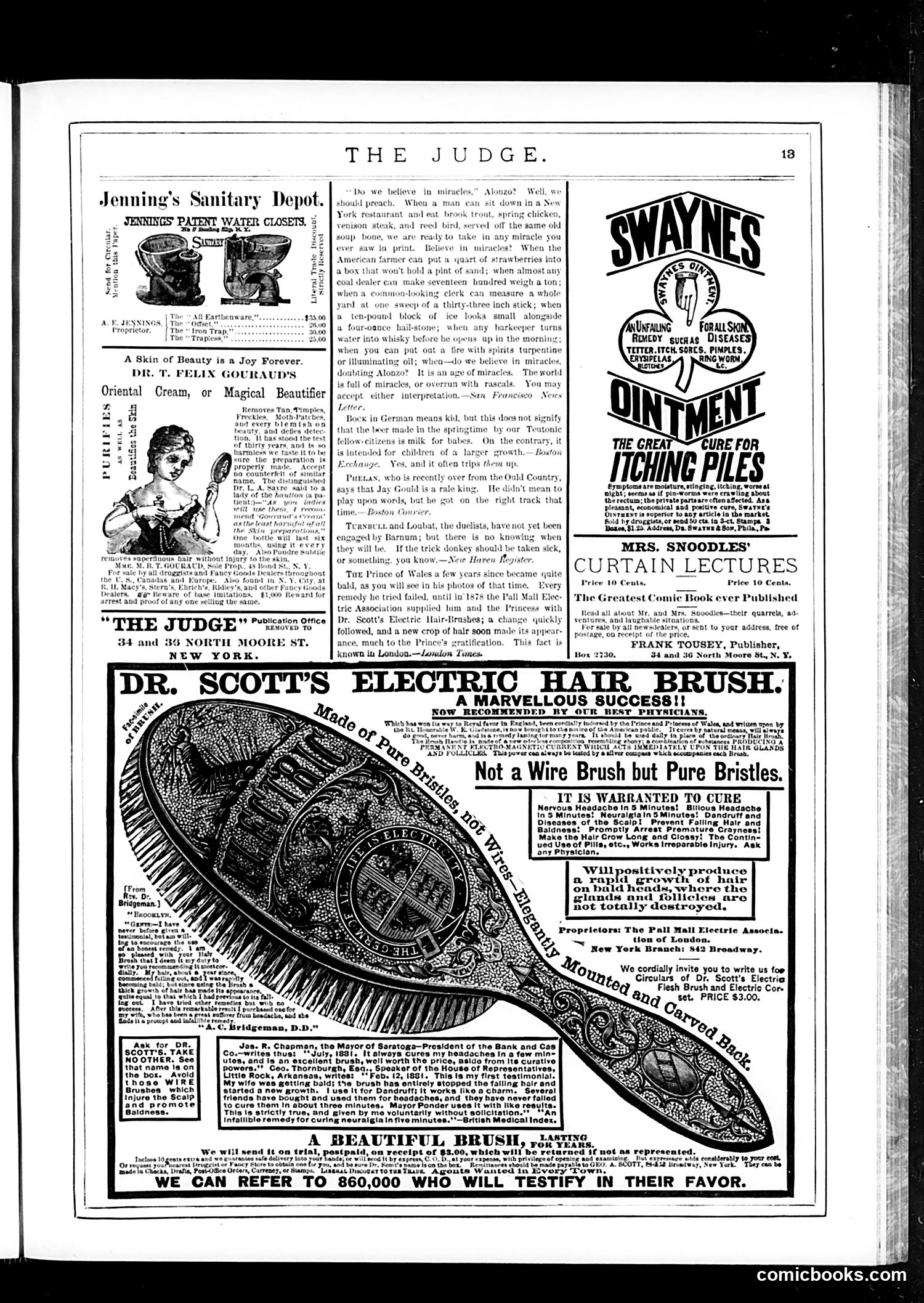
This page is primarily **advertising**, not political satire. It contains multiple patent medicine and beauty product advertisements typical of late 19th-century American magazines. The main featured ad is **Dr. Scott's Electric Hair Brush**—a pseudoscientific device claiming to cure headaches, neuralgia, dandruff, and promote hair growth through "electricity." The elaborate anatomical illustration and testimonials from officials (Mayor of Saratoga, Speaker of the House) are typical snake-oil marketing tactics of the era. Also advertised: - **Dr. Felix Gouraud's Oriental Cream** ("Magical Beautifier")—a skin-lightening cosmetic - **Swaynes Ointment**—for "itching piles" (hemorrhoids) - **Mrs. Snoodles' Curtain Lectures**—a humor book The page's top article discusses miracles and mentions the Prince of Wales, referencing dubious hair-growth claims. This reflects the credulous advertising environment where medical fraud flourished unchecked before FDA regulations.
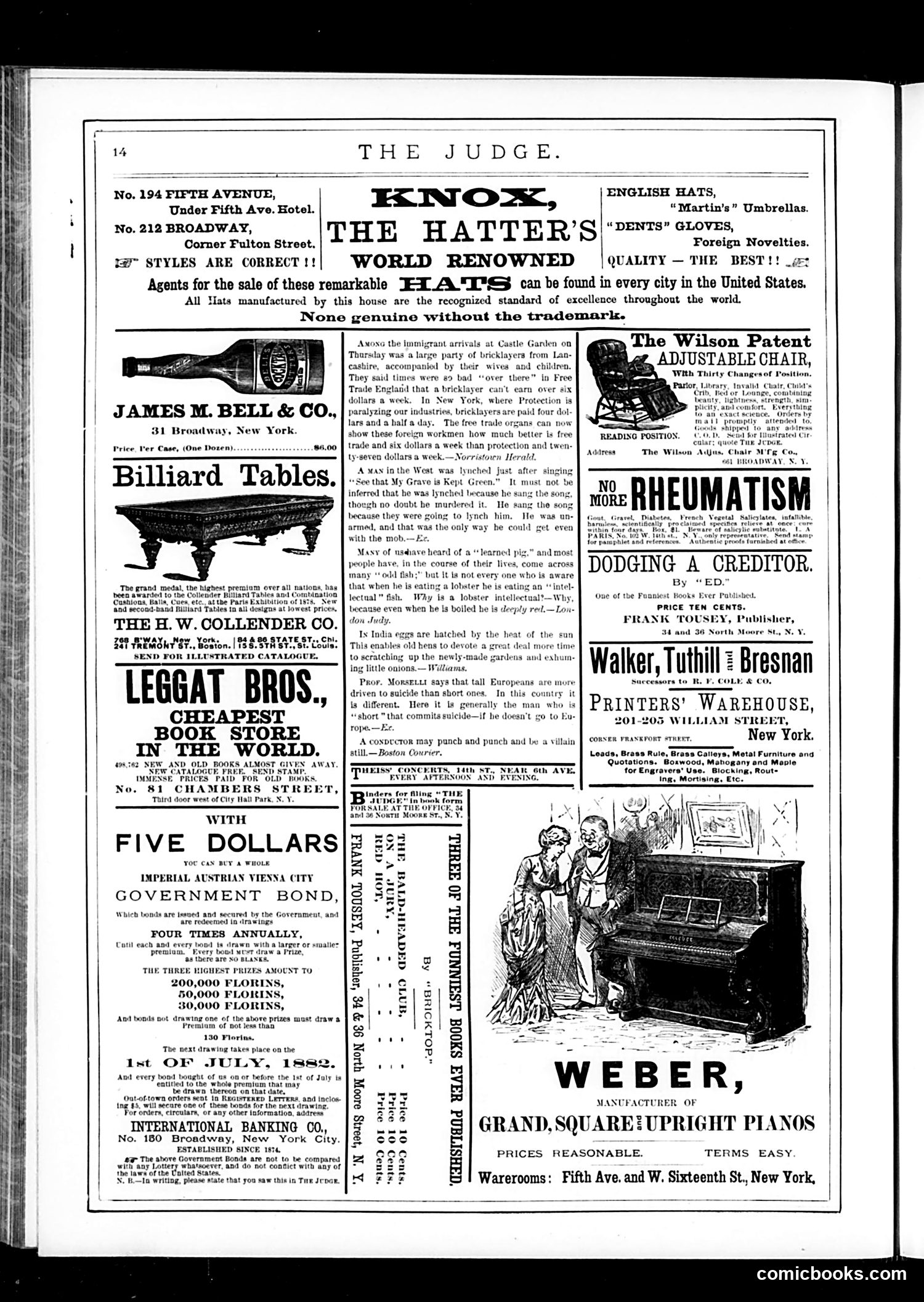
This page is primarily **advertising** rather than political satire. However, it contains one notable satirical item: The text column titled "Among the immigrant arrivals at Castle Garden on Thursday..." presents a **protectionist argument** mocking Free Trade. It describes English bricklayers earning only $6/week in "Free Trade England" versus $4.50/day (roughly $27/week) in America "where Protection is paralyzing our industries"—sarcastically highlighting the contradiction that the supposedly crippled protected economy actually pays workers far better. This appears to support protective tariffs against British competition, a major 1880s political debate. The remaining content is commercial advertising for hats, billiard tables, pianos, bonds, and books. A small illustration shows two figures near a piano, relating to Weber's piano advertisement below it. The page reflects Judge's typical mix of political commentary embedded among advertisements.
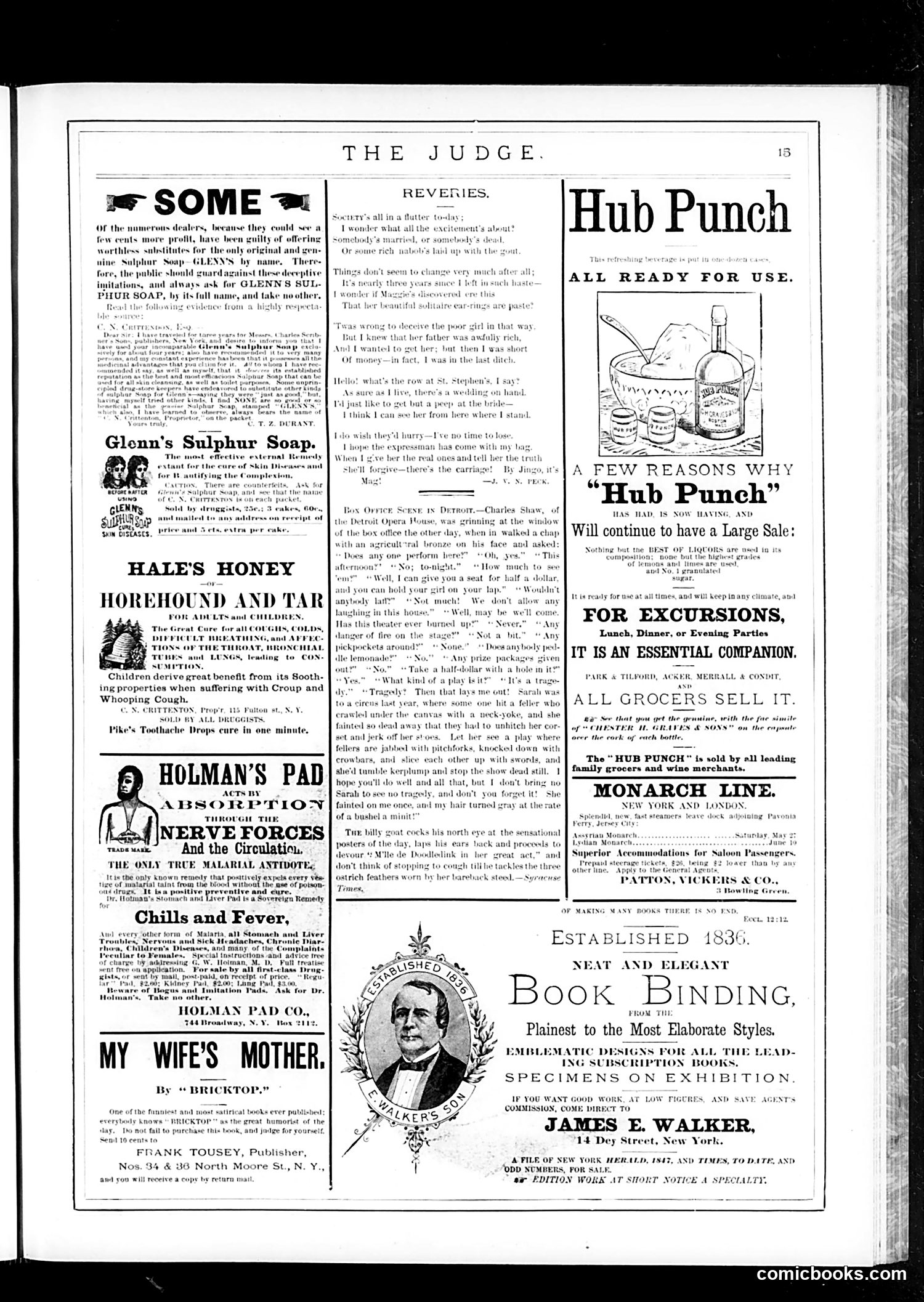
This is primarily an **advertising page** rather than a satirical cartoon page. The layout consists almost entirely of commercial advertisements for patent medicines and services typical of the late 19th century. The content includes ads for: - **Glenn's Sulphur Soap** and **Hale's Honey Horehound and Tar** (remedies for coughs/colds) - **Holman's Pad** (a magnetic health device claiming to cure malaria and circulation problems—a common medical fraud of the era) - **Hub Punch** (a beverage product) - Book binding services by James E. Walker The only potentially satirical content is a brief poetic piece titled "Reveries" about romantic daydreaming, though it's more whimsical than political. The page reflects Judge magazine's reliance on patent medicine advertising—an industry rife with false health claims that became a target of progressive-era reform, though that critique isn't evident here.
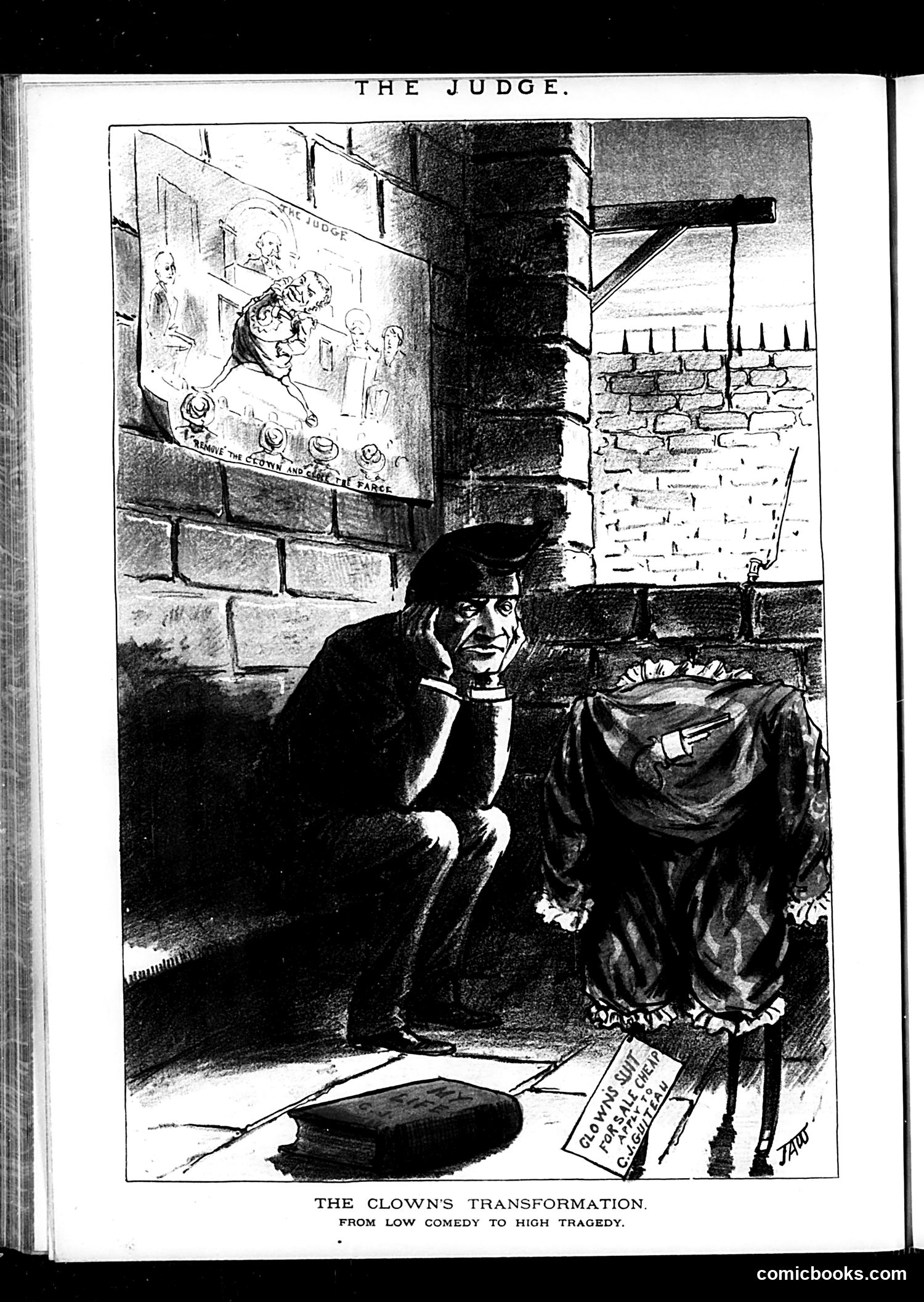
This single cartoon depicts a disheveled man in a cap and coat, seated in a bare room with brick walls. He's positioned near theatrical props and costumes, including what appears to be a clown outfit and mask. A playbill or document lies on the ground. The caption "The Clown's Transformation: From Low Comedy to High Tragedy" suggests satire about someone transitioning from comedic performance to serious dramatic roles—or possibly a social commentary about a person's fall from dignity. The sparse, prison-like setting and the man's weary posture imply hardship or degradation rather than artistic success. Without additional context identifying the specific figure, the cartoon appears to mock either theatrical pretension or the harsh reality awaiting performers attempting upward mobility.