
A complete issue · 16 pages · 1881
Judge — December 24, 1881
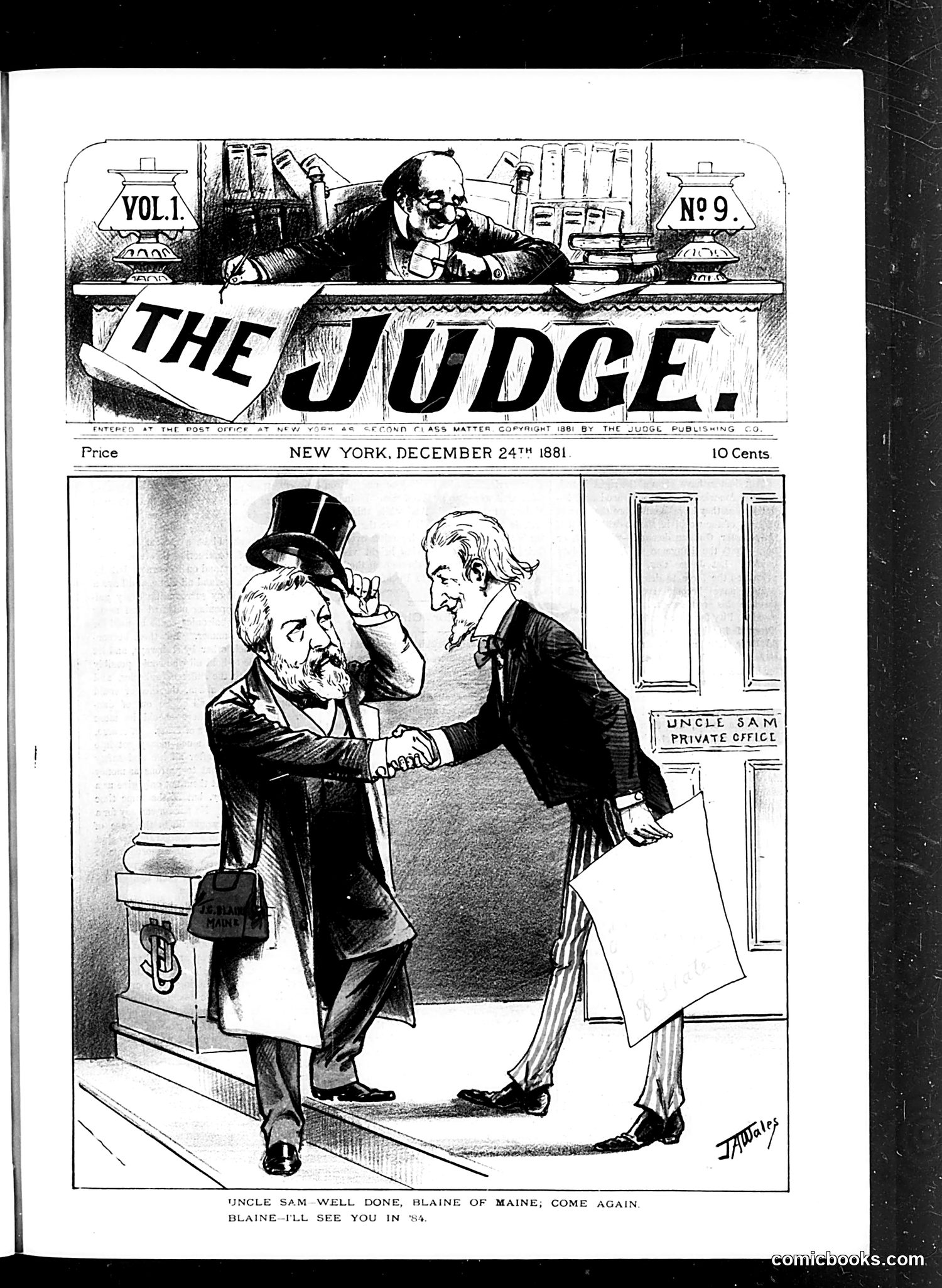
This cartoon depicts Uncle Sam (representing the United States government) greeting James G. Blaine of Maine at his private office. Blaine appears to be leaving with a money bag, suggesting financial or political gain from his visit. The caption indicates this is congratulatory—"Well done, Blaine of Maine; come again"—with Blaine's parting words referencing 1884, the next presidential election year. The satire likely mocks Blaine's political influence and financial dealings. Blaine was a prominent Republican politician known for controversial business connections; critics accused him of corruption. Judge's illustration suggests Uncle Sam rewards Blaine's political services with money, and anticipates his return as a presidential candidate in 1884.
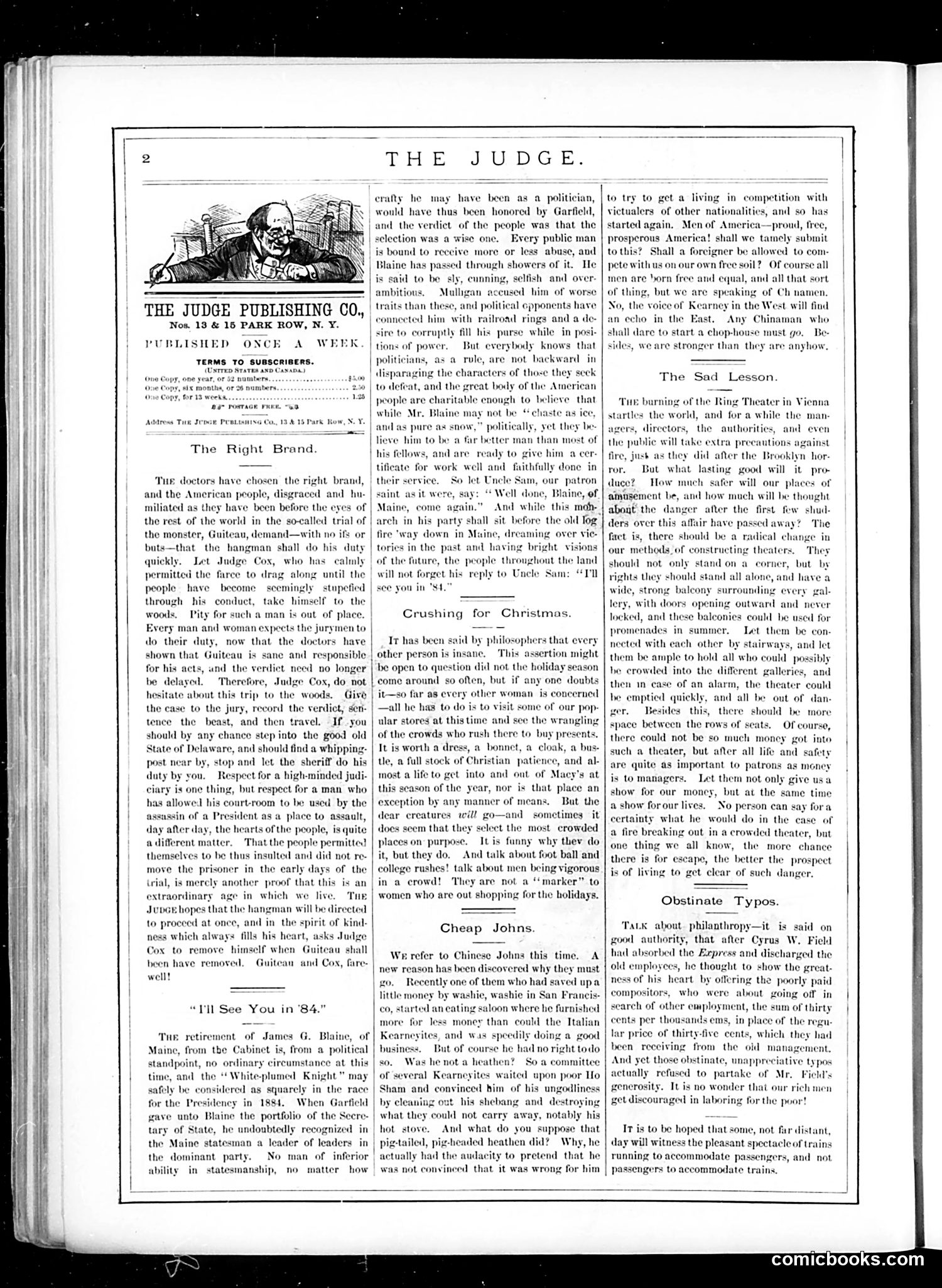
This page contains political commentary on two major 1880s controversies: **"The Right Brand"** attacks Judge Cox for mishandling the trial of Charles Guiteau, President Garfield's assassin. The article demands Cox expedite the verdict and execution, sarcastically suggesting he retreat to Delaware's whipping posts if he cannot fulfill his judicial duty. The underlying criticism: Cox's conduct has allowed the courtroom to become a political tool, compromising justice. **"'I'll See You in '84'"** discusses James G. Blaine's resignation as Secretary of State under Garfield. Though acknowledging Blaine faces accusations of corruption (railroad dealings, the "Mulligan letters"), the piece defends him as fundamentally honest and predicts his 1884 presidential run. The title references Blaine's confident response to Uncle Sam—he will return in 1884. Both pieces reflect Judge's Republican editorial stance, defending party figures while demanding accountability in separate matters.
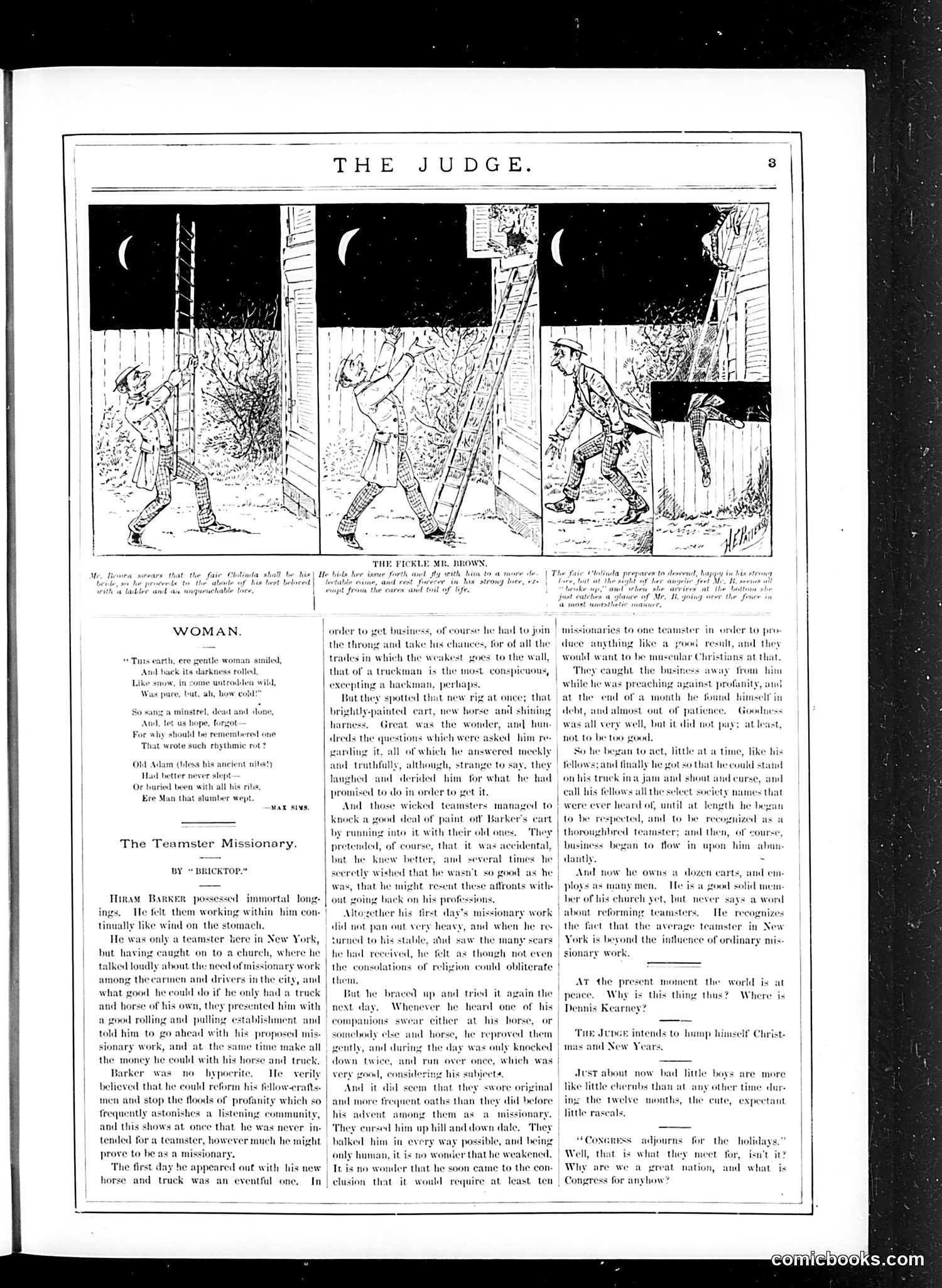
This page satirizes the tension between religious idealism and practical reality in the Gilded Age. **The Story:** A New York teamster named Barker, inspired by church activism, receives a new cart and horse to conduct missionary work among fellow workers while earning money. He preaches morality and abstinence from profanity. **The Satire's Point:** His fellow teamsters deliberately sabotage his new equipment, swearing at him constantly. Barker's "goodness" makes him ineffectual and mocked. Only when he abandons his missionary approach—adopting the same profanity and rough behavior as his peers—does he gain respect and business success. **The Joke:** Judge mocks both naive religious reformers who think moral preaching will change working-class culture, and the cynical reality that respectability requires abandoning principle. The cartoon illustrates Barker's failed attempts at ladder-climbing evangelism. The satire suggests that in the brutal world of labor, virtue is commercially disadvantageous.
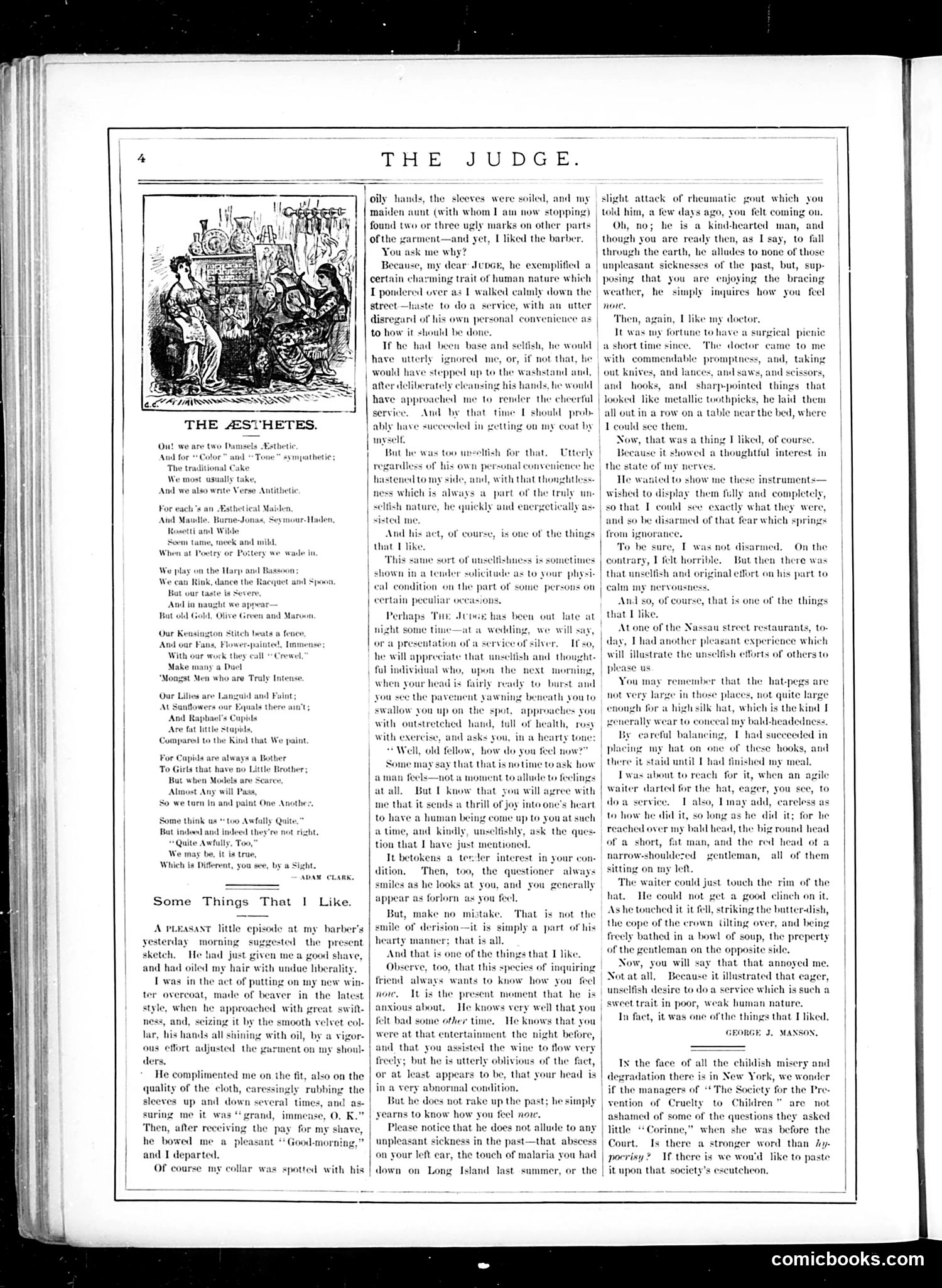
This page contains two distinct sections: **"The Æsthetes"** - A poem listing various aesthetic preferences, appears to be light social satire about artistic affectations popular in the era. **"Some Things That I Like"** - An essay by the author describing pleasant personal experiences, including visits to a barber, interactions with a doctor displaying surgical instruments, and observations about human nature and social interactions. The main illustration shows figures in what appears to be a barber shop or similar setting, though without clearer context it's difficult to identify specific political references or caricatures. The content seems focused on gentle, everyday social humor rather than pointed political satire. The page appears primarily literary rather than cartoon-driven.
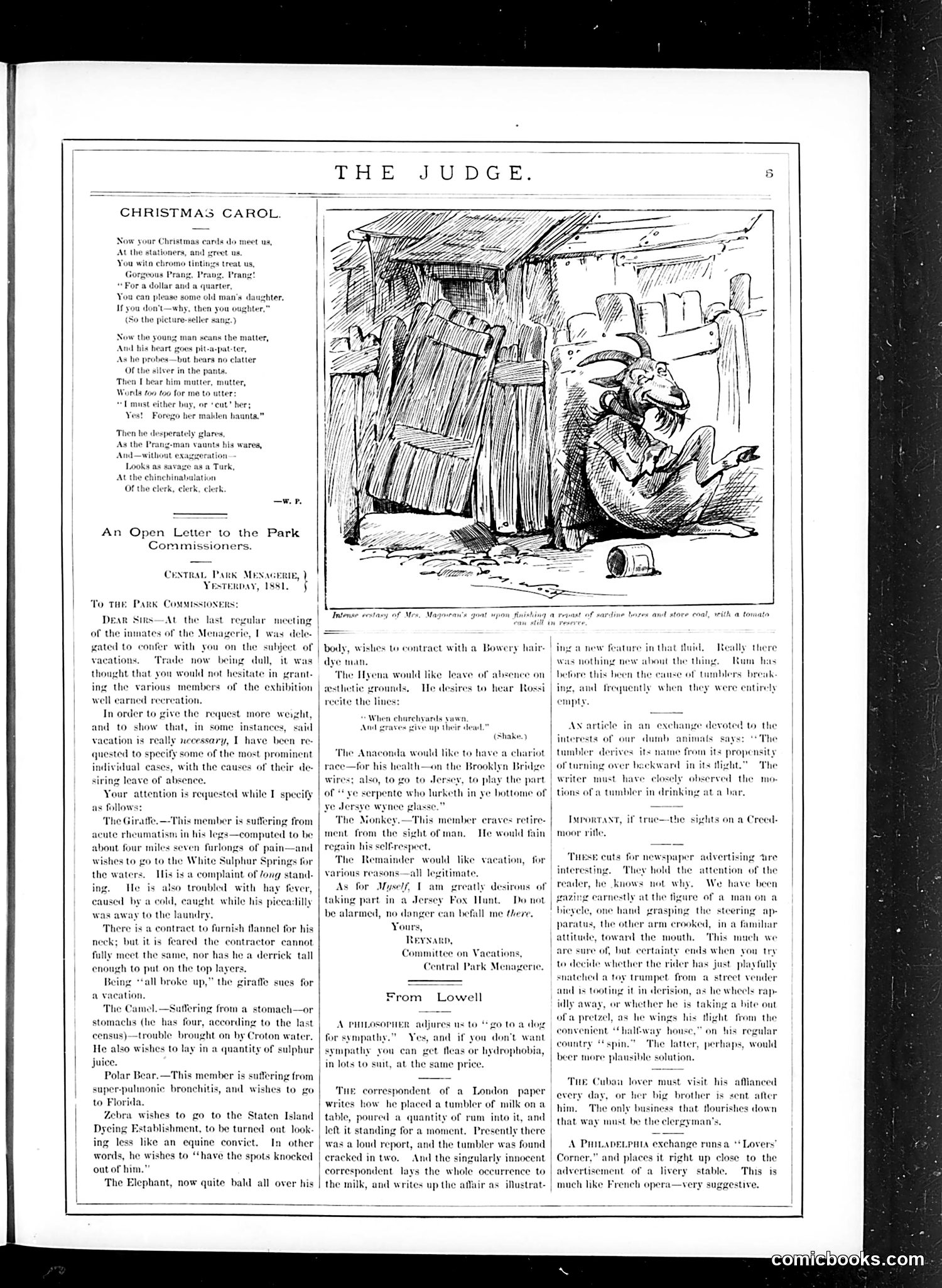
This page from Judge (1881) contains satirical commentary on New York City institutions and current events. **Main Cartoon:** The illustration depicts animals from Central Park's menagerie in a shabby shed, accompanying "An Open Letter to the Park Commissioners." The satire mocks the poor conditions at the Central Park Zoo, with a humorous letter from the menagerie's "Committee on Vacations" requesting that various animals be granted leave due to supposed ailments—a giraffe with rheumatism, a camel with digestive troubles, a polar bear with bronchitis, an elephant seeking hair dye. The joke is that these absurd requests expose the inadequate care animals receive in the facility. **"From Lowell" Section:** A brief humorous anecdote about a London correspondent placing milk and rum in a tumbler, which cracks from the chemical reaction. The joke satirizes how people eagerly attribute mundane occurrences to supernatural causes rather than simple explanations. The page primarily uses animal welfare and institutional neglect as vehicles for social satire, typical of Judge's reformist humor.
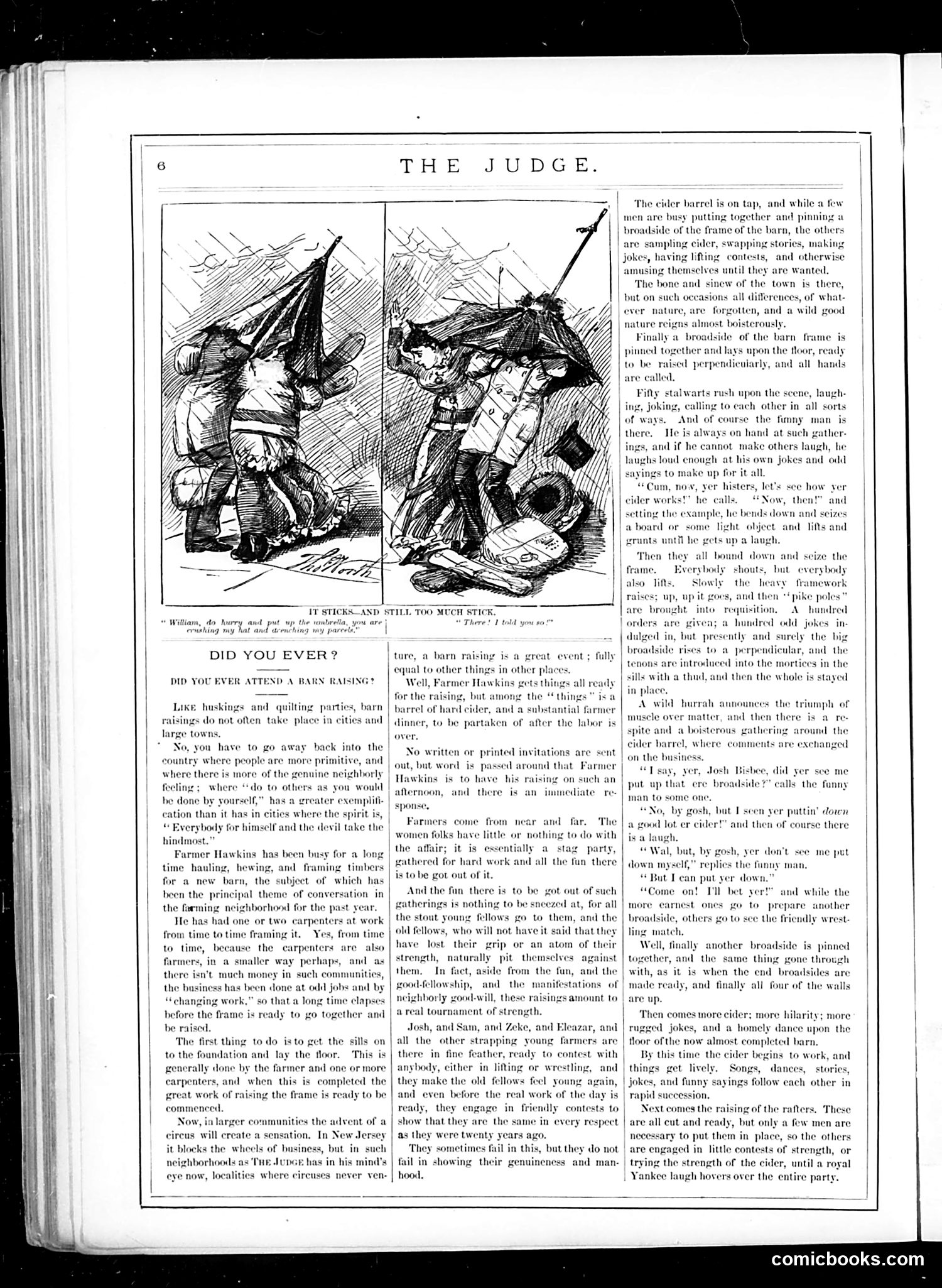
This page contains a satirical dialogue between Mr. and Mrs. Sappy about Christmas shopping. The humor targets middle-class anxieties about holiday spending and social competition. Mrs. Sappy recounts frittering away her fifteen-dollar budget on trivial expenses and status-conscious purchases. She hired an expensive carriage to outshine her wealthy acquaintance Mrs. Doodle (who arrived by cab), spent money on silk stockings and fancy slippers, and made various small impulse purchases. The satire mocks women's supposed inability to budget, their competitive social climbing, and the retail frenzy Christmas induces. The "Banquet Hall" setting is ironic—this modest domestic scene is treated as theatrical farce. The humor derives from recognizable middle-class experiences: the ferry commute, name-dropping the wealthy, and justifying endless spending through small individual purchases that mysteriously total far more than intended.
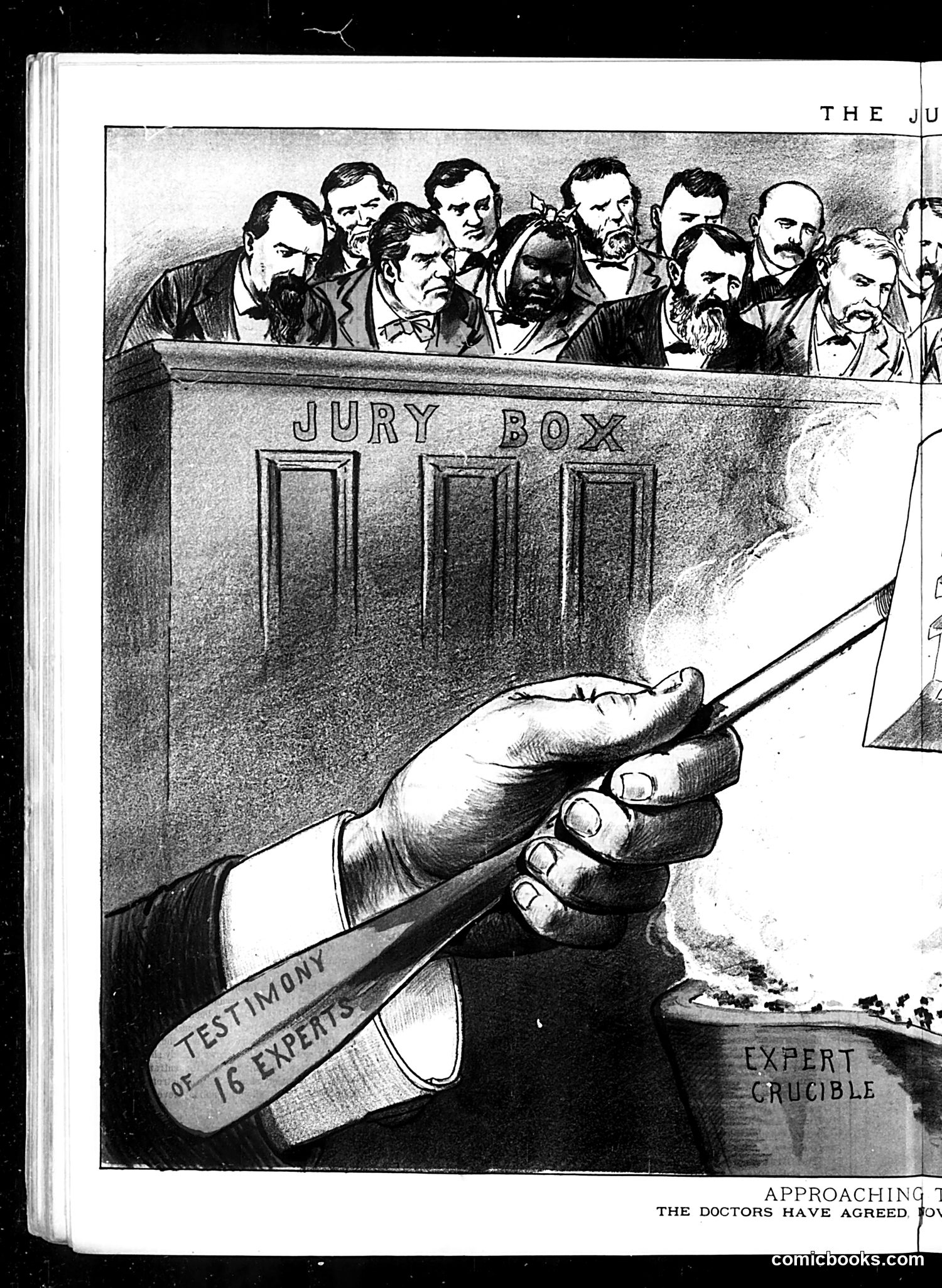
This is a satirical illustration depicting a jury box observing testimony from "16 Experts" (visible on the bat/paddle being held). A large hand wields this instrument toward an "Expert Crucible" (a vessel shown lower right), suggesting the experts' testimony is being tested or challenged. The cartoon satirizes expert witness testimony in legal proceedings, likely critiquing how multiple expert opinions are presented to juries. The "crucible" metaphor implies these testimonies are being subjected to intense scrutiny or are being weaponized to influence the jury's verdict. The specific legal case or context remains unclear from this page alone, but the satire targets the reliability and persuasiveness of expert testimony in American courts during what appears to be the early 20th century.
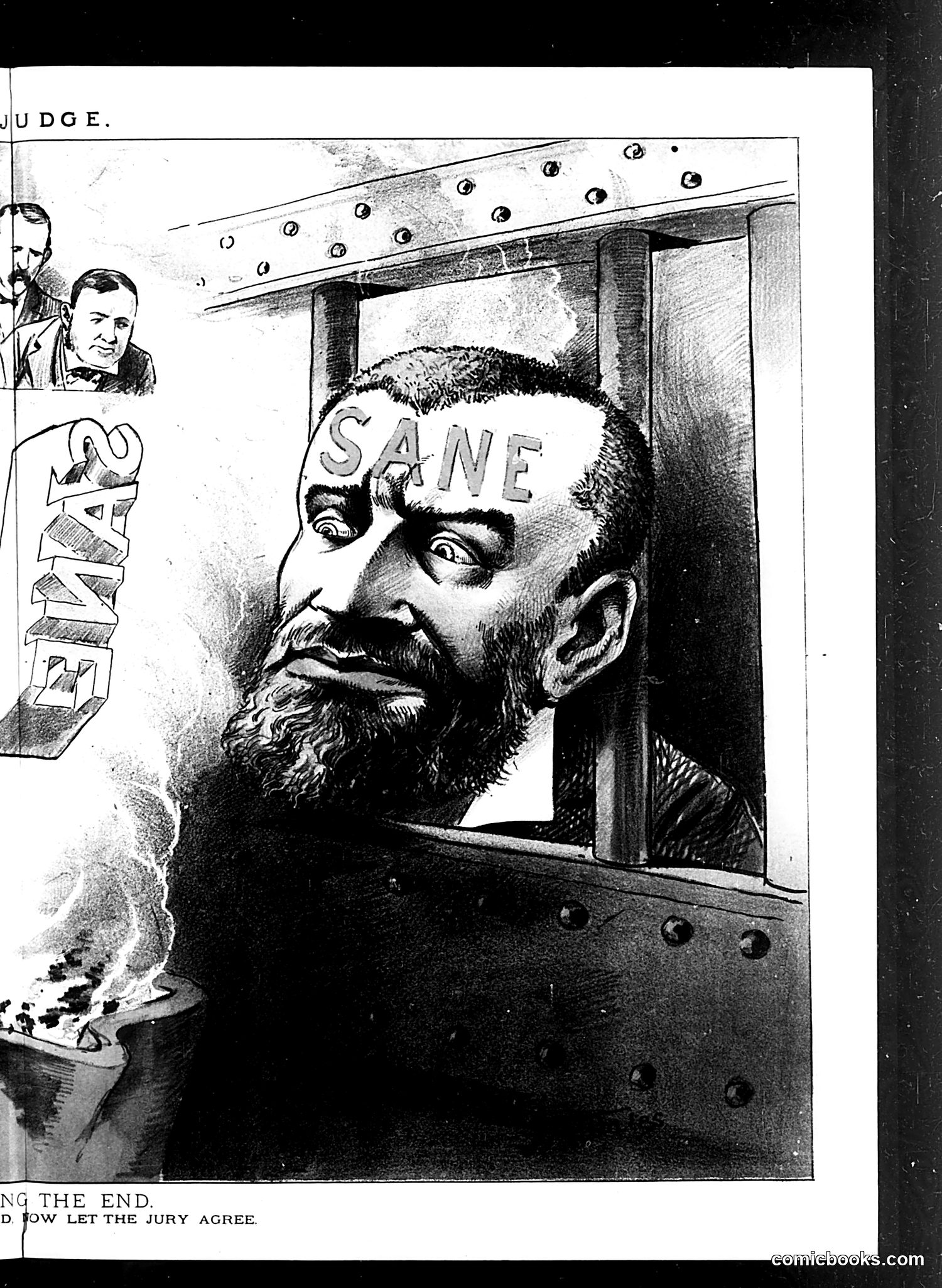
This Judge magazine cartoon depicts a bearded man marked with "SANE" on his forehead, visible through a window or opening. The word "SANE" appears stamped or branded on him, suggesting institutional judgment of his mental state. The caption references "the end" and jury agreement, implying this shows the conclusion of a sanity hearing or trial. The cartoon satirizes the process of determining insanity through legal proceedings—likely criticizing how juries might render verdicts on complex psychological matters. The two figures in the upper left appear to be observers or court officials. The overall satire suggests skepticism about whether legal juries can legitimately assess mental competence, or possibly mocks someone's dubious acquittal on insanity grounds. Without the magazine's date or more context, the specific case referenced remains unclear.
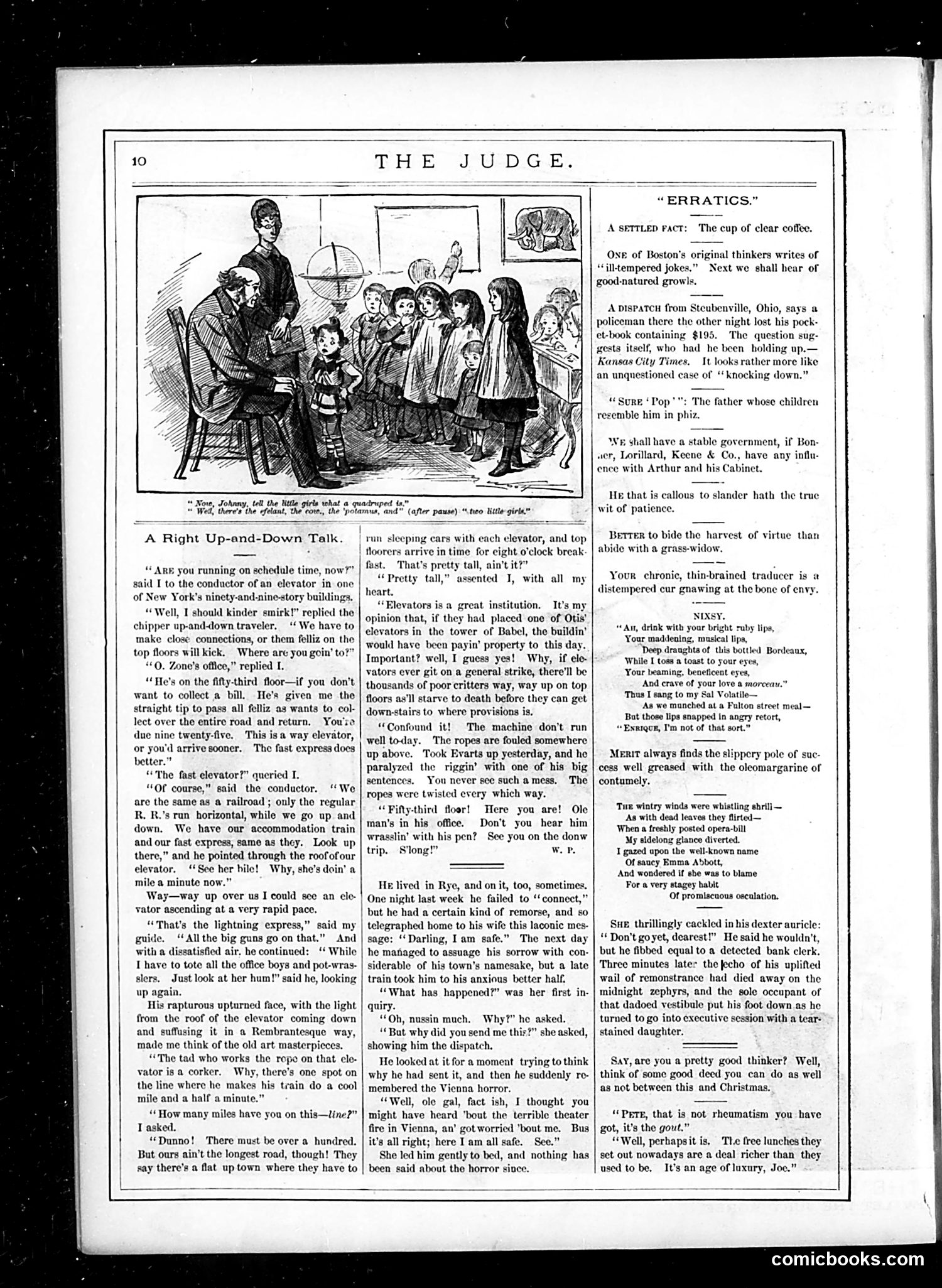
**"A Right Up-and-Down Talk"** is the main cartoon and accompanying story. It depicts an elevator conductor in a New York skyscraper humorously comparing elevator operations to railroad systems—claiming there are "accommodation" and "express" elevators, even "lightning express" cars running at "a mile and a half a minute." The satire mocks the rapid modernization of 1880s-90s New York and the grandiose claims made about new technology. The conductor's working-class dialect adds humor while subtly critiquing class divisions (poor clerks stuck in slow elevators while "big shots" zoom upward). The secondary item appears to reference a domestic incident involving a man from Rye who telegraphed his wife "Darling, I am safe"—apparently confusing some local event with a "Vienna horror" (likely a contemporary scandal). The humor lies in his muddled explanation. The page exemplifies *Judge's* focus on urban life, technology, class tension, and wordplay.
This page from **Judge** magazine contains humorous short items and satirical commentary typical of the publication, rather than political cartoons. The content includes: 1. **"Kellogg"** — A poem mocking a woman (Clara) who finally agrees to marry a wealthy man after long pursuit, with jokes about her losing her operatic career and social prominence. 2. **"Jay Charlton"** — A quip about legal disputes and landlords, using mythological reference to Jupiter's thunderbolt. 3. **Various brief satirical items** — Short jokes about contemporary figures like **Talmage** (likely the preacher T. DeWitt Talmage, referenced for refusing to debate critics), **Oscar Wilde** (mocking his aesthetic affectations), and **Madame Gerster** (a opera singer). 4. **"Goosey's Walk"** — A longer anecdote about an early morning patron ordering whisky at a restaurant bar, using "early bird" metaphors. The humor relies on wordplay, social commentary about marriage, wealth, and celebrity culture of the era, and gentle mockery of public figures. The overall tone is light satirical commentary rather than hard political critique.
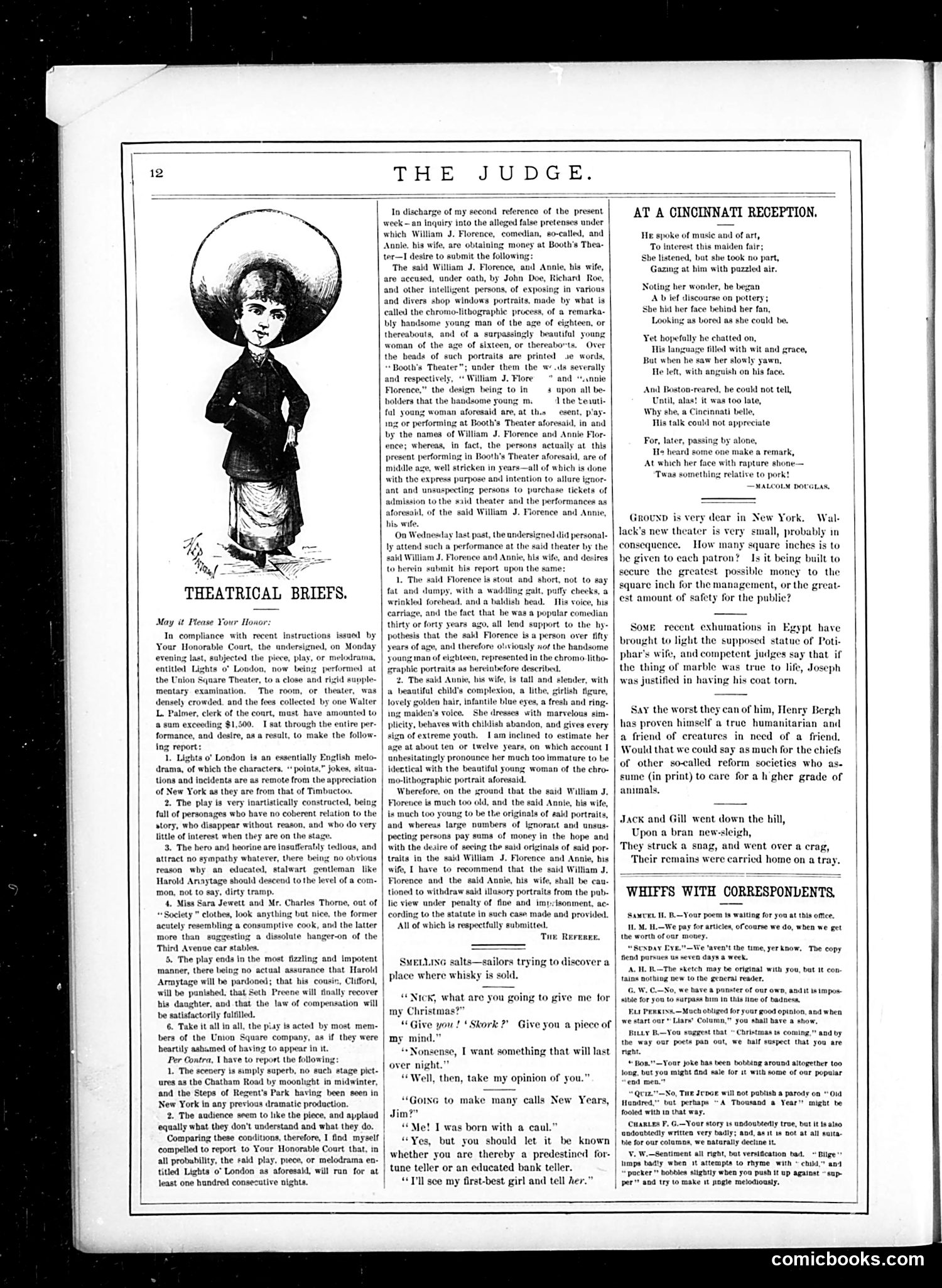
This page contains two theatrical reviews satirizing performances at New York theaters in the 1870s-80s. The main cartoon depicts a woman in period dress, likely illustrating the first review's subject: "Lights o' London," a melodrama at Union Square Theater. The reviewer mockingly praises the scenery while condemning the plot, characters, and acting—yet predicts it will run 100+ nights because audiences "like the piece" regardless of understanding it. The second review (in smaller text) humorously investigates William J. Florence and his wife Annie, accused of displaying deceptive chromolithograph portraits in shop windows. The portraits show them as beautiful young people (age 16-18), but they're actually middle-aged performers at Booth's Theater. The "investigation" format parodies official court inquiries, suggesting the Florences are fraudulently misrepresenting their youthful appearance to sell tickets. Both pieces mock theatrical deception and audience gullibility—common Judge satirical targets.
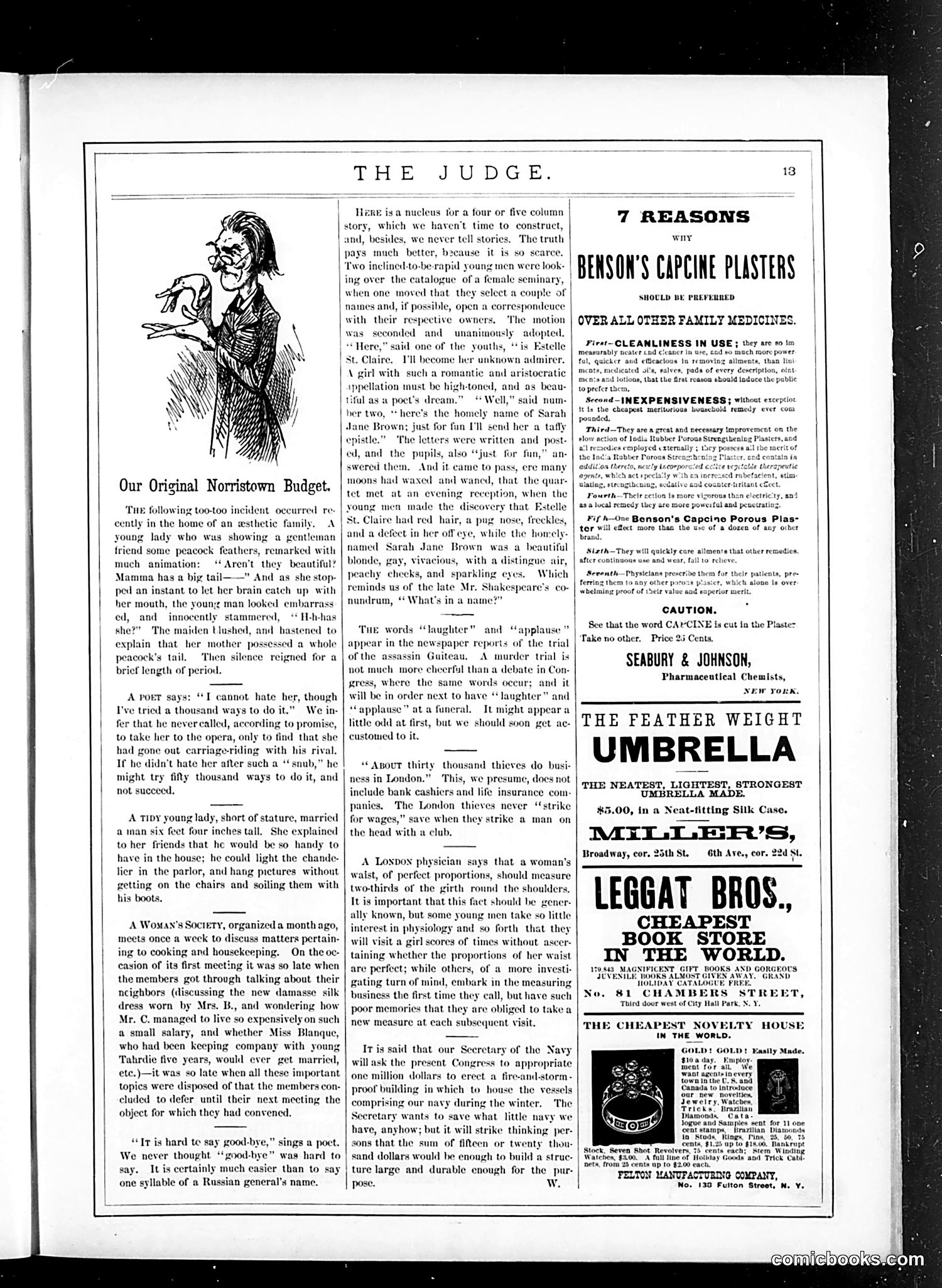
This page features **satirical anecdotes** mocking social pretension and romantic folly in what appears to be Norristown, Pennsylvania society. The main cartoon (top left) illustrates one story: a young woman awkwardly suggests her mother has "a big tail," creating embarrassment. The humor targets both feminine vanity (peacock feathers as status symbols) and verbal clumsiness. Other brief stories mock: - **Male romantic incompetence** (a man who breaks a date promise) - **Female social climbing** (a short woman dating a tall man for practical household benefits) - **Gossip-obsessed women's groups** that discuss neighbors' finances and marriage prospects instead of their stated purpose (housekeeping) The recurring joke involves **mistaken romantic expectations**: two young men write to girls based on their names alone—one assumes "Estelle St. Claire" is beautiful and refined, while his friend chooses "Sarah Jane Brown" as a joke. Reality reverses their expectations entirely. The satire targets **Victorian social pretension**, superficiality in courtship, and gossipy small-town society—universal human follies presented as characteristic of this particular community.
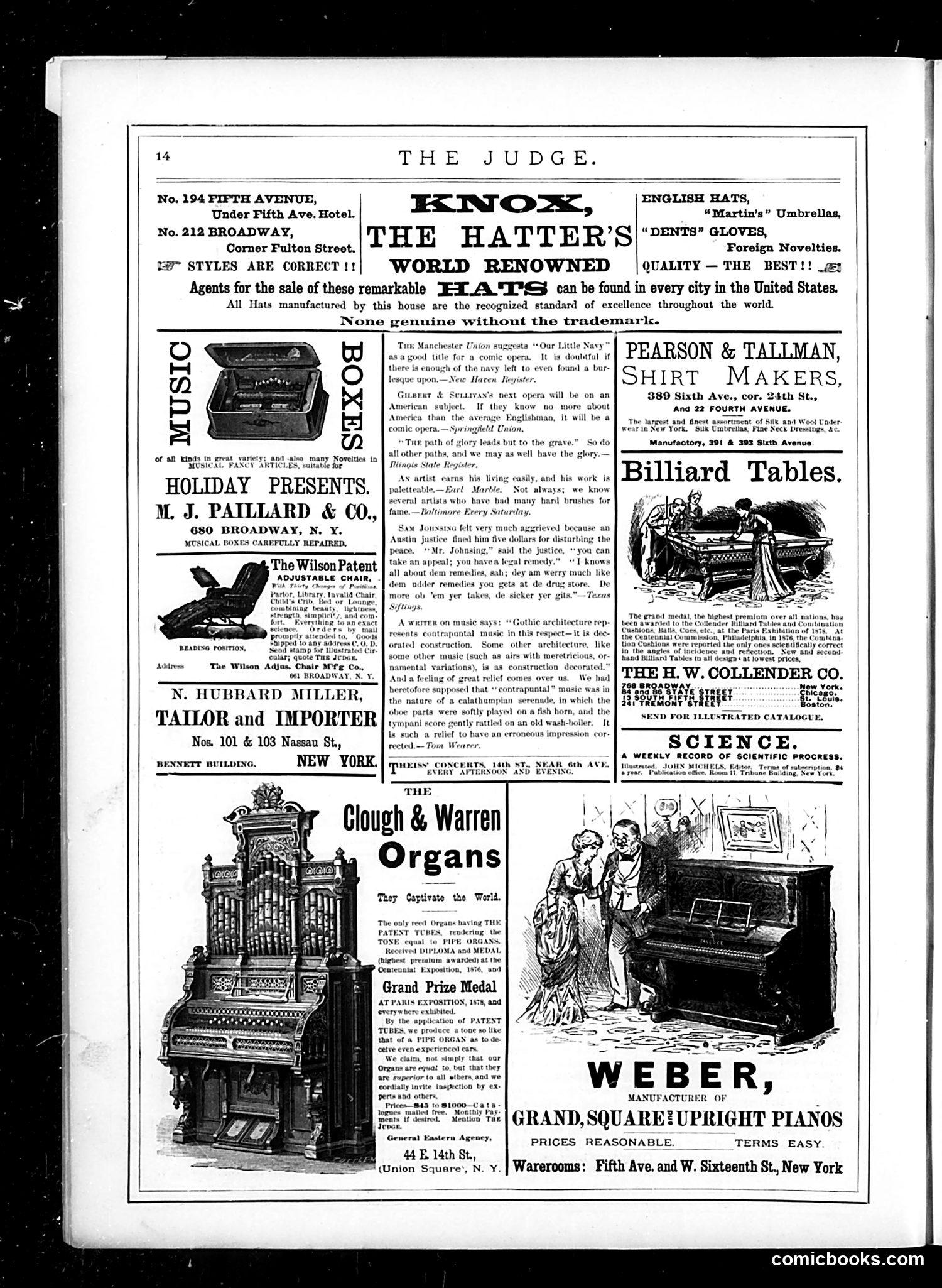
This page is predominantly **advertising**, not political satire. It showcases luxury goods and services targeting wealthy New York consumers in the late 19th century. Key advertisers include: - **Knox Hats** (Fifth Avenue/Broadway) — positioning themselves as the world standard - **Pearson & Tallman** — high-end shirt makers - **Billiard Tables** — leisure furniture for the wealthy - **Clough & Warren Organs** and **Weber Pianos** — musical instruments emphasizing quality and international prizes The only illustration with narrative content shows a **couple at a piano**, likely promoting domestic music-making as genteel entertainment. The page includes snippets of editorial commentary (on comic opera, a justice's ruling, "contraputal music") that appear to be filler between advertisements. This represents *Judge's* business model: satirical content subsidized by upscale advertisements reaching affluent readers. The page contains **no political cartoons or satire** — it's a commercial venture targeting the Victorian upper class.
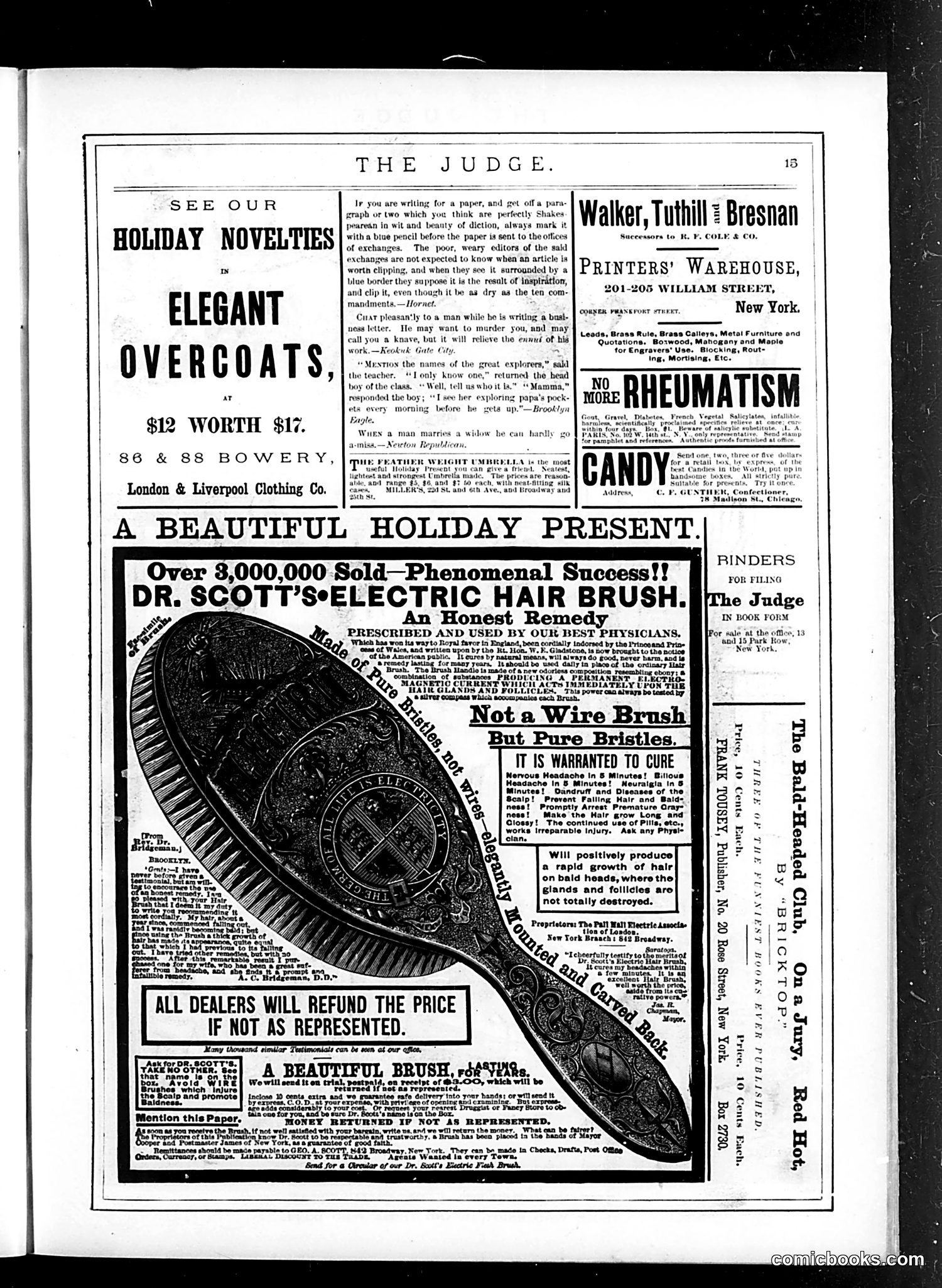
This page is **primarily advertising, not satire or political commentary**. It consists of commercial advertisements typical of late 19th-century periodicals. The dominant feature is a large advertisement for **Dr. Scott's Electric Hair Brush**—a dubious medical device claiming to cure nervous headaches, neuralgia, dandruff, hair loss, and baldness through "electricity." The ornate brush illustration and grandiose claims ("Over 3,000,000 Sold—Phenomenal Success!!") exemplify the era's patent medicine marketing, which exploited public fascination with electricity as a cure-all. Other ads include: - Elegant overcoats (London & Liverpool Clothing Co.) - Walker, Tuthill & Bresnan printers - "No More Rheumatism" remedy - Candy advertisement - Judge magazine subscription notice Small comedic text snippets appear (classroom humor about explorers, marriage jokes), but these are filler, not the page's purpose. This reflects Judge's mixed format: satirical content alongside revenue-generating advertisements targeting contemporary consumers.
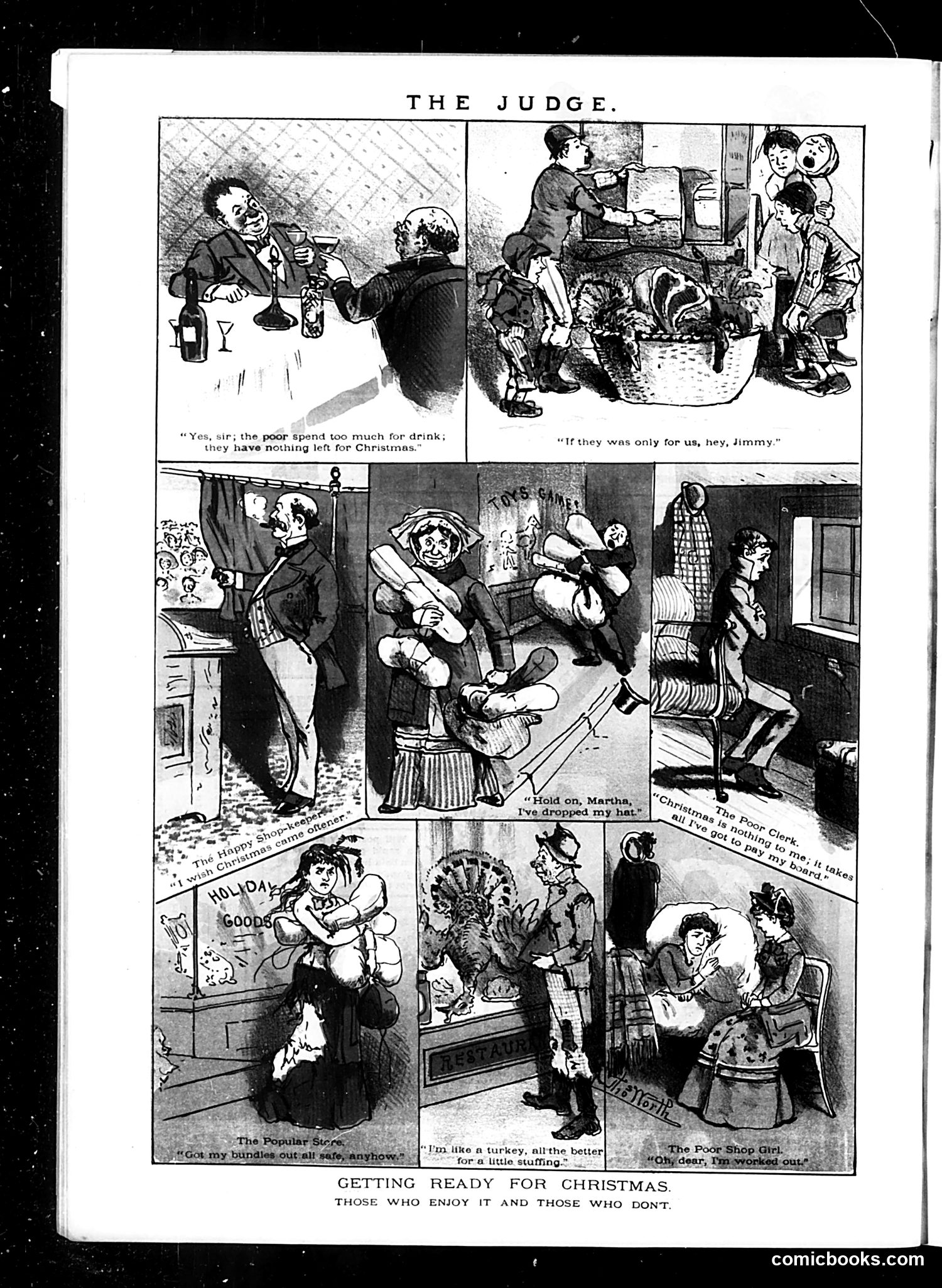
This satirical comic strip contrasts wealthy and poor preparations for Christmas. The top panel shows a well-dressed man lecturing about poor people's drinking habits, implying poverty results from moral failings rather than systemic issues. The remaining panels depict struggling working-class families—a man buying cheap holiday goods, children receiving minimal gifts, families shopping at discount stores marked "Holiday Goods"—alongside the implicit comfort of the wealthy (who enjoy Christmas). The satire critiques the hypocrisy of the affluent judging the poor's choices while ignoring structural inequality. The title "Those Who Enjoy It and Those Who Don't" underscores how Christmas celebration divided sharply along class lines in early 20th-century America, with the wealthy moralizing about poverty's causes.