
Judge, 1881-12-24 · page 2 of 16
Judge — December 24, 1881 — page 2: what you’re looking at
What you’re looking at
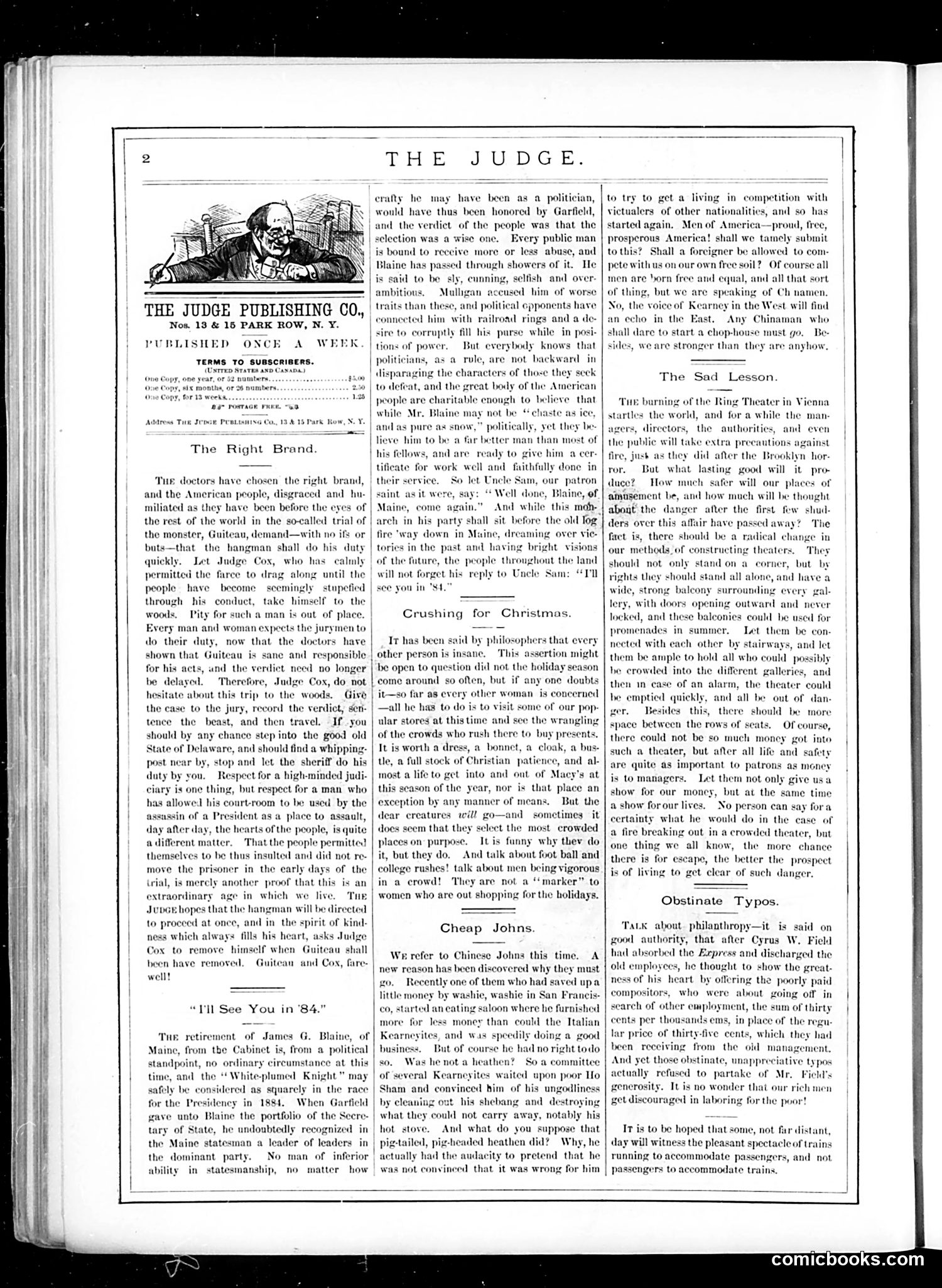
This page contains political commentary on two major 1880s controversies: **"The Right Brand"** attacks Judge Cox for mishandling the trial of Charles Guiteau, President Garfield's assassin. The article demands Cox expedite the verdict and execution, sarcastically suggesting he retreat to Delaware's whipping posts if he cannot fulfill his judicial duty. The underlying criticism: Cox's conduct has allowed the courtroom to become a political tool, compromising justice. **"'I'll See You in '84'"** discusses James G. Blaine's resignation as Secretary of State under Garfield. Though acknowledging Blaine faces accusations of corruption (railroad dealings, the "Mulligan letters"), the piece defends him as fundamentally honest and predicts his 1884 presidential run. The title references Blaine's confident response to Uncle Sam—he will return in 1884. Both pieces reflect Judge's Republican editorial stance, defending party figures while demanding accountability in separate matters.
📄 Transcribed text from this page (OCR, searchable)
Machine-transcribed from the original scan — historical spelling and the odd misread are preserved.
THE JUDGE PUBLISHING CO., Nos, 13 & 16 PARK ROW, N. Y. VUBLISHED ONC A WEEK TERMS TO SUBSCRIBERS. (Ustrep Staves axp Casaa) numbers oF, 1x months, oF 26 nu 1, TOF 13 weeks, year, 01 PORTAGE FREE. “ea 0 13.8 15 Park How, 8. ¥ The Right Brand. ‘Tur doctors have chosen the right brand, and the American people, disgraced and hu- miliated as they have been before the eyes of | the rest of the world in the so-called trial of | the monster, Guiteau, demand—with no ifs or | buts—that the hangman shall do his duty | quickly. Let Judge Cox, who has calmly permitted the faree to drag along until the people have become scemingly stupeti through his conduct, take himself to the woods. Pity for such a man is out of place. Every man and woman expects the jurymen to do their duty, now that the doctors shown that Guiteau is sane and responsible | for his s, und the verdict need no longer be delayed. Therefore, Judge Cox, do not hesitate the case to the jury, record the verdict, ser- the beast, and then travel. If you should by any chance step into the good old State of Delaware, and should find a whipping- post near by, stop and let the sheriff do his duty by you. Respect for a high-minded judi- ciary is one thing, but respect for a man who has allowed his court-room to be used by the President as a place to assault, ris of the people, is quite r. ‘That the people permitted themselves to be thus insulted and did not rn move the prisoner in the early days of the irial, is merely another proof that this i extraordinary which we live JvpGE hopes that the hangman will be dire to proceed at once, and in the spirit of kind- ness which always fills his heart, Cox to remove himself when Guiteau shall | Guitean and Cox, pout this trip to the woods, ge in been have removed. well! “Til See You in ‘84." Tue retirement of James G. Blaine, of Maine, from tbe Cabinet is, from a political standpoint, no ordinary circumstance at this time, and the “White-plumed Knight” may safe ynsidered as squarely in the ra or the Preside in 1884. When Garfield | gave unto Blaine the portfolio of the Seer tary of State, he undoubtedly recognized in the Maine statesman a leader of leaders in | the dominant party. » man of inferior in nanship, no matter how y be ability state: Give | ii crafty he may have been as a politician, would have thus been honored by Garfield, and the verdict of the people was that the selection was a ¥ Every public man is bound to receive more or less abuse, and Blaine has passed through showers of it. He is said to be sly, cunning, selfish and over. ambitic Mulligan accused him of wors traits than these, and political epponents have him with railroad rings and a d ruptly fill his purse while in posi- But everybody knows tha politici not backward. in disparaging the characters of those they seck to defeat, and the great body of the American people are charitable enough to believe that while Mr. Blaine may not be “che and as pure as snow,” politically, yet they be- lieve him to be a far better man than most of his fellows, and are ready to give him a cer- tifleate for work well and faithfully done in their service. So let Uncle Sam, our patron saint as it were, “Well done, Blaine, of Maine, come "And while this moh- arch in his party shall sit before the old log ‘way down in M aming over vie- tories in the past and having bright visions of the future, the people throughout the land will not forget his reply to Unele Sam: “1 see you in "$4." one. nine sire too tions of power, asa role, ste as ice, say ne, dr Crushing for Christmas. Ir has been said by philosophers that every other person is insane, This assertion might be open to question did not the holiday season come around so often, but if any one doubts ar as every other woman is concerned —all he has to do is to visit some of our pop ular stores at this time and see the wrang! of the crowds who rush there to. buy p It is worth a dress, a bonnet, a cli tle, a full stock of Christian patience, and al- most a life to get into and out of Macy's at this scason of the year, nor is that place an exception by any manner of means. But the dear creatures will go—and sometimes it docs seem that they select the most crowded places on: purpose. It is fanny why they do it, but they do. And talk about foot ball and college rushes! talk about men being vigorous in a crowd! They are not a “marker” to women who are out shopping for the holidays. Cheap Johns. We refer to Chinese Johns this time. A new reason has been discovered why they must Recently one of them who had saved up a little money by washie, washie in San Francis- arted an eating saloon where he furnished me r | Kearn s money than could the Italian and was speedily doing a good business. But of course he had no right todo so. Was he nota heathen? So a committee of several Kearneyites waited upon poor Ho Sham and convinced him of his ungodliness by cleaning out his shebang and destroying what they could not carry away, notably his hot And what do you suppose that pig-tailed, pig-headed heathen did? Why, he ly had the audacity to pretend that he was not convineed that it was wrong for him stove. to try to get a living in competition with tualers of other nationalities, and so has started again, Men of America—proud, free, prosperous America! shall we tamely submit tothis? Shall a forcigner be allowed to com- pete with us on our own free soil? Of course all men are Yorn free and equal, and all that sort of thing, but we are speaking of Ch namen. , the voice of Kearney in the West will find an echo in the East. Any C! whe shall dare to start a chop-hou , we are stronger than they he Sad Lesson. Tue burning of the I startle ng Theater in Vienna the world, and fe agers, di the auth the public will take extra pre fire, jusb as they did after the Brooklyn hor: ror, But what lasting good will it pro- «luce How much safer will our plices of amusement be, and how much will be thought abogt the dan fer the first few ders over this affair have passed away? fact is, there should be a radical change in our methods of constructing th They should not only stand on a corner, but by rights they should stand all alone, and have wide, strong balcony surrounding every gal- lery, with doors opening outward and never locked, anil these balconies could be uscd for promen Let them be con- nected with each other by stairways, and let them be ample to hold all who could possibly he crowded into the different galleries, and then in case of an alarm, the theater could nptied quickly, and all be out of dan- Besides this, there should be space between the rows of seats. Of course, there could not be so much money got into such a theater, but after all life and safety e quite as important to patron: is to managers. awhile the man- pctors, ities, and even wutions against ger shud- The ers, des in summer, as mone Let them not only give usa ow for our money, but at the same time a show forour lives. No person can say fora certainty what he would do in the case of a fire breaking out in a crowded theater, but one thing we all know, the more chance there is for escape, the better the prospect is of living to get clear of such danger. Obstinate Typos. Tat about. philanthropy—it is said on pod authority, that after Cyrus W. ld had absorbed the Express and discharged the old employees, he thought to show the great- ness of his heart by ollering the poorly paid compositors, who were about going off in arch of other employment, the sum of thirty ‘nts per thousands ems, in pla lar price of thirty-five cents, been receiving from the oid management, And yet those obstinate, unappreciative typos actually refused to partake of Mr. Fielt's generosity. It is no wonder that our rich men get discouraged in laborir eof the which they had for the poor! It is to be hoped that some, not far d y will witness the pleasant spectacle of trains running to accommodate passengers, and not passengers to accommodate t comicbooks.com