
Judge, 1881-12-24 · page 7 of 16
Judge — December 24, 1881 — page 7: what you’re looking at
What you’re looking at
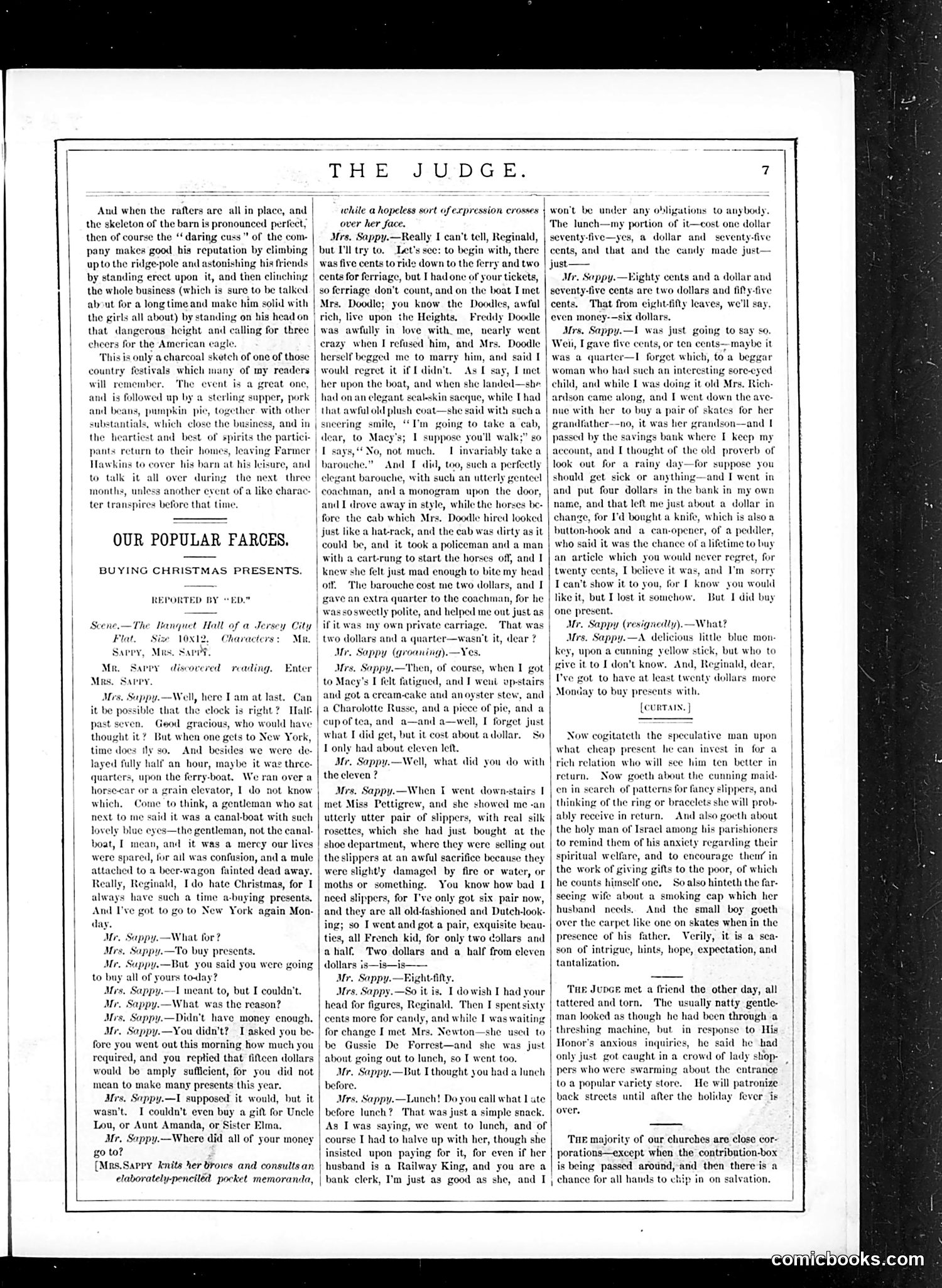
This page contains a satirical dialogue between Mr. and Mrs. Sappy about Christmas shopping. The humor targets middle-class anxieties about holiday spending and social competition. Mrs. Sappy recounts frittering away her fifteen-dollar budget on trivial expenses and status-conscious purchases. She hired an expensive carriage to outshine her wealthy acquaintance Mrs. Doodle (who arrived by cab), spent money on silk stockings and fancy slippers, and made various small impulse purchases. The satire mocks women's supposed inability to budget, their competitive social climbing, and the retail frenzy Christmas induces. The "Banquet Hall" setting is ironic—this modest domestic scene is treated as theatrical farce. The humor derives from recognizable middle-class experiences: the ferry commute, name-dropping the wealthy, and justifying endless spending through small individual purchases that mysteriously total far more than intended.
📄 Transcribed text from this page (OCR, searchable)
Machine-transcribed from the original scan — historical spelling and the odd misread are preserved.
THE JUDGE. Aud when the rafters are all in place, and the skeleton of the barn is pronounced perfect; then of course the ‘daring cuss" of the com- pany makes good his reputation by climbing upto the ridge-pole and astonishing his friends by standing erect upon it, and then clinching the whole business (which is sure to be talked. ab>ut for a longtimeand make him solid with the girls all about) by standing on his head on | that dangerous height and for the American cagl This is ouly a charcoal sketch of one of those country festivals which many of my readers will remember. ‘The event is a great one, and is followed up by a sterling supper, pork and beans, pumpkin pie, together with othe substantials, which close the business, and in the heartiest and best of spirits the partici- pants return to their homes, leaving Farmer Hawkins to cover it his leisure, and to talk it during the next three months, unless another event of a like chara ter transpires before that time, ling for three cheers all ove OUR POPULAR FARCES. BUYING CHRISTMAS PRESENTS. ene.—The Banquet Hall of a Flat. Siz 10x12. Sarry, Mrs. Sarr?. Mr. Mas. Sarpy. fersey City Characters: Mit. Sarpy discovered reading. Enter Mrs. Sappy.—Well, here Lam at last. Can it be possible that the elock is right? Malt: past seven, Geo gracious, who would have thought it? But when one gets to time And besides we were de- layed fully half an hour, maybe it wae three- quarters, upon the ferry-boat. We ran over a horse-car or a grain elevator, I do not know which. Come to think, a gentleman who sat next to me said it was a canal-boat with such lovely blue eyes—the gentleman, not the canal: boat, I mean, and it was a mercy our lives were 1, for ail was confusion, and a mule attached to a beer-wagon fainted dead away. Really, Reginald, Ido hate Christmas, for I always have such a time a-buying presents, And I've got to go to New York again Mon- day. Mr, Sappy.—What for? Ps ily so, Mrs, Sappy.—To buy presents. Mr. Sappy.—But you said you were going to buy all of yours today? Mrs. Sappy.—1 meant to, but I couldn't. Mr. Sappy.—What was the reason? Mrs. Sappy.—Didu't have money enough. Mr. Sappy.—You didn’t? I asked you be- fore you went out this morning how much you required, and you reptied that fiNeen dollars would be amply sufficient, for you did not mean to make many presents this year. Mrs. Sappy.—I supposed it would, but it wasn't. I couldn't even buy a gift for Uncle Lou, or Aunt Amanda, or Sister Elma. Mr. Sappy.—Where did all of your money go to? (Mns.Sappy knits her brows and consults an ew York, | | white a hopeless sort of expression crosses | over her face. Mrs. Sappy.—Really I can't tell, Reginald, but I'll try to. Let's see: to begin with, there | was five cents to ride down to the ferry and two | cents for ferriage, but I had one of your tickets, | | so ferriage don’t count, and on the boat I met Mrs. Doodle; you know the Doodles, awful rich, live upon the Heights, Freddy Doodle | was awfully in love with me, ucarly went | crazy when I refused him, and Mrs. Doodle herself begged me to marry him, and said I | | would regret it iff didn't. As L say, I inet | | her upon the boat, and when she landed—she had onan elegant scabskin sacque, while Thad that awfal old plush coat—she said with such a | sneering smile, “T'm going to take a cab, | | dear, to Macy's; I suppose you'll walk;” so | | 1 says,*No, not much. 1 invariably take a | barouche.” And T did, too, such a perfectly | clegant barouche, with suck an utterly genteel | coachman, anda monogram upon the door, | and I drove away in style, while the horses be- | fore the cab which Mrs. Doodle hired looked just like a hatrack, and the cab was dirty as it could be, and it took a policeman and a man | | with a cart-rung to start the horses off, and I | knew she felt just mad enough to bite my head off. ‘The barouche cost me two dollars, and I | gave an extra quarter to the coachman, for he | | wassosweetly polite, and helped me out just a | if it was ny own private carriage. ‘That was two dollars and a quarte n't it, dear ? Mr. Sappy (groaning).—Yes. Mrs. ‘Then, of course, when I got | to Macy's igued, and I went vp-stairs | and got a cream-cake and anoyster stew, and a Charolotte Russe, and a piece of pie, and a cupof tea, and a—and a—well, I forget just what I did get, but it cost about adollar, So | 1 only had about eleven left. Mr. Sappy.—Well, what did you do with the eleven ? | Mrs, Sappy.—When T went downstairs I | met Miss Pettigrew, and she showed me -an | utterly utter pair of slippers, with real silk rosettes, which she had just bought at the | shoe department, where they were selling out the slippers at an awful sacrifice because they were slightly damaged by fire or water, or moths or something. You know how bad I need slippers, for I've only got six pair now, and they are all old-fashioned and Dutch-look- ing; so I went and got a pair, exquisite beau- ties, all French kid, for only two dollars and ahalf. Two dollars and a half from eleven | dollars is—is—is—— | Mr. Sappy.—Fight-fity. | seventy-five— Mrs. Sappy.—So it is. 1 dowish I had your head for figures, Reginald. Then I spentsisty | cents more for candy, and while I was waiting | for change I met Mrs. Newton—she used to | | be Gussie De Forrest—and she was just | | about going out to lunch, so I went too, | | Mr. Sappy.—But I thought you had a luneh | before. Mrs. Sappy.—Lunch! Do you call what I ute before lunch? ‘That was just a simple snack. As Iwas saying, we went to lunch, and of course I had to halve up with her, though she | insisted upon paying for it, for even if her husband is a Railway King, and you are a won't be under any obligations to anybody. The lunch—my portion of it—cost one dollar , a dollar and seventy-five cents, and that and the candy made just— just: Mr. Sappy.—Kighty cents and a dollar and seventy-five cents are two dollars and fifty-five cents. That from eight-fily leaves, we even money-six dollar Mrs. Sappy.—1 was just going to say so. Weii, I gave tive cents, or ten cents—maybe it was a quarter—I forget which, toa beggar woman who had such an interesting sore-cyed child, and while I was doing it old Mrs. Rich- ardson came along, and I went down the ave- nue with her to buy a pair of skates for her grandfather-—no, it was her grandson—and 1 passed by the savings bauk where I keep my account, and [ thought of the old proverb of look out for a rainy day—for suppose you should get sick or anyth and I went in nd put four dollars in the bank in my own name, and that left me just about a dollar in change, for I'd bought a knife, which is alsoa button-hook and a can-opener, of a peddler, who said it was the chance of a lifetime to buy an article which you would never regret, for twenty cents, I believe it was, and I'm sorry I can’t show it to you, for I know you would like it, but I lost it somehow, But I did buy | one present. Mr. Sappy (resignedly).—What? Mrs. Sappy.—A delicious little blue mon- key, upon a cunning yellow stick, but who to ¢ it to Tdon't know, And, Reginald, dear, I've got to have at least twenty dollars more Monday to buy presents with, {curtats. j Now cogitateth the speculative man upon what cheap present he can invest in for a rich relation who will see him ten better in return, Now gocth about the cunning maid- en in search of patterns for fancy slippers, and thinking of the ring or bracelets she will prob- ably receive in return, And also gocth about the holy man of Israel among his parishioners to remind them of his any regarding their spiritual welfare, and to encourage theur in the work of giving gifts to the poor, of which he counts himself one, So also hinteth the far- seeing wife about a smoking cap which her husband needs. And the small boy goeth over the carpet like one on skates when in the presence of his father. Verily, it is a sea- son of intrigue, hints, hope, expectation, and tantalization. Tur JupGe met a friend the other day, all tattered and torn. The usually natty gentle- man looked as though he had been through a threshing machine, but in response to His Honor's anxious inquiries, he said he bad only just got caught in a crowd of lady sbop- pers who were swarming about the entrance to a popular variety store. He will patronize back streets until after the holiday fever is er. Tne majority of our churches are close cor- porations—except when the contribution-box is being passed around, and then there is a elaborately-penciléd pocket memoranda, | bank clerk, I'm just as good as she, and I, chance for all hands to ehip in on salvation, books.com