
A complete issue · 16 pages · 1881
Judge — November 26, 1881
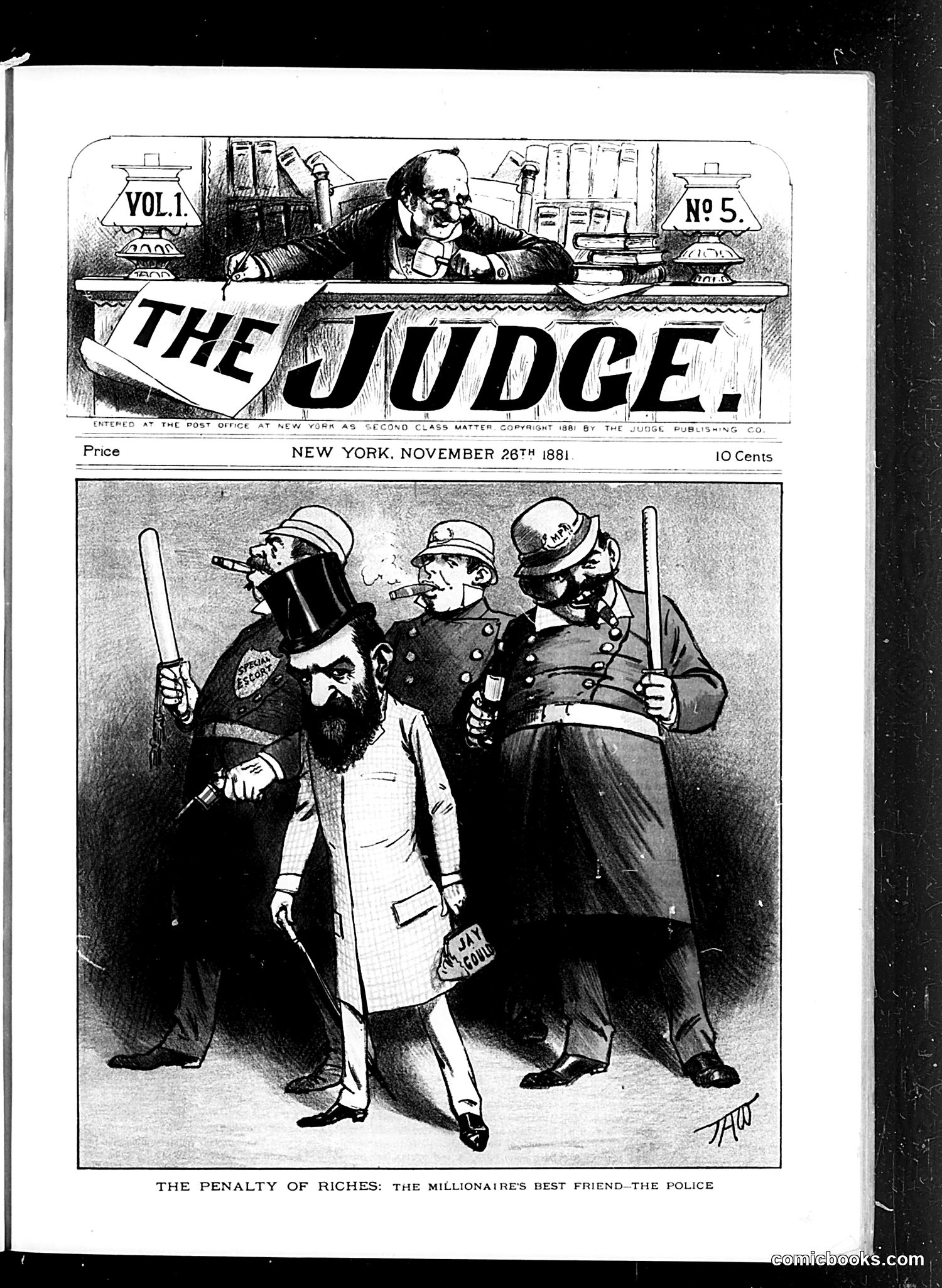
This satirical cartoon depicts police officers harassing a well-dressed man labeled "JAW BONE" (visible on his clothing). The caption reads "THE PENALTY OF RICHES: THE MILLIONAIRES BEST FRIEND—THE POLICE." The satire inverts expectations: instead of police protecting the wealthy, they're shown aggressively confronting a rich man with clubs and intimidation. This likely critiques the contradictory relationship between law enforcement and wealthy individuals in the Gilded Age—while the rich supposedly benefited from police protection of property rights, they were simultaneously targets of extortion and harassment by corrupt officers seeking bribes. The cartoon suggests that even wealth couldn't shield the affluent from police abuse during this period of widespread urban corruption in New York City.
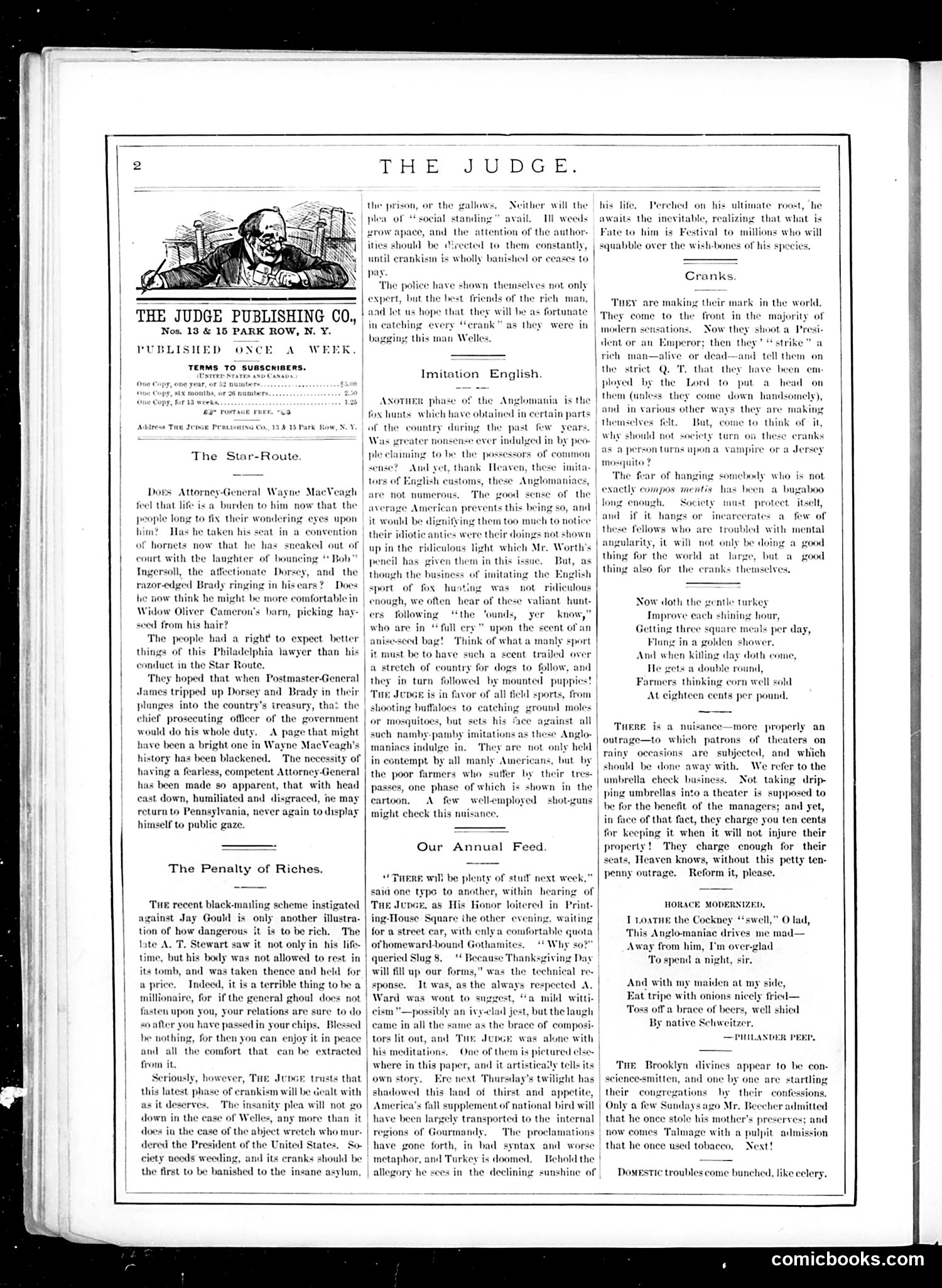
This page contains satirical commentary on contemporary American political and social issues, rather than illustrated cartoons. The main articles attack: **"The Star-Route"**: Criticizes Philadelphia lawyer and Attorney-General Wayne MacVeagh for his handling of the Star Route fraud scandal (involving postal contracts). The piece mocks his compromised performance, suggesting he's now "humiliated and disgraced." **"The Penalty of Riches"**: Comments on blackmail schemes targeting wealthy figures like Jay Gould, noting that riches create vulnerability to criminals and grave-robbers. **"Imitation English"**: Satirizes wealthy Americans' affectation of English customs, particularly fox hunting. The author mocks these pretentious "Anglomaniacs" who abandon dignified American pursuits to ape English gentry. The page appears to be from an era of significant political scandal and class satire, likely the 1880s based on references. The tone reflects Judge's consistent critique of political corruption, wealthy excess, and false gentility.
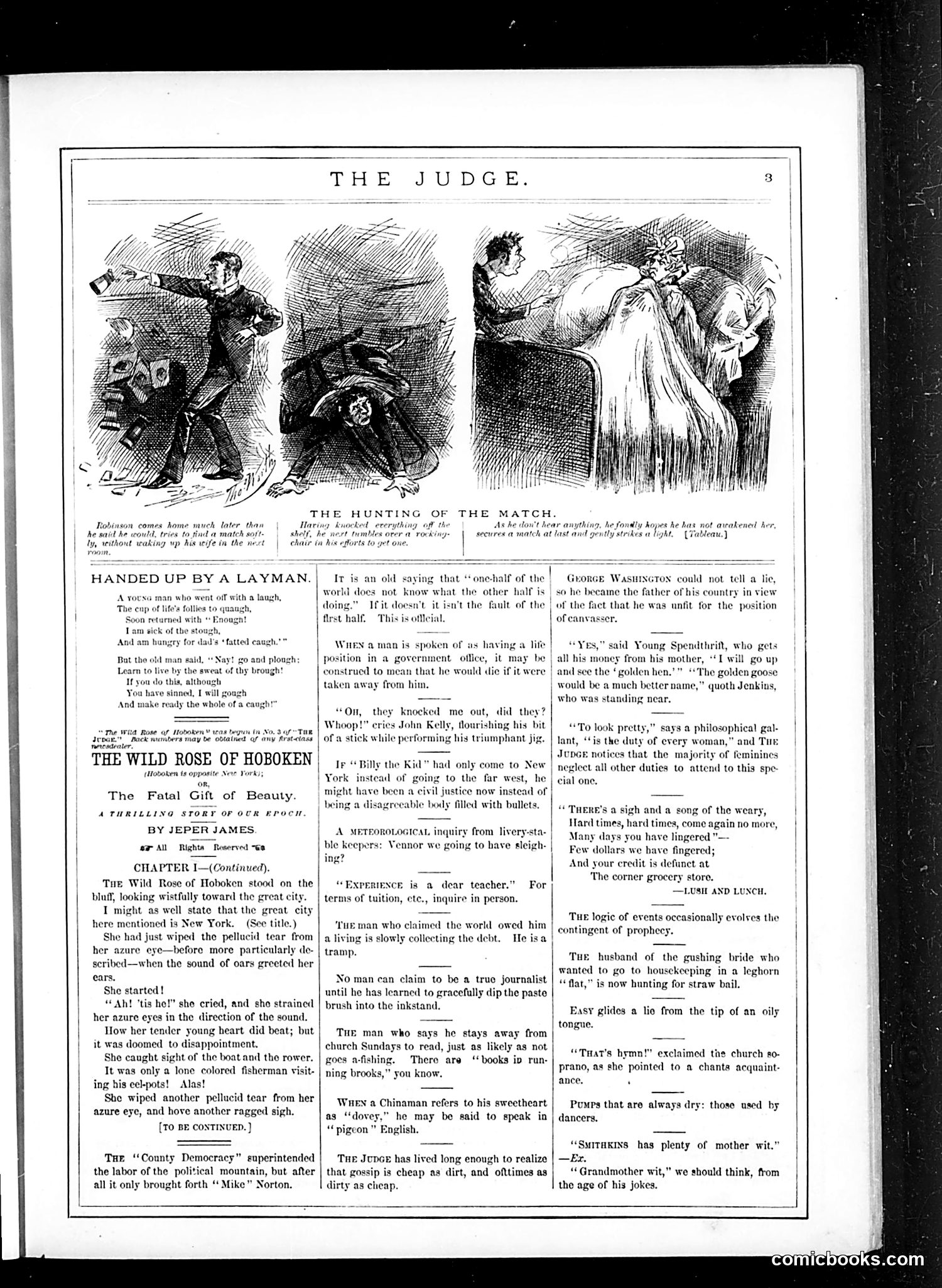
This page from *Judge* magazine contains several satirical pieces. The top cartoon "The Hunting of the Match" depicts a domestic comedy: a man sneaking home late, trying to find a match in the dark without waking his wife—the humor lies in the universally relatable marital awkwardness. Below that, "Handed Up by a Layman" is a poem mocking a young man who left home seeking life's pleasures, only to return hungry and sick, begging his father's forgiveness. The serialized story "The Wild Rose of Hoboken" parodies melodramatic penny-dreadfuls of the era, with its overwrought heroine with "azure eyes" and "pellucid tears" gazing across the Hudson toward New York City. The scattered one-liners throughout mock contemporary figures and attitudes: there's a jab at "Mike" Norton and the "County Democracy" (likely Tammany Hall politics), a reference to Billy the Kid, and typical era-specific social commentary on marriage, journalism, and gender roles. The overall tone is lighthearted social satire typical of 1880s American humor magazines.
This page contains the opening of a humorous short story for bachelor readers, "Inclined That Way" by "Bricktop." The narrative follows Tott McGudgeon, a 50-year-old workingman who has labored for the same employer, Mr. Tripper, for 25 years in apparent drudgery. The joke concerns McGudgeon's sudden romantic transformation: he's courting an heiress and plans to marry her fortune, abandoning both bachelorhood and his tedious job. Mr. Tripper expresses shock at this reversal—that an aging, perpetually gruff laborer would suddenly become romantically animated. The satire targets both working-class desperation (men viewing marriage as financial escape) and the fantasy of marrying wealth to avoid honest labor. The story plays on period anxieties about social mobility and the perceived "gold-digging" motivations of practical marriages among the poor. The humor relies on McGudgeon's transformation from invisible drudge to lovesick suitor being presented as absurdly improbable yet apparently occurring.
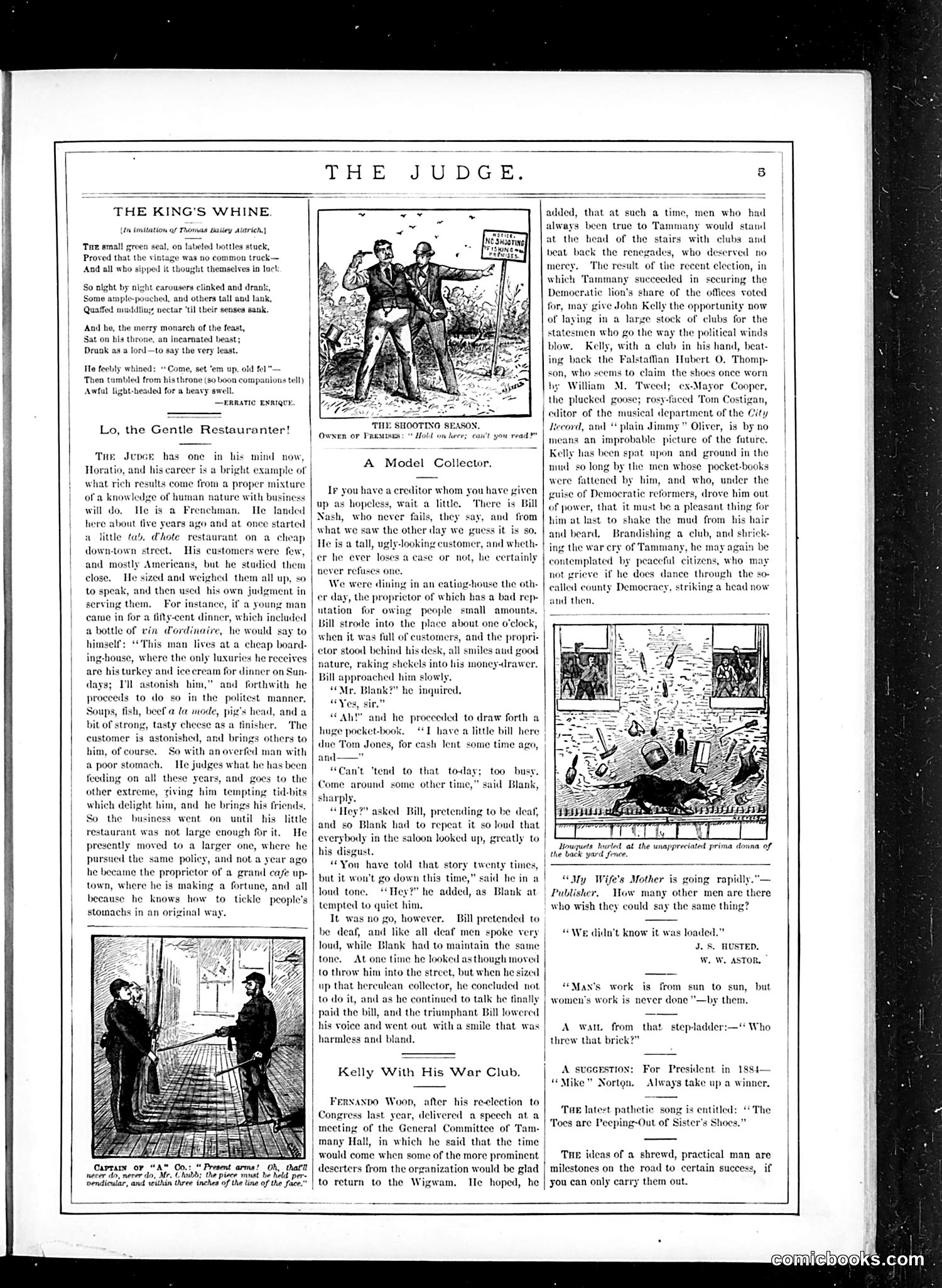
This page from *Judge* contains satirical commentary on drinking culture and debt collection. **"The King's Whine"** parodies Thomas Bailey Aldrich, depicting a drunk nobleman ("Erratic Enrique") who indulges nightly in wine and becomes increasingly pathetic—literally falling from his throne while intoxicated. The satire mocks aristocratic excess and moral degradation through alcohol. **"A Model Collector"** and **"Kelly With His War Club"** present contrasting figures: a French restaurateur who succeeds through understanding human nature, and "Bill," an aggressive debt collector who uses public shaming and deafness-feigning tactics to humiliate debtors into payment. The "war club" metaphor suggests Bill's intimidating collection methods. The cartoons satirize Gilded Age social behavior—aristocratic decadence, commercial ruthlessness, and the vulnerability of those in debt. The illustrations show the physical comedy of drunkenness and the social degradation of public debt confrontation, reflecting period anxieties about class, morality, and financial power dynamics.
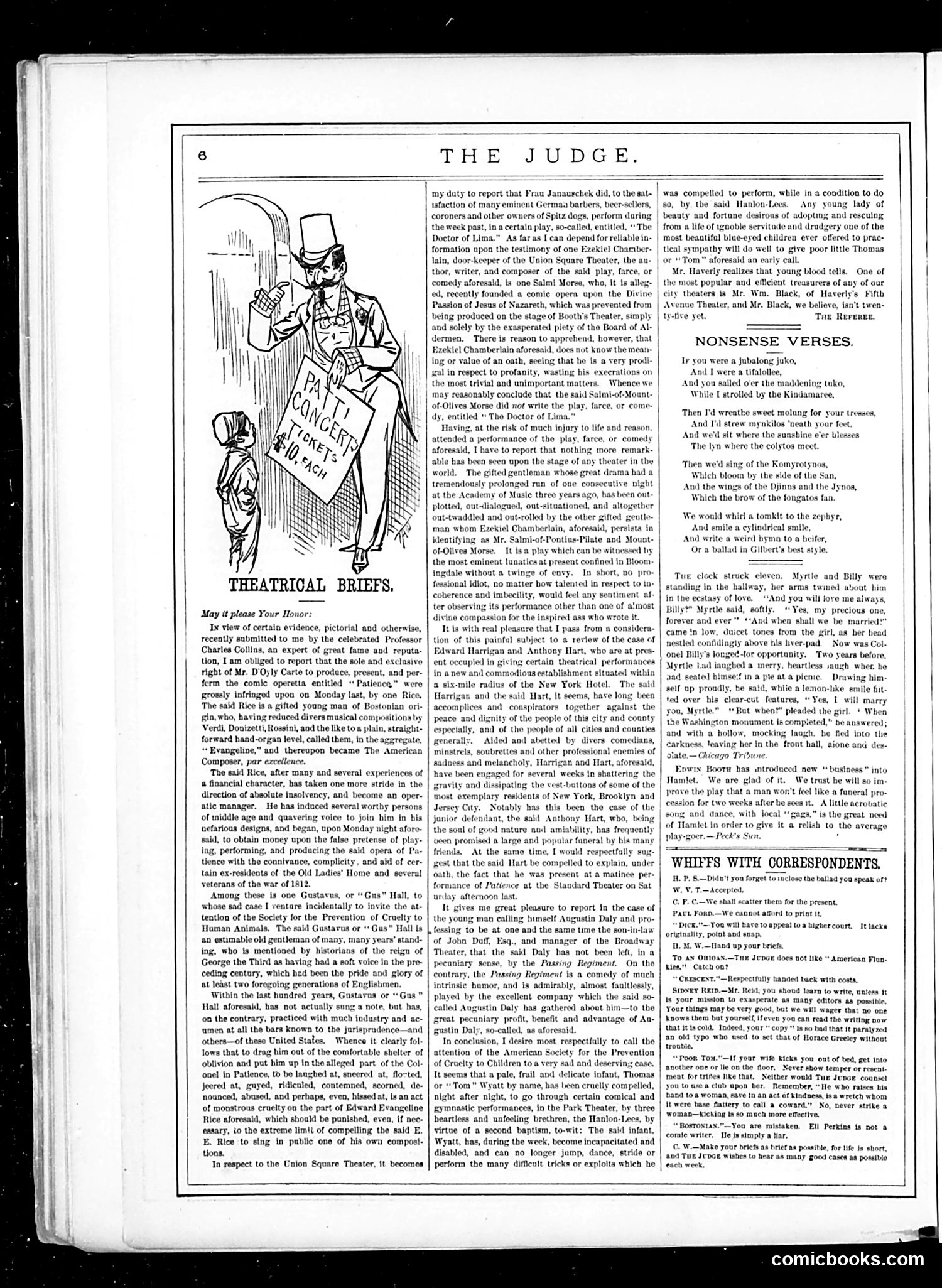
This is a mock legal "report" satirizing recent theatrical productions. Judge magazine's critic pretends to be a judge issuing formal complaints about three shows: 1. **E.E. Rice's "Evangeline"** — Rice, a Boston composer who previously adapted Italian operas into hand-organ music, is now producing opera. The joke mocks his financial failures and the absurdity of casting elderly, out-of-practice singers (like the aged "Gus" Hall, who hasn't sung in decades but frequented bars instead) in serious roles. 2. **"Patience"** — Rice allegedly infringed D'Oyly Carte's copyright on this Gilbert & Sullivan comic operetta. 3. **"The Doctor of Lima"** — Written by Salmi Morse, who previously attempted a sacrilegious opera about Jesus's Passion (blocked by NYC's Board of Aldermen), now presents this play. The satire ridicules both Rice's artistic pretensions and the aging performers pressed into service. The mock-judicial tone amplifies the absurdity.
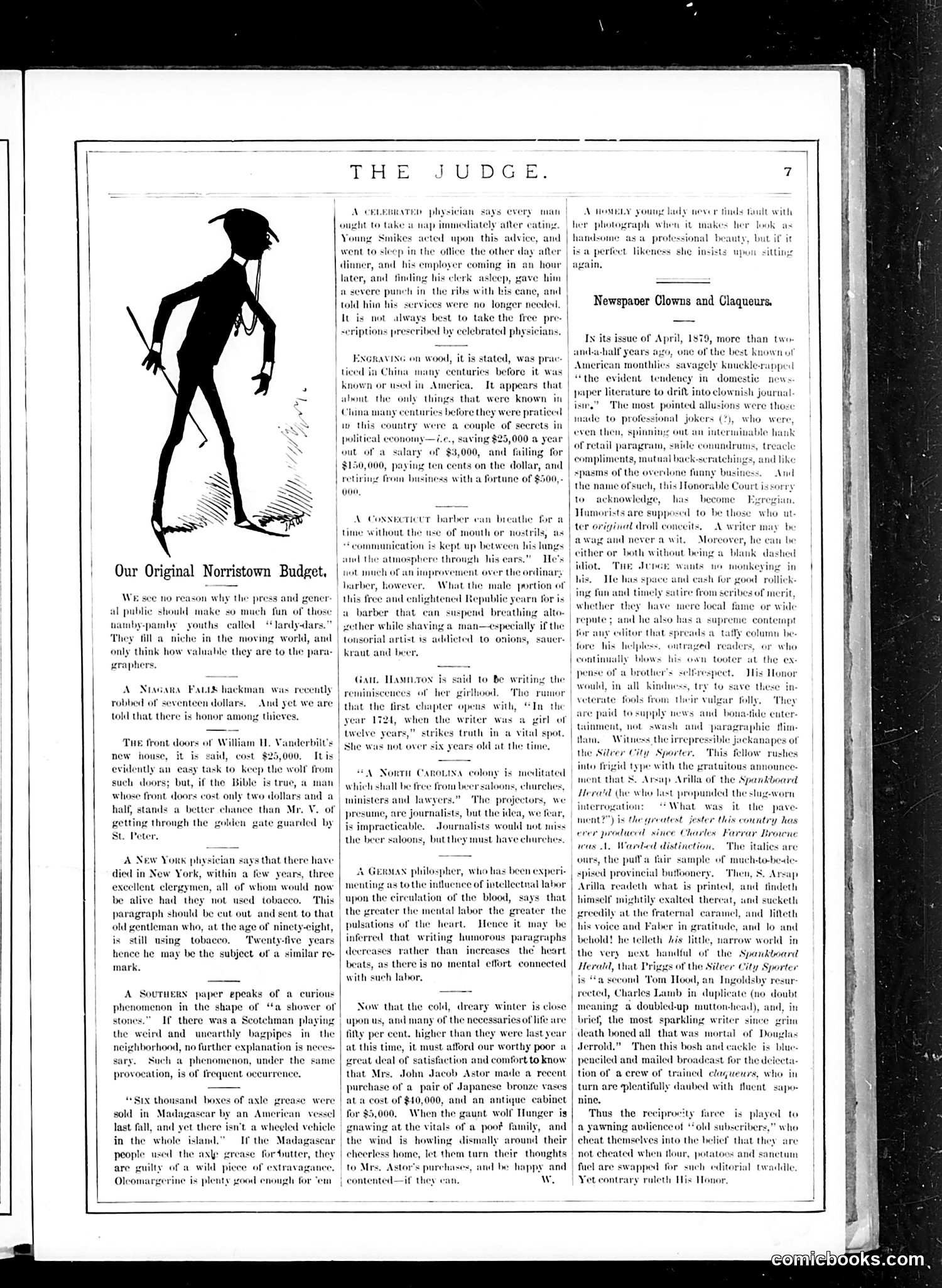
This page from *Judge* magazine contains several short satirical pieces mocking American life and journalism. **"Our Original Norristown Budget"** ridicules vapid young men called "lardy-lars" (likely "lardy-darts"—dandy types) as worthless parasites, while praising their usefulness to gossip columnists. **"Newspaper Clowns and Claqueurs"** (referencing an April 1879 article) attacks professional humor writers who dominate newspaper columns with cheap jokes, worn-out puns, and self-promotional backscratching rather than original wit. The piece argues true humorists create original ideas, not recycled material. The cartoonist's caricature appears to depict one such hack comedian—a thin, exaggerated figure representing these derivative "professional jokers." Other brief items mock absurdities: a physician's sleep-after-eating advice, improbable claims about Connecticut barbers, and the extreme wealth of figures like Vanderbilt. The satire targets both society's pretenders and the press's role in amplifying mediocrity.
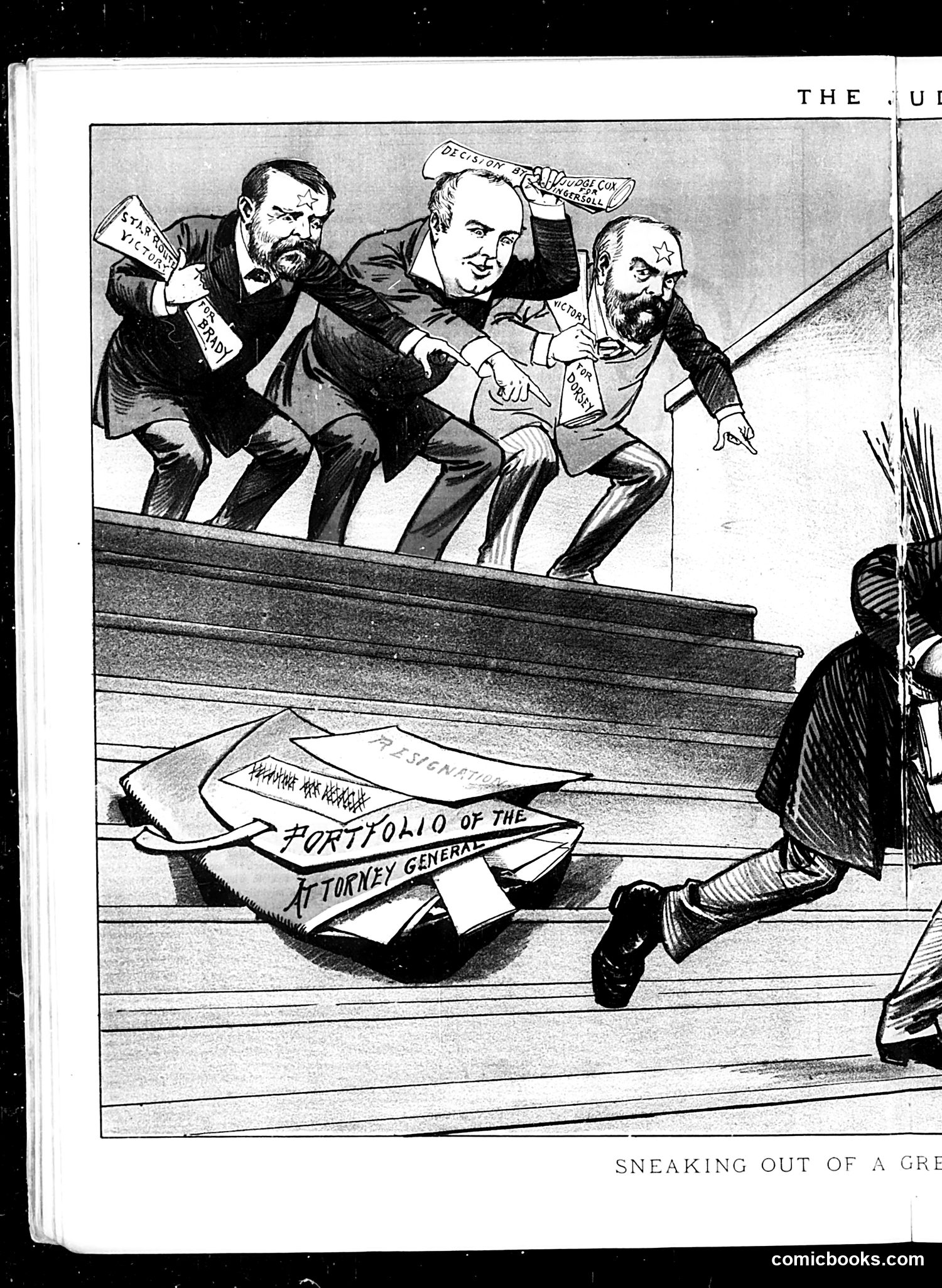
This appears to be a Judge magazine political cartoon titled "Sneaking Out of a Gre[at]" (title cut off). The image shows three men in formal attire sneaking away from steps, carrying documents labeled "Portfolio of the Attorney General" and what appears to be official papers marked "Resignation." The cartoon satirizes political figures attempting to quietly leave office or avoid accountability, likely referencing a scandal involving the Attorney General's office. The men's exaggerated facial expressions and body language suggest illicit activity—they're depicted as "sneaking" rather than departing openly. Without visible dates or clearer identification, the specific historical moment remains unclear, but the satire targets governmental corruption or impropriety, a recurring Judge magazine theme during the Progressive Era.
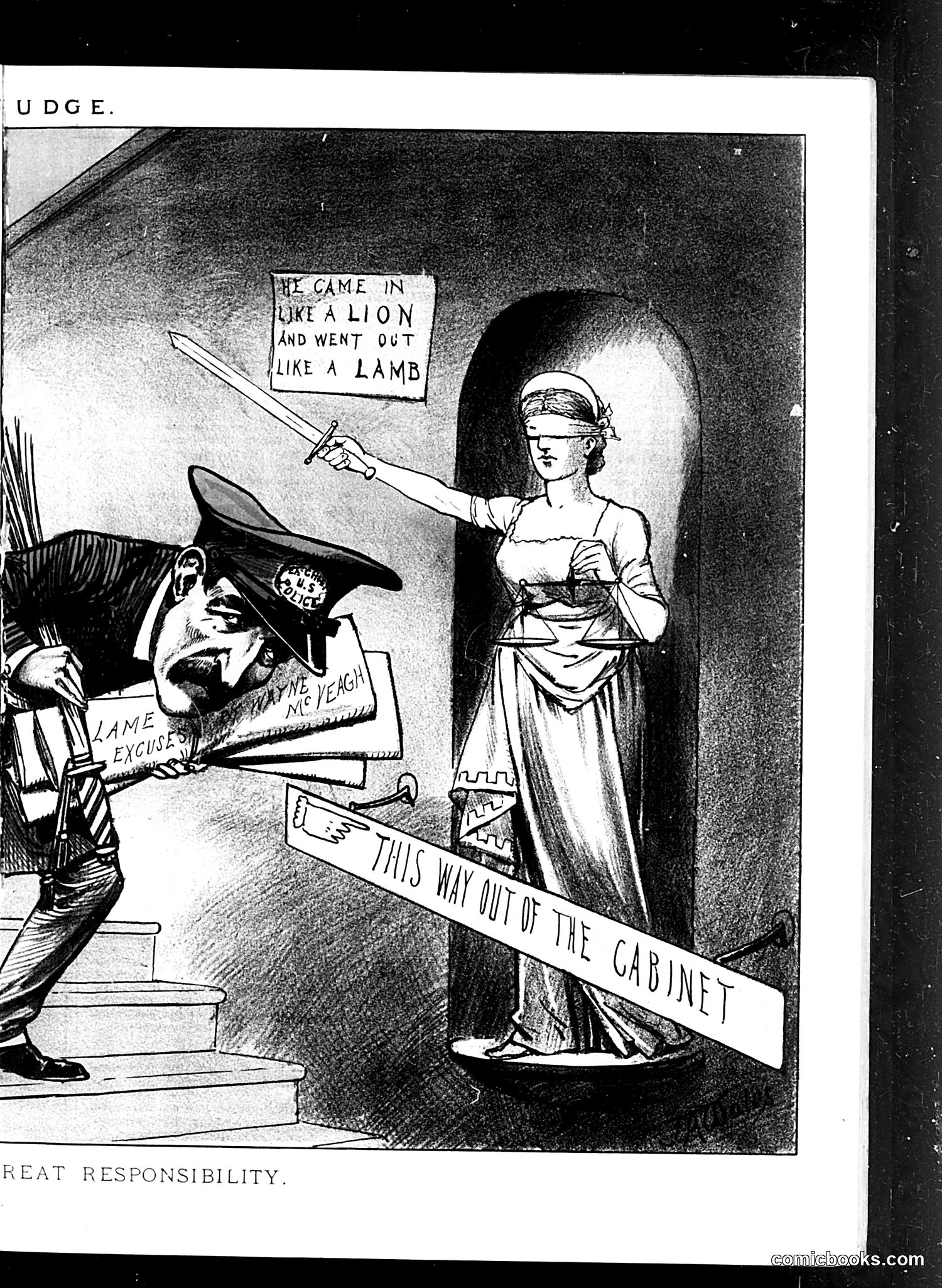
This Judge cartoon satirizes a political figure (likely a president or cabinet member) using the phrase "came in like a lion and went out like a lamb"—meaning someone who entered office aggressively but departed weakly or ineffectually. On the left, a military or political figure with a fierce expression holds a sword and papers labeled "LAME EXCUSE ME YEAH." On the right, a female allegorical figure (likely representing Justice, Democracy, or the Nation) points a sword at him, with a sign reading "THIS WAY OUT OF THE CABINET." The cartoon criticizes the figure for failing to live up to initial bold promises or aggressive policies, ultimately leaving office in diminished circumstance. The "Great Responsibility" caption suggests ironic commentary on unfulfilled duties.
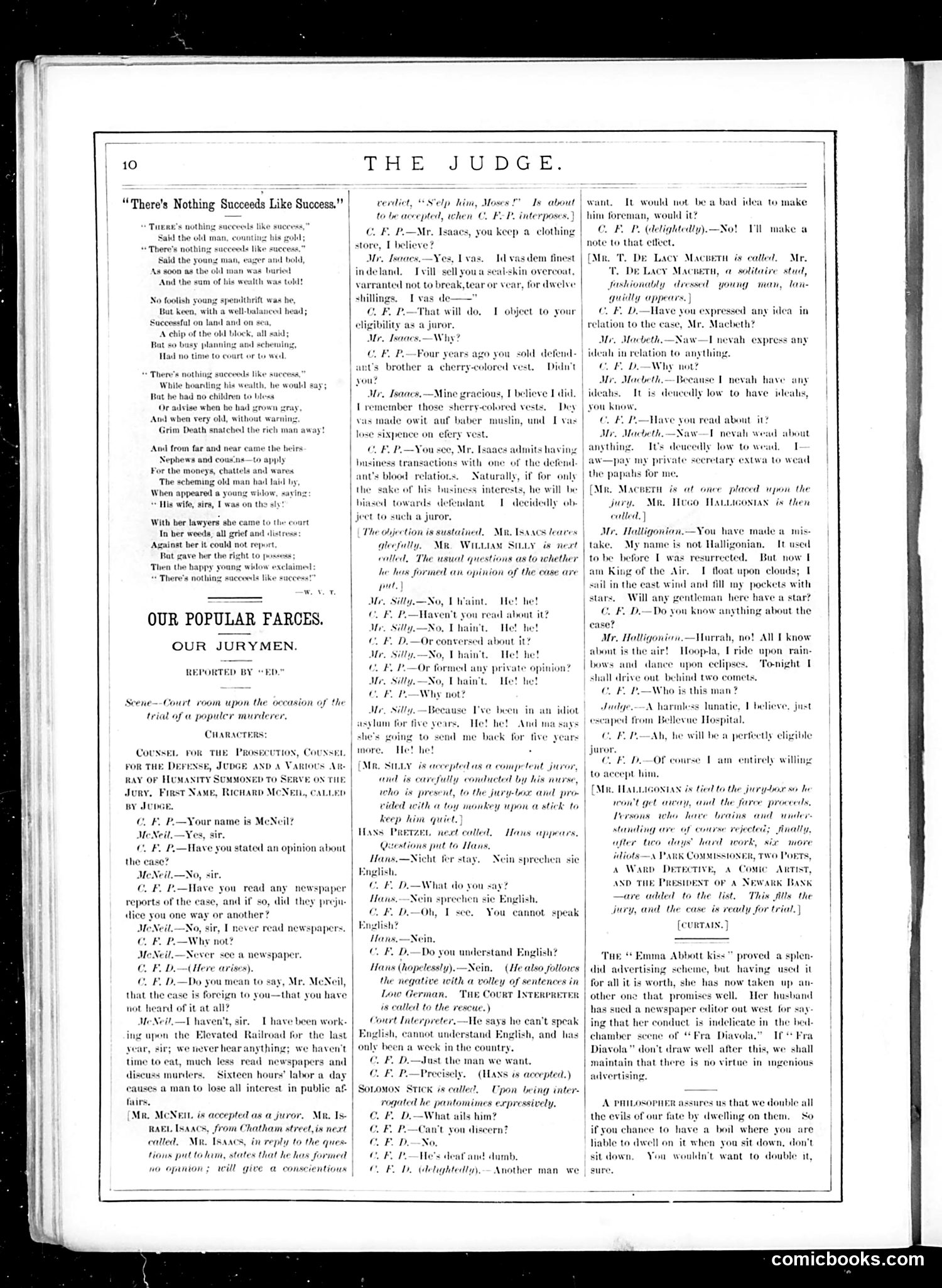
This satirical article mocks the jury selection process through comedic courtroom dialogue. The sketch depicts a murder trial where the judge and prosecution counsel struggle to find impartial jurors. **The satire targets:** - **Unqualified jurors**: The candidates are comically unsuitable—McNeil works 16-hour days and never reads newspapers; Isaacs has a financial relationship with the defendant; Silly spent five years in an asylum; Hans speaks only German; Solomon Stick is a deaf-mute. - **Jury selection standards**: The piece ridicules how minimal the actual vetting is. Despite obvious disqualifications, several are accepted as jurors anyway. - **American legal system**: By showing absurd jury composition, Judge satirizes the fundamental weakness of depending on random citizens for justice in serious criminal cases. The humor lies in the desperation to fill jury seats with manifestly unfit people, suggesting the system prioritizes speed over competence.
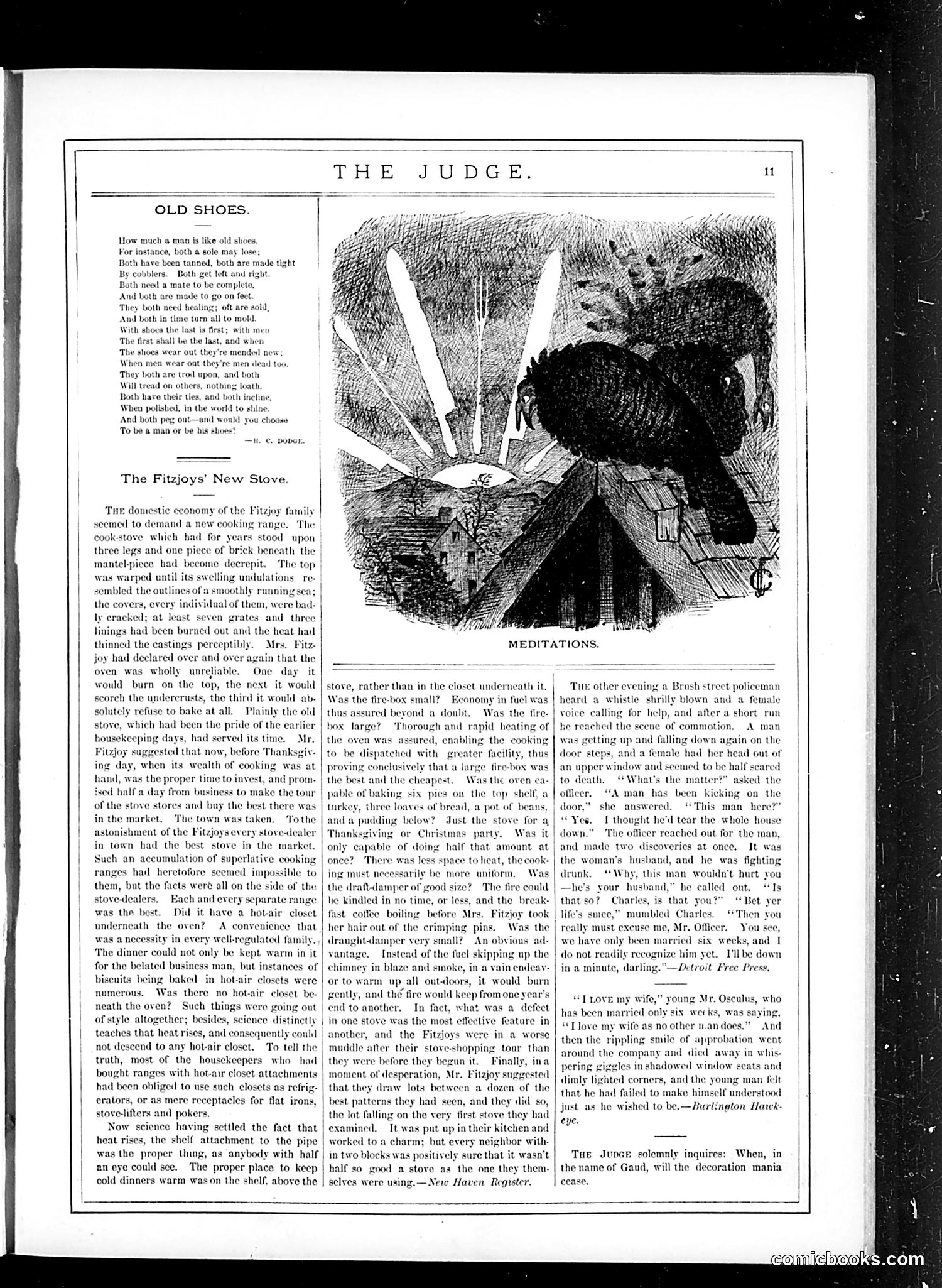
This page contains two unrelated pieces from *Judge* magazine: **"Old Shoes"** is a humorous poem comparing men to worn-out shoes—both need mates, both get "tanned," both eventually deteriorate and "turn all to mold." The joke is a cynical meditation on human mortality and similarity to inanimate objects. **"The Fitzjoys' New Stove"** is a satirical story mocking consumer marketing tactics. The Fitzjoys need a new cooking stove, and visit multiple dealers who each claim to sell "the best stove in the market." The satire exposes how salesmen use contradictory pseudo-scientific arguments to justify their products—some praise hot-air closets as essential, others claim science proves they're outdated. The piece ridicules how consumers are manipulated by confident merchants spouting opposing "facts" to justify inflated prices. The cartoon illustration labeled "Meditations" shows a figure gazing at sunrise, accompanying unrelated anecdotes about a policeman and a newly-married couple.
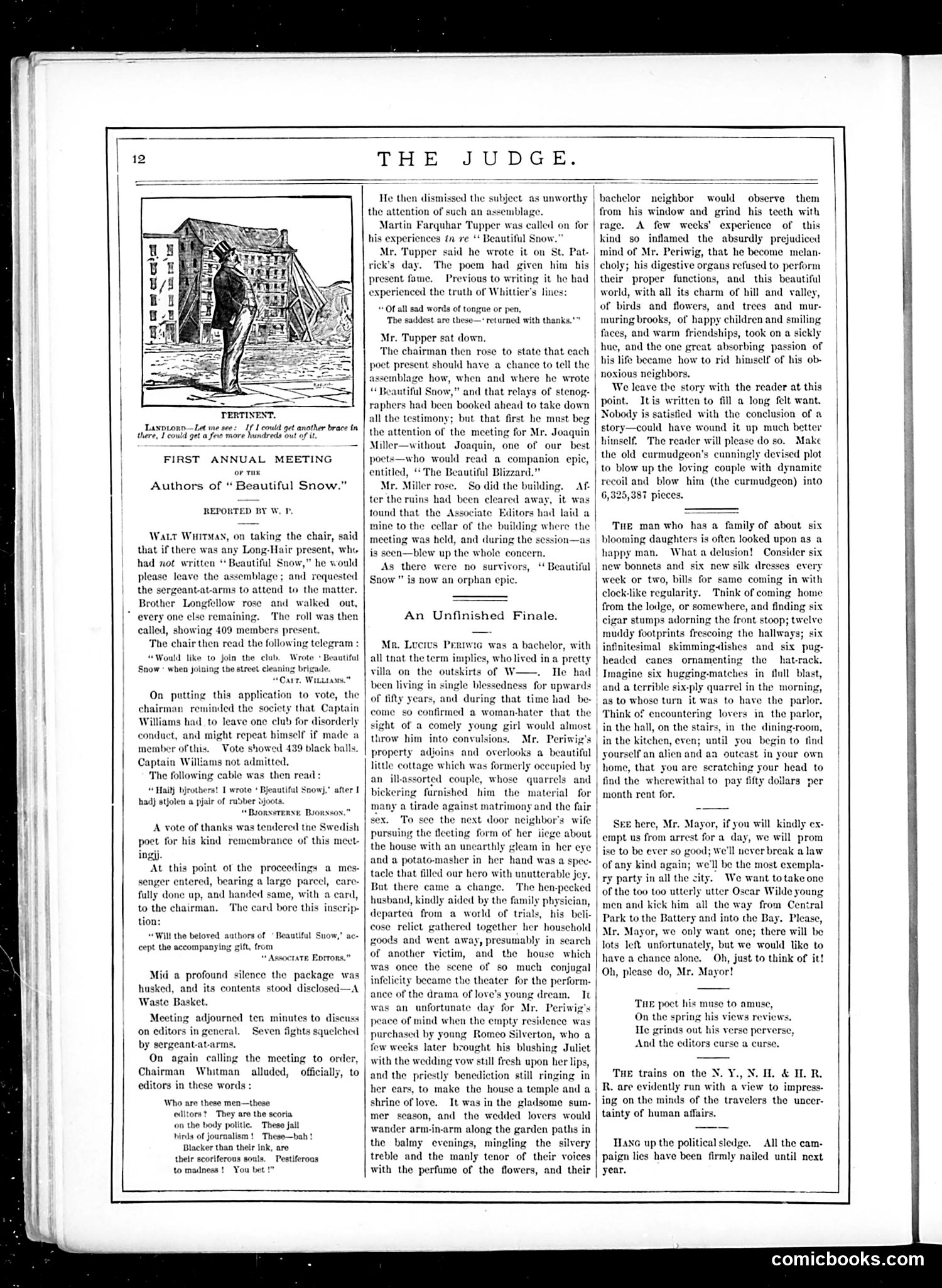
This page satirizes the literary phenomenon of "Beautiful Snow," a sentimental Victorian poem that became so ubiquitously reprinted and plagiarized that numerous authors claimed authorship. The main cartoon depicts a meeting of these supposed "authors," with Chair Walt Whitman dismissing anyone who *hasn't* written it—a joke highlighting the poem's absurd over-attribution. The absurdity escalates when the "Associate Editors" (represented by editors of *Judge* itself) send a waste basket as a "gift," mocking both the poem's quality and literary pretension. The satire culminates with building destruction when Editors literally blow up the meeting venue, suggesting the poem and its endless disputes deserve obliteration. The sidebar about Mr. Periwic introduces an unrelated sentimental narrative—likely parodying the *same* melodramatic style that made "Beautiful Snow" popular—reinforcing *Judge's* mockery of overwrought Victorian sentimentality and literary mediocrity.
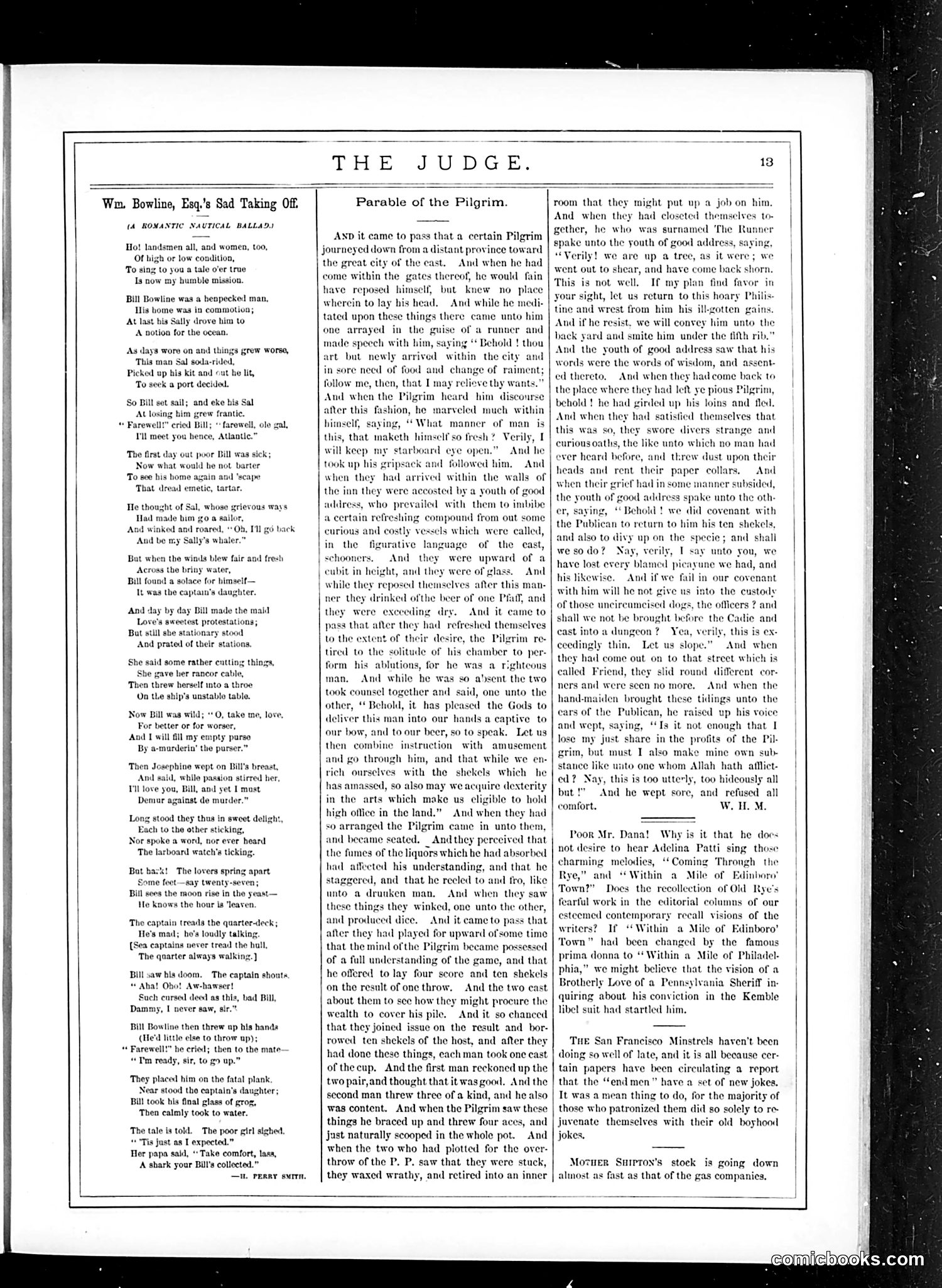
This page from *Judge* contains two satirical pieces: **"Wm. Bowline, Esq.'s Sad Taking Off"** is a humorous nautical ballad mocking Victorian melodrama. A henpecked husband escapes his nagging wife "Sal" by joining a ship's crew, where he romances the captain's daughter Josephine. When discovered, he's executed by walking the plank—a darkly comic commentary on how men sometimes fled domestic unhappiness, and how Victorian literature dramatized maritime life. **"Parable of the Pilgrim"** is a satirical con-artist story mimicking biblical language. A naive traveler arriving in a city encounters a smooth-talking runner offering assistance. The runner leads him to an inn where they're pressured to buy expensive drinks ("schooners") from deceptive proprietors. It's a straightforward critique of urban confidence schemes and hospitality industry fraud—likely reflecting real contemporary tourist exploitation in American cities. Both pieces use exaggeration and familiar literary styles to mock human folly and social problems of the era.
This page is primarily **advertising** with minimal editorial content. The layout shows typical late 19th-century magazine advertisements for commercial products: Knox hats, Benson's Capcine Plasters (a medical remedy), Horseford's Baking Powder, Weber pianos, and books published by Frank Tousey. Interspersed are brief humorous anecdotes—brief joke columns common to *Judge* magazine. One anecdote references "Mrs. Jones" borrowing a bonnet; another discusses fixing castor oil. These are mild domestic humor pieces rather than political satire. **There is no identifiable political cartoon on this page.** The single illustration shows two figures in period dress beside a tree—likely decorative accompaniment to book advertisements rather than editorial commentary. The page represents *Judge's* business model: satirical magazine content subsidized by commercial advertising. Without clearer political or social messaging visible, this appears to be a standard advertising/filler page rather than the magazine's satirical core.
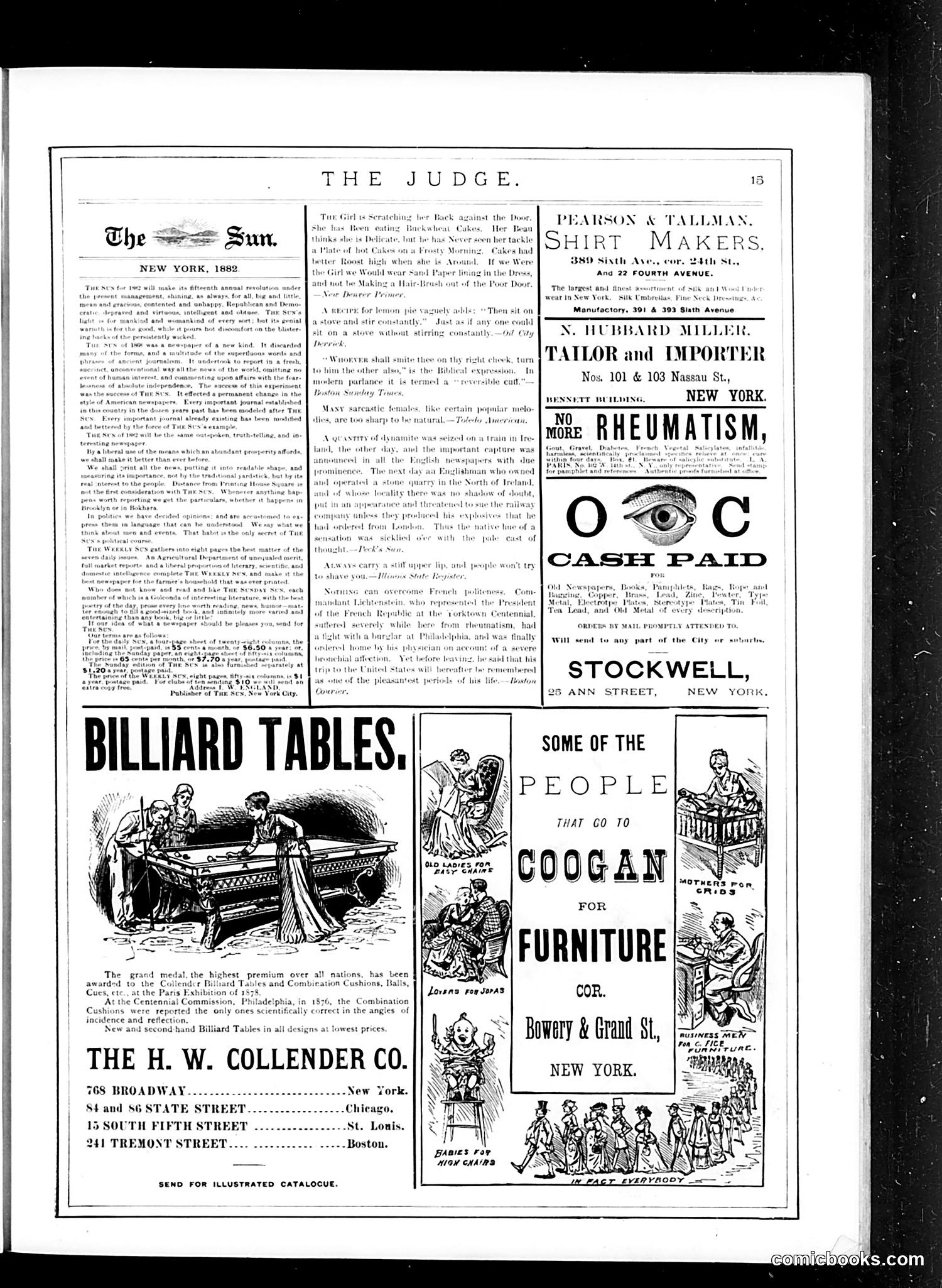
This page is primarily **advertising**, not satirical content. It showcases commercial advertisements for 1880s New York businesses: shirt makers, tailors, billiard table manufacturers, and furniture retailers. The only illustrated content is a section titled "Some of the People That Go to Coogan for Furniture" (Bowery & Grand Street). The sketches depict various social types visiting the furniture store—mothers with children, families, working-class people—rendered in period caricature style. This appears to be **populist advertising humor**: the joke is that furniture shopping attracts "everybody," from different social classes and walks of life, suggesting Coogan's broad customer appeal. The page otherwise contains typical period advertisements with Victorian-style typography and decorative illustrations, representing everyday commercial life in Gilded Age New York rather than political or social satire.
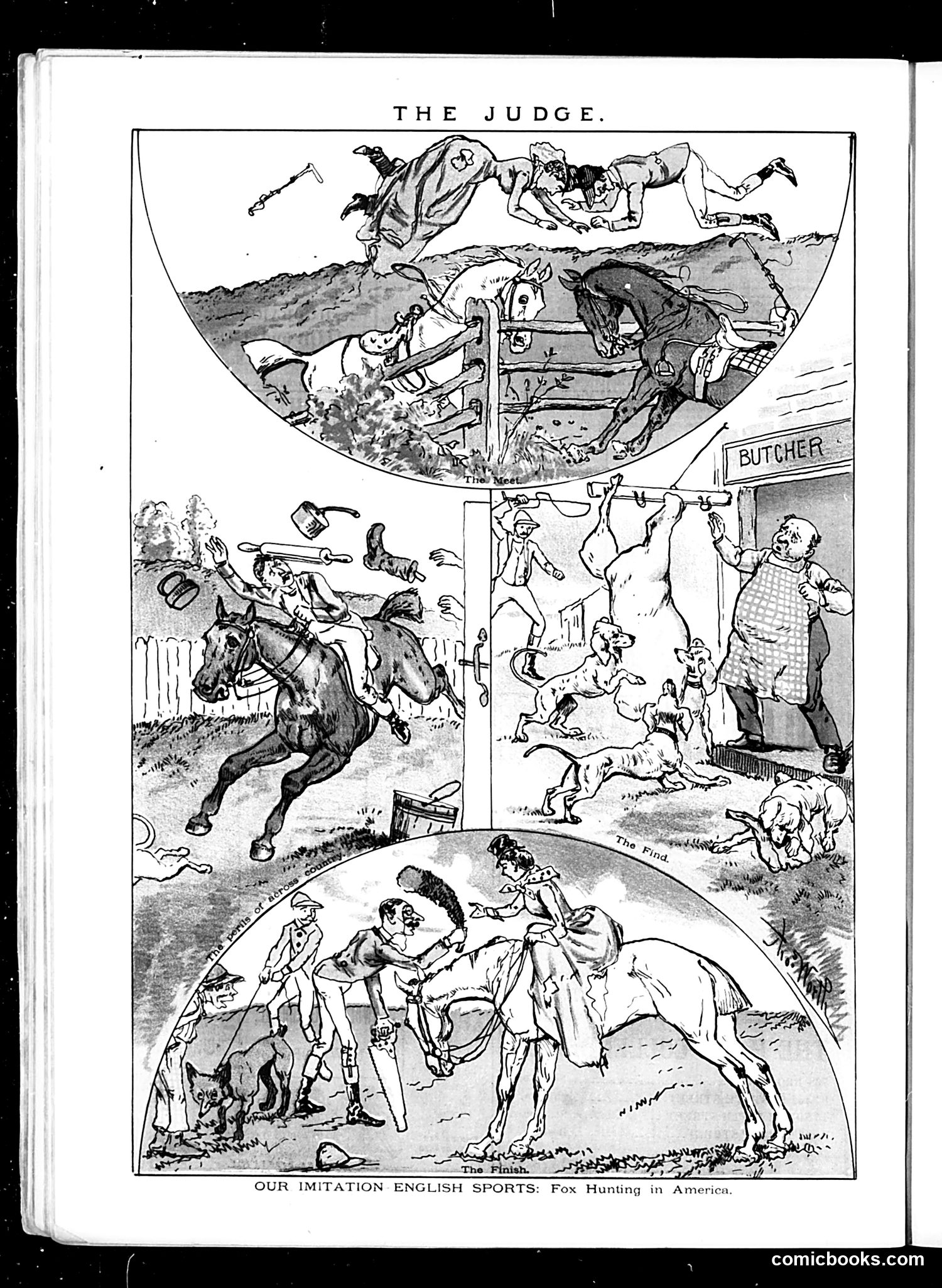
This cartoon satirizes Americans' attempt to imitate English fox hunting traditions. The page shows three sequential scenes labeled "The Meet," "The Find," and "The Finish," depicting an increasingly chaotic American version of the refined English sport. The satire progresses from organized hunters gathering, to them chasing what appears to be a butcher's carcass (labeled "BUTCHER"), to complete pandemonium with dogs, riders, and spectators in disarray. The joke mocks American social pretension—wealthy Americans awkwardly copying English aristocratic customs—while suggesting Americans lack the discipline or decorum for such refined pursuits. The exaggerated chaos and crude substitution (using butcher meat instead of actual foxes) emphasizes the fundamental incompatibility between American culture and English upper-class traditions.