
A complete issue · 16 pages · 1881
Judge — November 19, 1881
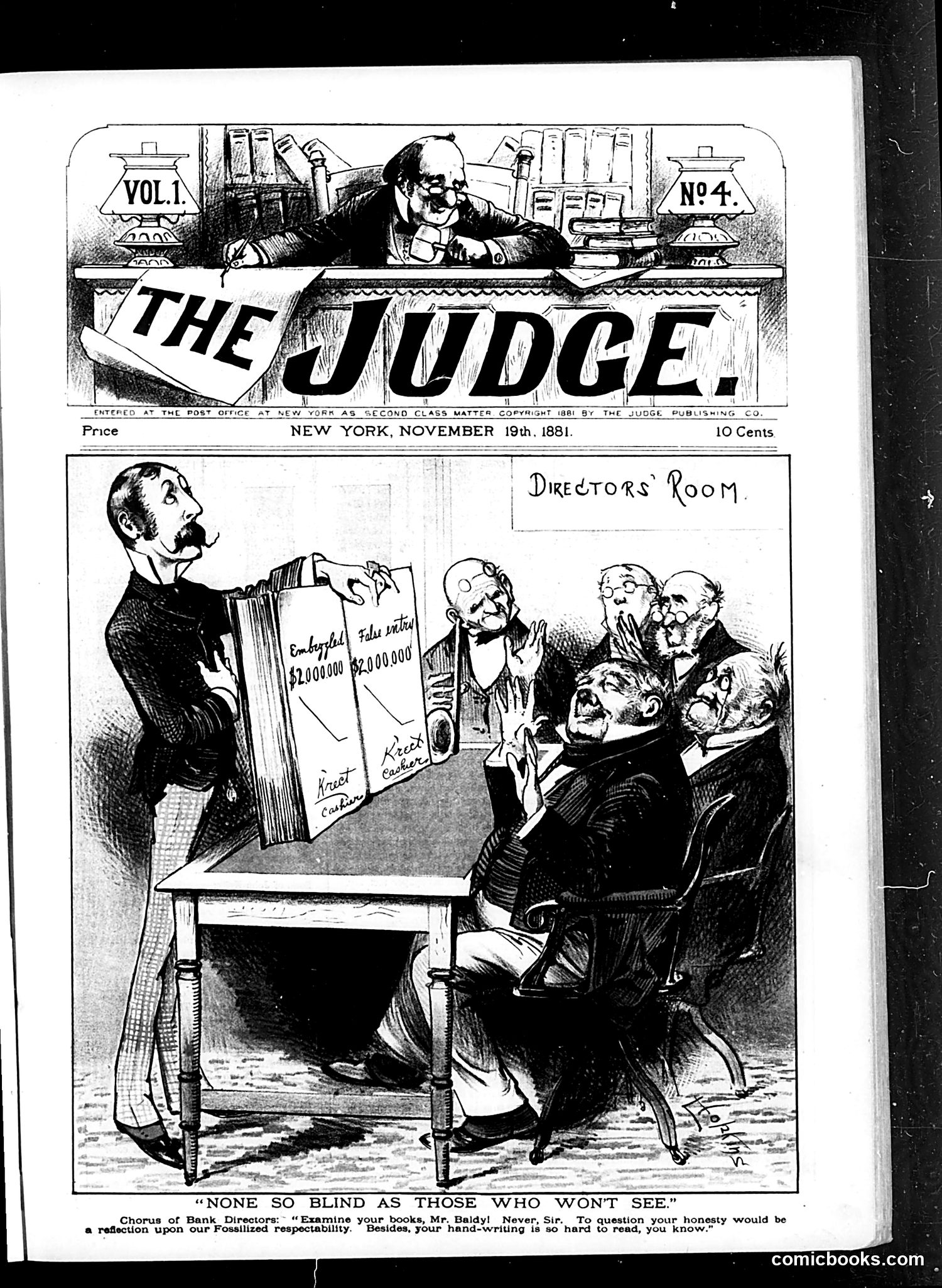
This cartoon satirizes bank directors who willfully ignore financial mismanagement or fraud. A well-dressed man (labeled "Mr. Baldy") presents falsified account books showing inflated figures ($2,000,000 repeated). The seated directors—caricatured as elderly, portly men—refuse to scrutinize his records, citing respect for his "honesty" and claiming his poor handwriting makes verification impossible. The satire targets deliberate negligence: the directors know examination would reveal wrongdoing but choose not to look. The phrase "None so blind as those who won't see" emphasizes their willful ignorance. This likely reflects real banking scandals of the 1880s era, when inadequate oversight and director collusion enabled embezzlement. The cartoon criticizes both dishonest bankers and complicit board members who prioritized appearances of respectability over actual accountability.
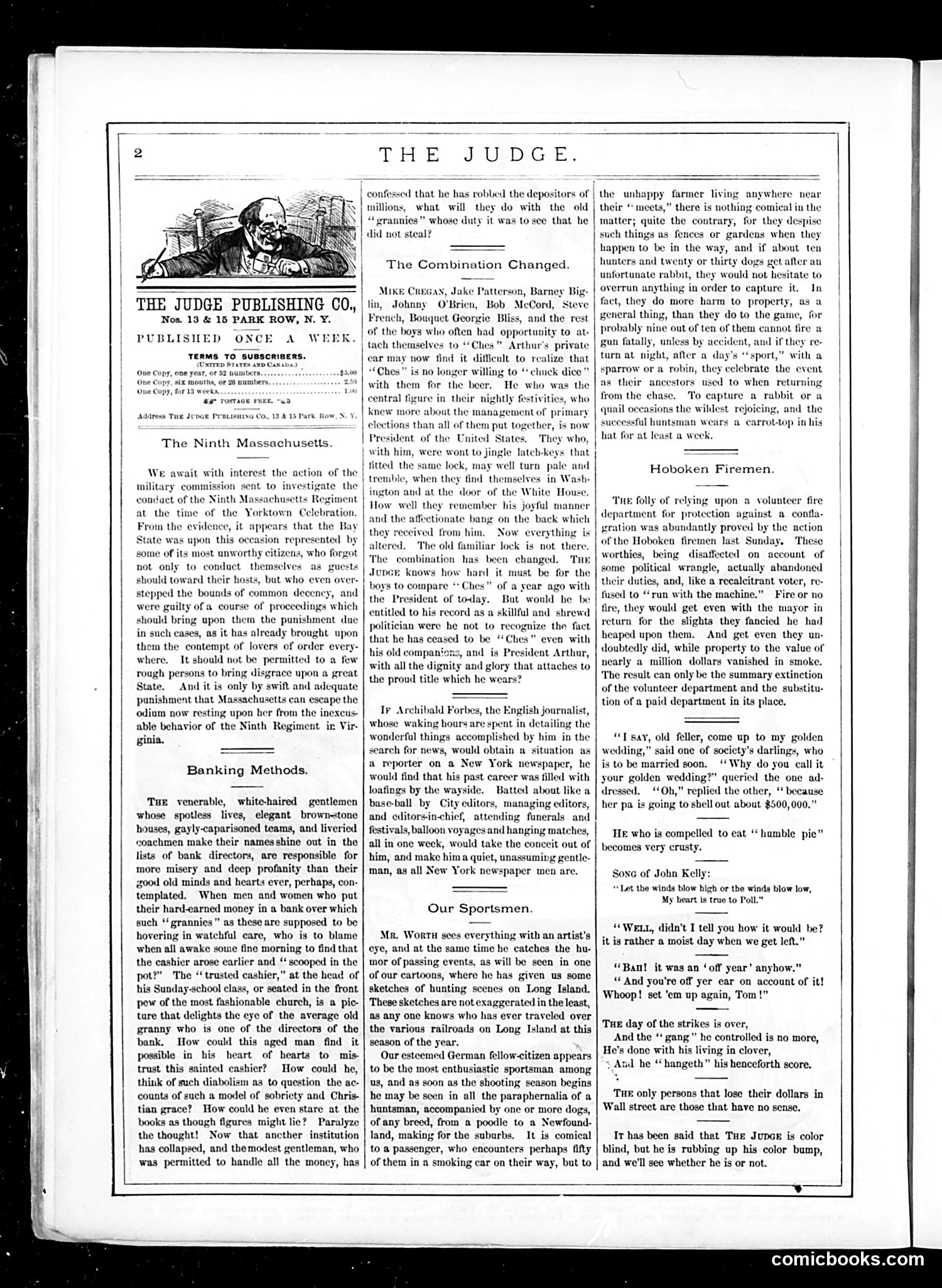
This cartoon satirizes **Chester Arthur's transformation** after becoming U.S. President. Arthur (nicknamed "Ches") was formerly a machine politician and patronage operative under the "Stalwart" faction, known for gambling, drinking, and backroom dealing with cronies like Mike Cregan, Jake Patterson, and others listed. The satire's point: these rough political associates are now shocked and excluded from the White House. Arthur, once their equal in vice and vice-presidency under Garfield, has assumed presidential dignity and won't "chuck dice" or socialize with them anymore. The "combination" (lock) has changed—they can no longer access their old friend. This reflects the irony of Arthur's actual post-1881 reform-minded presidency, which surprised critics who expected continued corruption. The cartoon mocks both Arthur's apparent hypocrisy and his former associates' distress at losing their connection to power.
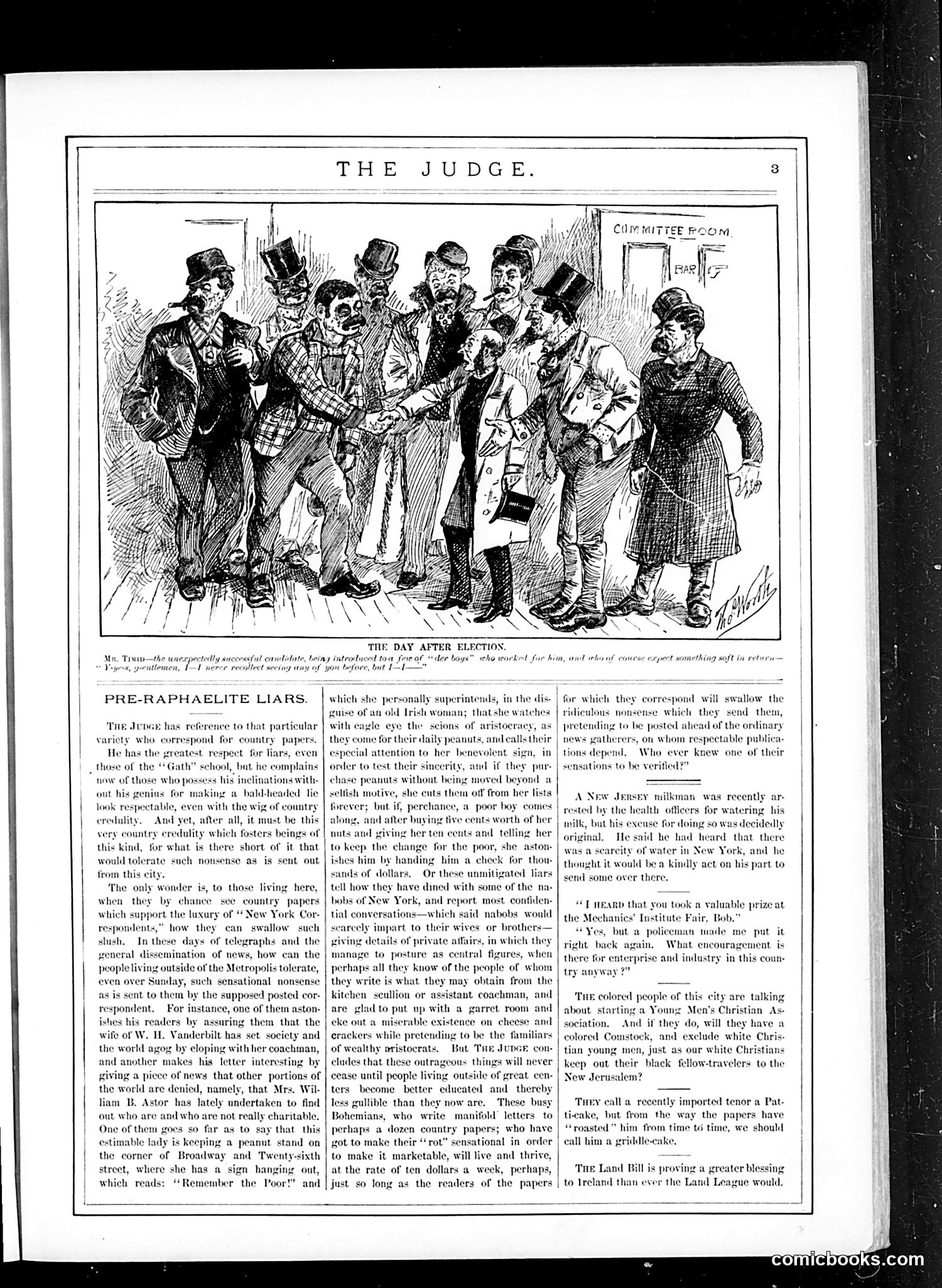
This page from *Judge* satirizes dishonest newspaper correspondents—particularly those writing from New York to provincial newspapers. The main article, "Pre-Raphaelite Liars," attacks correspondents who fabricate or wildly exaggerate stories about wealthy New York society figures to sensationalize their reports. The cartoon "The Day After Election" (top) depicts a crowded political scene, though the caption is partially illegible in the OCR. The critique focuses on how these "country paper" correspondents invent gossip (like stories about Mrs. Astor running a peanut stand) or claim insider knowledge they couldn't possibly have, merely to make their reports marketable. The author argues these fabricators thrive because readers in rural areas eagerly consume such nonsense. The satire ridicules both the liars and their credulous audience—a commentary on journalism ethics and rural gullibility in the Gilded Age.
This page contains a humorous short story titled "Inclined That Way: A Story for Bachelors" by "Bricktol," not a political cartoon. It's a romantic comedy involving three characters: Tom McGudgeon (a bachelor boarder), Mrs. Wax (his landlady with romantic interests in him), and Clara Queen (a young, fashionable woman). The satire targets Victorian romantic conventions and female behavior. Mrs. Wax, jealous when McGudgeon visits Clara, follows him in disguise. The humor derives from exposing vanity—Clara dresses extravagantly to attract attention, while Mrs. Wax attempts feminine manipulation through jealousy. The story mocks both women's scheming and McGudgeon's obliviousness. The social commentary critiques the artificiality of courtship rituals and women's reliance on appearance and emotional manipulation in marriage markets of the era.
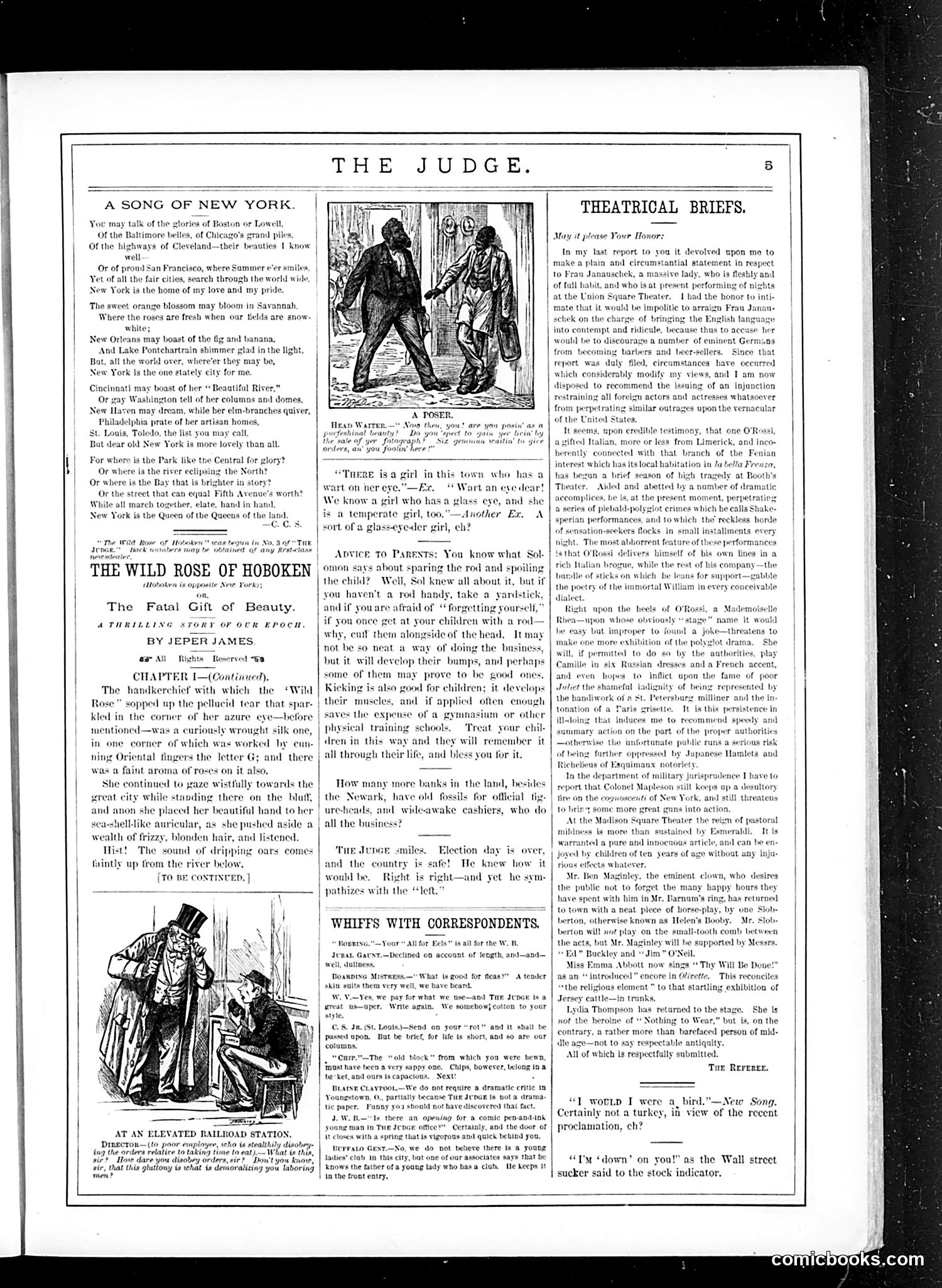
This page from *Judge* (a late-19th-century satirical weekly) contains several distinct pieces: **"A Song of New York"** celebrates New York City as superior to other American cities—a patriotic, boosterish poem typical of the era's urban pride. **"The Wild Rose of Hoboken"** is serialized melodramatic fiction, parodying the overwrought sentimental stories popular in dime novels. The heroine gazes from Hoboken (across the river from Manhattan) toward the city, creating intentional bathos—the contrast between lofty romantic language and mundane New Jersey settings. **The cartoons** (two visible sketches) appear to show lower-class or working-class figures in humorous situations—typical *Judge* fare satirizing everyday urban life. **"Whiffs with Correspondents"** is a humor column of brief reader submissions and editorial responses, poking fun at contemporary topics and language. The overall page reflects *Judge's* formula: mixing political/social satire with popular fiction parody and working-class humor for middle-class readers.
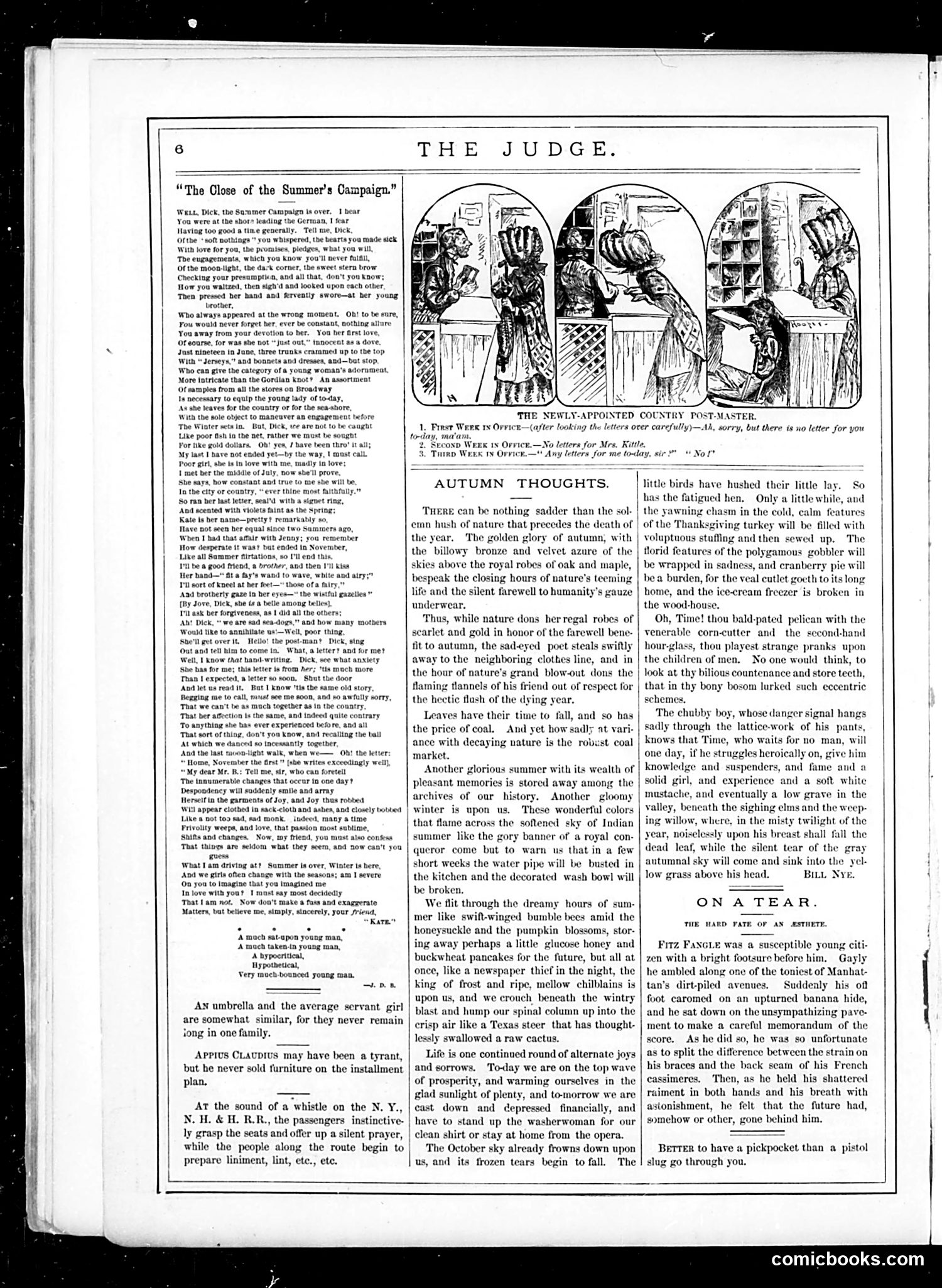
This satirical piece mocks the serial romantic escapades of affluent young men during the Victorian leisure season. The narrator, "Dick," confesses to a pattern of summer flirtations—making elaborate promises of devotion to naive young women ("just out" of society), then abandoning them come autumn. The satire targets the hypocrisy and callousness of privileged men who exploit the romantic idealism of sheltered young women. The detailed complaint about women's travel wardrobes and the condescending portrait of female naiveté reflect period gender attitudes. The joke hinges on Dick's expectation that Kate—his current victim—will simply accept his transition from suitor to "brother," unaware she's following the same cycle as unnamed previous conquests (Jenny, others). The final section shows Kate's letter proving his prediction correct: she's already expressing mounting anxiety and emotional dependence, exactly as he anticipated. Judge uses this to satirize both masculine duplicity and the social vulnerability of unmarried women in the marriage market.
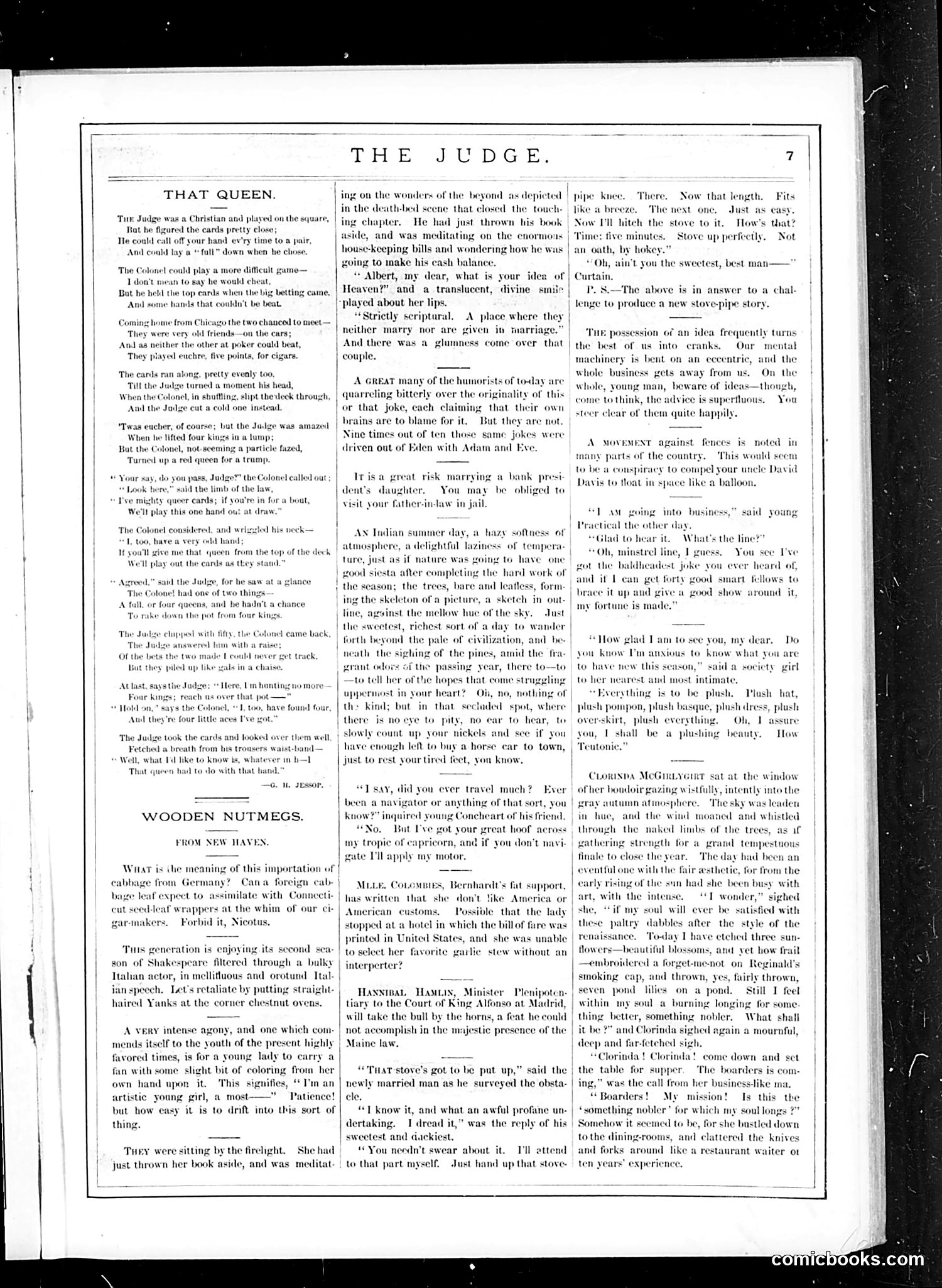
This page from *Judge* contains satirical stories and a brief section titled "Wooden Nutmegs from New Haven." **Main Content:** The page features literary pieces rather than political cartoons. "That Queen" is a narrative poem about a card game between the Judge and a Colonel, employing humor through wordplay and double meanings. Another piece discusses humorists quarreling over joke originality, satirizing their petty disputes. **Social Satire:** The "Wooden Nutmegs" section mocks Connecticut's reputation for producing shoddy goods. It includes anecdotes about absurd situations—a woman wanting garlic stew without garlic, a minister using a cow to accomplish tasks—that ridicule foolishness and provincial ignorance. **Context:** This appears typical of *Judge*'s content: humorous stories and observations targeting social pretension, regional stereotypes, and human folly rather than specific political figures. The tone is lighthearted rather than sharply polemical.
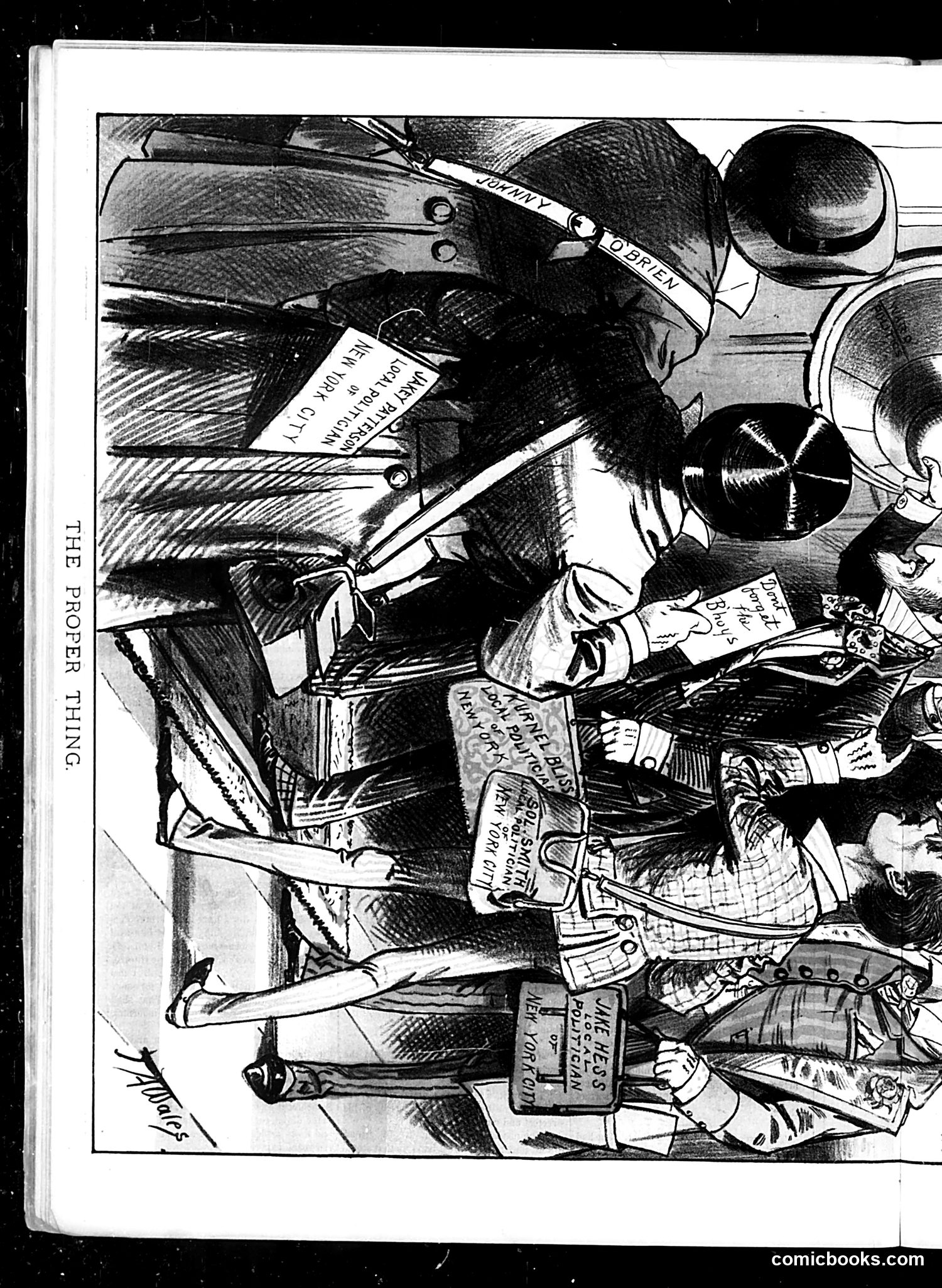
This cartoon appears to satirize wealth inequality and consumerism during the Gilded Age or Progressive Era. The central figure is a well-dressed woman surrounded by luxury goods—bottles of wine, dining implements, fancy hats, and various branded products with visible labels. The satire critiques how wealthy society women define themselves through conspicuous consumption and propriety. The caption "The Proper Thing" suggests irony: what's considered "proper" or respectable among the upper class is actually excessive materialism and status-seeking through possessions. The cartoon likely mocks both the superficiality of high society and the commercialism driving consumer culture. The abundance of branded goods visible suggests Judge magazine's concern about Americans being defined by—and controlled by—consumer purchases rather than character or genuine values.
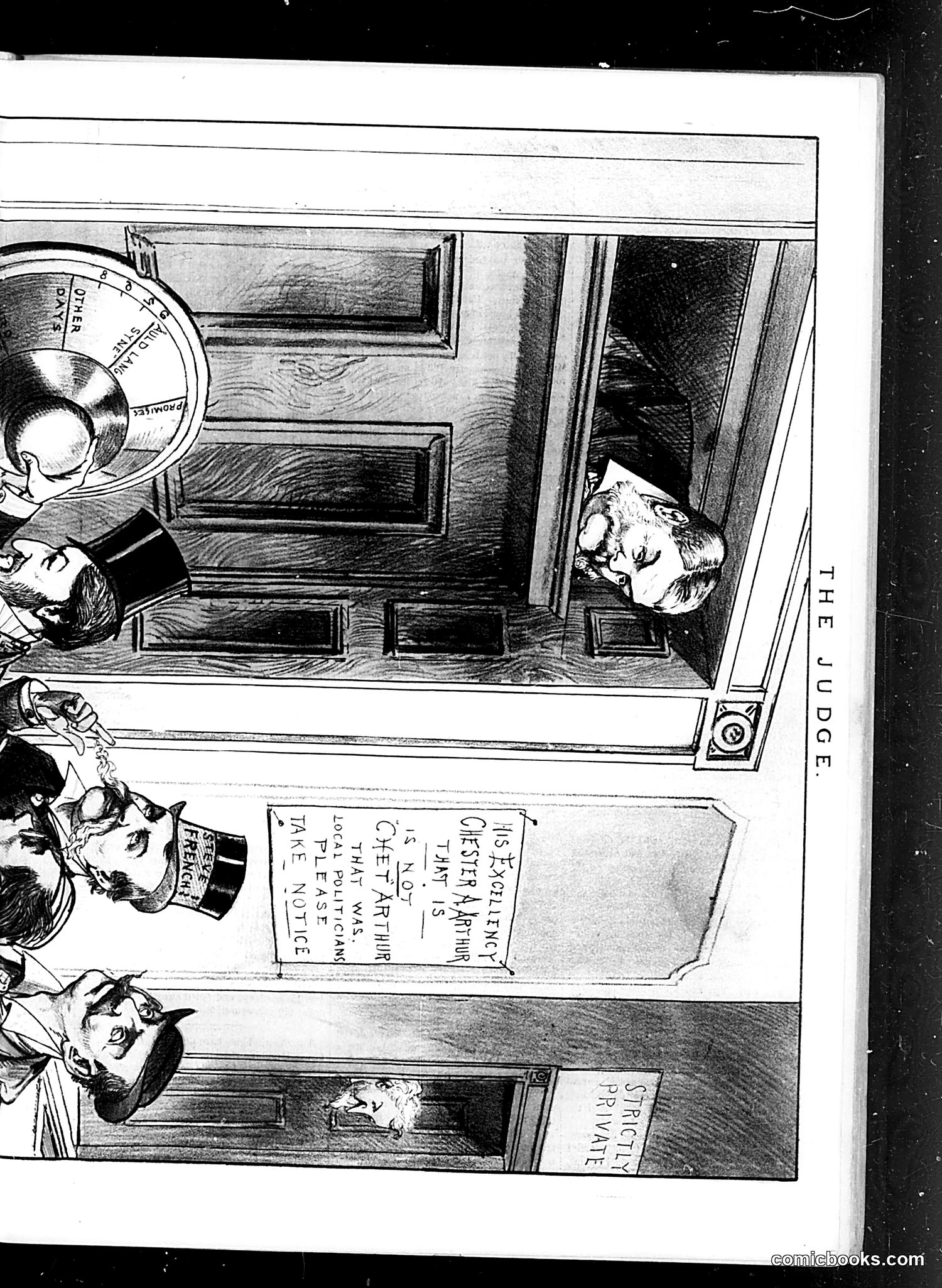
This appears to be a political cartoon titled "The Judge" satirizing Chester Arthur, who served as U.S. President (1881-1885). The cartoon depicts a courtroom scene where Arthur is being judged or tried. The visual composition suggests commentary on Arthur's presidency or political conduct, with figures observing him in what appears to be a judicial setting. The text "Local Politicians Please Take Notice" indicates the cartoon aims to warn or criticize local political figures, likely about corruption or misconduct similar to what the cartoon attributes to Arthur. The fragmented OCR text suggests the original message may have been clearer before degradation. Without seeing the complete text clearly, the specific charges or satirical point remain somewhat unclear, though it likely relates to Arthur's controversial patronage system or administrative practices during his presidency.
This page contains a humorous short story titled "Johnson's Patent Sea Lion," featuring a tall-tale salesman named Doolittle Johnson who bursts into a newspaper editor's (Colonel Hopkins's) office with a wild business scheme. The satire targets the **get-rich-quick promoter archetype** common in American popular culture. Johnson's scheme is absurdly simple: exhibit his son Bill (who apparently swims exceptionally well) as a "sea lion" to curious townspeople, charge admission, and split profits with the editor. The humor lies in the promoter's breathless confidence in an obviously fraudulent plan. The satire works on multiple levels: it mocks credulous newspaper editors willing to publish dubious claims for profit, the gullibility of small-town audiences, and the era's proliferation of dubious "attractions" and humbug. Johnson's exaggerated enthusiasm and theatrical mannerisms (winking, cocking his hat sideways) underscore the charlatan's desperation and theatrical nature.
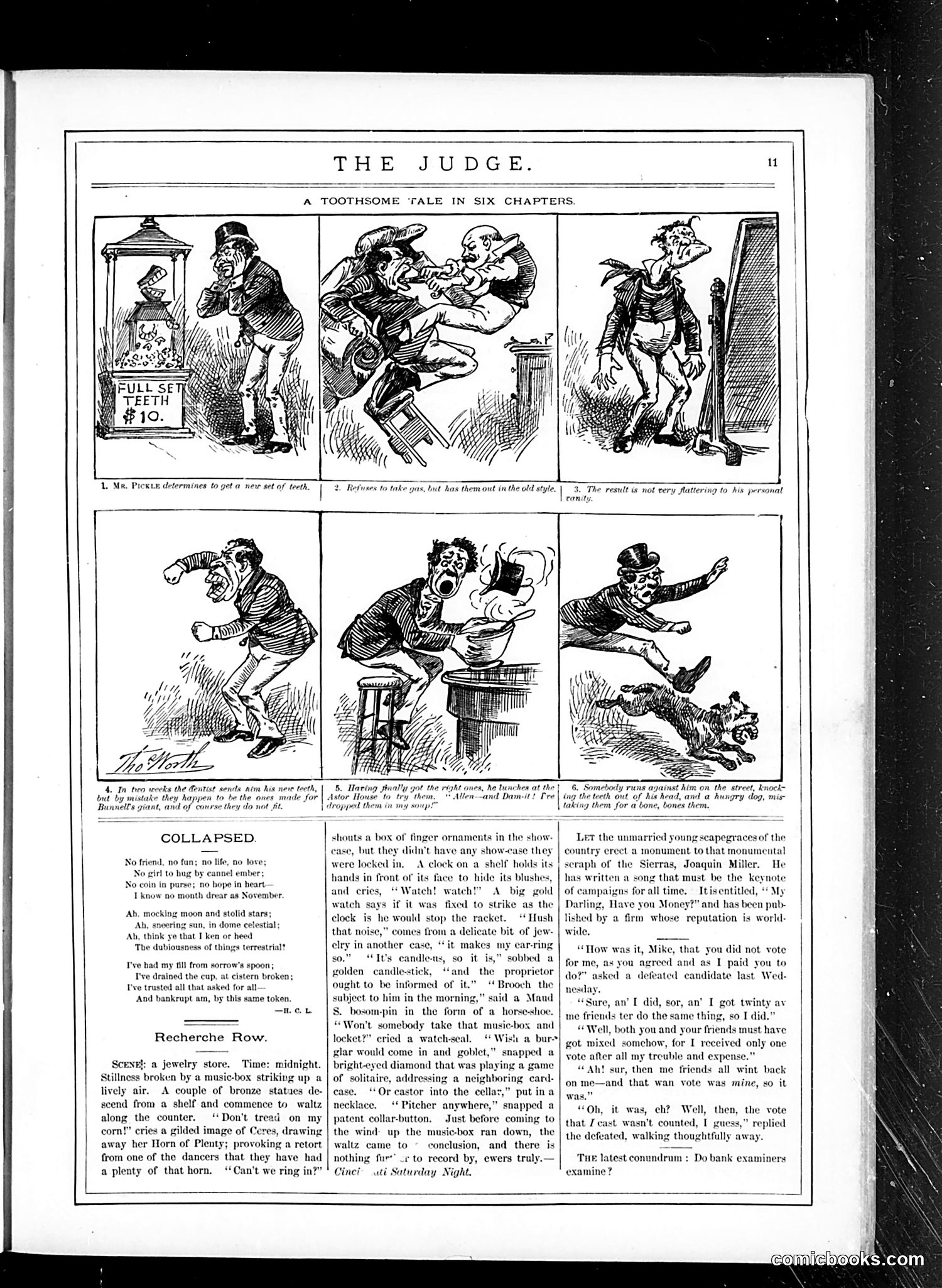
This page contains two satirical pieces from Judge magazine: **"A Toothsome Tale in Six Chapters"** is a visual comic strip about a man seeking false teeth. The narrative follows him obtaining dentures (#10) that don't fit properly, causing comedic mishaps—he attempts to use them, they cause embarrassment, and ultimately a dog mistakes them for a bone. **"Recherche Row"** is a prose satire set in a midnight jewelry store where inanimate objects (bronze statues, a clock, jewelry pieces, a music box) come to life and complain about the cacophonous music box playing. It's absurdist humor mocking pretentious ("recherche") goods and their personified grievances. The page also includes a melancholic poem titled "Collapsed" expressing despair, and a brief dialogue about election fraud where someone admits to receiving payment for votes that weren't properly cast. These pieces exemplify Judge's satirical approach: combining visual humor about everyday frustrations with social commentary on corruption and pretension.
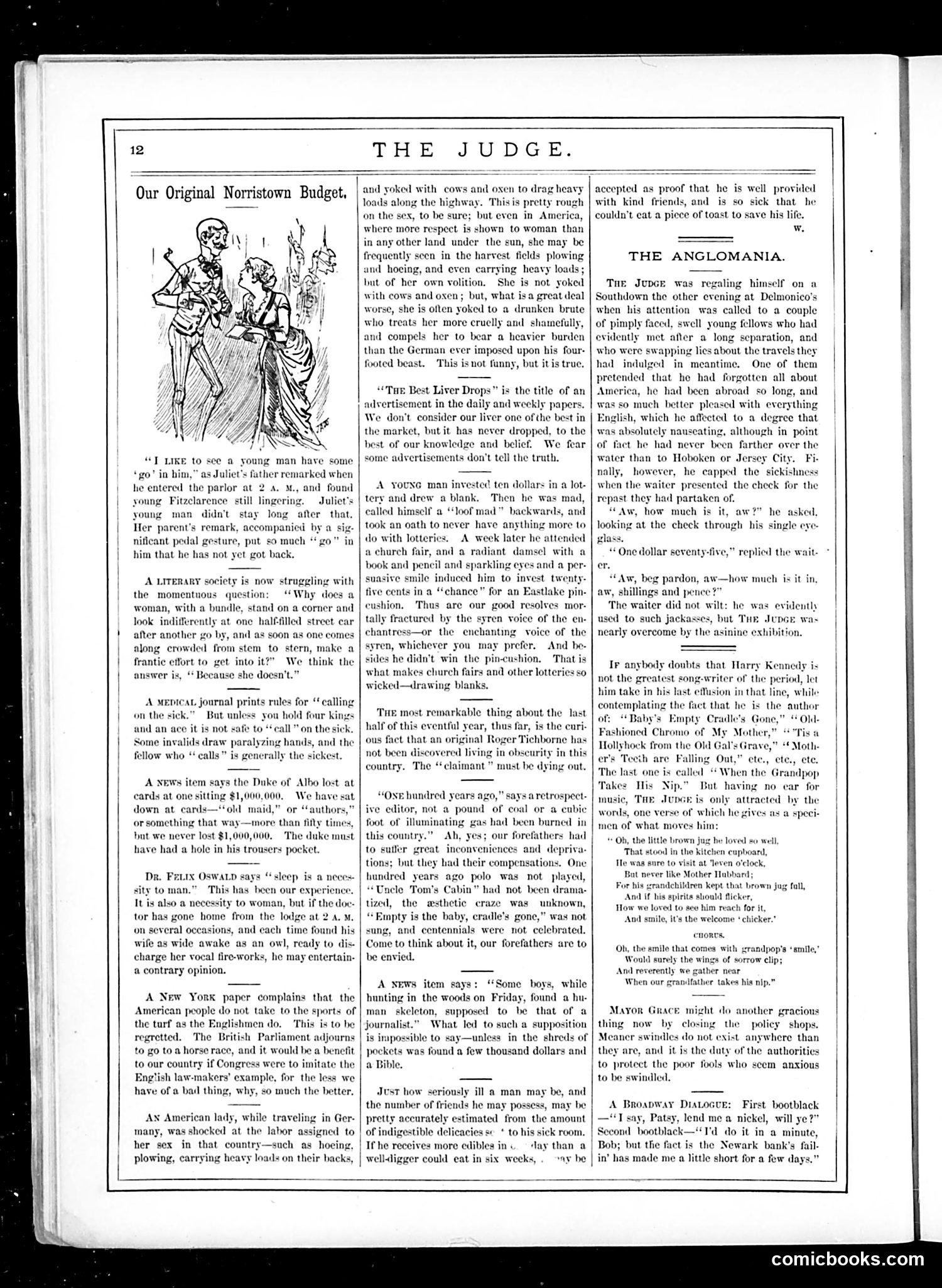
The main cartoon, titled "Our Original Norristown Budget," depicts a young couple in a domestic scene. The humor derives from the father's violent reaction to finding a young man (Fitzclarence) lingering with his daughter Juliet at 2 a.m. The father's "significant pedal gesture"—a kick—provides the punchline: the suitor leaves so quickly he hasn't returned yet. The rest of the page consists of short satirical commentary pieces on contemporary American life, including observations about: - Women's illogical behavior at streetcars - Card-playing among nobility (the Duke of Albo) - The necessity of sleep - American indifference to horse racing versus British enthusiasm - The harsh labor imposed on women in both Germany and America - Deceptive patent medicine advertisements - Church fundraising raffles targeting young men The overall tone is genteel Victorian satire targeting social pretension, gender relations, and commercial humbug.
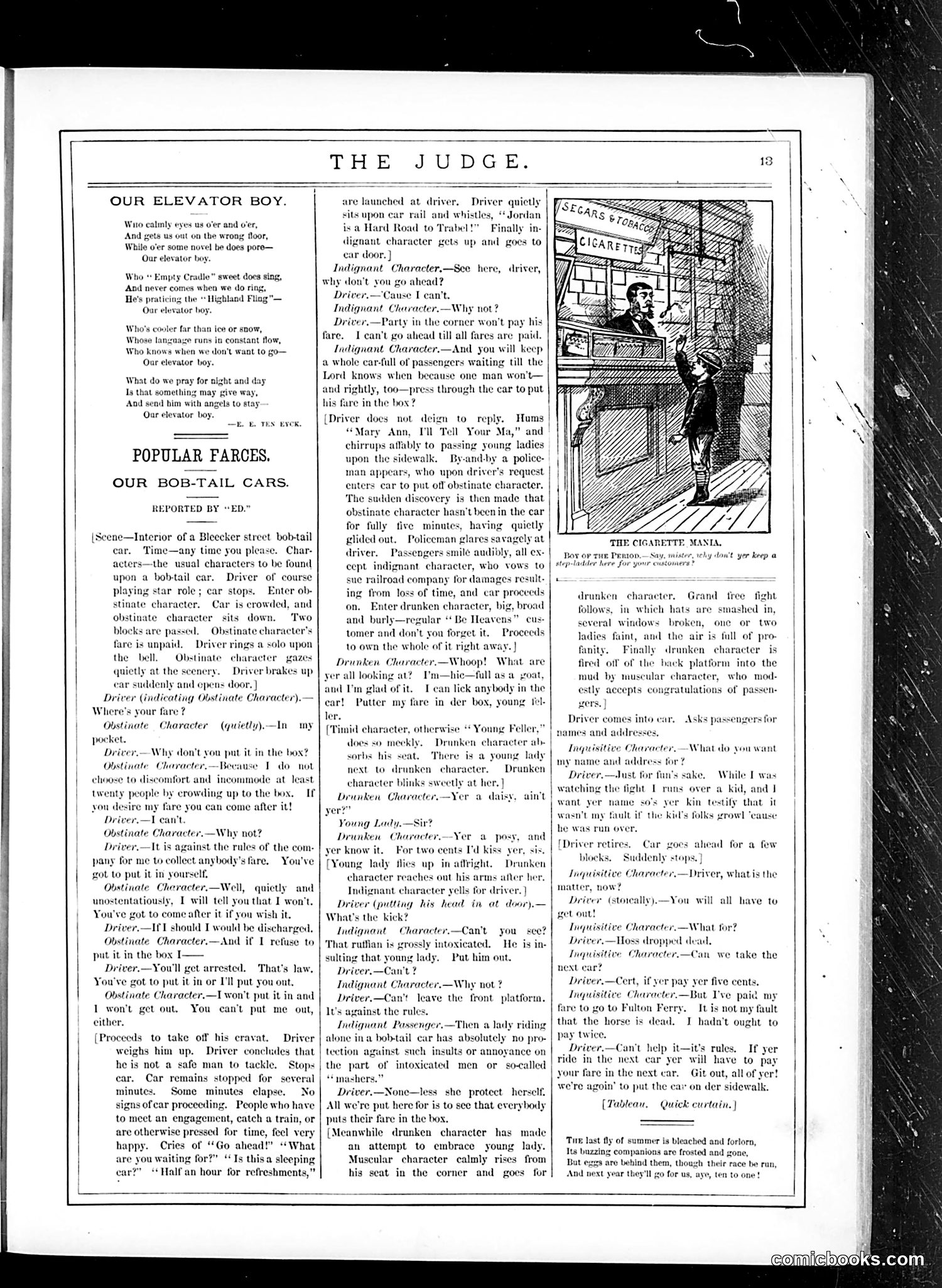
This sketch satirizes the dysfunction of New York City's streetcar system (bob-tail cars were small trolleys). The humor hinges on the absurdity of conflicting rules and social dynamics: **The Setup:** A passenger refuses to pay his fare into the collection box, citing the indignity of pushing through a crowded car. The driver cannot collect fares himself per company rules, creating a deadlock. **The Satire:** The system's rigidity paralyzes service—the car stops entirely, inconveniencing everyone while authorities are summoned. A policeman arrives uselessly. Meanwhile, the obstinate passenger simply leaves undetected, making everyone's suffering pointless. **Social Commentary:** Judge mocks both passenger entitlement ("I won't be inconvenienced") and corporate bureaucracy (inflexible rules that serve no one). The arriving drunk character suggests the system attracts various troublemakers. **Historical Context:** This reflects real frustrations with early 20th-century urban transit—crowded, rule-bound, staffed inadequately to enforce policies, ultimately benefiting neither passengers nor companies. The satire's strength is its circular absurdity: rules designed to streamline actually obstruct service entirely.
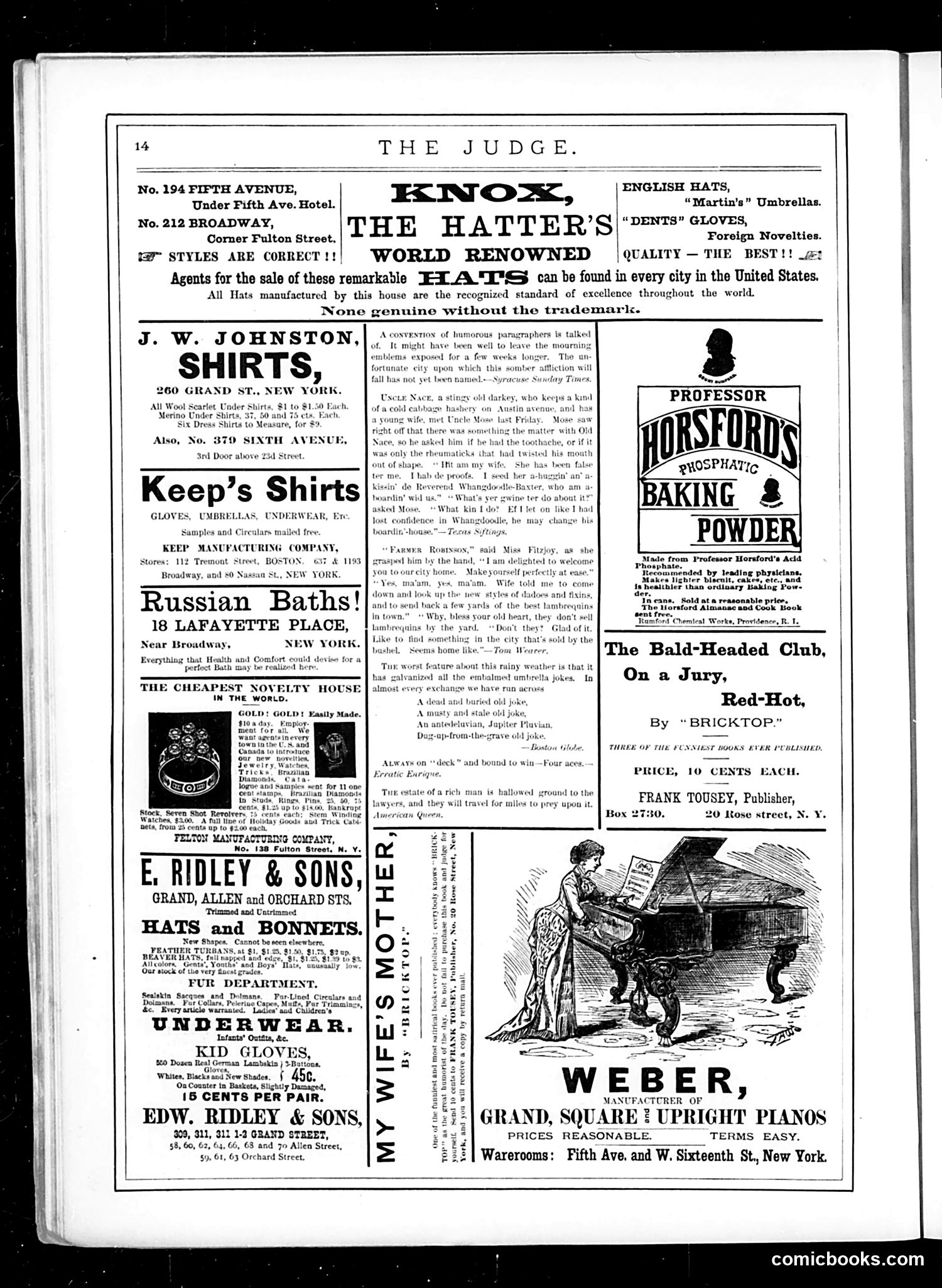
This is primarily an **advertising page** from Judge magazine, dominated by commercial notices for late 19th-century merchandise: hats, shirts, gloves, baking powder, and pianos. The only substantive editorial content is a brief **humorous piece** titled "The Bald-Headed Club, On a Jury, Red-Hot" by "Bricktop" (a recurring Judge humorist). The accompanying illustration shows a woman gesturing at a bald man, suggesting comedy derived from physical appearance—a common satirical trope of the era. The joke appears to be about a bald man serving on a jury, though the specific humor is unclear from the partial text visible. This likely played on period stereotypes about baldness and masculine authority/credibility in legal proceedings. The page reflects Judge's dual nature: a satirical publication that relied heavily on paid advertising to sustain operations, with editorial humor interspersed among commercial pitches.
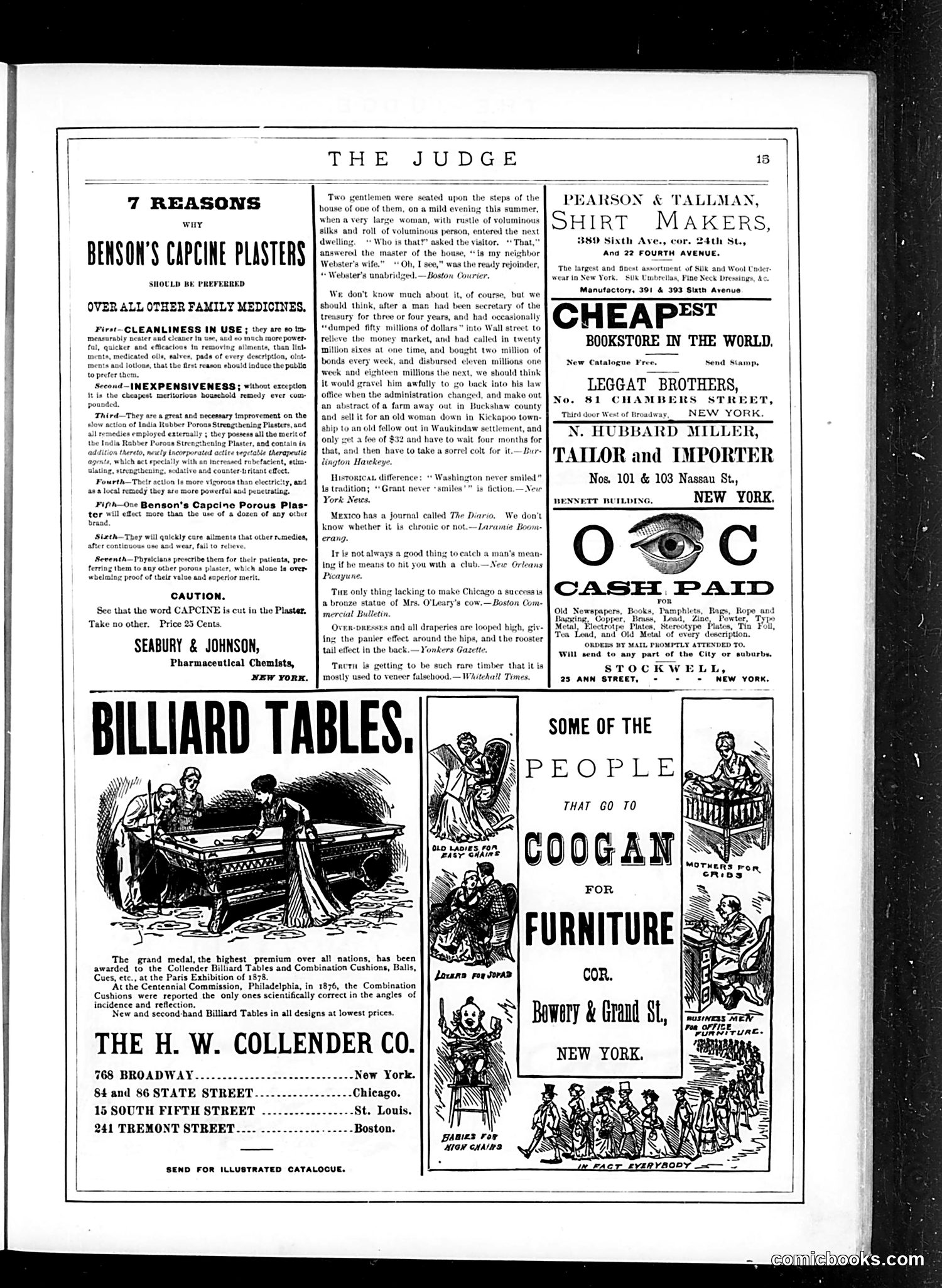
This page is primarily **advertising**, with minimal editorial or satirical content. The dominant features are commercial advertisements for products (Benson's Capscine Plasters, billiard tables, shirt makers, bookstores) and services typical of 1870s-80s New York. The only identifiable satirical content appears in brief quoted "jokes" or humorous observations scattered throughout—quips about Wall Street finance, Mrs. O'Leary's cow (the legendary cause of the 1871 Chicago Fire), and observations on regional American differences. These are mild, generic witticisms rather than pointed political satire. The page contains **no clear political cartoons or caricatures** of named public figures. The illustrations (billiard players, furniture customers) are generic commercial imagery, not satirical commentary. This appears to be a filler/advertising section of *Judge* magazine, not a page showcasing the publication's satirical editorial voice.
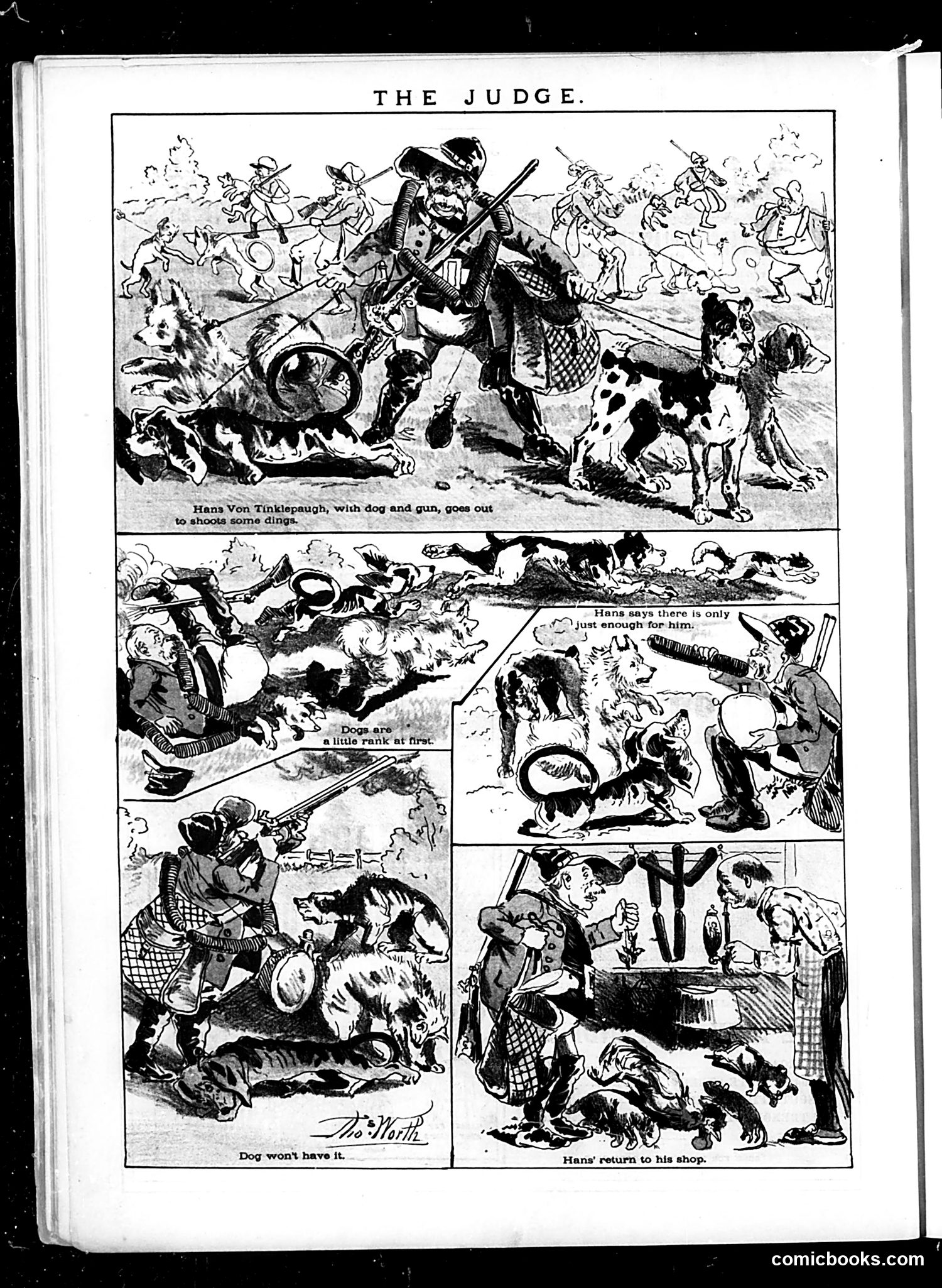
This is a sequential comic strip satirizing a character named Hans Von Tinklespaugh, a caricatured German immigrant (suggested by the German name and checkered clothing). The narrative shows Hans attempting to shoot dachshunds ("dine dogs"), which references the anti-German sentiment during the World War I era, when German-origin things—including dachshunds—faced prejudice in America. The joke appears to mock both Hans's bumbling attempts and American hostility toward German cultural symbols. The strip progresses from his failed hunting expedition through various humorous mishaps with the dogs, ending with his return to his shop. The visual style and crude caricature are typical of early 20th-century American political satire, reflecting xenophobic attitudes of the period.