
Judge, 1881-11-19 · page 12 of 16
Judge — November 19, 1881 — page 12: what you’re looking at
What you’re looking at
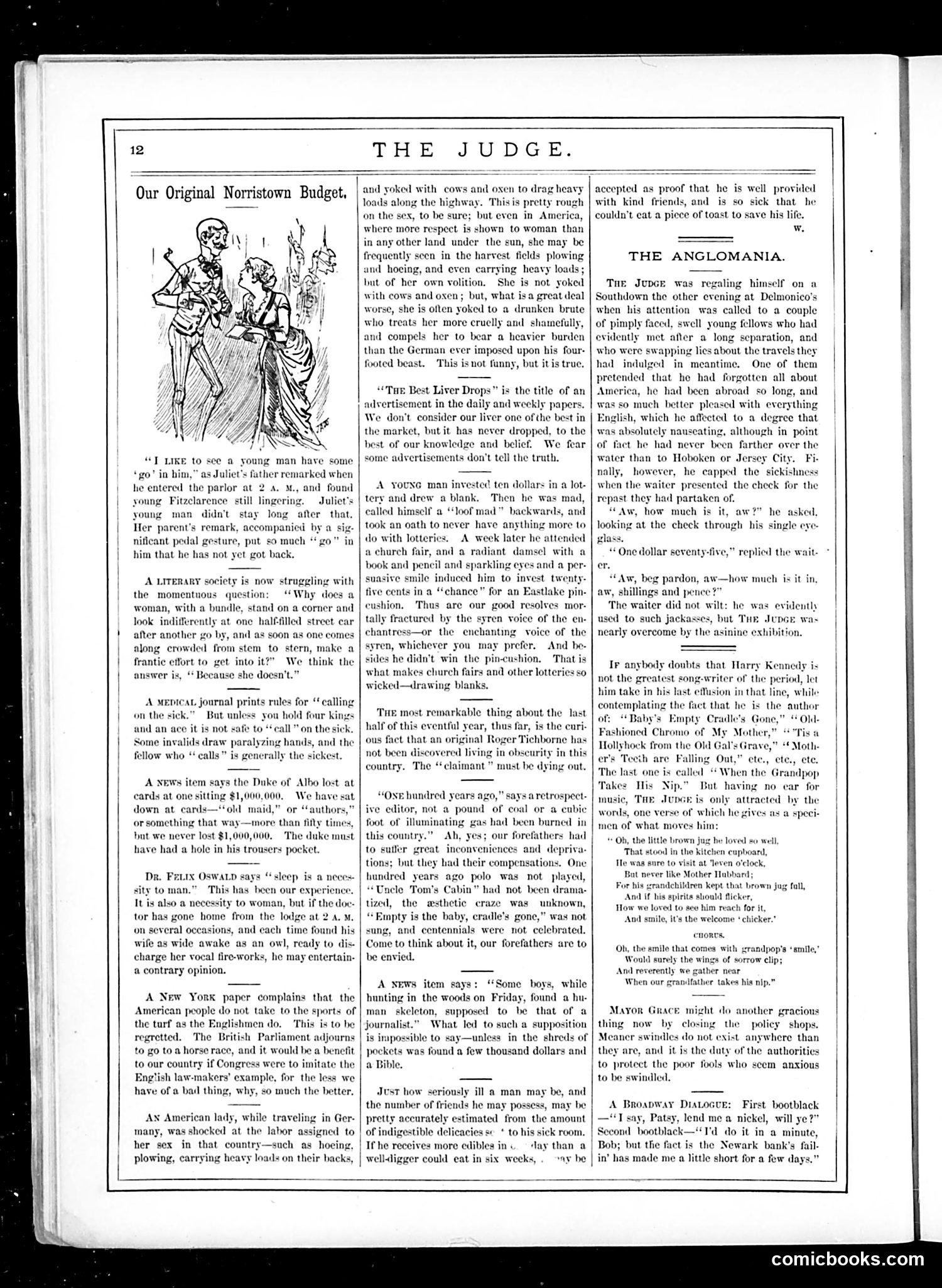
The main cartoon, titled "Our Original Norristown Budget," depicts a young couple in a domestic scene. The humor derives from the father's violent reaction to finding a young man (Fitzclarence) lingering with his daughter Juliet at 2 a.m. The father's "significant pedal gesture"—a kick—provides the punchline: the suitor leaves so quickly he hasn't returned yet. The rest of the page consists of short satirical commentary pieces on contemporary American life, including observations about: - Women's illogical behavior at streetcars - Card-playing among nobility (the Duke of Albo) - The necessity of sleep - American indifference to horse racing versus British enthusiasm - The harsh labor imposed on women in both Germany and America - Deceptive patent medicine advertisements - Church fundraising raffles targeting young men The overall tone is genteel Victorian satire targeting social pretension, gender relations, and commercial humbug.
📄 Transcribed text from this page (OCR, searchable)
Machine-transcribed from the original scan — historical spelling and the odd misread are preserved.
12 THE JUDGE. Our Original Norristown Budget, E to see a young man have some ‘go’ in him,” as Juliet’s father remarked when he entered the parlor at 2 a. M., and found young Fitzclarence still lingering. Juliet’s | young man didn't stay long after that. Her parent's remark, accompanied by a sig: nificant pedal gesture, put so much “ go” i him that he has not yet got back. A LiTeRary society is now struggling wi the momentuous questi “Why doe woman, with a bundle, stand on a corner and look indifferently at one halfilled street car after another go by, and as soon as one comes along crowded from stem to stern, make a frantic effort to get into it?” We think the answer is, ‘Because she doesn't.” A MEDICAL journal prints rules for “calling on the sick.” But unless you hold four king and an ace it is not safe to ‘ call” on the sick. Some invalids draw paralyzing hands, and the fellow who ‘ calls” is generally the sickest. A News item says the Duke of Albo lost at cards at one sitting $1,000,000, We have sat down at cards old maid,” or ‘authe or something that way—more than filly times, but we never lost $1,000,000. The duke must have had a hole in his trousers pocket. Da. Fetix OSwALp says “sleep is a neces: sity to man.” This has been our experience. | It is also a necessity to woman, but if the doe- | tor has gone home from the lod; 2a.M. on several occasions, and each time found his wife as wide awake as an owl, ready to dis. charge her vocal fire-works, he may entertain- a contrary opinion. A New York paper complains that the American people do not take to the sports of the turf as the Englishmen do. This is to be regretted. The British Parliament adjourns to go to a horse race, and it would be a benefit to our country if Congress were to imitate the English law-makers’ example, for the less we have of a bad thing, why, so much the better, Aw American lady, while traveling in Ger- many, was shocked at the labor assigned to her sex in that country—such as hoeing, plowing, carrying heavy loads on their backs, | and yoked with cows and oxen to drag hea loads along the highway. ‘This is pretty rough ‘on the sex, to be sure; but even in America, where more respect is shown to woman than in any other land under the sun, she may be frequently seen in the harvest fields plowing and hoeing, and even carrying heavy loads; Int of her own volition. She is not yoked with cows and oxen; but, what isa greatdeal she is often yoked to a drunken brute who treats her more cruelly and. shamefully, and compels her to bear a heavier burden than the German ever imposed upon his four- footed beast. This is not funny, but itis true. wor: “Tae Best Liver Drops” is the title of an advertisement in the daily and weekly papers. We don’t consider our liver one of the best in the market, but it has never dropped, to the best of our knowledge and belief. We fear some advertisements don't tell the truth. A YOUNG man invested ten dollars in a lot- tery and drew a blank. Then he was mad, called himself a ‘‘loof mad” backwards, and took an oath to never have anything more to do with lotteric A week later he attended achurch fair, and a radiant damsel with a book and pencil and sparkling eyes and a per- suasive smile induced him to invest twenty- five cents in a chance” for an Eastlake pin- cushion, Thus are our good resolves mor- tally fractured by the syren voice of the en- chantress—or the enchanting voice of the syren, whichever you may prefer. And be- les he didn't win the pin-cushion, what makes church fairs and other lotteries so wicked—drawing blanks. Tue most remarkable thing about the last half of this eventful year, thus far, is the curi- ous fact that an original Roger Tichborne has not been discovered living in obscurity in this country. The “claimant ” must be dying out. “Ose hundred years ago,” says aretrospect- ive editor, not a pound of coal or a cubic foot of illuminating gas had been burned in this country.” Ah, yes; our forefathers had to suifer great inconveniences and depriva tions; but they had their compensations. One hundred years ago polo was not played, Uncle Tom's Cabin” had not been drama- tized, the aesthetic was unknown, “ Empty is the b: was not sung, and centennials were not celebrated. Come to think about it, our forefathers are to be envied. A sews item says: ‘Some boys, hunting in the woods on Friday, found man skeleton, supposed to be that of a journalist.” What led to such a supposition is impossible to say—unless in the shreds of pockets was found a few thousand dollars and a Bible. while a hu. Just how seriously ill a man may be, and the number of friends he may possess, may be pretty accurately estimated from the amount of indigestible delicacies s+ * to his sic If he receives more edibles in« day t wellaligger could eat in six weeks, room. na vay be accepted as proof that he is well provided with kind friends, and is so sick that he couldn't eat a piece of toast to save his li w. THE ANGLOMANIA. Tur Jupce was regaling himself on a Southdown the other evening at Delmonico’s when his attention was called to a couple of pimply faced, swell young fellows who had evidently met afer a long separation, and who were swapping lies about the travels they had indulged in meantime. One of them pretended that he had forgotten all about America, he had been abroad so long, and was so much better pleased with everything English, which he affected to a degree that was absolutely nauseating, although in point of fact he had never been farther over the water than to Hoboken or Jersey Ci Fi- nally, however, he capped the sickishness when the waiter presented the check for the repast they had partaken of. “Aw, how much is it, he asked, looking at the check through his single eye- glass. “ One dollar seventy-five,” replied the wait- er. “Aw, beg pardon, aw—how much is it in, aw, shillings and pence?" ‘The waiter did not wilt: he was evidently used to such jackasses, but Tur Jupce was nearly overcome by the asinine exhibition. aw?" Ir anybody doubts that Harry Kennedy ix not the greatest song-writer of the period, let him take in his last effusion in that line, whik contemplating the fact that he is the author Baby's Empty Cradle’s Gone,” “ Old- Fashioned Chromo of My Mother,” Tis a Hollyhock from the Old ( ave,” * Moth- ers Teeth are Falling Out,” cte., ete., ete. The last one is called “When the Grandpop Takes His Nip.” But having no ear for music, THe Jupce is only attracted by the words, one ve which he gives as a speci- men of what moves him: Ob, the little brown jug he loved so well, That stood in the kitehen eu . He was sure to visit at ‘leven o'clock, Bat never like Mother Hubbard, For his children kept that brown jug fall, And if his spirits should flicker, How we loved to see him reach for it, And smile, it’s the welcome ‘ chicker.” criones. ‘Ob, the smile that cor Would surely the wings of sorrow clip; Anil reverently we gath When our gra es with grandpop's “smile,” near vifather takes his nip.” Mayor Grace might do another gracious thing now by closing the policy shops. Meaner swindles do not exist anywhere than they are, and it is the duty of the authorit to protect the poor fools who seem anxious to be swindled, A Broapway Diatoc bootblack —‘‘I say, Patsy, lend me a nickel, will ye?” Second bootblack—‘‘I'd do it in a minute, Bob; but the fact is the Newark bank's fail- | in’ has made me a little short for a few days,” comicbooks.com