
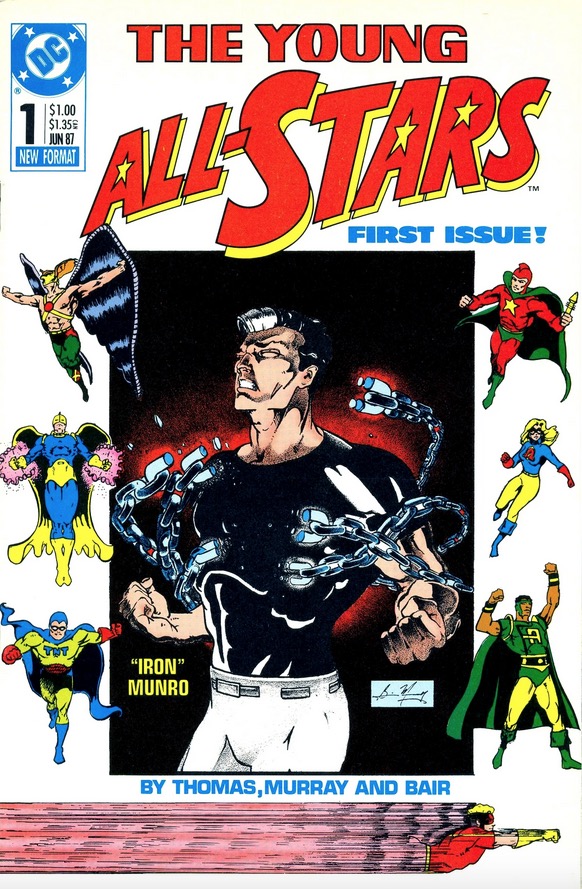
Young All-Stars #1
☆ Be the first to review + Add to your collection — Join freeYoung All-Stars #1 is one of the most direct creative responses to a continuity upheaval in DC's history: after Crisis on Infinite Earths erased Earth-Two from existence, Superman, Batman, Wonder Woman, and several other icons were retroactively removed from the World War II setting they had occupied in All-Star Squadron for six years. Rather than abandon the Golden Age era entirely, Roy Thomas launched this debut issue as a structural solution — introducing a roster of new characters deliberately designed to fill those narrative vacuums as thematic analogs. The issue also debuted Axis Amerika, a mirror-image villain team built on the same analog logic, and delivered the first appearance of Iron Munro, one of comics' most elaborately sourced new characters: the son of Philip Wylie's 1930 pulp novel hero Hugo Danner, himself a widely cited proto-Superman figure. In doing so, the issue wove canonical literary history directly into DC continuity, a form of 'League of Extraordinary Gentlemen'-style storytelling that was unusually sophisticated for a mainstream superhero launch.
ComicBooks.com Value
Show all 8 grades ▾
This exact issue on ebay
Raw — VF/NM ▾ $3.73–$10.59 4 listings
Raw / ungraded ▾ $1.5–$37.46 36 listings
More listings for this title
Read it digitally
Sell my copy
Have this issue — or a whole collection? Get a fair offer from us, skip the marketplace fees and the hassle.
We Buy Collections ▸History
All-Star Squadron concluded with issue #60 in March 1987 after Crisis on Infinite Earths stripped the Golden Age versions of Superman, Batman, Robin, Wonder Woman, Aquaman, Green Arrow, and Speedy from the WWII continuity — characters Thomas had built the entire series around. DC charged Thomas with developing a successor title, and he responded by conceptualizing the 'displaced energy' of those removed heroes as generating analog replacements: Young All-Stars. The series was co-created by Thomas, his wife Dann Thomas, and artist Michael Bair, who drew the first issue; Thomas has stated publicly that he was not warned in advance that those Golden Age figures would be phased out of continuity, making the entire creative pivot an improvisation under editorial constraint. The book launched in DC's then-new larger 'New Format' printing style and included an editorial text piece in which Roy Thomas explained his reasoning for the series directly to readers.
Trivia · 8 facts
- First appearance of Iron Munro (Arn Munro), a Superman analog deliberately constructed as the son of Hugo Danner — the superhuman protagonist of Philip Wylie's 1930 novel Gladiator, a book widely regarded as a possible inspiration for Superman's creation.
- First full team appearance of the Young All-Stars: Iron Munro, Flying Fox, Fury (Helena Kosmatos), Neptune Perkins, Dyna-Mite, and Tsunami.
- First full appearance of the villain team Axis Amerika, whose members — Übermensch, Gudra the Valkyrie, Der Grosshorn Eule (Horned Owl), Fledermaus, the archer Usil, and the amphibious Sea Wolf — were themselves evil analogs mirroring the Golden Age versions of Superman, Wonder Woman, Batman, Robin, Green Arrow, and Aquaman respectively.
- TNT (Dan Dunbar Sr.), the Golden Age hero and partner of Dyna-Mite, is killed in this issue by Axis Amerika — the first casualty of the All-Star Squadron in the new post-Crisis continuity.
- Written by Roy Thomas and Dann Thomas, with interior art by Michael Bair; cover dated June 1987, on-sale date confirmed from DC Releases #37.
- Flying Fox and Fury (Helena Kosmatos) make their first appearances alongside Iron Munro; Fury is established as the mother of the modern-day Fury (Lyta Trevor) of Infinity, Inc., retrofitting post-Crisis DC lineage.
- The series is a direct continuation from All-Star Squadron #60 (March 1987), which ended when that title was cancelled following Crisis on Infinite Earths; the final page of Young All-Stars #1 is an intentional homage to the cover of All-Star Squadron #1.
- The series ran 31 issues plus one annual before cancellation in 1989, with the series set in the year 1942 during World War II.
Full credits
Reviews
Reader reviews
No reader reviews yet.