
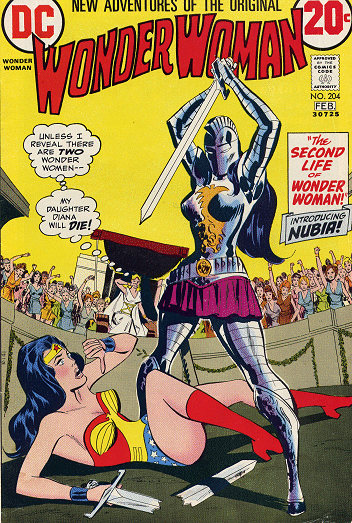
Wonder Woman #204
Wonder Woman #204 is one of the most consequential single issues in the Bronze Age because it accomplished two seismic things at once: it ended roughly four and a half years of Diana Prince's controversial, depowered 'mod' era—restoring her classic costume, Amazonian powers, and superhero identity for the first time since issue #179—and it introduced Nubia, DC Comics' first Black female superhero. Nubia's debut as an armored challenger who fights Diana to a draw, then reveals herself as Wonder Woman's long-lost twin sister, injected a radical new dimension into Amazon mythology and opened questions of identity, legacy, and race that the character and her successors have continued to explore for decades. The restoration itself was partly a response to feminist pressure: Gloria Steinem and other critics had publicly condemned the depowering of DC's premier superheroine, and the issue's 'Reader's Page' openly announced the change in direction, even including a sendoff to departing writer Dennis O'Neil. By collapsing an entire awkward era in a single issue and replacing it with a landmark first appearance, #204 stands as both a hard reset and a forward-looking creative statement.
In "The Second Life of the Original Wonder Woman," Wonder Woman returns to action with renewed purpose, reclaiming her powers and stepping into a new secret identity at the United Nations. Written by Robert Kanigher and brought to life by Don Heck’s dynamic art and Dick Giordano’s sharp inks, this 1973 issue marks a pivotal moment in Diana’s journey—set against the quiet tension of a world still reeling from loss. The cover by Don Heck and Dick Giordano captures the weight of her transformation, hinting at a story where legacy and duty collide.
ComicBooks.com Value
Show all 19 grades ▾
Find on ebay
Read it digitally
Sell my copy
Have this issue — or a whole collection? Get a fair offer from us, skip the marketplace fees and the hassle.
We Buy Collections ▸History
Robert Kanigher, who had written Wonder Woman for roughly nine years before leaving, returned to the title as writer-editor for issue #204—his first issue back—accompanied by artist Don Heck, who had already drawn issue #199. Kanigher's approach was aggressive: he killed off I-Ching (Diana's blind martial-arts mentor and the central supporting figure of the O'Neil era) via a random sniper in the issue's opening pages, used an amnesia plot device to strip away the continuity of the preceding run, and had Diana's memory and powers restored on Paradise Island, all within a single story. The cover was penciled by Don Heck and inked by Dick Giordano, while the interior inking credits have been disputed among indexers—some sources credit Vince Colletta, others Dick Giordano, with the Grand Comics Database noting the question remains unresolved.
Trivia · 8 facts
- First appearance of Nubia, introduced as Wonder Woman's armored, helmeted rival who reveals herself as Diana's long-lost twin sister and self-proclaimed 'Wonder Woman of the Floating Island.'
- Nubia is recognized as DC Comics' first Black female superhero, created by writer-editor Robert Kanigher and artist Don Heck.
- Wonder Woman regains her full Amazonian powers and returns to her classic star-spangled costume for the first time since issue #179 (1968), ending the roughly four-and-a-half-year 'depowered' era.
- Death of I-Ching, the blind Chinese mentor who had been Diana's central supporting character throughout the O'Neil run, killed by a random sniper early in the story.
- The story is titled 'The Second Life of the Original Wonder Woman' and was written and edited by Robert Kanigher, penciled by Don Heck, with a cover inked by Dick Giordano.
- The issue's 'Reader's Page' (substituting for a letters page) officially announced the return to the classic Wonder Woman status quo and included a farewell acknowledgment to the departing Dennis O'Neil.
- Diana Prince ends the issue with a new civilian identity as a translator at the United Nations in New York City.
- The issue has been reprinted multiple times, including in Diana Prince: Wonder Woman Vol. 4 (2009), Wonder Woman: A Celebration of 75 Years (2016), Wonder Woman Through the Years (2020), and as a Facsimile Edition published by DC in 2022/2023 to mark Nubia's 50th anniversary.
Full credits
Reprints
Reprinted in Marvila, la Mujer Maravilla #206 (1973), Aventures Fiction #55 (1977), Superamigos #10 (1986), Diana Prince: Wonder Woman #4 (2009), Wonder Woman: A Celebration of 75 Years #[nn] (2016), Wonder Woman: Diana Prince: Celebrating the '60s Omnibus #[nn] (2019), Wonder Woman Through the Years #[nn] (2020), Wonder Woman 204 (Facsimile Edition) #[nn] (2023)
Key issues in Wonder Woman
Reviews
Reader reviews
No reader reviews yet.