
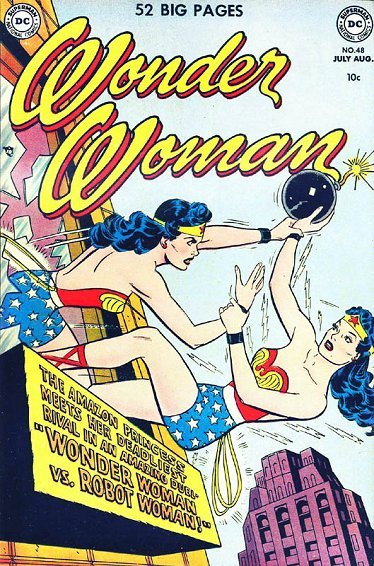
Wonder Woman #48
Wonder Woman #48 is a notable example of late Golden Age storytelling under Robert Kanigher, marking the debut of two villains — the criminal scientist Elektro and his creation, the Robot Woman — who introduced the doppelgänger-framing plot to Diana's rogues gallery, a device Kanigher would revisit throughout his long run. The issue also reflects the transitional editorial moment of mid-1951, when the solo Wonder Woman title was becoming DC's sole venue for the Amazon's adventures as Sensation Comics wound down; its three-story structure and filler strips capture the anthology format that defined the series across its first decade. The Binky Biggs backup strip, featuring his girlfriend Peg (Peggy Baxter), illustrates how DC used its flagship superhero books as launchpads for its parallel teen-humor line, cross-pollinating readership between genres.
In "Wonder Woman vs. Robot Woman!", the Amazon warrior faces her most uncanny adversary yet: a mechanical duplicate built to mimic her every move, now turned against her by criminals who’ve hijacked her voice commands to control her own Robot plane. With the treacherous ocean bed hiding a lost pirate ship and a crisis threatening Holliday College, Wonder Woman must outwit both her doppelgänger and the forces behind the theft, all while her signature aircraft—silent, transparent, and attuned to her voice—falls into enemy hands. The story, written by Charles Moulton and illustrated by Harry Peter, features a cover by Irwin Hasen and Bernard Sachs.
ComicBooks.com Value
Show all 13 grades ▾
This exact issue on ebay
Raw / ungraded ▾ $2.5–$357 4 listings
Read it digitally
Sell my copy
Have this issue — or a whole collection? Get a fair offer from us, skip the marketplace fees and the hassle.
We Buy Collections ▸History
By July 1951, Robert Kanigher had been writing the Wonder Woman title for roughly three years following William Moulton Marston's death in 1947, continuing to script under the house pseudonym 'Charles Moulton' that Marston had originally used. Harry G. Peter — who had illustrated the character since her 1941 debut — drew both main stories in this issue, maintaining visual continuity with the Marston era even as Kanigher's plotting moved toward science-fiction menaces like robot duplicates. The issue was edited by Whitney Ellsworth and assembled with the kind of dense, 52-page anthology format DC deployed in this era, padding its superhero lead with humor fillers, biography features, and text pieces drawn from multiple editorial departments.
Trivia · 8 facts
- Cover date July–August 1951 (on-sale approximately May 21, 1951); 52 pages; published by DC Comics as part of Wonder Woman Vol. 1.
- First appearance of the villain Elektro (a criminal scientist, unrelated to the later Marvel character of the same name) and his creation Robot Woman, both introduced in the 14-page lead story 'Wonder Woman vs. Robot Woman!'
- Written by Robert Kanigher under the 'Charles Moulton' house pseudonym; main story art by Harry G. Peter, who had drawn Wonder Woman since her 1941 debut.
- Edited by Whitney Ellsworth; the creative roster also included Bob Oksner, Henry Boltinoff, Julius Schwartz, John Giunta, Irv Novick, Martin Naydel, and Win Mortimer contributing backup and filler content.
- The issue contains three Wonder Woman stories: the lead robot-framing tale, 'The Treasure of Captain Storm' (12 pages, involving a women's college built unknowingly over pirate treasure), and 'The Theft of the Robot Plane' (criminals hijack Diana's invisible plane by recording her voice commands).
- Includes a 'Wonder Women of History' biographical feature on Anne Dacier scripted by Julius Schwartz — a regular educational back-matter feature of the era.
- A Binky Biggs filler strip featuring the character Peg (Peggy Baxter) appears as backup content; Binky is DC's Archie-analog teen-humor character created by Sheldon Mayer and Bob Oksner, who had his own title (Leave It to Binky) since 1948.
- The issue was published during a pivotal year for the Wonder Woman franchise: by the end of 1951, she would be dropped from Sensation Comics (after #106), leaving this bimonthly series as the sole ongoing Wonder Woman title.
Cast · 3 characters
Full credits
Reprints
Reprinted in Action Comics #204 (1955), Buzzy #68 (1955), Secret Hearts #97 (1964)
Key issues in Wonder Woman
Reviews
Reader reviews
No reader reviews yet.