
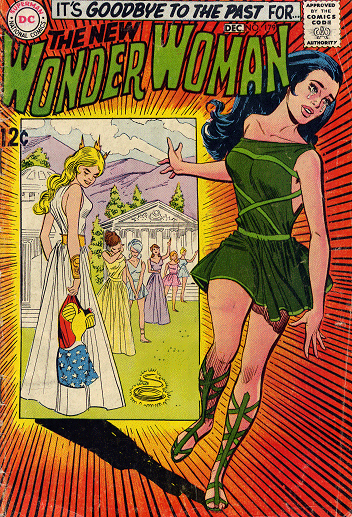
Wonder Woman #179
☆ Be the first to review + Add to your collection — Join freeWonder Woman #179 is the pivot point of one of the most debated character reinventions in Silver Age comics: Diana willingly performs the Amazon 'rite of renunciation,' surrendering her powers, her costume, and her divine birthright to remain in the mortal world rather than follow Hippolyta and the Amazons to another dimension. The issue introduces two characters who will define the next five years of the title — the blind martial-arts master I-Ching, Diana's new mentor, and the global crime lord Doctor Cyber, whose organization provides the engine for the entire 'mod era' run from #179 through the early 1970s. The transformation immediately became a cultural flashpoint: writer Denny O'Neil and artist Mike Sekowsky believed that grounding Diana as a self-made, trained mortal would elevate her as a feminist figure, while prominent feminist voices — including Gloria Steinem, who later put the costumed Wonder Woman on the first cover of Ms. Magazine in 1972 — argued the opposite, that stripping Earth's most powerful heroine of her powers was itself an act of diminishment. That unresolved tension has made #179 required reading in academic and fan discussions of gender and superhero narrative ever since.
In "Wonder Woman's Last Battle!", Diana Prince makes a life-altering choice: abandoning her powers and Amazonian legacy to stand by Steve Trevor, even as he's branded a traitor. With Hippolyta preparing the Amazons for a retreat to another dimension, Diana stays behind, taking up a new path under the guidance of I Ching. As Steve returns gravely wounded, Diana and her mentor must confront Doctor Cyber’s latest scheme—though the villain remains unseen. Written by Denny O'Neil and illustrated by Mike Sekowsky, with inks by Dick Giordano and letters by Milt Snapinn, this 1968 classic features a cover by Sekowsky and Giordano that captures the weight of Diana’s sacrifice.
ComicBooks.com Value
Show all 17 grades ▾
This exact issue on ebay
CGC 5.5 ▾ $100–$113 2 listings
Raw / ungraded ▾ $9.8–$120 16 listings
Read it digitally
Sell my copy
Have this issue — or a whole collection? Get a fair offer from us, skip the marketplace fees and the hassle.
We Buy Collections ▸History
The revamp was driven by editor Jack Miller, who enlisted Mike Sekowsky — already the definitive Justice League of America artist — to rework the stagnant Wonder Woman title that had been under Robert Kanigher's control since 1948. Sekowsky, who conceived the aesthetic direction of the new era and has been credited as its principal architect, brought Denny O'Neil in to script; O'Neil had just transferred to DC from Marvel and Charlton and was developing the socially engaged storytelling approach he would later perfect on Green Lantern/Green Arrow. The creative team drew inspiration from the British television series The Avengers, specifically Emma Peel, envisioning Diana as a mod, espionage-driven heroine whose competence came from skill and intellect rather than Olympian gifts. O'Neil's run on the book was brief — issue #179 was his second issue and nearly his last — and Sekowsky subsequently took over both writing and art duties from #182 onward, giving the era a somewhat uneven continuity but a visually consistent look.
Trivia · 9 facts
- Story title: 'Wonder Woman's Last Battle' — script by Denny O'Neil, pencils and continuity by Mike Sekowsky, inks by Dick Giordano, letters by Milt Snappin; cover also by Sekowsky and Giordano.
- Editor: Jack Miller.
- First appearance of I-Ching: a blind martial-arts master whose monastery was raided and whose fellow monks were slaughtered by Doctor Cyber's agents; he becomes Diana's trainer and long-running ally through the early 1970s.
- First appearance (first mention) of Doctor Cyber: introduced as the mysterious, unseen head of a global criminal network; Diana and I-Ching stop Cyber's plot to plant bombs in children's toys addressed to members of Congress, but never encounter the villain face-to-face in this issue.
- Tim Trench makes his debut appearance in this issue (credited as a cameo, unidentified); the hard-boiled private investigator — deliberately modeled on pulp noir archetypes, with his partner's name a nod to Sam Spade's dead partner Miles Archer — would become a formal supporting character beginning in #180.
- Diana performs the Amazon 'rite of renunciation,' relinquishing her powers, her costume, and her status as Wonder Woman; this launches the 'mod era' (also called the 'I-Ching era' or 'Diana Prince era'), which ran from #179 through approximately #204, when her powers and classic costume were restored.
- The issue debuted a redesigned 'wavy' Wonder Woman logo on the cover.
- Reprinted partially in Wonder Woman #191 (1970); reprinted in full in the trade paperback Diana Prince: Wonder Woman Vol. 1, in Wonder Woman: A Celebration of 75 Years (2016 hardcover), and in the Diana Prince: Wonder Woman 50th Anniversary Omnibus (2018).
- The feminist backlash against this era — led publicly by Gloria Steinem — directly influenced DC's decision to restore Diana's powers and costume in Wonder Woman #204 (1973); Steinem had placed the classically costumed Wonder Woman on the inaugural cover of Ms. Magazine in January 1972 as a counter-statement.
Cast · 4 characters
Full credits
Reprints
Reprinted in Wonder Woman #191 (1970), Heróis em Ação #7 (1985), Diana Prince: Wonder Woman #1 (2008), Wonder Woman: A Celebration of 75 Years #[nn] (2016), Wonder Woman: Diana Prince: Celebrating the '60s Omnibus #[nn] (2019), Wonder Woman: Steve Trevor #[nn] (2020)
Key issues in Wonder Woman
Reviews
Reader reviews
No reader reviews yet.