
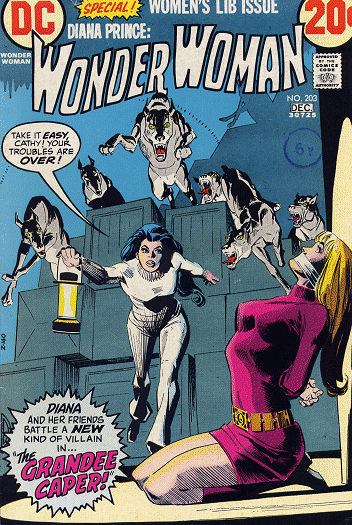
Wonder Woman #203
Wonder Woman #203 stands as the final chapter of the celebrated 'Diana Prince' depowered era — the last full issue in which Diana operates as a martial-arts street-level hero rather than a costumed superhuman. It is the only complete story from Samuel R. Delany's aborted six-part feminist arc, in which Diana battles real-world economic exploitation of women workers rather than costumed supervillains, representing one of the most ambitious attempts at socially grounded storytelling in the character's history. The abrupt cancellation of that arc — triggered in part by Gloria Steinem's objection to Diana's powerless state during a visit to DC's offices — became one of Bronze Age comics' most debated editorial turning points, generating scholarly analysis and ongoing debate about who truly spoke for feminist readers. The issue also carries a built-in irony that has fascinated historians: a story explicitly championing women's liberation was simultaneously the last gasp of the very run that feminism's most prominent spokesperson had lobbied to end.
In "The Grandee Caper," Wonder Woman finds herself without a home and temporarily stays with her former assistant, Cathy Perkins—now deeply involved in a women's liberation group. Written by Samuel R. Delany and illustrated by Dick Giordano, this 1972 issue captures a quietly revolutionary moment in the character’s life, grounded in real-world social currents of the era. The cover, also by Giordano, perfectly frames the story’s blend of personal displacement and political awakening.
ComicBooks.com Value
Show all 15 grades ▾
Find on ebay
Read it digitally
Sell my copy
Have this issue — or a whole collection? Get a fair offer from us, skip the marketplace fees and the hassle.
We Buy Collections ▸History
Editor Denny O'Neil, who had taken over the Wonder Woman title during its 'relevant' phase, recruited award-winning science fiction author Samuel R. Delany as writer because O'Neil felt Delany had an unusually sharp understanding of female characters; Delany himself later recalled simply volunteering to help after watching O'Neil struggle to find the right voice for the series. Delany plotted a six-issue arc in which Diana would confront a different real-world villain embodying sexist exploitation in each installment — a corrupt department store owner (issue #203), a supermarket chain crushing a women's food cooperative, a dismissive college advisor, and ultimately a conflict at a women's health clinic involving abortion access. The arc was shut down after only two issues when Steinem, touring the DC offices in connection with the launch of Ms. Magazine, saw the depowered Diana Prince stories and publicly objected; DC management used her reaction as justification to restore Wonder Woman's classic powers and costume with #204, and Delany departed. Academic Ann Matsuuchi later argued that Steinem's comment was 'conveniently used as an excuse' by DC, and Delany himself felt he never had the chance to explain his forward-looking intentions to Steinem.
Trivia · 8 facts
- Story title: 'The Grandee Caper!' — script by Samuel R. Delany, art and cover by Dick Giordano; cover date December 1972, on-sale September 7, 1972.
- This is the final full issue of the 'Diana Prince' era in which Wonder Woman operates without her traditional Amazonian powers or costume, a run that had begun in 1968.
- The issue was explicitly cover-bannered 'Special! Women's Lib Issue,' one of the earliest examples of a major superhero comic directly marketing itself to the women's liberation movement.
- The plot centers on Diana exposing Mr. Grandee, a department store owner who uses female employees as advertising symbols while paying them below minimum wage via a sweatshop supply chain — a self-consciously real-world, socially grounded antagonist.
- Delany's planned six-issue arc would have concluded with Wonder Woman defending an abortion clinic; #203 was the first — and only fully completed — installment of that arc before the series was reset.
- The villain Mr. Grandee was visually modeled on DC publisher Carmine Infantino, according to artist Dick Giordano, a detail confirmed via the Grand Comics Database.
- Starting with this issue, the letters column was renamed 'Princessions,' the winning entry in a reader contest; the winner was Anthony Kowalik of Harvey, Illinois.
- The issue has been reprinted four times: in a 1973 Spanish-language edition (Editorial Novaro), Diana Prince: Wonder Woman Vol. 4 (DC, 2009), the Diana Prince: Celebrating the '60s Omnibus (DC, 2018/2019), and Wonder Woman: 80 Years of the Amazon Warrior The Deluxe Edition (DC, 2021).
Full credits
Reprints
Reprinted in Marvila, la Mujer Maravilla #204 (1973), Diana Prince: Wonder Woman #4 (2009), Wonder Woman: Diana Prince: Celebrating the '60s Omnibus #[nn] (2019), Wonder Woman: 80 Years of the Amazon Warrior The Deluxe Edition #[nn] (2021)
Key issues in Wonder Woman
Reviews
Reader reviews
No reader reviews yet.