
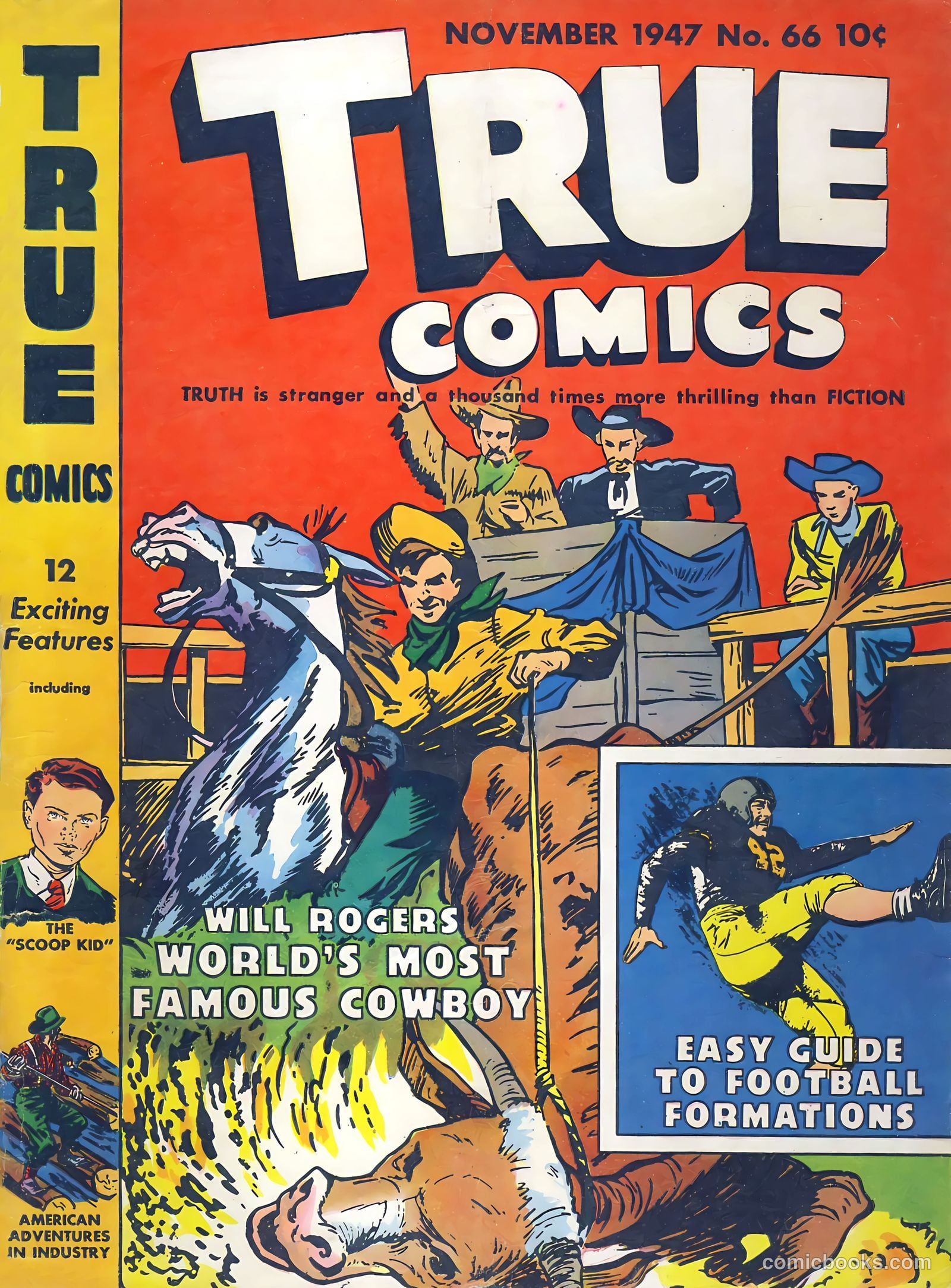
True Comics #66
☆ Be the first to review + Add to your collection — Join freeTrue Comics #66 is an anthology featuring multiple factual stories. One story chronicles the history of papermaking, beginning with the Fourdrinier brothers' invention of the first paper-making machine in England in 1798, continuing through American paper mills and chemist Benjamin Tilghman's discovery of the sulphite process in 1867, and concluding with modern timber-based paper production. Another story recounts the conflict between a Royal Canadian Mountie and Chief Pot-a-Pie, depicting the officer's efforts to maintain peace and order. The issue also includes "Thunderbolt Ace," detailing Lieutenant Colonel Francis Gabreski's military aviation career, from his enlistment in 1940 through his service as a fighter pilot at Pearl Harbor and subsequent achievements as a top American ace in Europe.
Born in Oklahoma's Indian Territory in 1879, Will Rogers parlayed his natural talent for roping and riding into a career that took him from Wild West shows to vaudeville stages, where his sharp wit and folksy humor won over audiences across the nation. Through newspapers, radio broadcasts, and films, Rogers became America's beloved humorist—using his gift for comedy to bridge gaps between everyday people and government leaders, all while never losing his generous spirit or his love of flying. This is the story of how a restless cowboy became one of the most popular and cherished figures in American life.
Bernard Krisher arrived in America in 1941 as a teenage refugee from Nazi-occupied Europe, carrying with him an unwavering belief in free speech. By sixteen, the young editor had launched a mimeographed magazine for his peers and earned their respect—now, as his publication prepares to grow beyond its homemade roots, Krisher's commitment to giving young people a voice faces its first real test. This true story captures how a boy who witnessed tyranny firsthand became a spokesman for the press freedom his new country promised.
Trace the evolution of papermaking from its ancient Chinese origins through the industrial revolution to modern American mills, following the invention of mechanical looms and chemical processes that transformed paper from a precious luxury into an essential material. Watch as logs are harvested, processed into pulp through innovative sulphite chemistry, and run through massive Fourdrinier machines to produce the millions of tons that became vital to the nation during wartime and beyond. This 1947 feature reveals how engineers and chemists continue to refine the industry that turns forest timber into the everyday commodity that powers modern life.
When the Canadian Pacific Railroad pushes through Cree hunting grounds in 1878 Saskatchewan, tensions boil over into cattle theft and confrontation. A lone Mountie, Constable Sutherland, rides into the camp to resolve the crisis—armed with nothing but nerve and a fifteen-minute ultimatum. What unfolds is a tense test of wits between a single officer and an entire tribe determined to defend their honor.
Adeline Trapp grew up defying convention in an era when women rarely swam, eventually becoming one of the most accomplished swimmers of her time—a feat that earned her the title "Queen of Hell Gate" after a grueling 1909 endurance race through New York's treacherous waters. Her courage in the water and tireless advocacy for sensible bathing suits and water safety made her a public figure who used her fame to champion both athletic achievement and lifesaving education. From her early days as a daring young teacher to her work with the Red Cross during World War II, Trapp's decades-long dedication to swimming and safety left a lasting impact on how women were viewed as athletes.
Robert Jack Stuart, nicknamed "Jackrabbit" for his speed on Army's football team, earned his reputation as one of the fleetest backfield men in the sport, building on a stellar athletic career that began at Will Rogers High School in his native Tulsa, Oklahoma. Before joining West Point, Stuart led Tulsa University to victory in the 1945 Orange Bowl, and he's continued to demonstrate his exceptional speed on the track, winning the 100 and 200-yard dashes for three consecutive years in Oklahoma State meets. His lightning-quick footwork makes him a dynamic force whenever he gets the ball.
Lt. Col. Francis Gabreski traded his pre-medical studies for the cockpit of a P-47 Thunderbolt, and through flying skill, courage, and quick thinking, he carved out an extraordinary record in the European theater during World War II. This is the true story of how Gabreski became the top American ace in Europe—a pilot who always fired first and never backed down from a fight.
Sailors aboard the British whaler *Balaena* encounter an unexpected group of penguins in Antarctic waters, leading to an amusing chain of events when the crew attempts to return their stowaways to the sea. When the same penguins turn up again during a later catch, the sailors decide to bring the determined hitchhikers all the way back to a London zoo.
ComicBooks.com Value
Show all 11 grades ▾
Find on ebay
Read it digitally
Sell my copy
Have this issue — or a whole collection? Get a fair offer from us, skip the marketplace fees and the hassle.
We Buy Collections ▸Key issues in True Comics
Reviews
Reader reviews
No reader reviews yet.