
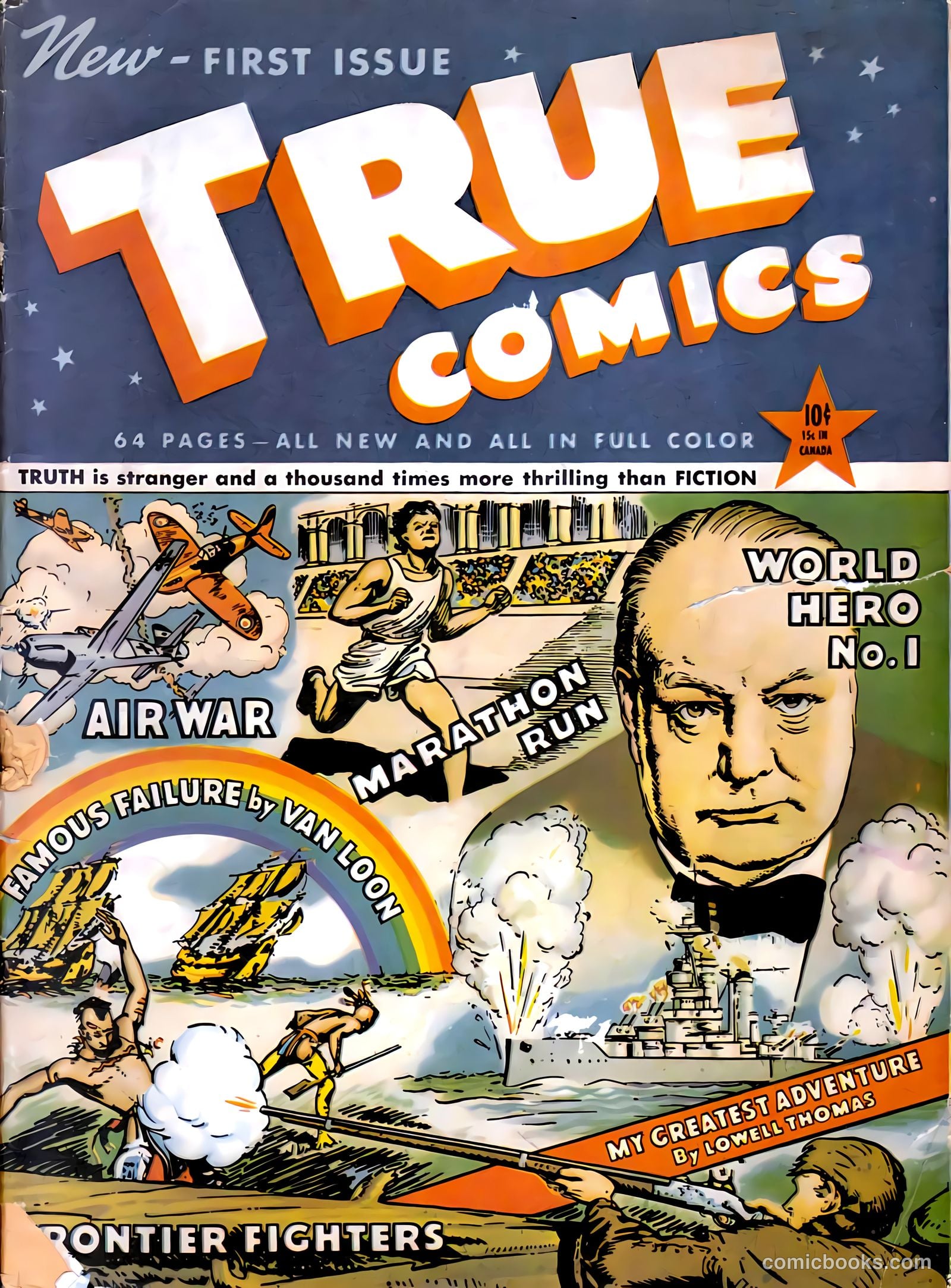
True Comics #1
☆ Be the first to review + Add to your collection — Join freeTrue Comics #1 (April 1941) holds a firm claim as the first educational comic book published in the United States, launching an entirely new genre within the medium at a moment when superhero and adventure comics dominated newsstands. Publisher George J. Hecht and The Parents' Institute used the comic format not to entertain through fantasy, but to argue—on the comic book's own visual terms—that real history, biography, and science could be more gripping than fiction, a philosophical stance that directly challenged the prevailing Golden Age model. The series proved durable enough to run 84 issues through 1950, outlasting every imitator it inspired, including DC Comics' Real Fact Comics, and stands as a key document in the long debate over comics' educational legitimacy that would escalate into the Senate hearings of 1954. It was also one of the earliest comic book series—possibly the first—to operate under a formal editorial advisory board of academic experts, a structural innovation that historian Jill Lepore has singled out as the feature that most distinguished it from its competitors.
True Comics #1 is an educational anthology featuring stories based on real historical events and figures. The visible stories include an account of Dutch Arctic explorers Heemskerk and Barents becoming trapped among icebergs in the Polar Sea and eventually reaching the Siberian island of Novaya Zemlya; Colonel George Rogers Clark's military campaign to capture Fort Sackville during the American Revolution, resulting in the surrender of the Northwest Territory to the Americans; and the story of Pheidippides, the Spartan runner who was sent to Athens to request aid against the Persians, receiving a divine vision from the god Pan before returning with news that inspired the Athenians to march to Marathon. The issue emphasizes factual, historically significant narratives presented as educational material for young readers.
George Rogers Clark, a Kentucky frontiersman with a bold vision, convinces Governor Patrick Henry to commission him as colonel and supply him with men to capture enemy-held forts in the Illinois country during the American Revolution. Raising a rugged army of backwoods riflemen, Clark leads his force down the Ohio River in 1778, executing a daring night raid on Kaskaskia and winning over the local French and Indian populations to the American cause. When British General Hamilton moves to reclaim the territory, Clark's determination and his men's deadly marksmanship decide the fate of the vast northwest frontier.
ComicBooks.com Value
Show all 12 grades ▾
Find on ebay
Read it digitally
Sell my copy
Have this issue — or a whole collection? Get a fair offer from us, skip the marketplace fees and the hassle.
We Buy Collections ▸History
The direct catalyst for True Comics was Sterling North's widely reprinted 1940 Chicago Daily News polemic 'A National Disgrace,' which branded mainstream comics a cultural menace and put the entire industry on the defensive. George J. Hecht, president and publisher of The Parents' Institute—already the home of the influential Parents' Magazine, which he had founded in 1926—saw an opening to fight back on the medium's own ground: rather than abolish comics, he would remake them as a vehicle for factual storytelling. Clara Savage Littledale, an editor at Parents' Magazine, formally introduced the concept to readers in a March 1941 article titled 'What To Do About the Comics?', and the first issue followed in April 1941, with Hecht himself writing the editorial introduction that laid out the title's founding philosophy.
Trivia · 8 facts
- Cover-dated April 1941, published by The Parents' Institute, Inc. (later Parents' Magazine Press / True Comics Press) — widely recognized as the first educational comic book series in the United States.
- Issue #1's cover features a portrait of Winston Churchill, and the lead story, 'World Hero No. 1,' is a biography of Churchill drawn by George Harrison and August M. Froehlich.
- Additional stories in #1 include accounts of yellow fever research ('Yellow Jack,' art by Harold De Lay), the first naval submarine, the Battle of Marathon, a text adventure by explorer Lowell Thomas, and a piece on military aviation — all based on documented historical events.
- The series ran continuously for 84 issues, from April 1941 to August 1950, making it the longest-running educational comic book of the Golden Age.
- True Comics operated under a formal editorial advisory board — branded 'Senior Advisory Editors' — composed of Columbia University historians, Teachers College professors, pollster George H. Gallup, and Parents' Magazine editor Clara Savage Littledale; child celebrities including Shirley Temple and Roddy McDowall were listed as 'Junior Advisory Editors.'
- Publisher George J. Hecht personally wrote the editorial introduction to issue #1, framing the series' governing motto: 'Truth is stranger and a thousand times more interesting than fiction!'
- The series directly spawned imitators across the industry, most notably DC Comics' Real Fact Comics (1946–1949), as well as Real Life Comics and Real Heroes, cementing the nonfiction comics genre as a recognized Golden Age category.
- Early issues ran to 68 pages of full-color content at a ten-cent cover price; the page count stepped down to 60 pages around issue #24, and then to 52 pages from roughly issue #30 onward.
Full credits
Reprints
Reprinted in Real Heroes #4 (1942), Take That, Adolf!: The Fighting Comic Books of the Second World War #[nn] (2017)
Key issues in True Comics
Reviews
Reader reviews
No reader reviews yet.