
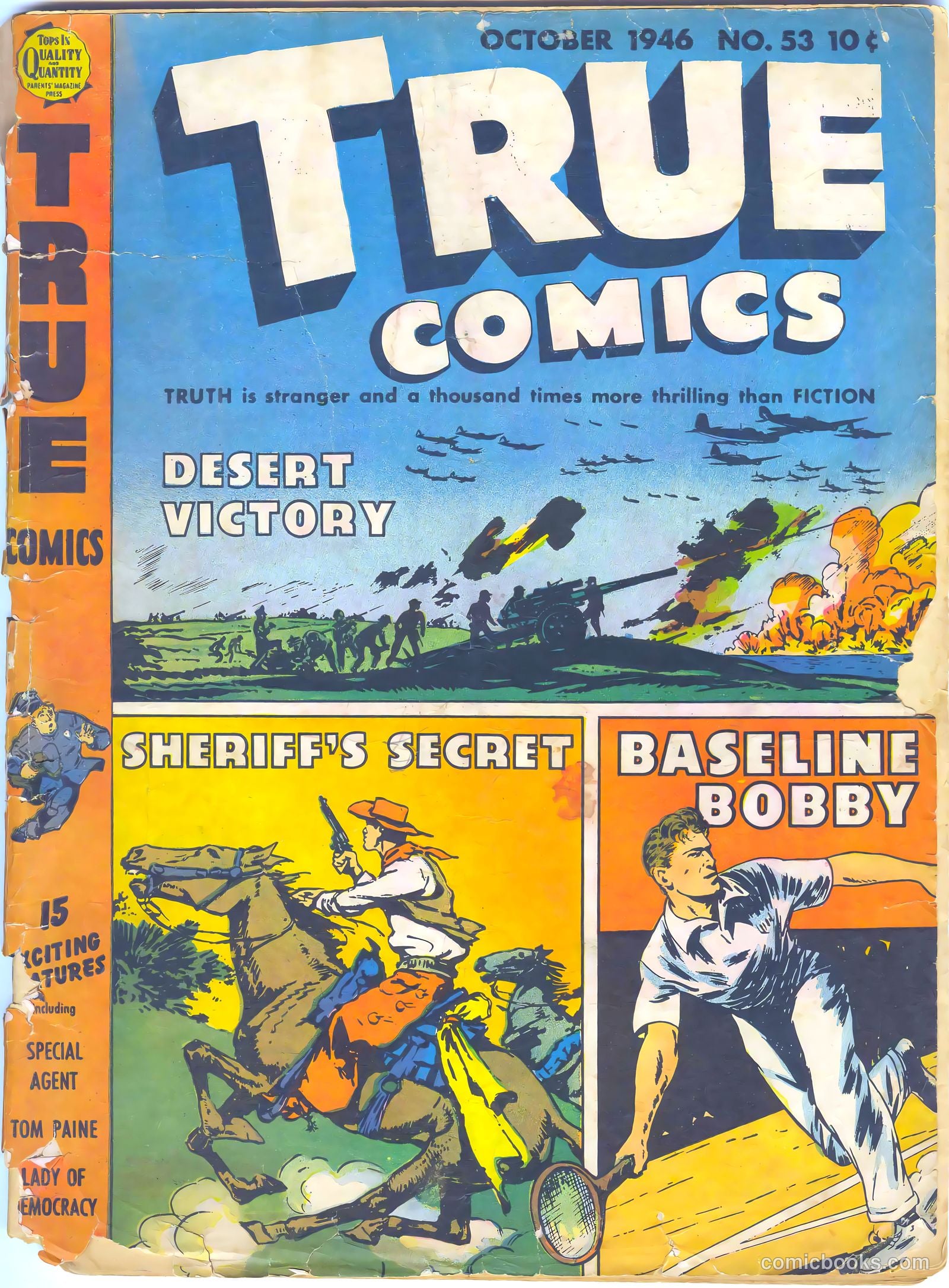
True Comics #53
☆ Be the first to review + Add to your collection — Join freeTrue Comics #53 is a solid mid-run entry in what Wikipedia identifies as the most successful — and certainly longest-running — educational comic book series of the Golden Age, a series that directly inspired DC Comics to launch its own Real Fact Comics imprint. The issue exemplifies the series' core mission of translating real-world biography and history into sequential art for young readers in postwar America, covering subjects ranging from Eleanor Roosevelt and Tom Paine to Wyatt Earp and Bobby Riggs — the last of whom would become far more culturally famous decades later, lending this particular issue an unexpected retrospective resonance. It also continues the recurring 'Secret Warriors' OSS adventure serial and the FBI's 'Special Agent' feature, two of the series' most popular ongoing strips. As part of a run overseen by one of the first formal editorial advisory boards in comics history — staffed by university historians, educators, and the pollster George Gallup — every issue of True Comics, including #53, represents an early experiment in using the comic book medium as a vehicle for credentialed, expert-supervised nonfiction.
True Comics #53 is an anthology presenting three factual stories. "Desert Victory" depicts a military engagement in a desert theater during wartime. "Sheriff's Secret" follows a tennis champion named Bobby Riggs who won the national clay court championship and the Eastern Grass Court Championship in 1937, and later won fifteen tournaments in 1938, ranking second nationally. "Baseline Bobby" continues Riggs's story, detailing his 1938 Davis Cup match at Germantown where he played ping-pong in the clubhouse when not competing. The issue also features "Special Agent Tom Paine" and "Lady of Democracy" among its stories.
When Eleanor Roosevelt entered the White House in 1933, she transformed the role of First Lady from ceremonial figurehead into active force for change, holding press conferences for women reporters, investigating conditions in Puerto Rico and West Virginia, and championing causes from youth employment to civil rights. Over twelve years, she became her husband's trusted assistant and eyes on the ground, traveling tirelessly to advocate for working people, students, and those denied opportunity. After the President's death in 1945, Roosevelt's work continued on the world stage as a United Nations delegate and chair of the Commission on Human Rights, dedicated to establishing an international bill of rights.
At El Alamein in the fall of 1942, British commanders Alexander and Montgomery devised an audacious deception to weaken Rommel's heavily fortified position without costly frontal assault. Motor torpedo boats, RAF bombers, and artillery coordinated a fake invasion complete with recorded battle sounds broadcast from speakers—convincing the Germans of a major seaborne attack and drawing their reserves away from the main line. The ruse worked perfectly, leaving the German defenses fractured when Montgomery's actual offensive struck.
This illustrated history traces the humble pencil from its Renaissance origins through its evolution into a modern industrial product—from the discovery of graphite in sixteenth-century England to Napoleon-era handmade treasures, and finally to twentieth-century mass production with rigorous laboratory controls. Learn how a simple drawing tool became something worth rewarding and protecting, and how today's pencil manufacturers ensure every stick meets exacting standards for strength and performance.
Robert L. Riggs took an unconventional path to tennis stardom—starting out convinced it was a "sissy" game before discovering a natural talent that would carry him from Los Angeles to national championships and beyond. This True Comics feature follows Bobby's scrappy rise through the ranks, from his first tournament victory just weeks after picking up a racket to competing at the highest levels of the sport, proving that heart and determination matter as much as size. Along the way, he'll face setbacks, hit the road chasing opportunities, and ultimately earn his place among the game's elite.
This five-page biography traces the remarkable life of Thomas Paine, from his humble beginnings in England through his emergence as a passionate advocate for human rights and democracy during the American and French revolutions. Armed with his pen and unshakeable conviction, Paine wrote landmark works like *Common Sense* and *The Crisis* that galvanized the American cause, then continued championing liberty across the Atlantic before enduring hardship and obscurity in his later years. Through it all, his fierce belief in freedom of speech, religion, and the dignity of the common man shaped the ideals that would outlive him.
This public service story presents the alarming impact of annual forest fires—over 200,000 blazes that destroy billions of trees and enough lumber to build thousands of homes—while offering readers practical safety rules to prevent such devastation when camping or picnicking in the woods. Through the concerns of citizens who've witnessed the real cost of carelessness, "Save Our Forests!" emphasizes the importance of proper fire prevention, from fully extinguishing cigarettes to ensuring matches are completely cold before disposal.
Doris Mae Gnauck turned a childhood passion for caring for sick chickens into genuine expertise, earning recognition as a poultry specialist while still a teenager in 1940s Wisconsin. From saving freezing flocks during brutal winters to diagnosing diseases on local farms, she became known for her knowledge—and surprised more than a few farmers who expected "Gnauck" to be a man. Now the first woman to major in poultry husbandry at the University of Wisconsin, she's pursuing her ambition to become a professor and researcher in the field.
Wyatt Earp arrives in Tombstone, Arizona in 1880 and uncovers a web of corruption linking the local sheriff's office to a rustling operation run by the Clanton-McLowery faction. When a gold shipment is robbed and the sheriff proves unwilling to pursue the thieves, Earp sets out on his own—only to discover he's been working as a special Wells Fargo agent all along, giving him the authority the corrupt town desperately needs. It's a tense showdown at the O.K. Corral that exposes the real crime running through the territory.
ComicBooks.com Value
Find on ebay
Read it digitally
Sell my copy
Have this issue — or a whole collection? Get a fair offer from us, skip the marketplace fees and the hassle.
We Buy Collections ▸History
True Comics was launched in April 1941 by The Parents' Institute, the publisher of Parents' Magazine, as a deliberate counter-programming effort against the superhero and adventure comics that critics of the era considered harmful to children. The series was structured around an unusually rigorous editorial apparatus: its advisory board included professors from Columbia and NYU, the editor of Parents' Magazine herself (Clara Savage Littledale), historian Hendrik Willem Van Loon, and even celebrity 'junior advisory editors' such as Shirley Temple and Roddy McDowall. By the time issue #53 reached newsstands in October 1946, the series had settled into a 52-page, full-color, ten-cent format (down from the original 68-page run of the earliest issues), with a stable rotating stable of artists including Sam Glankoff, Jack Sparling, Lorence Bjorklund, Louis Wolfe, and John Daly — the latter two also credited on the cover of this issue. True Comics, Inc., which produced the book, was formally a subsidiary of the Parents' Magazine publishing organization, with editorial offices in New York and printing operations in Chicago.
Trivia · 8 facts
- Published October 1946 by True Comics Press (True Comics, Inc.), a subsidiary of The Parents' Institute / Parents' Magazine; cover price ten cents, 52 pages, full color.
- Art and stories by Sam Glankoff, John Daly, Louis Wolfe, Lawrence Dresser, Ernie Schroeder, Jack Sparling, and Lorence Bjorklund; cover by Lorence Bjorklund and John Daly.
- Features a biographical story on Bobby Riggs — titled 'Baseline Bobby' — chronicling his early tennis career years before his 1973 'Battle of the Sexes' match against Billie Jean King gave him lasting pop-culture notoriety.
- Includes a story on Eleanor Roosevelt ('Lady of Democracy') and stories touching on historical figures Tom Paine and Wyatt Earp, consistent with the series' mission of presenting real-life biography in comics form.
- Continues two recurring series features: 'The Secret Warriors' (an ongoing dramatization of OSS wartime operations) and 'Special Agent of the Federal Bureau of Investigation,' the latter produced in cooperation with the FBI and running across many issues of the series.
- Also contains 'Monkey Business on Wall Street,' dramatizing a real 1946 incident in which a New York City pet shop accidentally released approximately one hundred monkeys into the city.
- True Comics #53 sits within what Wikipedia describes as the longest-running educational comic book series of its era (84 issues, 1941–1950), one that directly inspired DC Comics to create Real Fact Comics as a competing nonfiction title.
- The series' editorial board — which supervised all content including this issue — was one of the first formal advisory boards in comics history, staffed by university historians, educators, and public-opinion researcher George Gallup, as noted by historian Jill Lepore in The Secret History of Wonder Woman.
Full credits
Reprints
Reprinted in True Animal Picture-Stories #1 (1947), Red Ball Comic Book #[2] (1948), Special Agent #3 (1948), True Comics #84 (1950)
Key issues in True Comics
Reviews
Reader reviews
No reader reviews yet.