
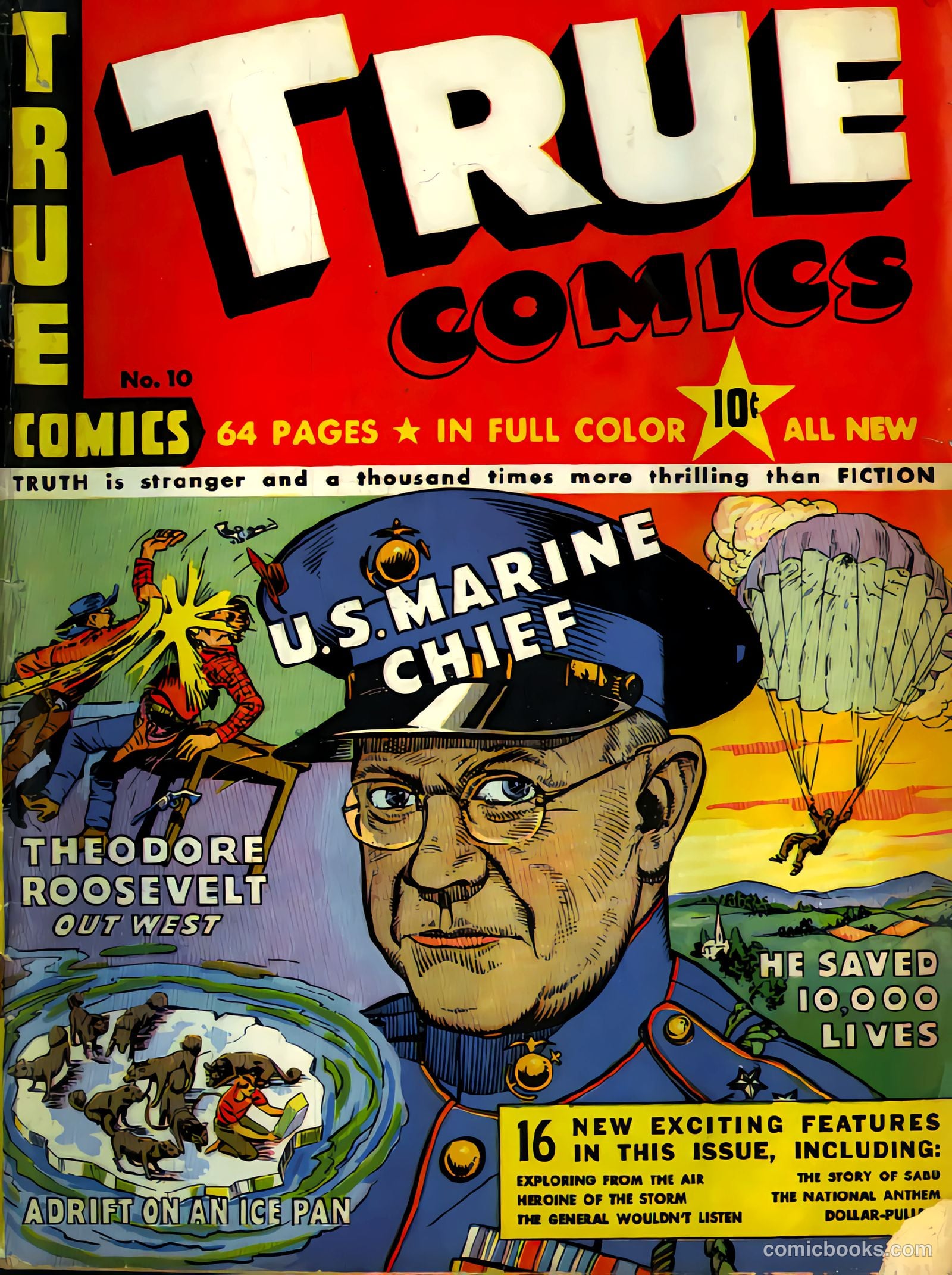
True Comics #10
☆ Be the first to review + Add to your collection — Join freeTrue Comics #10 is a representative early entry in what Wikipedia identifies as the most successful — or at least longest-running — educational comic book series of the Golden Age, a title that actively challenged the dominant superhero and adventure formula by insisting that factual biography and history could be just as gripping as fiction. Published in March 1942, only months after the United States entered World War II, the issue reflects the series' rapid pivot toward wartime civic education, blending profiles of military figures such as U.S. Navy Chief Admiral Harold R. Stark with international biography and agrarian history. By demonstrating that a commercially viable all-ages comic book could be produced without invented characters, True Comics directly inspired imitators including DC Comics' Real Fact Comics, reshaping what publishers believed the medium could accomplish. Its overarching editorial philosophy — governed by an unusually rigorous advisory board of university historians, educators, and the pollster George Gallup — made the series a genuine institutional experiment in comics as a vehicle for structured public education.
True Comics #10 is an anthology presenting factual stories about real people and events. "Exploring from the Air" tells of Jimmy Angel, a World War I aviator who discovered a 40,000-square-mile lost world in South America and the highest waterfall in the world. "The Story of Sabu" follows the rise of a young Indian elephant handler who became a Hollywood actor and star, eventually advising on animal expertise for film productions. "Theodore Roosevelt Out West" depicts Roosevelt's experiences as a cowpuncher in the Dakota territory, where he earned the respect of local cowboys through his toughness and skill before eventually running for President.
Major General Commandant Thomas Holcomb's rise through the Marine Corps spans decades of service shaped by his family's unbroken military legacy and his own devotion to marksmanship and innovation. From his early days as a sharpshooter who famously competed despite a rifle injury, through his service in the Philippines, China, and World War I, Holcomb earned a reputation as one of the Corps' toughest leaders. Now leading the Marines into a new era, he champions mechanization and speed, working alongside Admiral Harold Stark to transform the Corps into America's elite rapid-response force.
Samuel Morse begins his life as a talented painter in Massachusetts, earning his way through Yale and achieving recognition for his art in London and France. But on a voyage home in 1832, a conversation about electricity sparks an idea—what if messages could be sent instantly through wires?—and Morse becomes consumed with developing the telegraph, balancing his art career with perfecting his revolutionary invention. This is the remarkable true story of how a struggling artist transformed communication itself.
In 1755, George Washington serves as an aide to General Braddock during the French and Indian War, warning the commanding officer of a potential ambush as the British and colonial forces march toward Fort Duquesne—but Braddock dismisses the counsel, confident his European-trained soldiers need no guidance from local Indian scouts. When the French and Indians spring their trap the following morning, Washington finds himself rallying frightened troops through the chaos while Braddock's rigid tactics crumble under guerrilla warfare, leading to a devastating defeat that paradoxically establishes Washington's reputation and opens new doors for his military future.
A former World War aviator takes to the skies over South America on a hunt for gold, but Jimmy Angel's expedition across the wild Venezuelan plateau yields something far more extraordinary—a vast, uncharted wilderness teeming with prehistoric life and a waterfall of stunning proportions. With his wife at his side and a crashed plane behind him, Angel pursues his discoveries across treacherous terrain, driven by both fortune and the lure of exploring the unknown. This 1942 account in *True Comics* charts how aerial exploration transformed a soldier of fortune into a discoverer whose name would be etched into geography itself.
This educational feature traces bowling's rise from a 14th-century English pastime—nearly banned by royalty over concerns it threatened archery—through Sir Francis Drake's famous pre-battle game and the Dutch introduction of the sport to America, all the way to its modern dominance as the nation's most popular indoor activity. The story celebrates how bowling evolved from exclusive greens to accessible street alleys, and shows how skill rather than strength determines victory on today's lanes.
Sir Wilfred Grenfell, a doctor and missionary working in Labrador and Newfoundland, answers an urgent call to treat a gravely ill boy on Easter Sunday 1908—but his journey across a breaking ice inlet goes catastrophically wrong when he finds himself stranded on a drifting ice pan in the Arctic sea. Separated from his companions and facing deadly cold, Grenfell must use all his resourcefulness and the loyalty of his sled dogs to survive long enough for rescue. This extraordinary true account captures one of the remarkable adventures from over four decades of service in the frozen north.
Sabu arrives in rural India as an infant, nearly claimed by a cobra before his mother's quick thinking saves him—and from that harrowing start, his life becomes a remarkable journey from elephant keeper to international movie star. When a film crew discovers the young boy's natural mastery of animals, he's whisked away to England and Hollywood, where his gift for working with dangerous creatures makes him a trusted advisor on jungle pictures. Though he embraces his new life in America, Sabu never loses his deep connection to the beasts and people of his homeland, and he dreams of using his success to give back to the elephant boys of India.
When Norwegian refugees fleeing civil war discover Iceland in the ninth century, they establish a bold new settlement on this volcanic island between Europe and North America—founding the first republic in the Western Hemisphere over a thousand years ago. From the Norsemen's hardy traditions of law, wrestling, and fishing to Iceland's crucial modern role as a stepping-stone between two worlds, this story traces how a small island nation has remained a beacon of freedom through the centuries. In 1941, as the world faces new dangers, Iceland's legacy of independence takes on fresh importance when its leaders invite American protection in the face of wartime threats.
Theodore Roosevelt arrives in North Dakota as a young man seeking to restore his health, trading city life for the rough-and-tumble world of ranch work at Chimney Butte. Determined to prove himself among skeptical cowboys, Roosevelt earns their respect through courage and skill—from breaking a wild bronco named Dynamite to standing up to a belligerent gunslinger in town. His time out West transforms him from a tenderfoot into a seasoned man, setting him on the path toward the remarkable career that lay ahead.
The daughter of a lighthouse keeper on England's rocky coast, Grace Darling hears desperate cries one stormy night in 1838—and despite her fever, convinces her father that they're the only ones who can reach a ship wrecked on the rocks. Together, they brave the violent sea in a small boat to attempt a dangerous rescue. Her courage in the face of impossible odds would earn her a lasting place in history.
During the War of 1812, with Baltimore under siege and President James Madison determined not to surrender, U.S. Attorney Francis Scott Key negotiates with the British fleet to secure the release of a captured doctor—only to find himself detained aboard a British ship as the bombardment of Fort McHenry begins. Witnessing the American flag still flying over the fort at dawn after a night of relentless attack, Key is moved to compose a poem that captures the moment of defiance, which soon finds its way to a Baltimore singer and spreads across the city.
ComicBooks.com Value
Find on ebay
Read it digitally
Sell my copy
Have this issue — or a whole collection? Get a fair offer from us, skip the marketplace fees and the hassle.
We Buy Collections ▸History
True Comics was the creation of George J. Hecht, president of the Parents' Institute, the publishing house behind Parents' Magazine, which he had founded in 1926 with a child-welfare mission. The series launched in April 1941 and was editorially overseen by a senior advisory board that included Columbia University historians, New York University education professors, and Clara Savage Littledale of Parents' Magazine, with child-celebrity 'junior advisory editors' such as Shirley Temple and Roddy McDowall lending youth-audience credibility. Issue #10 was produced by Hecht alongside writer-editor Natalie Purvin Prager, the creative team responsible for most of the early run, and appeared just as the wartime context was beginning to inflect the series' subject selection toward active military leadership and hemisphere-spanning biography.
Trivia · 8 facts
- Published March 1942 by Parents' Magazine Press / True Comics Press as the tenth issue of the series, which ran for 84 issues from April 1941 to August 1950.
- Primary creative credits for this issue are George J. Hecht and Natalie Purvin Prager — the recurring writer-editor team for the early run of the series.
- Anchor feature 'He Saved 10,000 Lives, Part 1' dramatizes the life of Louis-Sébastien Lenormand, the French inventor of the modern parachute — a two-part story that concluded in issue #11.
- Issue includes 'Liberator of Mexico's Peasants,' an early comics biography of Mexican revolutionary Emiliano Zapata, making the issue an unusually politically global entry for a U.S. wartime children's publication.
- 'U.S. Navy Chief Admiral Harold R. Stark' reflects the series' shift toward featuring active wartime American military leadership in the months immediately following the attack on Pearl Harbor (December 1941).
- Additional stories include 'A Pig That Made History' (a Boston legal-history episode), 'The Count of Frontenac' (French colonial history), 'Carl Von Paulsen,' 'They Stole a Train,' and recurring reader-engagement departments 'Is It True?', 'Dollar Pullers,' and 'How Good is Your Memory?'
- The series that produced this issue was the first newsstand comic book devoted entirely to non-fiction biography and history, carrying the editorial motto 'Truth is stranger and a thousand times more interesting than fiction.'
- A Canadian edition of True Comics, titled True Picture-Magazine and carrying identical content, was published simultaneously by Parents' Magazine for the Canadian market.
Full credits
Reprints
Reprinted in True Aviation Comics Digest #2 (1943)
Key issues in True Comics
Reviews
Reader reviews
No reader reviews yet.