
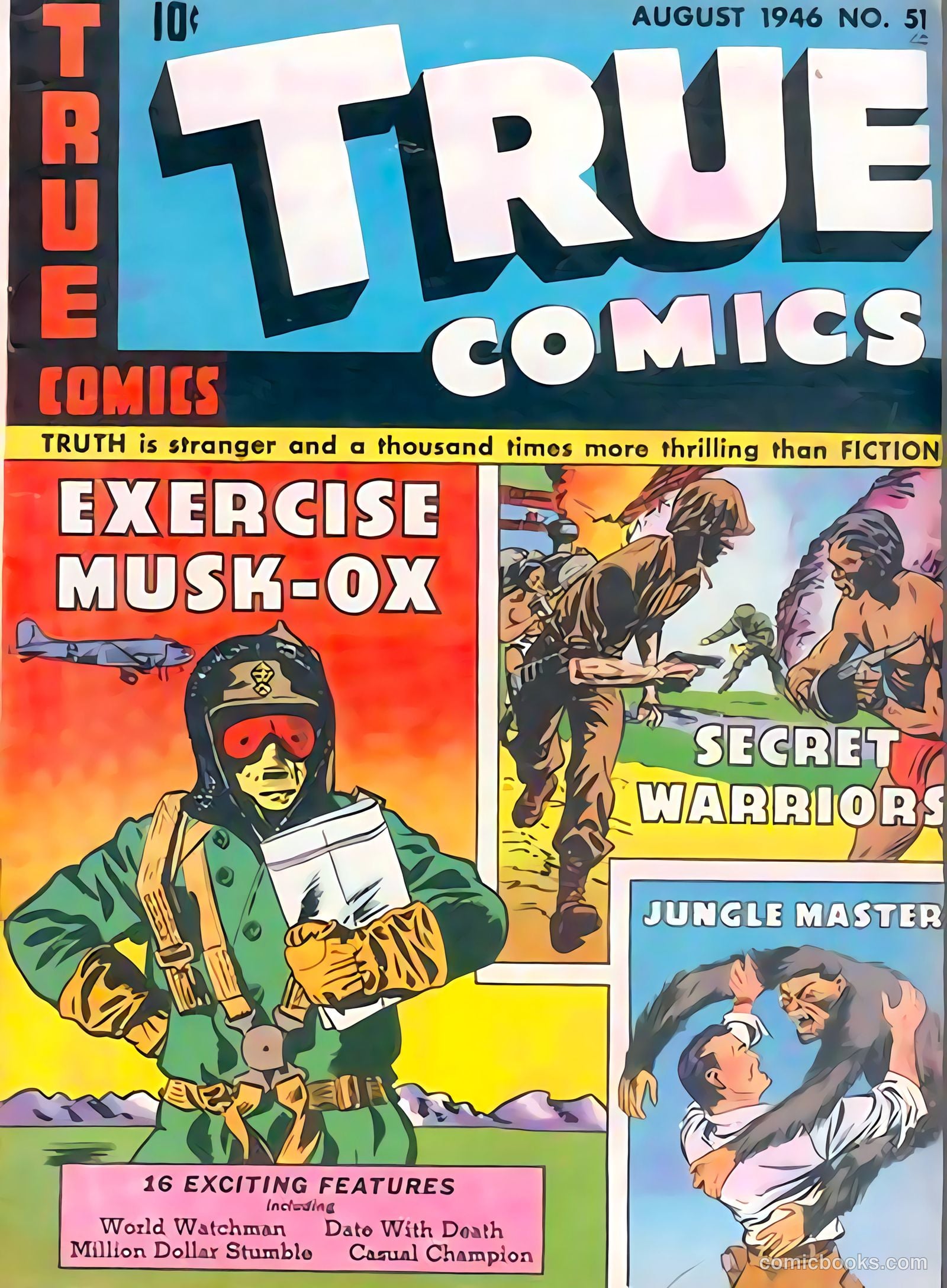
True Comics #51
☆ Be the first to review + Add to your collection — Join freeTrue Comics #51 (August 1946) is an anthology featuring 16 exciting factual stories. One story follows Dorothy Kirby and Patty Berg's golf careers, chronicling their amateur success and Dorothy's victories in Western Amateur tournaments leading to her winning the Western Amateur title twice. Another story details the life of William T. G. Morton, who pursued dental research at Baltimore College of Dental Surgery in 1840, later formed a dental practice partnership, attended Harvard Medical School, and ultimately sought to understand the causes of pain through medical knowledge.
A capable Norwegian lawyer and Labor Party champion, Trygve Lie rises through politics and wartime service to become a leading voice for international cooperation. When the Nazis invade Norway in 1940, Lie's foresight in stockpiling food supplies helps sustain his nation, and he pivots to foreign diplomacy as the country's government flees into exile. His steady hand during the birth of the United Nations earns him nomination and election as Secretary General, positioning him to tackle the world's most pressing postwar challenges.
When an American poster meant for Florida Seminoles arrives at an Alaskan trading post, a misunderstanding sparks a chain of goodwill—a group of Alaskan Indians, concerned that Uncle Sam appears barefoot in the image, decide to send him handmade moccasins as a gift. What begins as a joke sets off a series of well-intentioned efforts to honor the gesture without causing offense. "Gift to 'Big Chief'" captures a heartwarming tale of cross-cultural misunderstanding and the lengths people go to do right by one another.
In 1681, King Charles II grants William Penn land in America, and as the Quaker leader proposes names for his new territory, a playful misunderstanding between Penn and the King's secretary sets the stage for an unexpected honor. When Penn learns the land will bear his own name rather than a description of its forests, he's troubled by what he fears is vanity—until a revelation about whom the King truly means to commemorate puts his mind at ease. This is the true story of how Pennsylvania got its name.
Young Dorothy Germain of Drexel Hill, Pennsylvania, excels at basketball and fencing, but her father convinces her to take up golf instead—a sport she initially approaches as just a favor to him. As she trains under pro Marty Lyons, Dorothy's natural talent emerges, though knee injuries from her other athletic pursuits threaten to derail her golfing ambitions. This biography traces her rise through amateur tournaments and setbacks, showcasing the determination that would make her one of golf's rising stars.
During the October 1943 assault on Japanese-held Treasury Island in the Solomons, Seabee Aurelio Tassone devises an unconventional tactical solution when his unit encounters a heavily fortified enemy pillbox. Using his bulldozer as both shield and weapon, Tassone executes a daring maneuver that turns the tide of the battle and demonstrates the vital, often overlooked contribution of the Seabees to the war effort.
This 1946 educational story traces the history of food canning from Napoleon's era through modern industrial practice, following how a Parisian confectioner's prize-winning preservation method evolved from glass jars to metal containers, gained acceptance during the Civil War, and eventually became a carefully controlled process where brand-name canners oversee everything from seed selection to the final can. Discover how ingenuity and industry transformed food preservation from experimental curiosity into a reliable system that serves the nation.
When Japanese forces cut off the supply route to China in 1942, the Office of Strategic Services turned to an unlikely solution: recruiting and training the Kachin people of Burma, a fierce tribe with every reason to fight the occupation. Major Carl Eifler and his OSS team, guided by Father Stuart, venture into the jungle to forge an alliance that will transform 250,000 "monkey-eaters" into a formidable guerrilla force. What unfolds is a hard-won partnership of survival, strategy, and shared purpose as these warriors take the fight directly to the Japanese.
Forty-five Canadian scientists, American, and British observers join an ambitious Arctic expedition across 3,200 miles of Canada's icebound north, led by Lt. Col. P.D. Baird of Montreal. The team tests military equipment and collects meteorological data using specialized vehicles and air support, braving some of Earth's most unforgiving terrain to chart a path for future exploration and resource development in the Arctic.
Dr. William Morton's decades-long quest to eliminate pain through scientific experimentation culminates in a public demonstration at Massachusetts General Hospital, where he proves that surgical operations can be performed without suffering. Despite skepticism from the medical establishment, Morton's discovery of ether revolutionizes surgery and earns him recognition as a hero of medical science. This five-page biography celebrates how persistence and innovation can transform medicine and save countless lives.
In 1658, Captain Christopher Mings of the British Navy led his crew to Lake Maracaibo, Venezuela, searching for buried Spanish treasure—only to stumble upon a far greater fortune when a lucky accident reveals the hidden riches beneath the jungle floor. This swift tale of adventure and serendipity shows how sometimes the greatest discoveries come not from careful planning, but from an unexpected twist of fate.
When Fort Corregidor fell to the Japanese in May 1942, Colonel Bunker made a silent choice: he'd save a piece of the American flag rather than let the enemy claim it whole. Separated from his friend Colonel Ausmus in a prison camp, the two soldiers kept fragments of that flag hidden through years of captivity, each praying the other would survive to bring their relic home. Their remarkable true story of sacrifice and patriotism culminates in an honor befitting the courage they witnessed on Corregidor's final day.
Frank Buck started as a small-town boy with a passion for animals, collecting creatures from his childhood and eventually trading his Texas roots for the world's wildest jungles as one of history's greatest animal hunters. From trapping pythons in Singapore to capturing a man-eating tiger and even wrangling a leopard loose on a ship, Buck's daring expeditions across South America, Asia, and beyond earned him fame—and later, a second career writing bestselling books and producing motion pictures based on his extraordinary exploits. This is the true story of how a young dreamer became a legend of the jungle.
Captain Thomas G. Lanphier and his squadron execute a daring aerial ambush in the South Pacific, targeting a high-value objective whose movements have been precisely calculated from intercepted intelligence. Flying at low altitude to evade detection, Lanphier must navigate not only the deadly escort fighters but also his own mounting fuel concerns to complete the mission. Based on a true 1946 wartime exploit, this story captures the razor-thin margins between success and disaster at combat altitudes.
ComicBooks.com Value
Show all 7 grades ▾
Find on ebay
Read it digitally
Sell my copy
Have this issue — or a whole collection? Get a fair offer from us, skip the marketplace fees and the hassle.
We Buy Collections ▸Reprints
Reprinted in True Animal Picture-Stories #1 (1947), Red Ball Comic Book #[2] (1948), Girls' Fun and Fashion Magazine #47 (1950)
Key issues in True Comics
Reviews
Reader reviews
No reader reviews yet.