
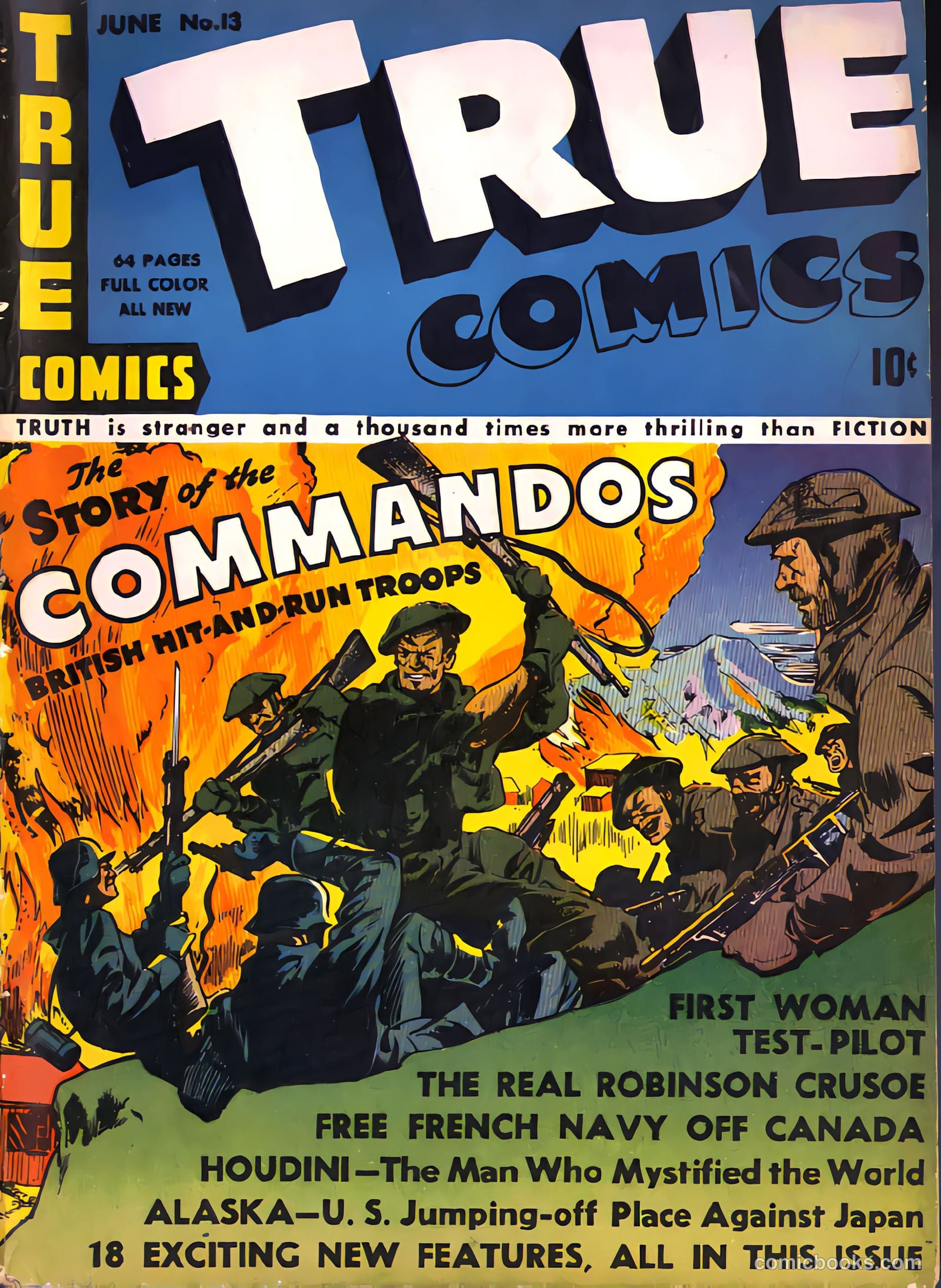
True Comics #13
☆ Be the first to review + Add to your collection — Join freeTrue Comics #13 is an anthology featuring multiple true-life stories presented as educational comics. Featured stories include "The Story of the Commandos: British Hit-and-Run Troops," an account of military special operations; "Houdini—The Man Who Mystified the World," chronicling the famous escape artist's rise from circus performer to international celebrity; "The Real Robinson Crusoe," detailing a castaway's survival; "First Woman Test-Pilot"; "Free French Navy off Canada," depicting naval forces operating with a mysterious mission involving code messages and submarine encounters; and "Alaska—U.S. Jumping-off Place Against Japan." The issue also includes interactive features such as "Your Glass Quiz," a 20-item visual puzzle identifying glass objects.
Admiral Ernest J. King's rise from a young dreamer in Ohio to the commanding officer of the U.S. Navy unfolds through decades of service—submarine rescues, air combat training, and combat observation during the world wars—that forge him into the only leader capable of taking the helm as Commander in Chief. When Japan attacks Pearl Harbor in 1941, King accepts his mandate to lead the Navy through the trials ahead, armed with hard-won expertise across sea, air, and underwater warfare. This is the story of how one man's determination and diverse experience prepared him for the moment his nation needed him most.
William Sidney Porter, better known by his pen name O. Henry, found himself stranded in Salvador on the Fourth of July—and decided to celebrate the American holiday in rousing frontier style with a ragtag crew of locals and fellow expatriates. When their spirited Independence Day festivities accidentally thwart an actual armed rebellion threatening the region, Porter and his companions discover that sometimes the best adventures come from simply making a little noise for the right reasons.
This 1942 True Comics feature traces the origins and rigorous training of Britain's commando forces, from the hit-and-run Boer tactics of South Africa to the elite volunteer units operating in World War II. Drawn from every branch of the army, these soldiers endure severe conditioning in combat skills, navigation, amphibious operations, and survival—learning to move silently through enemy territory, handle explosives, and operate as independent fighters when separated from their units. By the story's end, after months of relentless preparation, these commandos are ready to strike behind Nazi lines.
Alaska transformed from a remote wilderness into a vital American strategic asset in this fascinating historical account. Tracing the territory's discovery by Russian explorers through its purchase by the United States and subsequent development of vast natural resources—gold, timber, furs, and fisheries—the story shows how what many once dismissed as worthless frozen land became essential to national defense in the Pacific.
This 1942 non-fiction story traces glass from its accidental discovery around 2500 B.C. through its journey to America, where craftsmen like Caspar Wistar and Henry Stiegel built the nation's glass industry—complete with Benjamin Franklin's invention of bifocal spectacles along the way. The narrative then shifts to showcase how modern machinery has transformed glassmaking, from machine-blown bottles to pressed lenses, and highlights glass's crucial role in the war effort, from range-finders and fighter-plane windows to food containers that preserve rations for fighting troops.
When Scottish sailor Alexander Selkirk ran away to sea at nineteen, he eventually found himself marooned on the remote Juan Fernandez Island after jumping ship from a brutal captain—forced to survive alone by taming wild goats and cats, tracking the endless days by notches carved in a tree. Years later, a rescue by an English vessel brings Selkirk back to civilization, where his incredible true story of survival becomes the inspiration for Daniel Defoe's timeless novel *Robinson Crusoe*. This is the real tale behind one of literature's greatest adventures.
Alma Heflin refuses to settle for amateur flying, pursuing a career as a serious pilot and breaking barriers in the male-dominated aviation industry during the 1940s. Her determination leads her from flying treacherous routes to becoming the first woman apprentice in an airplane factory, and eventually to the cockpit as a test pilot evaluating planes for military service. Each week she puts new aircraft through their paces—from engine climbs to devastating power dives—knowing her thorough work keeps training pilots safe.
Hugh Noyes Mulcahy, a pitcher for the Philadelphia Phillies, has climbed from the minors to the majors through talent and determination—but in March 1941, he makes a choice that surprises his teammates and fans alike when he enlists in the U.S. Army. This is the story of how one ballplayer stepped away from the big league to answer a bigger call.
In 1870, Colonel Albert J. Fountain volunteers to track a dangerous Indian war party threatening settlers, armed with his trusty Henry repeater rifle and guided by an old Indian friend's warning. After a harrowing two-day pursuit through the mountains, Fountain uses his rifle's superior firepower to hold off his attackers while his companion Pedro races to Fort McCrea for reinforcements. A true frontiersman at heart, Fountain's mission reflects the settlers' struggle for peace and security in the untamed West.
ComicBooks.com Value
Find on ebay
Read it digitally
Sell my copy
Have this issue — or a whole collection? Get a fair offer from us, skip the marketplace fees and the hassle.
We Buy Collections ▸Reprints
Reprinted in True Aviation Comics Digest #2 (1943)
Key issues in True Comics
Reviews
Reader reviews
No reader reviews yet.