
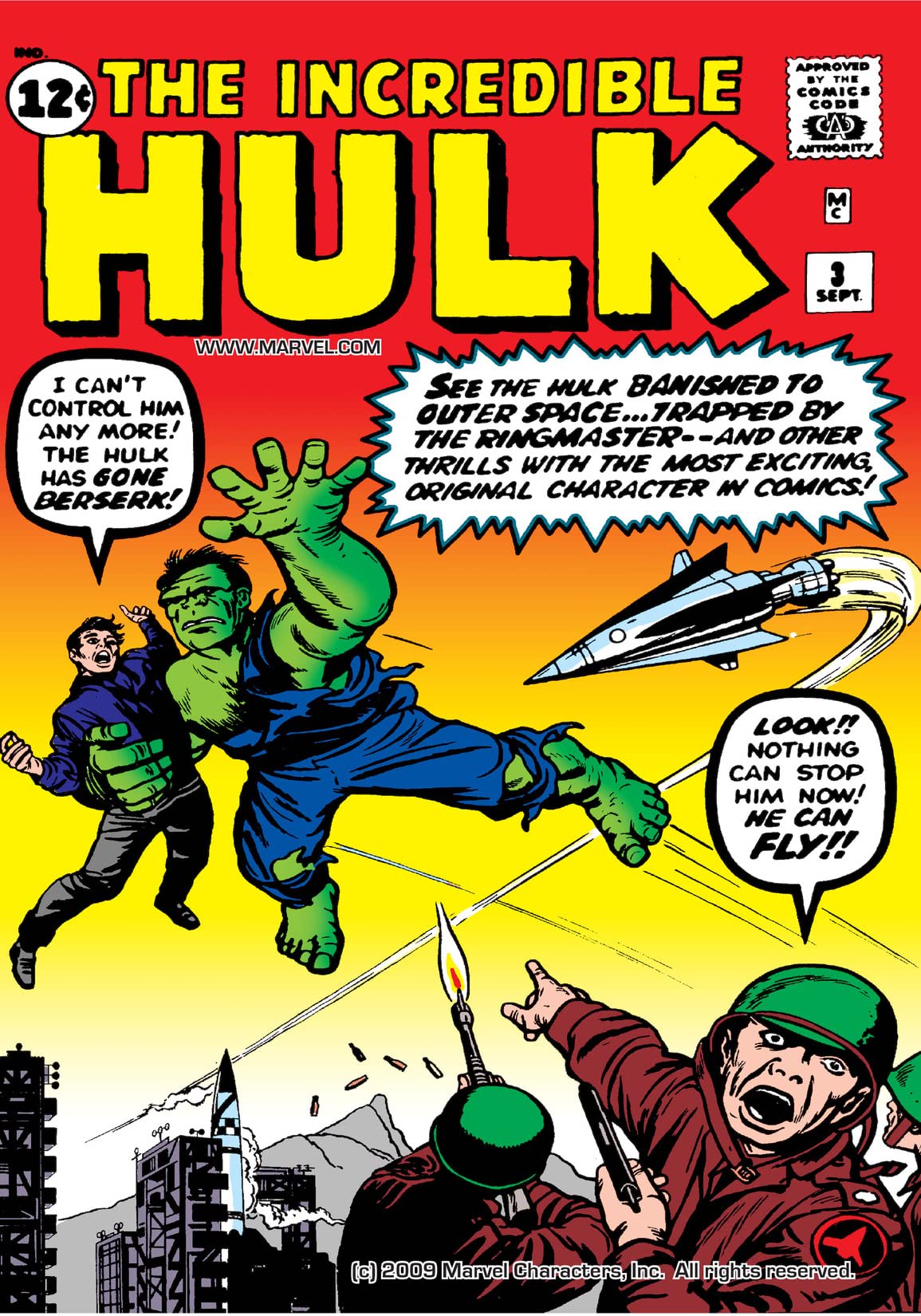
The Incredible Hulk #3
The Incredible Hulk #3 is one of the most structurally eventful issues of the original six-issue run, packing in three separate milestones across its 36 pages. It marks the Silver Age debut of Maynard Tiboldt — the Ringmaster — along with his entire Circus of Crime ensemble, introducing a villain collective that would go on to bedevil the Hulk, Spider-Man, and the Avengers for decades. Beyond the first appearances, the issue reshapes the Hulk's fundamental rules: the space-rocket story establishes for the first time that the Hulk can exist during daylight hours, breaking the strict night-only transformation mechanic set in the first two issues, while a secondary dose of cosmic radiation forges a mental link between the Hulk and Rick Jones — a story engine that would drive the title through the rest of its original run and foreshadow decades of gamma-lore about psychic bonds. One fan commentator also noted that the premise of shooting the Hulk into space to be rid of him, and the terrified officer's warning that he'll return unstoppable, arguably planted the seed for the Planet Hulk and World War Hulk sagas that arrived decades later.
In "Banished to Outer Space," the Hulk is unwittingly launched into orbit by General Ross, who tricks him into a test rocket under the guise of national security. With the sun's rays triggering his transformation, Bruce Banner is exposed to new radiation during the journey, leaving the Hulk permanently unable to return to his human form—now bound to Rick's will, but only as long as Rick stays awake. Written by Stan Lee and illustrated by Jack Kirby, with inks by Dick Ayers and colors by Stan Goldberg, this pivotal 1962 issue features a cover by Kirby and Ayers, marking a turning point in the Hulk's story.
In "Banished to Outer Space," the military captures Rick, who convinces General Ross that the Hulk must test a new experimental rocket for national security. After tricking the Hulk into the capsule, Rick sends him into space—only to realize Ross has used him to eliminate his enemy. When Rick overrides the rocket’s programming to return to Earth, Banner, transformed back to human form under the sun’s light, is exposed to more radiation. Now permanently the Hulk, he remains under Rick’s control—so long as Rick stays awake.
In "The Ringmaster," Rick takes a rare break from his Hulk-sitting duties and heads to a traveling circus—only to find himself under the spell of a hypnotic criminal running the show. When the Hulk arrives to rescue his friend, he’s captured and forced into the act, his strength turned into spectacle while Rick remains under the ringmaster’s control.
ComicBooks.com Value
Show all 21 grades ▾
This exact issue on ebay
CGC 5.5 ▾ $1,900–$2,650 3 listings
CGC 3.5 ▾ $850–$941 2 listings
Raw / ungraded ▾ $3.19–$495 15 listings
More listings for this title
Read it digitally
Sell my copy
Have this issue — or a whole collection? Get a fair offer from us, skip the marketplace fees and the hassle.
We Buy Collections ▸History
The issue was written by Stan Lee, penciled by Jack Kirby, inked by Dick Ayers, lettered by Art Simek, and colored by Stan Goldberg — the same core creative team that had launched the title just months earlier in May 1962. It was released on July 3, 1962, carrying a September 1962 cover date, as part of the brief original Hulk series that would run only six issues before cancellation. The series was a product of Marvel's early Silver Age experimentation: Lee and Kirby were consciously straddling the monster-comic market they had cultivated through the Atlas era and the emerging superhero market ignited by Fantastic Four, and the Hulk's rapid, issue-by-issue rule changes — color, transformation triggers, and control mechanics all shifted across the six issues — reflect that ongoing creative negotiation in real time.
Trivia · 8 facts
- First appearance of the Ringmaster (Maynard Tiboldt, son of Golden Age villain Fritz Tiboldt) and his Circus of Crime, including the Human Cannonball, Bruto the Strongman, and Teena the Fat Lady — all Silver Age debuts.
- First time the Hulk is shown transforming during daylight hours; in issues #1 and #2, Banner could only become the Hulk at night.
- Establishes the mental/telepathic control Rick Jones has over the Hulk, born of a second accidental cosmic-radiation dose — a key plot mechanic that carries through the remaining original issues.
- Contains three distinct stories: 'Banished to Outer Space!' (Hulk shot into orbit by General Ross), 'The Origin of the Hulk!' (a three-page recap of events from issue #1), and 'The Ringmaster' (first Circus of Crime story).
- Also showcases the Hulk's superhuman leaping ability in an early prominent display — described as his signature mode of travel.
- Credited creative team: Writer — Stan Lee; Pencils — Jack Kirby; Inks — Dick Ayers; Colors — Stan Goldberg; Letters — Art Simek. Cover also by Kirby and Ayers.
- The issue has been widely reprinted, including in Essential Hulk Vol. 1, Marvel Masterworks: The Incredible Hulk Vol. 1 (multiple editions), the Incredible Hulk Omnibus Vol. 1, the Epic Collection: Incredible Hulk Vol. 1, and the Mighty Marvel Masterworks: The Incredible Hulk Vol. 1 — The Green Goliath (2021).
- The Ringmaster (Maynard Tiboldt) debuted here as a Silver Age reinvention of the original Ringmaster (Fritz Tiboldt), a Golden Age Nazi villain who first appeared in Captain America Comics #5 (1941) — linking the new villain to Marvel's wartime continuity.
Cast · 10 characters
Full credits
Reprints
Reprinted in Marvel Tales Annual #2 (1965), The Incredible Hulk #72-124 (1966), Marvel Collectors' Item Classics #3 (1966), Smash! #19 (1966), Koloss #3/1968 (1968), Incredible Hulk [King Size Special] #2 (1969), The Mighty World of Marvel #5 (1972), The Mighty World of Marvel #6 (1972), Hulk #3 (1974), Giant-Size Defenders #1 (1974), The Mighty World of Marvel #100 (1974), Marvel Treasury Edition #5 (1975), Hulk E I Difensori #2 (1975), Incredible Hulk Annual #1978 (1978), The Incredible Hulk #[nn] (1978), The Incredible Hulk #[1] (81446-X) (1978), The Incredible Hulk #[nn] (1978), De spectaculaire Spider-Man #2 (1979), Edderkoppen pocket [Edderkoppen superseriepocket] #1 (1979), Gamma la bombe qui a créé Hulk #[1] (1979), Hulk Pocket Book #2 (1980), L'Incredibile Hulk #11 (1981), L'Incredibile Hulk #12 (1981), Hulk #2 (1982) + 36 more
Key issues in The Incredible Hulk
Variants (1)
Reviews
Reader reviews
No reader reviews yet.