
The Flash #133
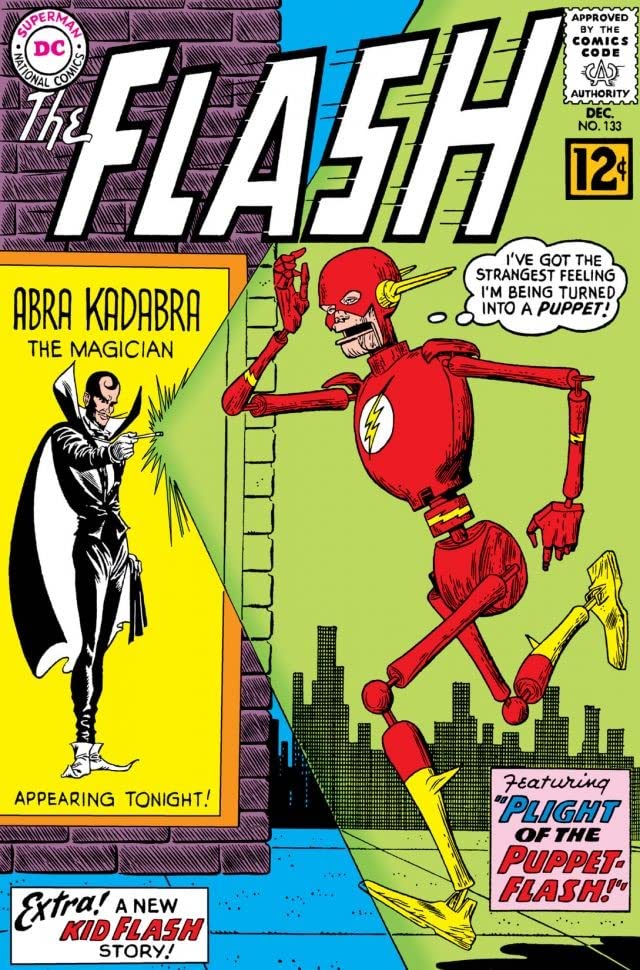
☆ Be the first to review + Add to your collection — Join freeThe Flash #133 (cover date December 1962) holds a clear, concrete key-issue designation: it is the second appearance and the first cover appearance of Abra Kadabra, the 64th-century time-traveling illusionist who would become one of the most enduring and conceptually distinctive members of the Flash's Rogues Gallery. Abra Kadabra's premise — that sufficiently advanced future technology is indistinguishable from stage magic, and that an applause-starved performer might cross millennia just to find an audience — gave Silver Age storytelling a genuinely original villain archetype, one that grew richer as later writers expanded his role in multi-decade arcs. The issue also features a backup story in which three disabled boys independently deduce Kid Flash's secret identity, a plot thread that shows the Schwartz-era editorial team deliberately crafting emotionally grounded superhero stories for younger readers, well before such sensitivity was standard practice. Together, the two stories make this issue a meaningful cross-section of what the Broome-Infantino-Schwartz machine was capable of producing at full creative stride.
In "The Plight of the Puppet-Flash!", the Flash faces his most bizarre foe yet when the time-traveling trickster Abra Kadabra, freed from prison through futuristic trickery, orchestrates a humiliating campaign to undermine him—turning the Fastest Man Alive into a marionette and exposing him in a twisted puppet show. Written by John Broome and brought to life with dynamic art by Carmine Infantino, inks by Joe Giella, and lettering by Joe Letterese, this 1962 classic features a cover by Carmine Infantino and Murphy Anderson that captures the absurd menace of the moment.
In "The Plight of the Puppet-Flash!", Abra Kadabra, newly freed thanks to his futuristic trickery, turns his sights on the Flash, orchestrating a scheme to ruin Barry Allen’s reputation. Using his cunning and strange science, he manipulates events to turn the hero into a puppet, staging a humiliating performance that leaves Iris West and the city stunned.
ComicBooks.com Value
Show all 22 grades ▾
This exact issue on ebay
CGC 9.4 ▾ $1,530–$1,750 2 listings
Raw / ungraded ▾ $38.7–$50 3 listings
More listings for this title
Read it digitally
Sell my copy
Have this issue — or a whole collection? Get a fair offer from us, skip the marketplace fees and the hassle.
We Buy Collections ▸History
The issue sits squarely within the most productive stretch of the Silver Age Flash, written by John Broome — who scripted the majority of Barry Allen's Silver Age adventures from Showcase #4 through 1970 — and drawn by Carmine Infantino, the artist whose streamlined, space-age visual language had defined the character since his 1956 revival. Interior inks were handled by Joe Giella, while the cover was inked by Murphy Anderson, a common split on the title at the time. Editor Julius Schwartz, whose science-fiction sensibility shaped the entire Silver Age Flash lineup, had introduced Abra Kadabra just five issues earlier in The Flash #128 (May 1962), and the rapid return in #133 signals that the creative team recognized they had landed on a villain concept worth developing quickly.
Trivia · 8 facts
- Second appearance of Abra Kadabra (Citizen Abra), whose debut was The Flash #128 (May 1962), also by John Broome and Carmine Infantino.
- First cover appearance of Abra Kadabra — the 'Puppet Flash' cover by Infantino (pencils) and Murphy Anderson (inks) is the character's first prominent visual showcase on a newsstand cover.
- Lead story titled 'The Plight of the Puppet-Flash!' — written by John Broome, penciled by Carmine Infantino, inked by Joe Giella — in which Abra Kadabra engineers a gubernatorial pardon via hypnosis, launches a smear-campaign puppet show depicting the Flash as a buffoon, and ultimately transmutes Barry Allen into a literal puppet.
- Backup story titled 'Secret of the Handicapped Boys!' — also by Broome and Infantino/Giella — in which Wally West's Kid Flash identity is deduced by three disabled children at a summer camp: one who is mute, one deaf, and one blind, each using a different sense to piece together the clues.
- The issue was on sale October 25, 1962, with a cover date of December 1962, published by National Periodical Publications (DC) at the standard Silver Age cover price.
- Abra Kadabra is established as a time-traveler from the 64th century whose 'magic' is purely advanced technology — a science-fiction framing device that made him conceptually distinct from supernatural villains and consistent with Julius Schwartz's preference for scientifically grounded storytelling.
- The issue has been reprinted multiple times in multiple countries and formats, including Showcase Presents: The Flash Vol. 2 (2008), The Flash Archives Vol. 5 (2009), The Flash: The Silver Age Omnibus Vol. 2 (2017), and The Flash: The Silver Age Vol. 3 trade paperback (2018), as well as international editions in Australia, Germany, Sweden, and the Netherlands in the 1970s.
- Abra Kadabra later appeared in the live-action Arrowverse series The Flash, portrayed by David Dastmalchian, and has remained a recurring antagonist across multiple DC continuities and storylines into the 21st century.
Full credits
Reprints
Reprinted in The Hundred Comic #79 (1963), Flash #51 (1963), The Flash #169 (1967), All Favourites Comic #63 (1967), Lynet #3/1968 (1968), The Flash #202 (1970), Flash #3/1971 (1971), Flits Classics #2619 (1971), Superman Presents Tip Top Comic Monthly #75 (1971), The Flash #229 (1974), Flash #25 (1975), Showcase Presents: The Flash #2 (2008), The Flash Archives #5 (2009), The Flash: The Silver Age Omnibus #2 (2017), The Flash: The Silver Age #3 (2018), The Hundred Comic #80, Top Comics Blitzmann #113
Key issues in The Flash
Reviews
Reader reviews
No reader reviews yet.