
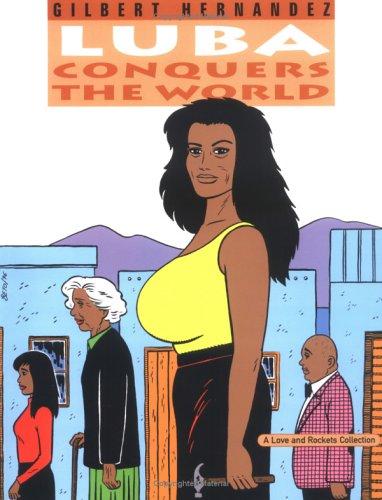
The Complete Love & Rockets #14
☆ Be the first to review + Add to your collection — Join freeThis volume collects the early 'Luba' stories from Gilbert Hernandez's contributions to the Love and Rockets series, following the larger-than-life character Luba as she navigates family drama, political upheaval, and her own formidable presence in the fictional Central American town of Palomar. Originally serialized in the comic book series, these tales showcase Hernandez's intricate, soap-operatic storytelling and expressive black-and-white art. The collection is part of Fantagraphics' comprehensive 'Complete Love & Rockets' library, which gathers the Hernandez brothers' landmark independent comic in chronological order.
In "Farewell, My Palomar...", Jesus reconnects with Marcos after his release from jail, their moment shadowed by the past and the weight of time. As he moves through the city, he encounters Israel in his high-rise office and Satch in his home at Felix, each a ghost of Palomar’s tangled history. Flashbacks reveal the boys’ failed attempt to get a bath from Luba at her bañadora business, a quiet memory that echoes through the story’s emotional core.
In "Farewell, My Palomar, Part 2," Jesus returns to the outskirts of Palomar, haunted by the weight of his past, only to stand before Tonantzin Villasenor’s grave. Flashbacks reveal the quiet unraveling of his marriage and the choices that led to his imprisonment, casting a long shadow over his present. Amid the echoes of old lives and buried regrets, the town itself feels like a witness to a story that never truly ended.
In "Farewell, My Palomar, Part 3," the close-knit community of Palomar gathers for a bittersweet celebration as Guadalupe prepares to leave for the States to pursue her studies and Pipo Jimenez sets off to expand her sportswear business. Amid the laughter and farewells, Pipo asks Sergio to keep her departure a secret, but Luba—watching quietly—already knows the truth. The town’s warmth and quiet undercurrents of change ripple through the final moments before departure.
In "Farewell, My Palomar, Part 4," Gato Reyna confronts Vicente about the painful decision to fire him from the plant, laying bare the weight of choices made under pressure. Guadalupe seeks guidance from Jesus as she prepares to leave for the States, while Sergio’s anger erupts in a sudden clash with his father Gato. Amidst these moments, quiet scenes unfold—Jesus and Tonantzin in a tender memory, Luba and her family at the beach—each thread weaving into the complex, enduring life of Palomar.
In "A Trick of the Unconscious," Casimira flees into the night after her friend Bruno is attacked by a black bird that steals his eye, driven by a desperate need to confront the creature. She stumbles through a dreamlike cemetery where she encounters older versions of Joselito, Concepcion, and Socorro at a wake—possibly her own—while the lives of others unravel in parallel: Doralis endures her husband’s cruelty, Socorro grapples with a shocking revelation about her father, and Sergio, Jesus, and Gato navigate new beginnings in Los Angeles.
In "Pipo," the eponymous woman reflects on her life with quiet intensity—her origins, the birth of her son, her marriage and divorce from Gato, and the quiet determination that built her successful sportwear business in Palomar and later in Hollywood, all while navigating a world where she didn’t know a word of English. The story unfolds as a personal reckoning, weaving memory and resilience into a portrait of a woman shaped by love, loss, and quiet ambition.
In a 1927 Chicago flashback, Gorgo escapes a trap set by gangsters and exacts a brutal revenge, protecting his father’s life. Years later, back in Palomar, Gorgo shares a cryptic moment with a mysterious tree, as if testing fate or confronting something beyond human understanding—Papa Pito and Tipin’ Tipin witness the quiet intensity of his revelation.
In "Mouth Trap," young Fritz and her sister Petra are left alone when their mother, Maria, disappears after going out to eat—leaving the girls to fend for themselves in their rundown apartment. The story quietly captures the fragile tension of childhood isolation, as the sisters navigate hunger, fear, and the quiet dread of abandonment.
In "Love Story," Petra navigates a series of fragmented memories and moments that span years, stitching together a past defined by loss, connection, and quiet revelation. From her recovery after surgery to a childhood encounter with Gorgo, whose life intersects with hers in unexpected ways, the story unfolds through sudden shifts in time—each one revealing more about the ties that bind Petra, Maria, and the mysterious Gorgo. As secrets surface and old wounds resurface, the past refuses to stay buried, shaping the fragile present in ways neither she nor those around her fully understand.
In *Bread, Love and Maria*, Gorgo delivers news to Hector Martinez that his ex-wife Maria has died, triggering a poignant journey through decades of memory. Spanning from their first meeting at a 1948 beauty pageant to their marriage, divorce, and the years Hector spent in hiding after turning on the mob to protect Maria, Petra, and Fritz, the story unfolds in nonlinear flashes that reveal the deep, enduring threads of love, loyalty, and loss.
In "The Gorgo Wheel," Doralis tracks down Gorgo after seeing him in the news, drawn by a mysterious pull to uncover long-buried family secrets. As she presses him to reveal the full story of his ties to her aunts Fritz and Petra, the past unfolds in layered flashbacks—revealing hidden connections, shifting loyalties, and the quiet moments that shaped lives across generations. With the Martinez family gathering and a journey southward in motion, the story weaves between memory and present, tracing how love, loss, and legacy echo through time.
In "Luba Conquers the World," Luba reconnects with her half-sisters Fritz and Petra, setting the stage for new chapters in the lives of these intertwined families. Amid shifting alliances and quiet reckonings, Guadalupe’s manipulation pushes Jesus to a sudden, mysterious departure, while Gato confronts Guadalupe with the truth about Jimmy’s parentage—leaving her to decide what comes next.
ComicBooks.com Value
Find on ebay
Where to buy
Read it digitally
Sell my copy
Have this issue — or a whole collection? Get a fair offer from us, skip the marketplace fees and the hassle.
We Buy Collections ▸Full credits
Reprints
↩ Reprints Ten Years of Love and Rockets #[nn] (1992), Love and Rockets #41 (1993), Love and Rockets #42 (1993), Love and Rockets #43 (1993), Love and Rockets #44 (1994), Love and Rockets #45 (1994), Love and Rockets #46 (1994), Love and Rockets #47 (1995), Love and Rockets #48 (1995), Love and Rockets #50 (1996)
Reprinted in Palomar: The Heartbreak Soup Stories (A Love and Rockets Book) #[nn] (2003), Love and Rockets Library #[4] (2007), Love and Rockets #[4] (2007), Love and Rockets: The Covers #[nn] (2013), Be bop a Luba #1, Love and Rockets #13
Reviews
Reader reviews
No reader reviews yet.