
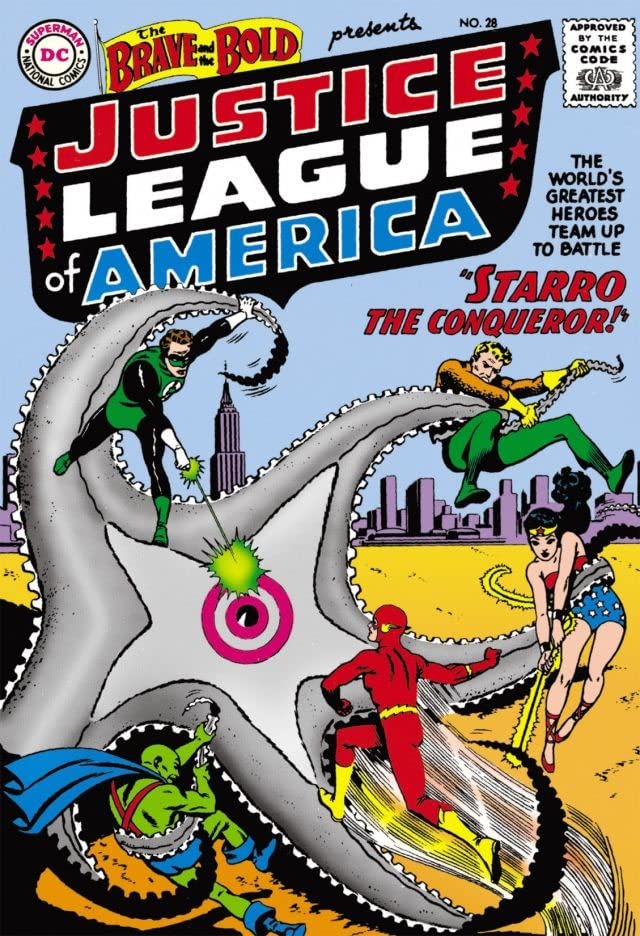
The Brave and the Bold #28
The Brave and the Bold #28 is the single issue that established the modern superhero team as a genre cornerstone: it marks the first published appearance of the Justice League of America, assembling DC's most recognizable Silver Age heroes — Superman, Batman, Wonder Woman, The Flash (Barry Allen), Green Lantern (Hal Jordan), Aquaman, and the Martian Manhunter — under one cover for the first time. The story also introduced Starro the Conqueror, DC's first major alien-invasion super-villain and the template for countless mind-control antagonists that followed. Its cultural reach extended beyond DC's own line: the JLA's immediate commercial success directly prompted rival publisher Martin Goodman to commission Stan Lee and Jack Kirby to produce their own superhero team, ultimately resulting in the Fantastic Four and the broader Marvel Universe. In this sense, a single 36-page Silver Age try-out story reshaped the entire American comics industry.
In "Starro the Conqueror!", Aquaman races to warn his fellow heroes after a talking puffer fish warns of an alien invasion by the starfish-like Starro the Conqueror. With Starro's three mind-controlled starfish lieutenants already wreaking havoc, Wonder Woman, Superman, Green Lantern, Flash, and J’onn J’onzz rally to defend Earth—though not all can answer the call. Written by Gardner Fox and illustrated by Mike Sekowsky, with inks by Bernard Sachs and letters by Gaspar Saladino, this 1960 DC classic features a cover by Mike Sekowsky and Murphy Anderson.
When a frantic Peter the Puffer Fish warns Aquaman of an alien invasion, the sea king rallies Wonder Woman, Green Lantern, Flash, and J’onn J’onzz to face Starro the Conqueror—a starfish from beyond the stars who’s turned three Earthly starfish into his mind-controlled lieutenants. With the team split into squads and the planet under siege, the heroes must unite across their differing domains to stop an enemy whose reach extends far beyond the ocean’s edge.
In "Starro vs. Green Lantern," the Green Lantern faces off against a giant alien starfish sent to conquer Earth, one of three monstrous invaders threatening the planet. As the hero battles the creature, he discovers that only those unaffected by its mind-control—like the oddly immune Snapper Carr—can help devise a plan to stop it. With time running out and the fate of Happy Harbor hanging in the balance, the heroes must unite before Starro's influence spreads further.
In a high-stakes showdown from *The Brave and the Bold* #28, Wonder Woman and J'onn J'onzz race to rescue a team of scientists captured by a rogue Starro lieutenant. As they uncover the alien’s chilling ability to share absorbed knowledge and powers—now enabling a nuclear-level attack—the duo must outthink a foe whose strength grows with every mind it conquers.
In "Starro vs. the Flash!" from The Brave and the Bold #28 (1960), the Flash races against time in Happy Harbor, where a Starro duplicate has taken control and the townspeople lie under its mind-altering influence. With only a single teenager still free, Flash must confront the alien threat, uncover the location of the real Starro, and decide whether to bring a young reporter along for the final confrontation.
When the alien menace Starro unleashes his mind-control powers on the Justice League of America, the team must think fast to break his hold—especially when they discover that Snapper Carr’s unusual resistance stems from a surprising source. With a clever twist involving a few barrels of lime, the heroes turn the tide in a battle that could have gone either way.
ComicBooks.com Value
Show all 21 grades ▾
This exact issue on ebay
CGC 5.5 ▾ $5,350–$5,795 3 listings
CGC 4.5 ▾ $2,400–$5,000 4 listings
CGC 4 ▾ $3,053–$4,250 3 listings
CGC 3.5 ▾ $3,200–$4,400 3 listings
CGC 2.5 ▾ $2,400–$2,500 3 listings
PGX 4 ▾ $3,295–$3,495 2 listings
Raw — VG ▾ $4,292–$6,050 2 listings
Raw — GD ▾ $158–$2,150 2 listings
Raw / ungraded ▾ $1.99–$6,895 5 listings
More listings for this title
- BamPowComics & Collectibles · Chesterland, OH1 on eBay ↗
- Cosmic Comics & Cards · Grand Prairie, TX1 on eBay ↗
- JAF Comics · Bethlehem, PA1 on eBay ↗
- The Time Capsule · Seekonk, MA1 on eBay ↗
Read it digitally
Sell my copy
Have this issue — or a whole collection? Get a fair offer from us, skip the marketplace fees and the hassle.
We Buy Collections ▸History
Editor Julius Schwartz, who had shepherded the Silver Age revival of the Flash and Green Lantern, commissioned writer Gardner Fox — the original architect of the Justice Society of America in the 1940s — and penciller Mike Sekowsky to create a modern successor team. Schwartz deliberately rechristened the group the 'Justice League of America' rather than reviving the 'Justice Society' name, reasoning that 'League' would resonate better with young readers who associated the word with sports organizations. DC, still cautious about launching new titles, road-tested the concept in The Brave and the Bold, which had been repurposed as a try-out anthology starting with issue #25; the JLA's debut in issue #28, published on December 29, 1959 with a cover date of February–March 1960, proved so successful that the team earned its own ongoing title within eight months. Fox and Sekowsky went on to collaborate on the first 65 Justice League adventures together.
Trivia · 8 facts
- First appearance of the Justice League of America, comprising Aquaman, Wonder Woman, The Flash (Barry Allen), Green Lantern (Hal Jordan), and Martian Manhunter (J'Onn J'Onzz) as the active combatants, with Superman and Batman appearing only in cameo due to prior commitments within the story.
- First appearance of Starro the Conqueror, an alien telepathic starfish who transforms three ordinary Earth starfish into giant deputies and attempts to use nuclear energy and mass mind-control to subjugate humanity — DC's first Silver Age alien-kaiju-scale villain.
- First appearance of Lucas 'Snapper' Carr (full name later established as Lucas Carr), a teenage civilian from Happy Harbor, Rhode Island, who is inadvertently immune to Starro's mental control because of lime (calcium oxide) on his lawn-work clothes; the JLA reward him with honorary membership and a signal device, making him the team's mascot for the next nine years.
- First cover appearances of Aquaman and Martian Manhunter anywhere in DC Comics, despite both characters having ongoing backup features in other titles at the time.
- Written by Gardner Fox and pencilled by Mike Sekowsky, with inking split across multiple hands — Bernard Sachs and Joe Giella on interior chapters, Murphy Anderson on key segments — and a cover by Sekowsky and Anderson; letters by Gaspar Saladino.
- The issue was physically published on December 29, 1959, carrying a cover date of February–March 1960; the story is titled 'Justice League of America: Starro the Conqueror!' and is structured in five chapters, with each chapter following a different hero or sub-group facing one of Starro's deputies before the full-team finale.
- The story notably presents the JLA as already fully formed — with established headquarters, signal devices, and mutual familiarity — rather than depicting any origin or formation, a deliberate narrative choice that generated decades of continuity work retconning the team's founding (most notably in the 1998 maxi-series JLA: Year One).
- The issue has been reprinted extensively, including in Justice League of America #39 (1965), DC Silver Age Classics: The Brave and the Bold #28 (1992), Millennium Edition: The Brave and the Bold #28 (2000), Showcase Presents: Justice League of America Vol. 1 (2005), and Justice League of America: A Celebration of 60 Years (2020), among many other collected editions.
Cast · 16 characters
Full credits
Reprints
Reprinted in Mighty Comic #17 (1960), Justice League of America #39 (1965), The Comic Book in America: An Illustrated History #[nn] (1989), DC Silver Age Classics The Brave and the Bold 28 #[nn] (1992), Justice League of America Archives #1 (1992), DC Comics: Sixty Years of the World's Favorite Comic Book Heroes #[nn] (1995), The Brave and the Bold #28 [The Monopoly Game: Justice League of America Collector's Edition] #[nn] (1999), Justice League of America Super Spectacular No. 1, 1975 Issue #[nn] (1999), Millennium Edition: The Brave and the Bold 28 #[nn] (2000), Showcase Presents: Justice League of America #1 (2006), The Justice League of America Omnibus #1 (2014), DC Comics Graphic Novel Collection #4 (2015), Justice League of America: The Silver Age #1 (2016), The Brave and the Bold 28 (Facsimile Edition) #[nn] (2020), Justice League of America: A Celebration of 60 Years #[nn] (2020), Justice League of America: The Silver Age Omnibus #1 (2020), Nathan Never / Justice League #[0] (45) (2022), DC Finest: Justice League of America: Starro the Conqueror #[nn] (2026)
Key issues in The Brave and the Bold
Reviews
Reader reviews
No reader reviews yet.