
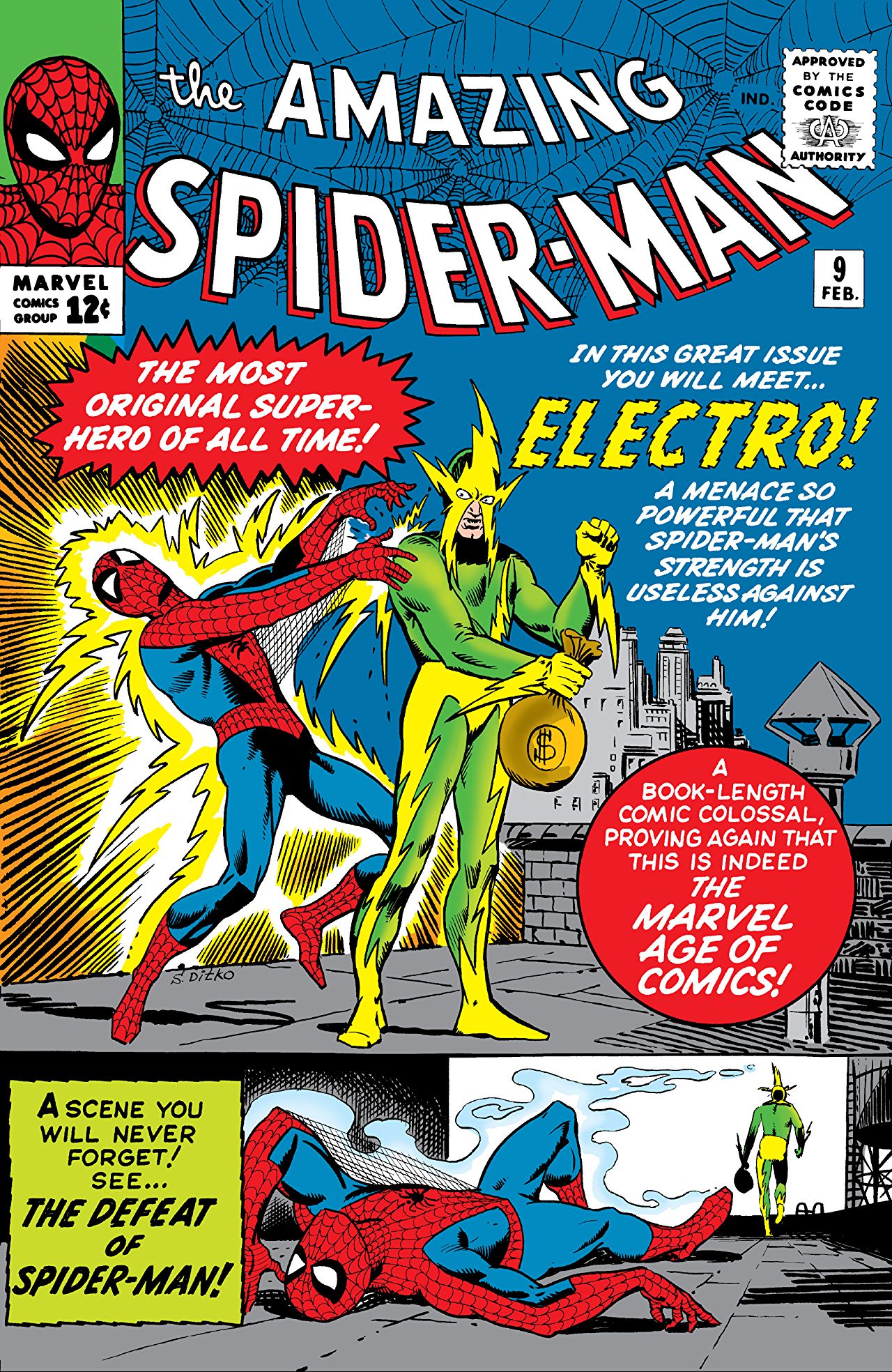
The Amazing Spider-Man #9
The Amazing Spider-Man #9 (February 1964) is the debut issue of Electro — Maxwell 'Max' Dillon — one of Spider-Man's most enduring rogues-gallery staples and, just months later, a founding member of the original Sinister Six. Beyond the villain introduction, the story is a landmark in how Stan Lee and Steve Ditko used superhero action to dramatize everyday hardship: Peter Parker is torn between sitting at a hospitalized Aunt May's bedside and earning money to pay her medical bills, marking the first sustained use of what would become a defining Spider-Man storytelling template. The issue also establishes the recurring J. Jonah Jameson trope of publicly accusing a villain of being Spider-Man in disguise — a comedic-editorial beat the creative team would return to repeatedly — and deepens the romantic subplot between Peter and Betty Brant with early hints of a shared emotional longing.
In "The Man Called Electro!", Spider-Man faces his most electrifying challenge yet as the villain orchestrates a jailbreak to assemble a crew of fellow criminals. With Aunt May hospitalized and his usual web-slinging focus tested, Peter Parker must juggle saving the city and protecting his loved ones—while the electric menace charges ahead. Written by Stan Lee and illustrated with dynamic precision by Steve Ditko, the cover by Ditko captures the crackling tension of a hero pushed to his limits.
ComicBooks.com Value
Show all 22 grades ▾
This exact issue on ebay
CGC 7.5 ▾ $1,395–$4,795 3 listings
CGC 5.5 ▾ $900–$2,400 2 listings
CGC 4.5 ▾ $1,200–$1,499 4 listings
CGC 3.5 ▾ $975–$1,460 4 listings
CGC 3 ▾ $875–$1,300 2 listings
CGC 2.5 ▾ $718–$895 4 listings
Raw — NM- ▾ $3.99–$19.95 2 listings
Raw — VF/NM ▾ $3.99–$11.99 3 listings
Raw — VG ▾ $659–$1,073 2 listings
Raw / ungraded ▾ $2.49–$990 18 listings
Read it digitally
Sell my copy
Have this issue — or a whole collection? Get a fair offer from us, skip the marketplace fees and the hassle.
We Buy Collections ▸History
The issue was produced during the height of the Lee–Ditko collaboration that built Spider-Man's Silver Age rogues gallery, with Stan Lee scripting, Steve Ditko handling pencils, inks, and cover composition, Stan Goldberg on colors, and Artie Simek on letters — all under Lee's editorial stewardship. Ditko had prior experience with electricity-powered characters, having drawn one in Strange Suspense Stories #48 (1960), and while the name 'Electro' had appeared in earlier Timely/Atlas publications, the 1964 Lee-Ditko version proved far more durable than any predecessor. The issue shipped in November 1963 under a February 1964 cover date, placing it squarely in the accelerating production pace of early Marvel's expanding superhero line.
Trivia · 7 facts
- First appearance and origin of Electro (Maxwell 'Max' Dillon), created by writer Stan Lee and artist Steve Ditko; cover-dated February 1964, on sale November 1963.
- Full credits: Stan Lee (writer/editor), Steve Ditko (pencils, inks, cover), Stan Goldberg (colors), Artie Simek (letters).
- Electro's origin: lineman Max Dillon is struck by lightning while repairing a power line, becoming a living electrical capacitor who turns to crime; Spider-Man defeats him using a fire hose and rubber insulating gloves.
- First appearance of Aunt May in the hospital — an ongoing narrative device that recurs throughout the series — as well as the first time J. Jonah Jameson publicly declares a villain to be Spider-Man in disguise.
- Electro went on to be a founding member of the original Sinister Six (Amazing Spider-Man Annual #1, 1964), alongside Doctor Octopus, Vulture, Sandman, Mysterio, and Kraven the Hunter.
- The story was reprinted in Marvel Tales (as part of the early reprint run), Marvel Masterworks Vol. 1, Essential Spider-Man #1 (1996, black-and-white), Spider-Man Classics #10 (January 1994), and numerous international editions.
- Jamie Foxx portrayed the Max Dillon version of Electro in live-action films The Amazing Spider-Man 2 (2014) and Spider-Man: No Way Home (2021).
Cast · 7 characters
Full credits
Reprints
Reprinted in Marvel Tales #6 (1967), Fantastiske Fire og Edderkoppen #9/1968 (1968), O Homem-Aranha #6 (1969), Marvel #3 (1970), Marvel #4 (1970), Strange #7 (1970), Spider-Man Comics Weekly #1 (1973), Die Spinne #11 (1974), The Amazing Spider-Man #2 (81444) (1978), El Hombre Araña / El Asombroso Hombre Araña #8 (1980), Marvel Tales #146 (1982), O Espectacular Homem-Aranha #4 (1983), The Marvel Saga the Official History of the Marvel Universe #12 (1986), Marvel Masterworks #1 (1987), Σπάιντερ Μαν [Spider-Man] #394 (1988), The Exploits of Spider-Man #11 (1993), Spider-Man Classic #5 (1993), Spider-Man Classics #10 (1994), The Essential Spider-Man #1 (1996), Marvels Abonnements-blad #13 (1997), Marvel Masterworks: The Amazing Spider-Man #[1] (1998), Spider-Man Komplett #9 (1999), Spiderman: Stan Lee y Steve Ditko #1 (2002), Biblioteca Marvel: Spiderman #2 (2003) + 23 more
Key issues in The Amazing Spider-Man
 ★
★ ★
★ ★
★ ★
★ ★
★ ★
★ ★
★ ★
★Variants (1)
Reviews
Reader reviews
No reader reviews yet.