
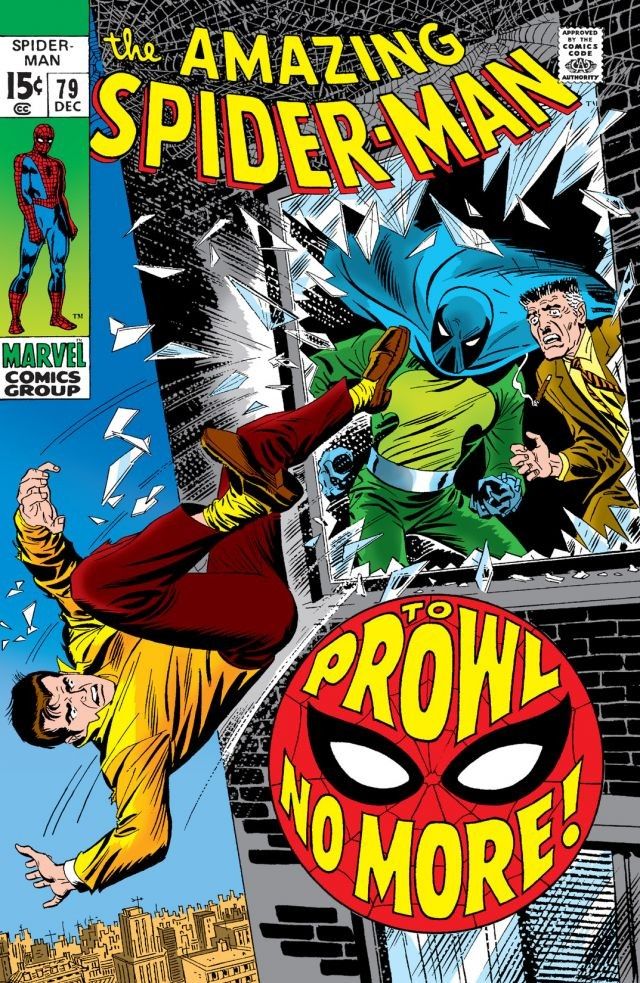
The Amazing Spider-Man #79
☆ Be the first to review + Add to your collection — Join freeAmazing Spider-Man #79 concludes the debut two-part arc of Hobie Brown, the Prowler — one of Marvel's earliest African-American costumed characters to headline a story in the publisher's flagship title — and delivers what became a defining moment in Spider-Man storytelling: rather than unmasking a thug, Peter Parker finds a mirror of himself, a disenfranchised young man of equal age whose ingenuity has turned toward desperation rather than heroism. The mercy Spider-Man extends to Hobie at the end of this issue set the template for the Prowler's decades-long career as a reluctant ally rather than a recurring villain, a dynamic that later writers, animators, and filmmakers have returned to repeatedly. As the final Amazing Spider-Man issue with a 1960s cover date, it also stands as a quiet bookend to the Silver Age iteration of the title. The story's compression — originally plotted as three issues but squeezed into two — makes it an inadvertent document of the editorial tension between Marvel's multi-part storytelling ambitions and the brief, publisher-mandated 'no continued stories' edict that briefly interrupted that tradition.
In "To Prowl No More!", Spider-Man faces off against the mysterious Prowler in a tense showdown that ends with the thief escaping via gas bomb. The Prowler, revealed to be a young man named Hobie with a twisted plan to become a hero by recovering stolen goods, sets up another heist—only to be outsmarted by Peter Parker, who anticipates his move. With the gas ineffective and the truth exposed, Spider-Man confronts the Prowler not as a villain, but as a misguided kid with good intentions. Written by Stan Lee and illustrated by John Buscema with inks by Jim Mooney, this 1969 issue features a standout cover by John Romita.
ComicBooks.com Value
Show all 22 grades ▾
This exact issue on ebay
CGC 8.5 ▾ $110–$290 3 listings
Raw — FN ▾ $34.99–$59.99 8 listings
Raw — VG+ ▾ $33.81–$48 5 listings
Raw / ungraded ▾ $1.5–$80 32 listings
Read it digitally
Sell my copy
Have this issue — or a whole collection? Get a fair offer from us, skip the marketplace fees and the hassle.
We Buy Collections ▸History
Stan Lee wrote the issue against the backdrop of an awkward editorial mandate: in his 'Stan's Soapbox' column published in ASM #77 (October 1969), Lee announced that Marvel was abandoning continued stories, a policy widely attributed to publisher Martin Goodman rather than to Lee himself. Because the Prowler arc had been conceived as a three-parter, Lee was forced to compress its resolution into this single issue, and he openly acknowledged the crunch on the inside front cover. Interior penciling was handled by John Buscema on layouts with Jim Mooney finishing and inking, while John Romita Sr. provided the cover; the Prowler character itself traced back even further — to a sketch and character name proposed by Romita's 13-year-old son John Romita Jr., whose design idea Stan Lee adapted (keeping the name but replacing the costume concept with one originally intended for a villain called the Stalker, slated for the never-published Spectacular Spider-Man #3).
Trivia · 8 facts
- Second appearance of the Prowler (Hobie Brown), whose debut was Amazing Spider-Man #78 (November 1969); this issue concludes their first encounter.
- Written by Stan Lee; pencils by John Buscema (layouts) and Jim Mooney (finishes/inks); lettering by Sam Rosen; cover art by John Romita Sr.
- Cover-dated December 1969 — the last issue of The Amazing Spider-Man to carry a 1960s cover date.
- The Prowler, Hobie Brown, is depicted as an African-American teenage inventor whose background as a frustrated, unemployed window washer parallels Peter Parker's own working-class frustrations; Spider-Man opts not to turn him over to the police after unmasking him.
- The story was originally planned as a three-part arc but was condensed to two issues due to Marvel's short-lived 'no continued stories' editorial policy, as acknowledged by Stan Lee in the issue itself.
- The Prowler character concept originated with a sketch and name submitted by John Romita Jr. at age 13; Lee kept the name but John Romita Sr. redesigned the costume, drawing on a design he had prepared for the unpublished Spectacular Spider-Man #3.
- Hobie Brown's redemption in this issue seeded his later role as a Spider-Man ally, including impersonating Spider-Man in ASM #87 to help protect Peter Parker's secret identity.
- Reprinted in Marvel Tales #60 (August 1975), with the cover altered — Peter Parker falling from the window was redrawn to show Spider-Man in costume in the same pose; also collected in Essential Spider-Man Vol. 4 and the Amazing Spider-Man Omnibus Vol. 3, among other collections.
Full credits
Reprints
Reprinted in Marvelserien #39 (1970), El Sorprendente Hombre Araña #98 (1970), Hit Comics #144 (1970), Astounding Stories #85 (1971), L'étonnant Spider-Man #7 (1971), L'étonnant Spider-Man #8 (1971), Spider-Man Comics Weekly #97 (1974), Spider-Man Comics Weekly #98 (1974), Marvel Tales #60 (1975), Strange #76 (1976), El Hombre Araña / El Asombroso Hombre Araña #73 (1981), Spider-Man Comics Magazine #9 (1988), L'Uomo Ragno Classic #24 (1993), The Essential Spider-Man #4 (2000), Spiderman de John Romita #33 (2001), Spider-Man Komplett #12 (2001), The Essential Spider-Man #4 [Third Edition] (2011), The Amazing Spider-Man Omnibus #3 (2017), Amazing Spider-Man Epic Collection #5 (2020), Alter Ego #189 (2024), Die Spinne #80, El Tony Extraordinario Suplemento [El Fabuloso Hombre Araña] #254, HIP Classics #19144, Ihmesarja #53 + 1 more
Key issues in The Amazing Spider-Man
 ★
★ ★
★ ★
★ ★
★ ★
★ ★
★ ★
★ ★
★Variants (1)
Reviews
Reader reviews
No reader reviews yet.