
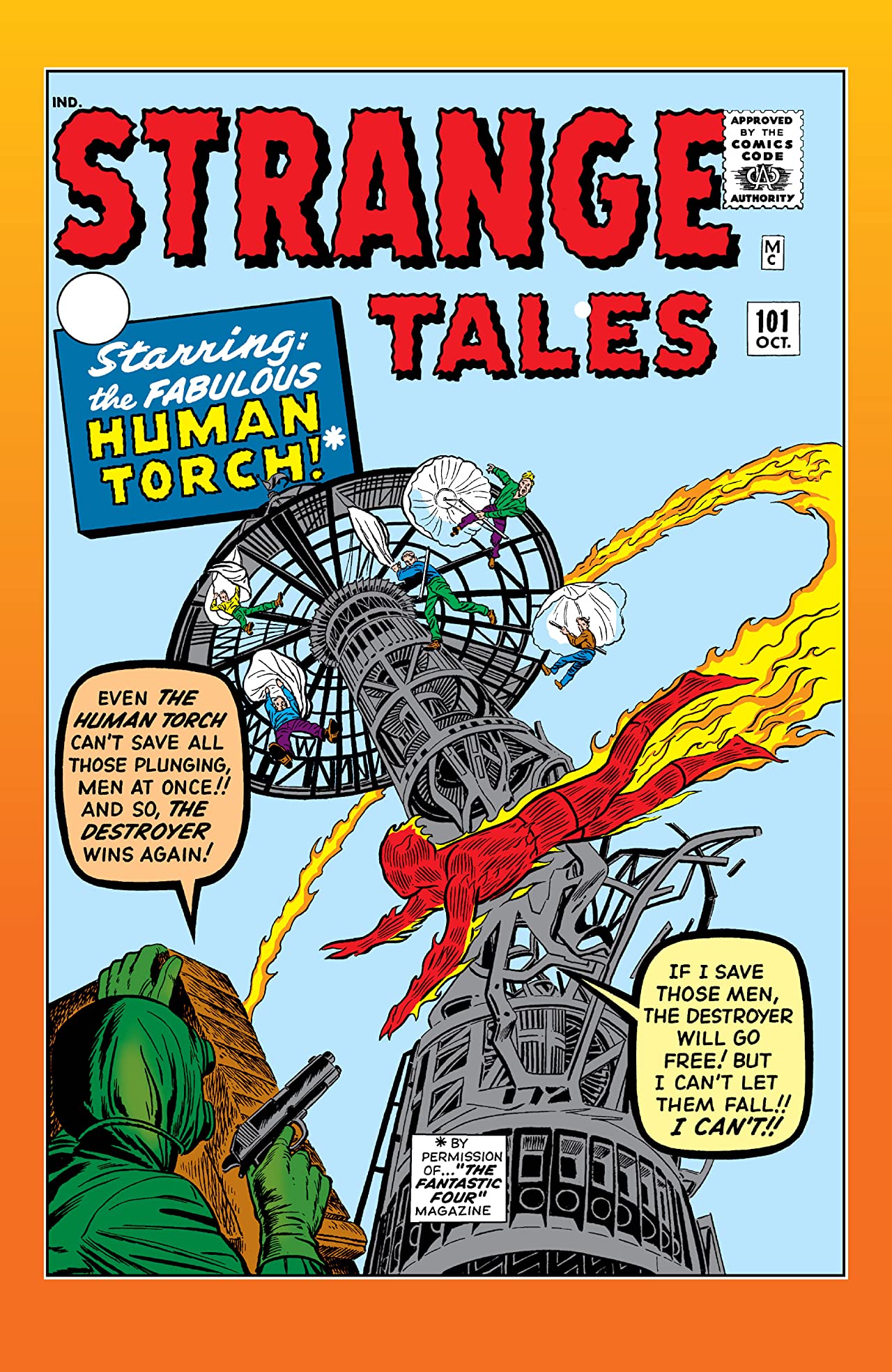
Strange Tales #101
☆ Be the first to review + Add to your collection — Join freeStrange Tales #101 marks a pivotal moment in the formation of the Marvel Universe: it is the first Silver Age solo outing for Johnny Storm, the Human Torch, and the first time a Fantastic Four member headlined their own ongoing feature in a separate title. By transplanting Johnny and Sue into the fictional Long Island suburb of Glenville and writing stories that explicitly referenced Fantastic Four continuity, Stan Lee and company demonstrated that Marvel's comics shared a single, coherent world — an early and conscious step toward the interconnected universe that would define the publisher's identity for decades. The issue also signals Strange Tales' transformation from an Atlas-era monster anthology into a superhero showcase, a transition that would later bring Doctor Strange and Nick Fury to the same title.
In Strange Tales #101, the Human Torch returns to his hometown of Glenville to investigate mysterious sabotage at the local amusement park, where a seemingly innocent ride hides a secret: a signal jammer designed to block transmissions from a Communist spy embedded in the town's newspaper. Written by Stan Lee and Larry Lieber, with Jack Kirby's dynamic art and Dick Ayers' sharp inks, this issue blends Cold War intrigue with the Torch’s signature flair—cover by Kirby and Ayers.
In the quiet town of Glenville, Johnny Storm—still learning to balance his powers with his identity—unravels a web of sabotage at the local amusement park, uncovering a hidden message relay tied to a Communist submarine. With the town’s safety at stake, he must piece together the truth behind the sabotage before the next signal goes out.
In "The Impossible Spaceship!" from Strange Tales #101, a mysterious vessel descends upon Earth, baffling scientists and civilians alike with its silent arrival and unexplained presence. Though it remains for a time, the ship departs without explanation—leaving behind only the quiet mystery of its fleeting visit and the unsettling realization that it may have been more than metal and circuitry.
In "What Is X-35?" from Strange Tales #101, a desperate criminal fleeing capture finds himself haunted by the relentless presence of the number X-35—appearing in strange, unsettling ways. As his panic mounts, the number becomes inescapable, culminating in a chilling final encounter with a car bearing that same ominous plate.
ComicBooks.com Value
Show all 21 grades ▾
This exact issue on ebay
CGC 5.5 ▾ $600–$606 2 listings
CGC 4.5 ▾ $300–$350 2 listings
CGC 4 ▾ $314–$723 2 listings
CGC 3.5 ▾ $240–$264 4 listings
CGC 2.5 ▾ $180–$230 2 listings
CGC 2 ▾ $210–$215 2 listings
Raw — VG ▾ $170–$250 3 listings
Raw / ungraded ▾ $85–$356 10 listings
Read it digitally
Sell my copy
Have this issue — or a whole collection? Get a fair offer from us, skip the marketplace fees and the hassle.
We Buy Collections ▸History
Publisher Martin Goodman had a long institutional affection for the Human Torch name, dating to Carl Burgos's android original debuting in Marvel Comics #1 (October 1939), and that nostalgia almost certainly drove the decision to spin the Silver Age Torch into his own feature once Fantastic Four proved a hit. The lead story was plotted by Stan Lee, scripted by Larry Lieber, penciled by Jack Kirby, and inked by Dick Ayers — the same core team that was building the Marvel line across multiple anthology titles simultaneously. The scripting arrangement (Lee plotting, Lieber dialoguing) reflected a transitional phase Marvel was working through in mid-1962, before Lee consolidated nearly all scripting duties under his own pen using the Marvel Method.
Trivia · 9 facts
- First Silver Age solo Human Torch story — the first solo Human Torch story in any format since 1954.
- Cover-dated October 1962; on-sale date July 10, 1962. Published by Marvel Comics. Cover price: 12 cents.
- Lead story credits: plot by Stan Lee, script/dialogue by Larry Lieber, pencils by Jack Kirby, inks by Dick Ayers, letters by Artie Simek. Edited by Stan Lee.
- Cover art by Jack Kirby and Dick Ayers; the splash page bills Johnny Storm as 'America's Favorite Superhero.'
- The 13-page main story is split into two parts: an untitled Part 1 (7 pages) and Part 2 titled 'The Flaming Fury Strikes Back!' (6 pages). It introduces the villain Destroyer (Charles Stanton, a Soviet spy and newspaper editor) in his first appearance.
- The issue contains an in-story diagram of Sue and Johnny's Glenville, New York home, including Johnny's fire-resistant bedroom equipped with chemistry equipment and undersea maps — a piece of character-building worldbuilding rare for the era.
- The Fantastic Four's origin is recapped by Johnny in the main story, with the rest of the FF (Reed Richards, Sue Storm, Ben Grimm) appearing in flashback; Ben Grimm also makes a cameo in the main story, marking an early cross-title team interaction.
- The story has been collected numerous times: Marvel Tales #3 (1966), The Human Torch #1 (1974 reprint series), Essential Human Torch Vol. 1 (2003), Marvel Masterworks: The Human Torch Vol. 1 (2006 and 2014 editions), Marvel Firsts: The 1960s (2011), and The Human Torch & The Thing: Strange Tales — The Complete Collection (2018).
- The backup stories in the issue feature art by Don Heck (plot by Lee/Lieber) and Steve Ditko (script by Stan Lee), reflecting the anthology's dual superhero/sci-fi identity at the time of transition.
Cast · 4 characters
Full credits
Reprints
↩ Reprints Strange Tales #58 (1957)
Reprinted in Weird Planets #1 (1962), Los 4 Fantásticos #17 (1963), Marvel Tales #3 (1966), Dæmonen #34 (1968), Fakkelen og Jernmannen #1/1968 (1968), Uncanny Tales #83 (1971), I Fantastici Quattro #5 (1971), The Human Torch #1 (1974), The Empire Strikes Back Weekly #118 (1980), The Marvel Saga the Official History of the Marvel Universe #5 (1986), Essential Human Torch #1 (2003), Marvel Masterworks: The Human Torch #1 (2006), Marvel Firsts: The 1960s #[nn] (2011), Marvel Masterworks: The Human Torch #1 (2014), The Human Torch & The Thing: Strange Tales - The Complete Collection #[nn] (2018), Marvel Masters of Suspense: Stan Lee & Steve Ditko Omnibus #2 (2019)
Key issues in Strange Tales
Variants (1)
Reviews
Reader reviews
No reader reviews yet.