
Racket Squad in Action #12
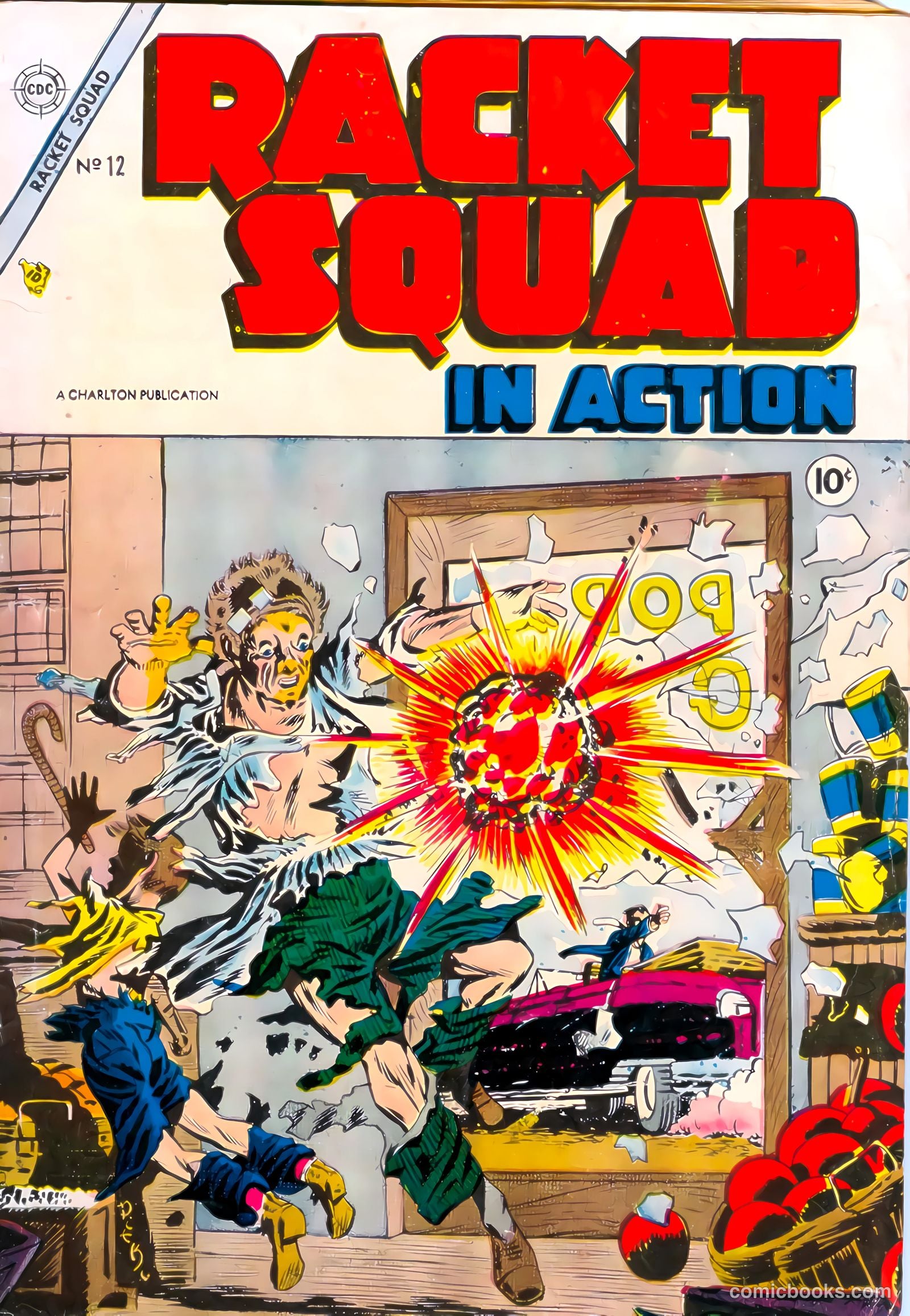
☆ Be the first to review + Add to your collection — Join freeRacket Squad in Action #12 (August 1954) sits at a compelling crossroads in comics history: it arrived in the final weeks before the Comics Code Authority reshaped the entire industry, making its cover — a visceral explosion scene rendered by the young Steve Ditko — one of the last fully uninhibited examples of pre-Code crime-cover design Ditko ever produced for Charlton. The issue also pairs that Ditko cover with interior pencils attributed to Joe Shuster, the co-creator of Superman, illustrating how dramatically fortunes had shifted for Golden Age giants by the mid-1950s. As part of a series that threaded the needle between pre-Code sensationalism and a consumer-fraud focus that actually helped it survive the Code era, the issue encapsulates the creative and commercial tensions that defined American crime comics at their turning point.
# Racket Squad in Action #12 This issue is an anthology containing two crime stories. The first story follows the Racket Squad as they set up a sting operation against Mrs. Jaromir, a criminal who is blackmailing money from victims by threatening to kidnap their husbands, with plans to intercept the payoff at Fifth Street and First Avenue. "The Stock Market Swindlers" details a scheme where con artists exploit post-war prosperity and inflation to defraud people of their savings through fraudulent investment schemes, ultimately leading to their capture when one store owner reports them to police.
Anton Krim and his crew prey on desperate immigrants by posing as agents of an Eastern European government, threatening torture and death to relatives still behind the Iron Curtain unless extortionate "insurance" payments are made. When Stanislaw Kasimir realizes the swindle—his mother, whom they claim to hold prisoner, has been dead for days—he risks everything to tip off Inspector O'Malley and the Racket Squad. What unfolds is a high-stakes cat-and-mouse game as the law closes in on Krim's operation, with Kasimir's safety hanging in the balance.
When a man repeatedly returns expensive silver items for cash refunds, Inspector O'Malley and his assistant Steve Pryor smell a con—and they're right. The trail leads to the Union Silver Company itself, where the real scheme unfolds in the shipping department. It's a clever theft disguised as customer service, and it'll take sharp undercover work and quick action to stop Barry Cornell before he makes off with the goods.
When young couple Joe and Anna Crane fall victim to Theodore H. Pearson's elaborate stock-swindling schemes, Agent Dan Crandall of the Racket Squad goes undercover to expose the con man's operation. As Pearson escalates from fake investment promises to posing as a tax counselor to pocket innocent people's checks, Crandall closes in—leading to a desperate cat-and-mouse chase through the city's sewers that will determine whether this slick operator faces justice.
When Freddie pays for a carnival ride with a ten-dollar bill, the ticket seller hands back what appears to be nine singles—but the young man's girlfriend urges him to count his change later, confident he watched the transaction carefully enough. What Freddie doesn't realize is that a carnival grifter's sleight of hand is far faster than even the most attentive eye, and he's about to learn an expensive lesson in the con known as the "fast count."
When racketeers Tony Carlson and Ralph set up a phony storefront modernization scheme to shake down shop owners for protection money, they target William Thomas—a successful store owner who initially pays under duress but eventually reports them to police. After Thomas becomes too frightened to testify when struck by a hit-and-run accident, the criminals grow bold enough to overreach, allowing an undercover officer to catch them red-handed. The Racket Squad closes in to show these extortionists that their old-fashioned protection game leads nowhere but prison.
ComicBooks.com Value
Show all 18 grades ▾
Find on ebay
Read it digitally
Sell my copy
Have this issue — or a whole collection? Get a fair offer from us, skip the marketplace fees and the hassle.
We Buy Collections ▸History
Racket Squad in Action launched in May–June 1952 under Charlton's Capitol Stories imprint and ran 29 issues through March 1958, edited by Alfred V. Fago with Walter Gibson as assistant editor on earlier numbers. The series distinguished itself within the crowded crime-comics field by centering stories on swindlers and confidence schemes rather than mob violence — a structural choice that, according to collectors' commentary, gave it more longevity under the Code than gore-focused rivals. Issue #12, cover-dated August 1954, arrived during Steve Ditko's very first months at Charlton: Ditko had only begun working for the Derby, Connecticut publisher earlier that same year, with his first Charlton publication being the horror story 'Cinderella' in The Thing! #12 (February 1954). Charlton's notoriously low page rates came with a compensating lack of editorial interference, a creative environment that allowed a young Ditko unusual freedom to develop his visual style.
Trivia · 8 facts
- Published by Charlton Comics (under the Capitol Stories / Charlton imprint), cover-dated August 1954, as part of the 29-issue run of Racket Squad in Action (1952–1958).
- Cover art is by Steve Ditko — an explosion scene widely cited as among the most graphically violent covers Ditko produced during his early Charlton period — created during Ditko's first year of work at the company.
- Interior pencils on the lead story ('The Ransom Swindle!') are credited to Joe Shuster, with inks by Ray Osrin — a notable post-Superman assignment for Shuster, who was ghosting work at Charlton under largely anonymous conditions in this era.
- A second interior story, 'Fast Count,' features art by Chic Stone, a journeyman artist who would later ink Jack Kirby's work at Marvel in the 1960s.
- The issue also contains a text story, 'The Keys to Death,' consistent with the series' anthology format mixing comic strips and prose crime pieces.
- Racket Squad in Action's focus on confidence rackets and swindles — rather than homicide-heavy crime — is credited by collectors and historians with allowing the title to continue publishing after the Comics Code Authority was instituted in late 1954, outlasting most of its pre-Code crime-comic peers.
- Steve Ditko's Charlton association began in early 1954 and continued intermittently until the company folded in 1986; issue #12 is therefore an artifact of his earliest professional phase, predating his tuberculosis-related hiatus from comics in mid-1954.
- The series ran bi-monthly and was published in color at a standard 10-cent cover price; its indicia title was 'Racket Squad in Action' for all issues except #23, #28, and #29, which used the shortened title 'Racket Squad.'
Full credits
Reprints
Reprinted in Tales of the Underworld #2 (1960), Tales of the Underworld #3 (1960), Astounding Stories #32 (1968), Secrets of the Unknown #127 (1971), The Steve Ditko Archives #1 (2009), The Steve Ditko Archives #1 (2014), Hip Comics #19183 (2015), Gwandanaland Comics #1325 (2017), Astounding Stories #22
Reviews
Reader reviews
No reader reviews yet.