
New Comics #2
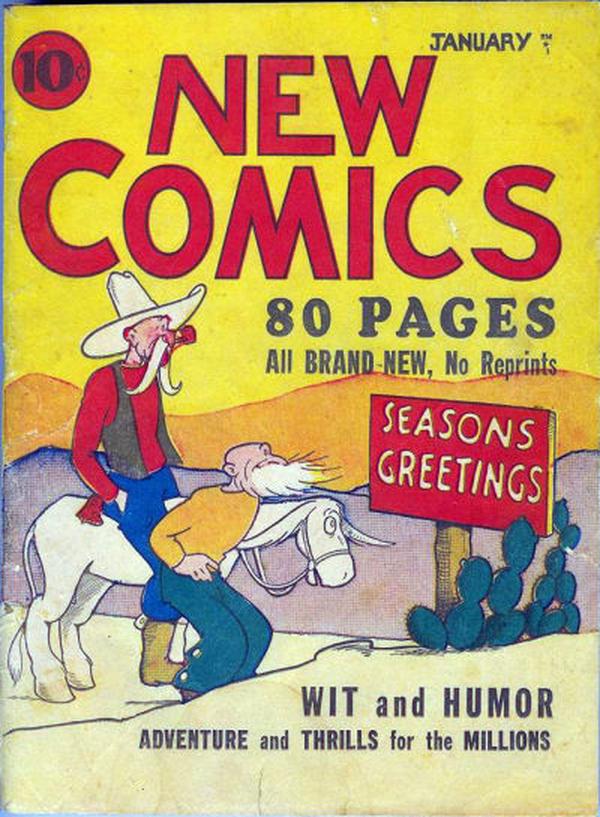
☆ Be the first to review + Add to your collection — Join freeNew Comics #2 (cover-dated January 1936) marks the debut of 'Federal Men,' the FBI-agent serial written by Jerry Siegel and drawn by Joe Shuster — the same duo who would go on to create Superman just two years later. The inaugural 'Federal Men' story, 'The Manning Baby Kidnapping,' introduced Steve Carson, a government agent whose undercover detective work and reliance on forensic science made him a prototype for the procedural-hero archetype in American comics. The issue belongs to the foundational run of New Comics, only the second ongoing title published by Malcolm Wheeler-Nicholson's National Allied Publications (the direct ancestor of DC Comics), making every issue of the series a piece of the institutional bedrock on which DC was built. That Siegel and Shuster were already experimenting with morally grounded, socially aware action storytelling here — more than a year before their Superman pitch was accepted — adds considerable retrospective significance to this modest anthology issue.
"Knife Ambush, Part 2" sees Kendal Quick left in command of the Black Bess after Lord Barlow takes the captured Spanish Man o'War back to England, leaving the crew and their spoils in Quick’s hands. With the treasure laid out on deck and the ship now under his authority, Quick makes a bold promise about what’s to come—though the true test of his leadership is just beginning. Written, drawn, and inked by Jon Blummer, this 1936 adventure features a striking cover by R. G. Leffingwell.
In this lighthearted 1936 tale from *New Comics #2*, young Jibby’s hunger leads him to suggest turkey for dinner—only to be told it’s too costly. Determined to prove his mother wrong, he grabs a shotgun and sets off to hunt one, only to find a turkey far too large for his small frame. After a comically disastrous encounter, Jibby returns home, thoroughly bested, and quietly agrees with his mother that turkeys really are too expensive.
Blimp’s cross-country journey from New York to San Diego takes a detour when he’s arrested in the sleepy town of Pottersville, Pennsylvania. There, he teams up with the quick-witted Juniper Jones, and together they make off with a historic stagecoach from the local museum—just to keep their trip going.
In "The Train Robbery, Part 1," Johnny and Jane find themselves caught in a sudden holdup while en route to Buffalo Junction to meet their Uncle Bob. With quick thinking and courage, they alert Captain Bill and help uncover the outlaw’s identity by recognizing Rancher Lane’s foreman among the bandits.
In the sweltering heat of the Channel, with Lord Barlow at the helm and Kendal Quick at his side, the Black Bess cuts through the waves, hunting the Spanish fleet. After capturing a Man o'War and uncovering its hidden treasure, Barlow entrusts Quick with command of the ship, leaving him to prove that the prize they’ve taken is only the beginning.
Jo, a man still reeling from a botched hair-cutting machine explosion, tries one last remedy—only to find his hair returns after reading a lurid detective tale. The story’s cover, labeled "Hair-raising detective stories," holds the unexpected key to his sudden regrowth.
In "The Time Machine, Part 2," Weed, Mowther, and little Fritz find themselves a century in the past, lodging at Blumel's inn where Weed quickly develops a crush on his own niece, Abigail—much to his own bewilderment and the others' amusement.
In this 1936 humor gem from *New Comics #2*, aspiring stuntman Dunk takes a wild leap into showbiz with a bizarre audition: tickle the famously unamused Mr. Gloom into laughter. When a shattered window and a brick lead to unexpected giggles, Dunk finds himself in a sticky situation—balancing a reward, a repair bill, and a manager’s sharp eye.
In "null," Beany stumbles through a surreal world of giant cats, warped architecture, and impossible physics—only to wake up with a start, realizing it was all a dream. The story’s playful absurdity unfolds in just two pages, blending whimsy and visual gags with a quiet punchline.
In this playful 1936 adventure from *New Comics #2*, Peter and Ho-lah-an’s target practice takes a chaotic turn when a stray shot hits a farmer in the backside—setting off a madcap chase that sends them scrambling into an outbuilding to watch the chaos unfold. As a woman with a basket of eggs crashes into the scene and the farmer’s fury turns to surprise, the boys find themselves caught in a moment of unexpected mayhem.
ComicBooks.com Value
Find on ebay
- Arcane Comics · Shoreline, WA3 on eBay ↗
- The 616 Comics LLC · Mantua Township, NJ2 on eBay ↗
- Comic Book Station1 on eBay ↗
Read it digitally
Sell my copy
Have this issue — or a whole collection? Get a fair offer from us, skip the marketplace fees and the hassle.
We Buy Collections ▸History
New Comics launched in December 1935 as Wheeler-Nicholson's second title, designed at a size close to what would become the standard Golden Age comic book format — a deliberate departure from his oversized tabloid New Fun Comics. By the time issue #2 arrived in January 1936, Siegel and Shuster had been contributing to Wheeler-Nicholson's line for just a few months, having debuted in New Fun #6 (October 1935) with 'Henri Duval' and 'Doctor Occult.' 'Federal Men' was their third major feature for the publisher, and it ran continuously through the title's eventual renamings — first to New Adventure Comics with issue #12, and then to Adventure Comics with issue #32 — ultimately continuing until 1942, with later installments drawn by Chad Grothkopf while Siegel continued writing.
Trivia · 8 facts
- Cover-dated January 1936; published by National Allied Newspaper Syndicate, Inc. (Wheeler-Nicholson's National Allied Publications imprint).
- First appearance of Steve Carson, FBI agent and lead character of the 'Federal Men' serial, in the story titled 'The Manning Baby Kidnapping.'
- Officer Walsh appears as the antagonist of the 'Federal Men' debut — a corrupt cop working alongside a kidnapping accomplice named Kate Lane, who dies in the story's resolution.
- The 'Federal Men' feature was written by Jerry Siegel and drawn by Joe Shuster, who would create Superman for DC's Action Comics #1 in June 1938.
- Steve Carson's debut story hinges on undercover detective work and forensic ballistics evidence gathered from police shooting ranges — an early example of procedural crime-solving in American comics.
- The issue also introduces the serial 'Captain Bill of the Rangers' (by W.M. Allison), which was subsequently renamed 'Captain Jim of the Texas Rangers' between issues #3 and #4.
- 'Federal Men' ran continuously in this title through all its name changes — New Comics, New Adventure Comics, and finally Adventure Comics — until 1942, making Steve Carson one of the earliest long-running non-superhero comic book protagonists.
- New Comics as a series was itself a historically significant format artifact: it appeared at close to what became the standard Golden Age comic book size, distinct from Wheeler-Nicholson's oversized tabloid New Fun Comics.
Cast · 2 characters
Full credits
Reprints
Reprinted in New Book of Comics #1 (1936), Atomic Comics #1 (1946), DC Comics Before Superman: Major Malcolm Wheeler-Nicholson's Pulp Comics #[nn] (2018)
Key issues in New Comics
Reviews
Reader reviews
No reader reviews yet.