
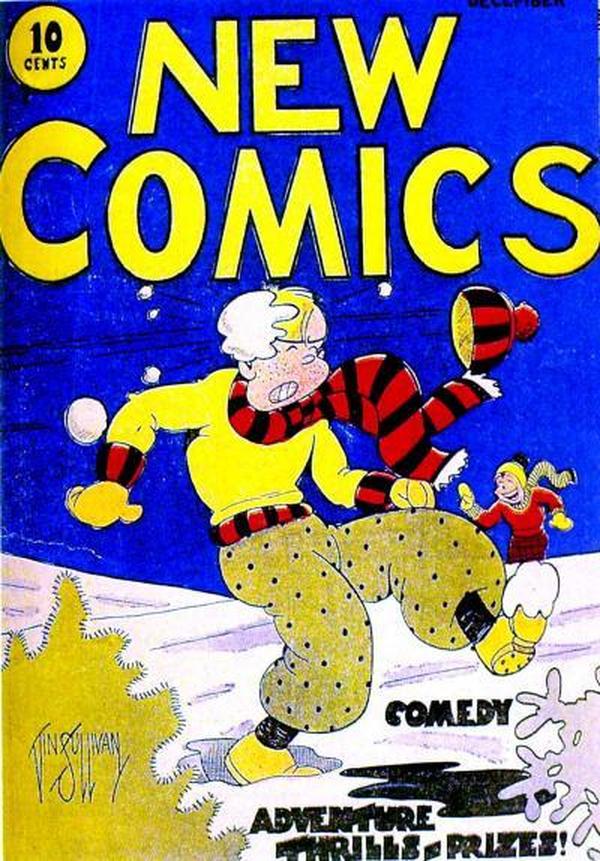
New Comics #1
☆ Be the first to review + Add to your collection — Join freeNew Comics #1 (December 1935 cover date, on sale November 12, 1935) holds a pivotal place in comics history as the second ongoing title published by Major Malcolm Wheeler-Nicholson's National Allied Publications — the company that would evolve into DC Comics. Where its predecessor, New Fun, was a tabloid-sized oddity, New Comics debuted at a trimmed format recognizable as the prototype of the Golden Age comic-book standard, making it a direct physical ancestor of every mainstream American comic book that followed. The title proved to have extraordinary staying power: it was renamed New Adventure Comics with issue #12, then simply Adventure Comics with issue #32, ultimately running all the way to issue #503 in 1983 (and being briefly revived in 2009), making it one of the longest-running periodicals in the medium's history. Its pages gave some of the most consequential figures in comics history — Walt Kelly, Sheldon Mayer, and Vin Sullivan — among their earliest professional platforms.
In "Knife Ambush, Part 1," gambler Jim Gale finds himself entangled in a dangerous game after winning a pearl necklace from a man who tries to reclaim it by force. Rescued by a mysterious servant of a woman in black, Jim follows up on a newspaper reward notice—only to discover his savior is the very person he’s been sent to find. With odds stacked and stakes rising, he places his $1,000 bet on 17-20—on the black. Written by Billy Weston and illustrated by Tom Cooper, with a striking cover by Vin Sullivan, this early DC tale blends suspense and intrigue in a 1935 classic.
In the winter of 1935, a newborn prince—marked by a three-pointed birth sign—is abandoned in the forest by order of his grandmother. Found by the forester Kol the Wise, the child’s survival hinges on a moment of instinct and faith, as the man fights off wolves and takes the infant home, whispering that the gods have marked him for more than death.
In this 1935 humor short from *New Comics #1*, Blimp launches a wildly impractical publicity stunt: cycling 3,000 miles from New York to the San Diego Exposition. After two weeks of grueling travel, he’s down to his last hope for a meal in Pottsville, Pennsylvania—only to end up behind bars.
In a lighthearted 1935 tale from *New Comics #1*, the Tinker twins—known for their spotless record at the Cadet Academy—face their first real challenge when seniors plot to tarnish their reputation by releasing a goat into their dormitory. The chaotic scene ends with the twins caught in a tussle, leading to a stern order to report to their senior officer the next morning.
In this 1935 humor short from *New Comics #1*, inventor Jo tries to streamline his daily routine with a wild new hair-cutting machine—only to discover it’s more suited for a horror movie than a barber shop. When the contraption malfunctions in spectacular fashion, Jo’s experiment ends with a shocking, all-over-the-head result.
In "17-20 In the Black [Part 1]," gambler Jim Gale finds himself entangled in a mystery after winning a pearl necklace at a high-stakes game—only to have its owner attempt a daring theft. Rescued by a mysterious servant who leads him to a lady in black, Jim is stunned to learn the reward for returning the necklace is posted in the paper. When he arrives at the address, he’s met with an unexpected twist, and with a bold decision, places his $1,000 reward on 17-20—on the black.
In this lighthearted 1935 tale from *New Comics #1*, Freddie’s act of kindness on a trolley car backfires when a fat woman takes his seat, prompting the men beside her to shove him off. Moments later, he spots a fat man stuck halfway down a manhole, hat raised to catch coins—Freddie’s next move isn’t what you’d expect.
In "Episode One" from New Comics #1 (1935), Jo Quick is branded a coward for refusing to join Lord Barlow’s privateer mission against Spanish ships—until he quietly stops a sabotage attempt he’d secretly overheard, turning the tide in his favor and earning his place aboard.
In this playful 1935 short, Jibby trades a much-needed haircut for an ice cream sundae, convincing a young friend to cut his hair instead. When his father later pulls off Jibby’s cap, the surprise is immediate—his head is nearly bald.
In a quiet moment of adventure, Peter shares his food with a young Indian named Ho-lah-an, sparking an unlikely bond. Together, they learn the simple skill of weaving grass into a lasso—just in time to outwit a charging ram and ride off on its back.
ComicBooks.com Value
Show all 18 grades ▾
More listings for this title
- The 616 Comics LLC · Mantua Township, NJ7 on eBay ↗
- Comic Book Station1 on eBay ↗
- JAF Comics · Bethlehem, PA1 on eBay ↗
- Rebel Base Comics & Toys · Charlotte, NC1 on eBay ↗
Read it digitally
Sell my copy
Have this issue — or a whole collection? Get a fair offer from us, skip the marketplace fees and the hassle.
We Buy Collections ▸History
After the tabloid-formatted New Fun Comics showed only modest traction on newsstands, Wheeler-Nicholson deliberately designed New Comics to be closer to the size of the already-established Famous Funnies, while keeping the editorial commitment to all-original material rather than newspaper-strip reprints. The issue ran 80 pages, surpassing Famous Funnies in page count, though its interior pages were printed in black and white rather than color. Published under the corporate banner of National Allied Newspaper Syndicate, Inc. — with editorial offices at 373 Fourth Avenue, New York — the book carried a cover drawn by future DC editor Vin Sullivan, whose single-scene illustration helped the issue look more like a cohesive publication than its predecessor's tabloid covers. Wheeler-Nicholson himself had a hand in writing and editing the contents, continuing his practice of recruiting fresh talent because the rights to syndicated newspaper strips were largely locked up by competitors.
Trivia · 8 facts
- Published by Major Malcolm Wheeler-Nicholson's National Allied Publications (DC's corporate predecessor); cover-dated December 1935, with an on-sale date of November 12, 1935.
- The second ongoing title in DC's lineage, following New Fun Comics #1 (February 1935); its format — smaller than New Fun's tabloid size — approximated what would become the recognized standard dimensions of Golden Age comic books.
- All-original content: like New Fun before it, New Comics #1 contained no newspaper-strip reprints, continuing Wheeler-Nicholson's risky but industry-shaping editorial policy of commissioning entirely new material.
- Walt Kelly — decades later famous as the creator of Pogo — contributed an illustrated adaptation of Jonathan Swift's Gulliver's Travels to this issue, one of his earliest published comic-book appearances.
- Sheldon Mayer, who would go on to become one of DC's most important editors and the creator of Scribbly, Sugar and Spike, and Black Orchid, contributed multiple strips including J. Worthington Blimp, Esq. and The Strange Adventures of Mr. Weed.
- Vin Sullivan, who would later edit Detective Comics and discover Batman creator Bob Kane, drew the cover and contributed the Jibby Jones strip; Whitney Ellsworth, another future DC editor, also contributed work.
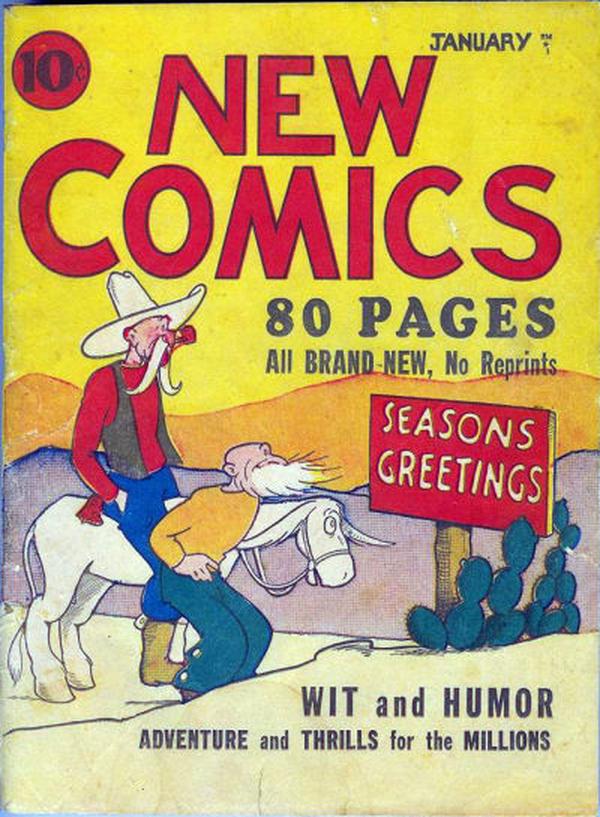
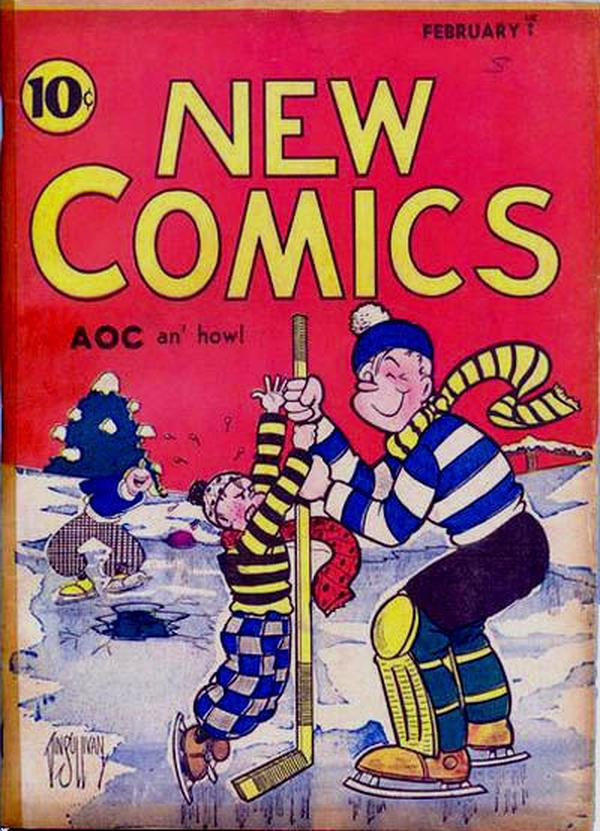
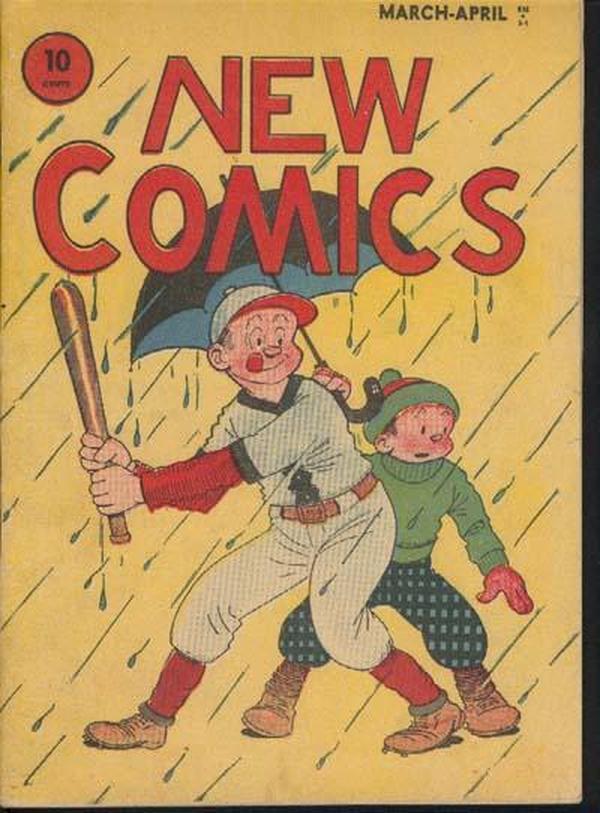
- The series underwent two title changes during its run: becoming New Adventure Comics with issue #12 and Adventure Comics with issue #32, ultimately continuing until issue #503 (1983) and a brief 2009 revival — one of the longest-running periodicals in American comics history.
- Several strips that debuted in New Comics #1 — including Chikko Chakko, Captain Quick, Capt. Spiniker, and J. Worthington Blimp — later jumped to Centaur Publications' Comics Magazine, an early example of talent and features migrating between competing publishers.
Full credits
Reprints
Reprinted in New Book of Comics #1 (1936), Atomic Comics #1 (1946), Adventure Comics #503 (1983), Walt Kelly's Pogo #1 (2014), DC Comics Before Superman: Major Malcolm Wheeler-Nicholson's Pulp Comics #[nn] (2018)
Key issues in New Comics
Reviews
Reader reviews
No reader reviews yet.