
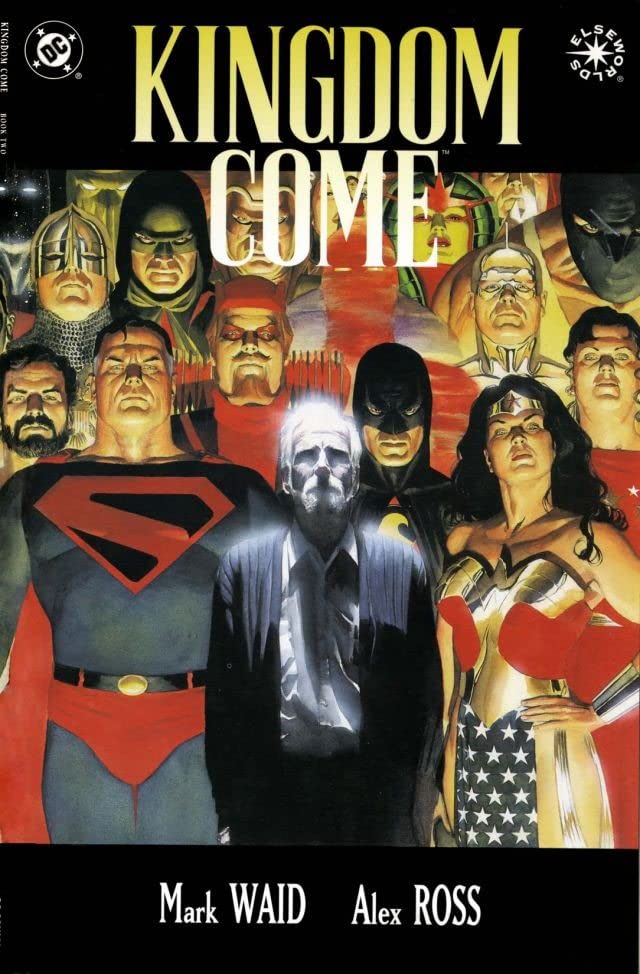
Kingdom Come #2
☆ Be the first to review + Add to your collection — Join freeKingdom Come #2 — subtitled 'Truth and Justice' — is the structural turning point of one of the most critically celebrated Elseworlds stories DC has ever published, the moment where Superman publicly reassembles the Justice League in response to a generation of amoral metahumans who have made the world more dangerous than the villains they displaced. The issue deepens the series' central argument — that classic heroism rooted in inspiration rather than intimidation is both necessary and fragile — and does so through Alex Ross's fully painted gouache artwork, a medium choice that gave DC's icons a weight and gravitas rarely seen on newsstand paper. As part of the four-issue series that won five Eisner and Harvey Awards, every chapter including this one functions as a building block of a work that permanently raised the bar for prestige-format storytelling at DC. The characters and design concepts introduced or developed across the run — among them the Kingdom Come Superman 'S' emblem, eventually adopted by the DCU proper, and Wonder Woman's golden eagle armor — have filtered back into mainstream continuity and live-action film, demonstrating the series' long reach beyond its Elseworlds classification.
ComicBooks.com Value
Show all 9 grades ▾
This exact issue on ebay
CGC 9.8 ▾ $145 3 listings
CGC 9.6 ▾ $55–$187 4 listings
CGC 9.4 ▾ $56–$59 2 listings
Raw — VF/NM ▾ $3.74–$15.98 5 listings
Raw / ungraded ▾ $2.5–$25 22 listings
More listings for this title
Read it digitally
Sell my copy
Have this issue — or a whole collection? Get a fair offer from us, skip the marketplace fees and the hassle.
We Buy Collections ▸History
The series originated with artist Alex Ross, who conceived a 'grand opus' for DC characters while completing Marvels for Marvel in 1994, drafting a 40-page handwritten outline and pitching it initially to writer James Robinson before DC paired him with Mark Waid, chosen for his encyclopedic command of DC history. Ross contributed significantly to the story's concept and character designs — illustrating all four issues in gouache — while Waid shaped and scripted the narrative, though the precise division of creative credit became a source of public dispute between the two. The editorial team under senior editor Dan Raspler and executive editor Mike Carlin, with Jenette Kahn as editor-in-chief, shaped the project into a four-issue prestige-format Elseworlds series published between May and August 1996; the collected edition later expanded the story by several pages, adding an epilogue included in every subsequent printing. Waid and Ross consciously designed the story as a rebuke of the violent antihero archetype that had come to dominate 1990s comics, particularly those associated with Image Comics.
Trivia · 8 facts
- Issue title is 'Truth and Justice'; cover-dated June 1996, it went on sale June 12, 1996 (DC Fandom records an earlier ship date of April 12, 1996 — sources conflict slightly on exact dates).
- This issue depicts Superman publicly reforming the Justice League, appearing before a United Nations press conference alongside returning heroes including Green Lantern (Alan Scott), Hawkman, Red Robin, and others.
- Batman, Green Arrow, and others refuse to join Superman's revived League and instead form a covert third faction aligned with Lex Luthor — a political fracture that drives the series' conflict forward.
- Key Collector identifies this issue as the first appearance of Kid Flash (Iris West), daughter of Wally West, within the Kingdom Come timeline.
- Phil Sheldon — the photojournalist protagonist of Alex Ross's earlier Marvel series Marvels — makes a cameo at the U.N. press conference, an in-universe cross-company Easter egg Ross inserted as a nod to his prior work.
- The nightclub scene in this issue is densely populated with DC deep cuts: a Kingdom Come analogue of Rorschach (from Watchmen) appears next to the Question, aged versions of Weather Wizard and Captain Cold are depicted as bar owners, and the Human Bomb holds a beer branded with a 'Q' referencing Quality Comics, where the character debuted.
- A Spectre-guided flashback in the issue visually echoes the cover poses of the heroes' debut comics — Action Comics #1 for Superman, Detective Comics #27 for Batman, and Wonder Woman #1 (1942) for Wonder Woman — a deliberate visual homage to DC's publishing history.
- The issue has been reprinted continuously in the Kingdom Come trade paperback, hardcover, the 2006 Absolute Kingdom Come slipcase edition, the 2016 20th Anniversary Deluxe Edition, and international editions including Brazilian (Panini, 2004) and Polish (Egmont, 2005) printings.
Full credits
Reprints
Reprinted in Kingdom Come #[nn] (1997), Kingdom Come (Limited Hardcover Edition) #[nn] (1997), Kingdom Come #[nn] (1997), Kingdom Come #[nn] (1997), Spécial DC #2 (1997), Kingdom Come #[nn] (1997), Gigant #2/2004 (2004), Reino do Amanhã #[nn] (2004), Kingdom Come #[nn] (2005), Ultimate Edition: Kingdom Come #[nn] (2005), Absolute Kingdom Come #[nn] (2006), Kingdom Come #[nn] (2008), Kingdom Come #[nn] (2012), Kingdom Come: The 20th Anniversary Deluxe Edition #[nn] (2016), DC Comics Graphic Novel Collection #90 (2016), Kingdom Come #[nn] (2019), Play Magazine #11
Key issues in Kingdom Come
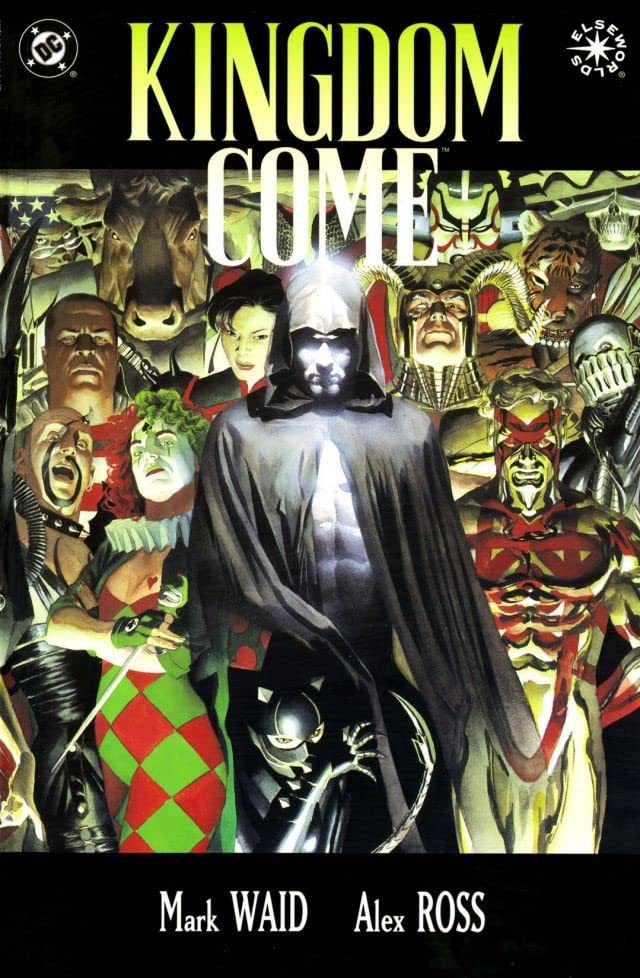
Variants (1)
Reviews
Reader reviews
No reader reviews yet.