
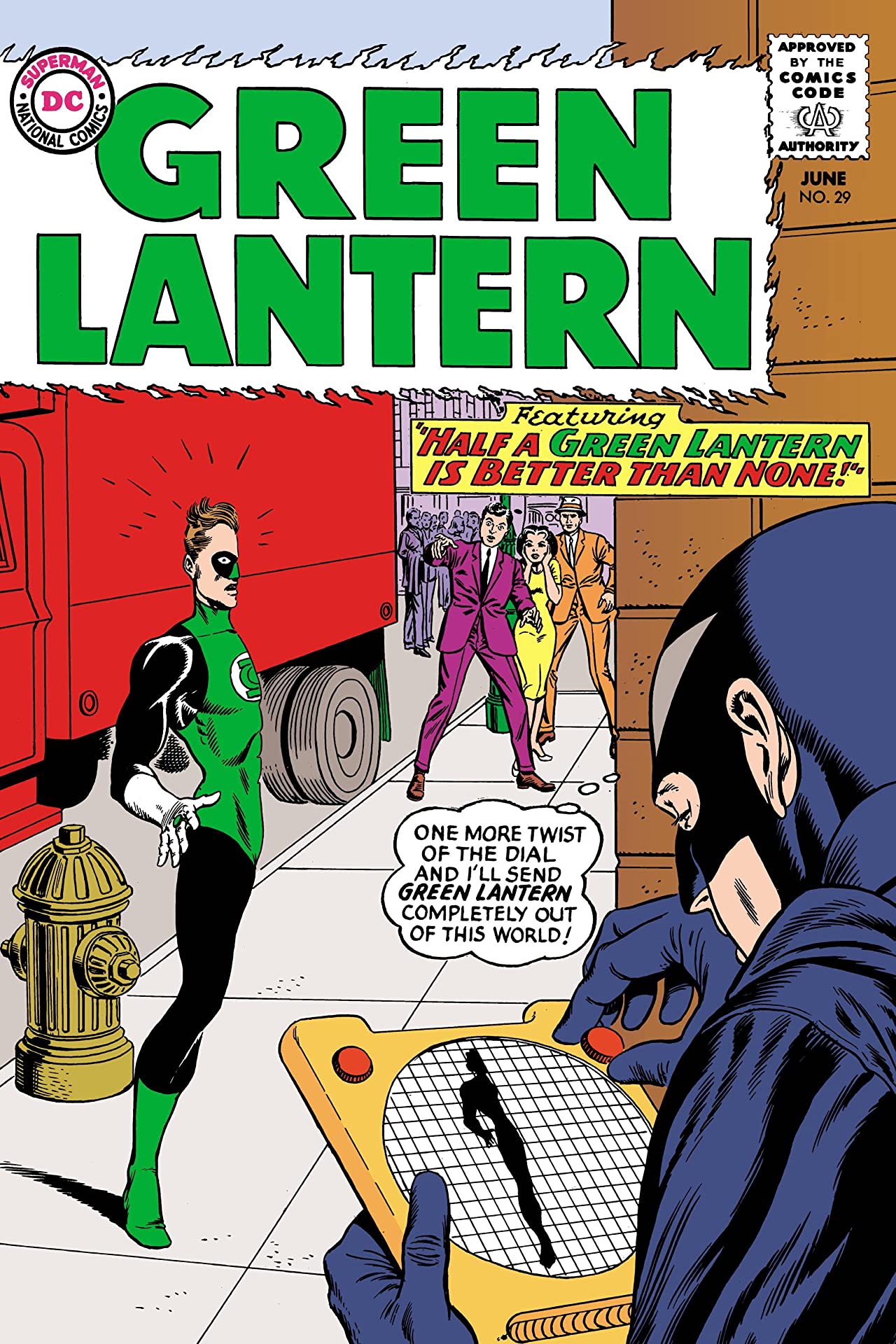
Green Lantern #29
Green Lantern #29 (June 1964) is the debut issue of William Hand, the Black Hand — a Silver Age rogue whose concept of draining and redirecting Green Lantern's own ring energy made him a uniquely parasitic threat in Hal Jordan's rogues gallery. For decades he remained a second-tier, gimmick-heavy villain, but that origin story proved far more consequential than it first appeared: Geoff Johns retroactively seeded Black Hand as the prophesied 'avatar of death' and the first Black Lantern, making this issue the narrative seed of the 2009 crossover Blackest Night, one of the most commercially and critically significant Green Lantern events in DC's history. The issue is also a minor formal curiosity of the Silver Age: artist Gil Kane breaks the fourth wall in the story's pages, appearing as himself to narrate Black Hand's origin directly to the reader — an unusual metafictional touch for a mainstream superhero comic of the era.
In "Half a Green Lantern Is Better Than None!", Green Lantern faces a desperate twist when Black Hand captures his power ring and traps it in a device designed to drain his energy. With his ring gone and his powers suspended, Hal Jordan must find a way to fight back—before he’s lost entirely. Written by John Broome and illustrated by Gil Kane with inks by Sid Greene, this 1964 classic features cover art by Gil Kane and Murphy Anderson.
When Black Hand captures Green Lantern’s power ring and traps it in a device meant to drain its energy, the hero must find a way to fight back—before he’s lost forever in another dimension. The story pits willpower against cunning in a battle where even half a ring might be enough to make a difference.
In "Half a Green Lantern Is Better Than None! Part II," Black Hand unleashes a sinister device designed to siphon and imprison Green Lantern’s power ring, trapping the hero in another dimension. With his willpower tested like never before, Green Lantern must find a way to reclaim his strength before the energy is lost forever.
ComicBooks.com Value
Show all 22 grades ▾
This exact issue on ebay
CGC 8 ▾ $350–$550 3 listings
Raw — VF/NM ▾ $5.99–$500 2 listings
Raw — VG+ ▾ $71.89–$115 2 listings
Raw — GOOD ▾ $23–$27.02 2 listings
Raw / ungraded ▾ $1.99–$117 19 listings
Read it digitally
Sell my copy
Have this issue — or a whole collection? Get a fair offer from us, skip the marketplace fees and the hassle.
We Buy Collections ▸History
The issue was written by John Broome, the primary architect of the Silver Age Green Lantern mythology, with pencils and cover art by Gil Kane — the same creative partnership responsible for launching Hal Jordan in Showcase #22 (1959) and for creating Sinestro, Carol Ferris's Star Sapphire persona, and eventually Guy Gardner. The issue carried a second story scripted by Gardner Fox, who was sharing writing duties with Broome on the series from issue #16 onward. Julius Schwartz served as editor, consistent with his role overseeing the entire Silver Age Green Lantern run. The on-sale date recorded in the Grand Comics Database is April 9, 1964, with a June 1964 cover date — a standard bimonthly scheduling gap for DC at the time.
Trivia · 8 facts
- First appearance and origin of Black Hand (William Hand), a villain who constructs a device to siphon ambient energy from Green Lantern's power ring and weaponize it against him.
- Lead story titled 'Half a Green Lantern Is Better Than None!' written by John Broome, with pencils and cover art by Gil Kane and inks by Sid Greene.
- Second story in the issue written by Gardner Fox, with Gil Kane on art and Sid Greene inking; lettering on both stories by Gaspar Saladino; edited by Julius Schwartz.
- The issue also introduces three members of William Hand's family — brothers Joe Hand, David Hand, and Peter Hand — all making their first and only significant appearances.
- Artist Gil Kane makes an in-story cameo as himself, breaking the fourth wall to narrate Black Hand's backstory to the reader — an unusual metafictional device for a 1964 superhero comic.
- The second story features a cameo by the full Justice League of America roster (Hal Jordan, Batman, Superman, Wonder Woman, Flash, Aquaman, Atom, Martian Manhunter, and Snapper Carr), though Green Lantern declines their help and handles the threat solo.
- The original story presents Black Hand's energy-absorbing device as his own invention; Geoff Johns later retconned in Green Lantern: Secret Origin that the device was originally built by Atrocitus of the Five Inversions.
- The main story has been reprinted in The Green Lantern Archives Vol. 4, Showcase Presents: Green Lantern Vol. 2, and also in The Flash #229; the full issue is available as a digital edition via DC/Kindle.
Full credits
Reprints
Reprinted in Rymdmannen #2/1969 (1969), Groene Lantaarn Classics #2728 (1973), The Flash #229 (1974), Green Lantern Archives #4 (2002), Showcase Presents: Green Lantern #2 (2007), The Green Lantern Omnibus #2 (2012), Green Lantern: The Silver Age Omnibus #1 (2017), Green Lantern: The Silver Age #3 (2018), DC Finest: Green Lantern: The Defeat of Green Lantern #[nn] (2025), Green Lantern Album #3
Key issues in Green Lantern
 ★
★ ★
★ ★
★ ★
★ ★
★ ★
★ ★
★ ★
★Reviews
Reader reviews
No reader reviews yet.