
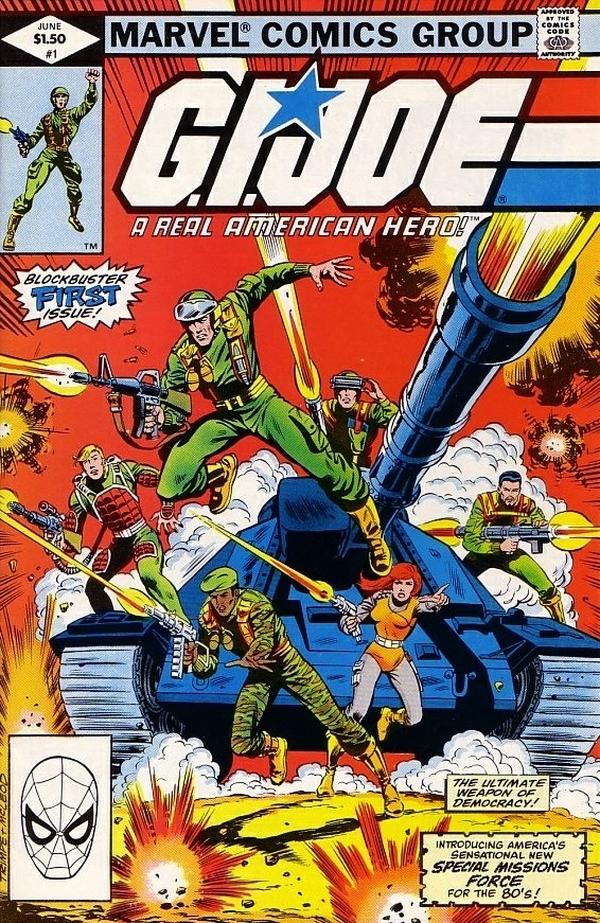
G.I. Joe, a Real American Hero #1
☆ Be the first to review + Add to your collection — Join freeG.I. Joe: A Real American Hero #1 launched not only one of Marvel's longest-running licensed series but also a genuine cross-media phenomenon, credited with transforming Hasbro's 3¾-inch action figure relaunch into a pop-culture institution that ran for over a decade. The issue delivered the first comic-book appearances of an enormous ensemble — Snake-Eyes, Scarlett, Hawk, Stalker, Cobra Commander, the Baroness, and the rest of the original thirteen Joes — establishing the characters, their underground headquarters called 'The Pit,' and the Cobra terrorist organization all at once. Historically, it is the anchor of what became the first comic book ever promoted through a dedicated television commercial, a maneuver that exploited a regulatory loophole and reshaped how toy companies could market to children, earning the descriptor 'a historically crucial moment in media convergence.' Writer Larry Hama's approach — treating the toy tie-in with the same narrative seriousness he would bring to any original work, grounding characters in real military detail and distinct personal histories — set a template that proved a licensed comic could be a genuinely substantive storytelling vehicle.
"Operation: Lady Doomsday" kicks off G.I. Joe, a Real American Hero #1 with a tense desert mission that puts Scarlett and Snake-Eyes on their own against unknown threats. As Rock N Roll races to deliver a critical package, the trio’s survival hinges on timing and skill—just as their ammo runs low, a timely rescue unfolds before they escape under pressure. Written by Larry Hama and illustrated by Don Perlin, with inks by Jack Abel, colors by Glynis Wein, and letters by Rick Parker, the issue’s cover by Herb Trimpe and Bob McLeod captures the mission’s high-stakes urgency.
In "Operation: Lady Doomsday," Cobra strikes fast and silent, seizing a high-profile nuclear physicist and vanishing into the shadows. With the world's security hanging in the balance, the G.I. Joe team is assembled for their first mission—racing against time to rescue the scientist before her knowledge falls into the wrong hands.
In the scorching desert, Scarlett and Snake-Eyes are stranded with dwindling supplies, forced to rely on each other as Rock N Roll races to deliver a critical package to Stalker and Clutch. With ammo running low and the heat closing in, their survival hinges on a timely rescue—and a tense, unexpected reunion with their comrades just as the mission’s final leg begins.
ComicBooks.com Value
Show all 22 grades ▾
This exact issue on ebay
CGC 9.6 ▾ $377–$450 5 listings
CGC 9.4 ▾ $245–$257 2 listings
CGC 9 ▾ $220–$300 3 listings
CGC 8.5 ▾ $170–$250 2 listings
CGC 8 ▾ $160–$190 2 listings
CGC 7.5 ▾ $125–$200 3 listings
Raw — NM ▾ $17.25–$175 4 listings
Raw — VF ▾ $123–$208 4 listings
Raw / ungraded ▾ $3.99–$200 18 listings
More listings for this title
Read it digitally
Sell my copy
Have this issue — or a whole collection? Get a fair offer from us, skip the marketplace fees and the hassle.
We Buy Collections ▸History
The series emerged from a 1981–82 partnership between Marvel and Hasbro, brokered in part through a chance encounter between Jim Shooter and a Hasbro executive, and shaped at a subsequent editorial meeting where Archie Goodwin proposed Cobra Command as the Joe team's recurring antagonist — an idea inspired by HYDRA's role opposite S.H.I.E.L.D. Hama had already been developing an unpublished project called 'Fury Force,' premised on the son of Nick Fury assembling elite commandos against HYDRA, and Shooter adapted that concept for the Joe assignment; Hama later acknowledged he took the job because he had been seeking writing work for a decade and was the last editor in the building willing to accept a project that required splitting page rates with Hasbro's licensing fee. The inaugural issue was edited by Tom DeFalco under editor-in-chief Jim Shooter, and the cover — penciled by Herb Trimpe and inked by Bob McLeod — was released with both a direct-edition and newsstand edition; a notable editorial complication surfaced only decades later when Hama revealed that a key Hawk speech in the issue had been altered without his consent, a grievance he described as having 'stuck in my craw for decades' until Image/Skybound restored his original dialogue in a 2023 special reprint.
Trivia · 8 facts
- First appearances of the entire original thirteen-member G.I. Joe team: Hawk, Stalker, Breaker, Clutch, Scarlett, Snake-Eyes, Rock 'n' Roll, Steeler, Grand Slam, Flash, Short-Fuze, Grunt, and Zap — all drawn directly from Hasbro's inaugural 1982 action-figure assortment.
- First appearances of two primary villains: Cobra Commander (co-conceived by Archie Goodwin) and the Baroness — notably, the Baroness is the earliest G.I. Joe character whose comic debut predated the conception of her action figure.
- The issue contains two complete stories: the lead 'Operation: Lady Doomsday' (pencils by Herb Trimpe, inks by Bob McLeod) and the backup 'Hot Potato' (pencils by Don Perlin, inks by Jack Abel), both written by Larry Hama — making it an oversized, 52-page double-sized premiere.
- The Pit (the Joe team's underground headquarters), the MOBAT tank, the VAMP jeep, the H.A.L., J.U.M.P., and R.A.M. military vehicles all receive their first appearances, along with a two-page diagram of the Pit base.
- Issue #1 also establishes the team's official in-universe designation as 'Special Counter-Terrorist Unit Delta,' and the in-house joke character 'Shooter' (named for editor-in-chief Jim Shooter) appears, later canonized as a real Joe by Hama in Devil's Due's G.I. Joe Declassified #1–3.
- The television commercial produced to promote this issue was the first commercial ever created to advertise a comic book; by framing it as a comic-book ad rather than a toy ad, Hasbro was legally able to run animated sequences far longer than the ten-second limit then imposed on toy commercials.
- The issue has been reprinted numerous times across multiple publishers and formats, including the G.I. Joe Special Treasury Edition (Marvel, 1982), Tales of G.I. Joe #1 (Marvel, 1988), G.I. Joe: The Complete Collection Vol. 1 (IDW, 2012), and a 2023 Image/Skybound special edition that restores Hama's original Hawk dialogue for the first time in print.
- Writer Larry Hama drew on his own U.S. military service and named several characters after men he had served with, bringing an authenticity to the dialogue and tactics that distinguished the series from typical toy-licensed comics of the era.
Cast · 23 characters
Full credits
Reprints
Reprinted in G.I. Joe, a Real American Hero [25th Anniversary Action Figure Reprint Series] #1 (1982), G.I. Joe Special Treasury Edition #1 (1982), Micronauts #42 (1982), Team America #2 (1982), G.I. Joe #1 (1982), G.I. Joe #2 (1982), G.I. Joe #3 (1983), G.I. Joe Yearbook #1 (1985), G.I. Joe Yearbook #2 (1986), G.I. Joe Comics Magazine #1 (1986), Comandos em Ação #1 (1987), G.I. Joe Heros Sans Frontieres #1 (1987), Tales of G.I. Joe #1 (1988), G.I. Joe Héroes Internacionales #12 (1988), G. I. Joe Comandos Heroicos #1 (1988), Action Force #5/1988 (1988), Action Force / G.I. Joe #1/1993 (1993), G.I. Joe #1 (2002), G.I. Joe: A Real American Hero #1 (2004), Hundred Penny Press: G.I. Joe: Real American Hero #1 (2011), G.I. Joe: The Complete Collection #1 (2012), G.I. Joe: A Real American Hero #1 Hundred Penny Press #[nn] (2014), G.I. Joe a Real American Hero #1 Larry Hama Cut #[nn] (2023), G.I. Joe: A Real American Hero Compendium #1 (2024) + 3 more
Key issues in G.I. Joe, a Real American Hero
Variants (1)
Reviews
Reader reviews
No reader reviews yet.