
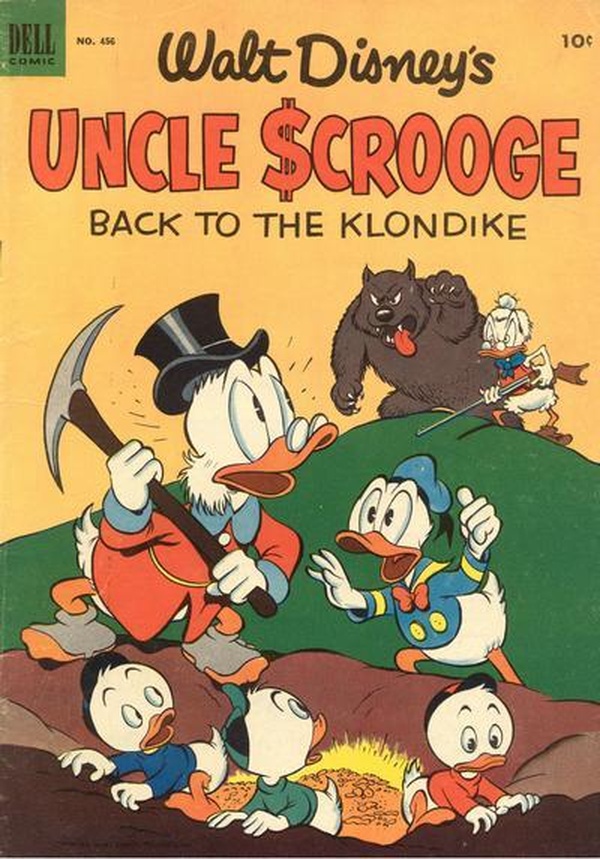
Four Color #456
☆ Be the first to review + Add to your collection — Join freeFour Color #456 — effectively Uncle Scrooge #2 — contains Carl Barks's 'Back to the Klondike,' a story widely regarded as a turning point in how Scrooge McDuck was written: it is the first tale to reveal that behind his miserly exterior lies a guarded emotional life shaped by loneliness and loss. The issue also introduces Glittering Goldie (Goldie O'Gilt), Scrooge's secret sweetheart and the only significant romantic figure in his entire mythology, a character so resonant that later creators from Don Rosa to the DuckTales animation team returned to her repeatedly. By making the Klondike Gold Rush the irreducible core of Scrooge's origin — rather than a passing reference — Barks gave the Duck universe a usable, emotionally grounded backstory that would anchor decades of subsequent storytelling across multiple publishers and countries.
In "Fare Delay," Carl Barks delivers a classic tale of memory, gold, and long-buried debts, as Scrooge McDuck, spurred by a dose of pills, suddenly remembers the exact spot where he stashed a fortune in nuggets fifty years prior. When the ducks journey to the Klondike, they’re met with a surprise: Scrooge’s old claim is now held by Glittering Goldie, a former dance hall girl with a past—and a debt—Scrooge is determined to collect. With Barks handling every aspect of the art and storytelling, this 1953 Four Color #456 is a masterclass in visual storytelling and nostalgic adventure, all wrapped in a cover by Barks himself.
In "Back to the Klondike," Scrooge McDuck, spurred by memory-restoring pills, recalls the hidden cache of gold he buried in the Yukon half a century ago. When he and the ducks return to the Klondike, they discover his old claim now belongs to Glittering Goldie, a glamorous former dance hall girl from his gold rush days—and someone who still owes him a thousand dollars, plus interest.
ComicBooks.com Value
Show all 20 grades ▾
This exact issue on ebay
Raw — VG+ ▾ $254–$331 2 listings
Raw — VG ▾ $53–$200 4 listings
Raw — VERY GOOD ▾ $170–$230 2 listings
Raw / ungraded ▾ $30–$300 8 listings
Read it digitally
Sell my copy
Have this issue — or a whole collection? Get a fair offer from us, skip the marketplace fees and the hassle.
We Buy Collections ▸History
Carl Barks wrote and drew the story in the autumn of 1952 — art for the lead story was submitted on September 18, 1952 — after finding a copy of Ethel Anderson Becker's photographic record of the Klondike Gold Rush, 'Klondike '98,' in a Seattle bookshop during a period when he was living out of motels following his second divorce. The raw material he pulled from that book — a saloon fight and an abduction sequence — violated Disney editorial standards, and the story was cut from 32 pages to 27 before publication; the excised pages altered character motivations, making Scrooge more ambiguous and Goldie less sympathetic. Almost all of the cut artwork was eventually recovered, and the story was restored to its full length for a 1981 reprint, with Barks himself reconstructing a missing half-page; a single lost panel from that half-page was not rediscovered until 2021.
Trivia · 8 facts
- First appearance of Glittering Goldie (Goldie O'Gilt), portrayed as a dance-hall singer in Dawson City during the Klondike Gold Rush and the only significant romantic figure in Scrooge McDuck's history.
- The issue is the second of three Uncle Scrooge tryout issues published in Dell's Four Color anthology before Scrooge was granted his own ongoing series beginning with issue #4 (legacy numbering).
- Entire contents — cover, lead story ('Back to the Klondike,' 27 pages), backup story ('Somethin' Fishy Here,' 5 pages), inside front cover, inside back cover, and back cover strip — were written and drawn by Carl Barks.
- The story was editorially cut from 32 to 27 pages before publication because Dell's editors considered the barroom-fight and abduction scenes inappropriate for a Disney comic; the deleted pages changed both Scrooge's and Goldie's characterizations.
- This is the first story to make the Klondike Gold Rush an essential, defining chapter of Scrooge's past rather than a casual background detail; subsequent creators — including Barks himself, Don Rosa, and European artists — referenced it more frequently than any other period of Scrooge's life.
- Barks modeled Glittering Goldie in part on real-life Klondike entertainer Kathleen Rockwell, known as 'Klondike Kate.'
- The story was loosely adapted as the first produced episode (though not the first aired) of the syndicated animated series DuckTales in 1987, marking Glittering Goldie's animated debut.
- The issue has been reprinted internationally across more than a decade of publications, including the Carl Barks Library (Another Rainbow, 1983 series), Uncle Scrooge McDuck His Life and Times (Celestial Arts, 1987), Gladstone Comic Album #4 (1988), and the Complete Carl Barks Disney Library Vol. 12 (Fantagraphics, 2012).
Cast · 6 characters
Full credits
Reprints
Reprinted in Donald Duck #35/1955 (1955), Le Journal de Mickey #292 (1957), Donald Duck & Co #52/1959 (1959), Donald Duck & Co #1/1960 (1960), Donald Duck & Co #2/1960 (1960), Donald Duck & Co #12/1960 (1960), Donald Duck & Co #13/1960 (1960), Walt Disney the Best of Uncle Scrooge and Donald Duck #1 (1966), Donald Duck & Co #42/1967 (1967), Oscar Mondadori [Oscar Fumetto] #170 (1968), The Rocket's Blast-Comicollector #117 (1975), Walt Disney's Giant Comics #684 (1977), Walt Disney Uncle Scrooge #142 (1977), Donald Ducks Show #[31] (1977), Walt Disney Uncle Scrooge #156 (1978), Kalle Ankas bästisar #15 (1981), Uncle Scrooge, His Life and Times #1 (1981), The Complete Carl Barks #12 (1982), Walt Disney's Godbiter #48 (1983), Walt Disney's Comics and Stories #2 (1984), The Carl Barks Library #3 (1984), The Complete Carl Barks #32 (1985), Gladstone Comic Album #4 (1988), Disney's DuckTales #12 (1990) + 20 more
Key issues in Four Color
 ★
★ ★
★ ★
★ ★
★ ★
★ ★
★ ★
★Reviews
Reader reviews
No reader reviews yet.