
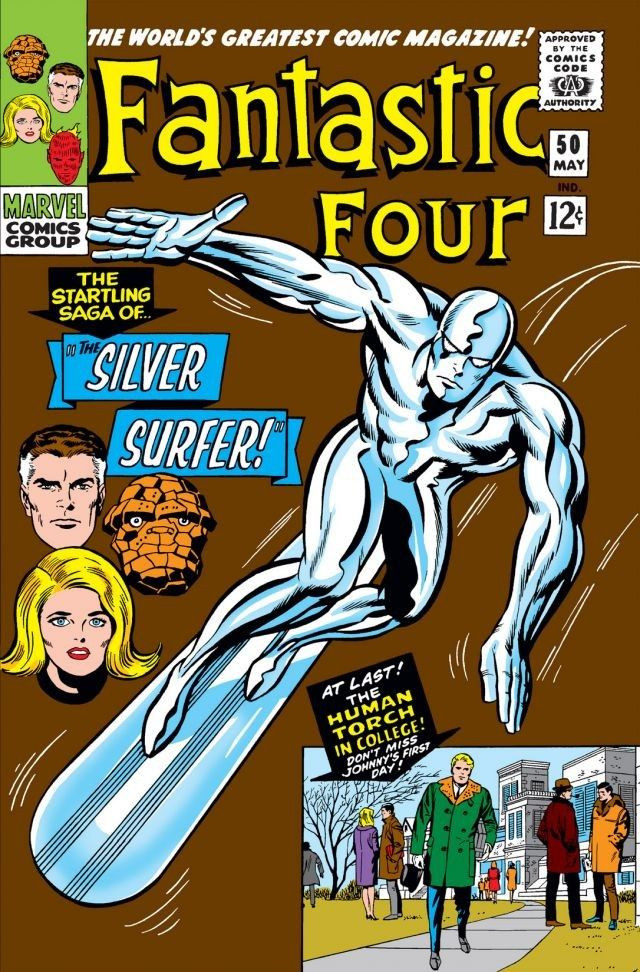
Fantastic Four #50
☆ Be the first to review + Add to your collection — Join freeFantastic Four #50 (May 1966) closes out what fans and historians call 'The Galactus Trilogy,' the three-issue arc that permanently shifted superhero comics toward cosmic-mythological storytelling. The issue crystallizes the Silver Surfer's defining character arc — a once-willing herald who breaks with his god-like master to defend humanity — and seals the consequences of that defiance by writing him permanently into Earth's atmosphere, exiled and alone. By resolving a planetary extinction threat not through superhero muscle but through a stolen doomsday weapon and a herald's moral awakening, Lee and Kirby demonstrated that mainstream comics could sustain genuinely philosophical stakes, a lesson that influenced the medium for decades. The Atlantic called the trilogy 'the indisputable pinnacle of the so-called Silver Age of comic books,' and the issue's dual-track structure — cosmic climax in the first half, grounded collegiate soap opera in the second — showed the team's bold willingness to swing between scales within a single issue.
In "The Startling Saga of the Silver Surfer!", the Fantastic Four face their most cosmic threat yet as the Silver Surfer joins them in confronting Galactus, whose arrival looms over Earth. Meanwhile, Johnny Storm begins a new chapter at Metro College, where he crosses paths with Wyatt Wingfoot. Written by Stan Lee and Jack Kirby, with art by Jack Kirby and inks by Joe Sinnott, this landmark issue features a cover by Kirby and Sinnott that captures the epic scale of the battle.
ComicBooks.com Value
Show all 22 grades ▾
This exact issue on ebay
CGC 9 ▾ $3,295–$3,450 2 listings
CGC 8.5 ▾ $1,912–$2,200 2 listings
CGC 8 ▾ $2,100–$2,300 2 listings
CGC 7.5 ▾ $490–$835 6 listings
CGC 7 ▾ $590–$1,000 4 listings
CGC 6.5 ▾ $550–$600 4 listings
CGC 5.5 ▾ $380–$585 3 listings
CGC 5 ▾ $200–$600 7 listings
CGC 4.5 ▾ $300–$380 4 listings
CGC 4 ▾ $250–$355 2 listings
CGC 3.5 ▾ $207–$250 3 listings
CGC 3 ▾ $252–$295 3 listings
CGC ▾ $290–$365 2 listings
Raw — FN+ ▾ $449–$794 2 listings
Raw — FN ▾ $275–$325 2 listings
Raw — VG+ ▾ $220–$231 2 listings
Raw — VG ▾ $79.76–$390 8 listings
Raw — GD ▾ $120–$325 4 listings
Raw — GOOD ▾ $150–$230 2 listings
Raw / ungraded ▾ $10–$375 27 listings
More listings for this title
Read it digitally
Sell my copy
Have this issue — or a whole collection? Get a fair offer from us, skip the marketplace fees and the hassle.
We Buy Collections ▸History
The issue was scripted by Stan Lee and plotted and penciled by Jack Kirby, with inks by Joe Sinnott and lettering by Sam Rosen; it was released to newsstands on February 10, 1966, carrying a May 1966 cover date. The Silver Surfer himself was famously an unplanned addition — Kirby inserted the character into the pages of Fantastic Four #48 without discussion, and Lee recalled seeing the figure mid-production and thinking Kirby had gone too far, before being won over by the nobility of the design. Kirby later explained that Galactus needed a herald because he was 'tired of drawing spaceships,' and that the Silver Surfer represented the fallen angel archetype to him. Kirby originally had no intention of bringing Galactus back after this arc, wanting to preserve the character's singular aura of awe, but reader enthusiasm prompted Lee to request return appearances.
Trivia · 8 facts
- Published May 1966 (on-sale February 10, 1966) by Marvel Comics; script by Stan Lee, pencils by Jack Kirby, inks by Joe Sinnott, lettering by Sam Rosen.
- Concludes 'The Galactus Trilogy' (Fantastic Four #48–50), which introduced both Galactus and the Silver Surfer; this issue is the 3rd appearance of the Silver Surfer and the 2nd full appearance of Galactus.
- First appearance of Wyatt Wingfoot — a Native American college student inspired by Olympic athlete Jim Thorpe — who becomes a long-running supporting character and close friend of Johnny Storm.
- Introduces the Ultimate Nullifier, the weapon retrieved by the Human Torch from Galactus's worldship; Reed Richards's threat to use it is what finally compels Galactus to withdraw from Earth.
- Galactus punishes the Silver Surfer for his betrayal by permanently stripping him of his space-time powers and exiling him on Earth, the very planet he saved — the origin point for the Surfer's solo series launched in 1968.
- The letters page features a contribution from a 14-year-old Gerard Conway, who would later become one of Marvel's most significant writers and co-creator of the Punisher.
- The Galactus Trilogy — with this issue as its conclusion — was adapted into the 1967 Fantastic Four animated TV series and again for the 1994 Fantastic Four animated series; it also served as the basis for Marvels #3 (1994) by Kurt Busiek and Alex Ross.
- The issue has been widely reprinted, including in Marvel's Greatest Comics #37 (1972), Marvel Treasury Edition #2 (1974), Marvel Masterworks: Fantastic Four Vol. 5, the Fantastic Four Omnibus Vol. 2, and a 2019 Facsimile Edition reproducing the original ads and letters page.
Cast · 18 characters
Full credits
Reprints
Reprinted in HIP Comics #1910 (1967), Les Chefs-d'œuvre de la bande dessinée #[nn] (1967), Hit Comics #10 (1967), Marvel's Greatest Comics #37 (1972), I Fantastici Quattro #46 (1972), Une Aventure des Fantastiques #2 (1973), O Homem-Aranha #65 (1974), The Mighty World of Marvel #107 (1974), The Mighty World of Marvel #108 (1974), Marvel Treasury Edition #2 (1974), Die Fantastischen Vier #46 (1975), The Fantastic Four #[nn] (1979), Los 4 Fantásticos #28 (1980), Fantastic Four Pocket Book #4 (1980), Marvel-pocket #1/1985; 2 (1985), Marvel-pocket #2/1985 (1985), Une Aventure des Fantastiques #40 (1986), Clásicos Marvel #19 (1990), Silver Surfer: The Coming of Galactus #[nn] (1992), Marvel Masterworks #25 (1993), Fantastic Four #[nn] (1998), Essential Fantastic Four #3 (2000), Le Surfer d'Argent - L'intégrale #0 (2003), Marvel : Les origines #2 (2003) + 29 more
Key issues in Fantastic Four
 ★
★ ★
★ ★
★ ★
★ ★
★ ★
★ ★
★ ★
★Variants (1)
Reviews
Reader reviews
No reader reviews yet.