
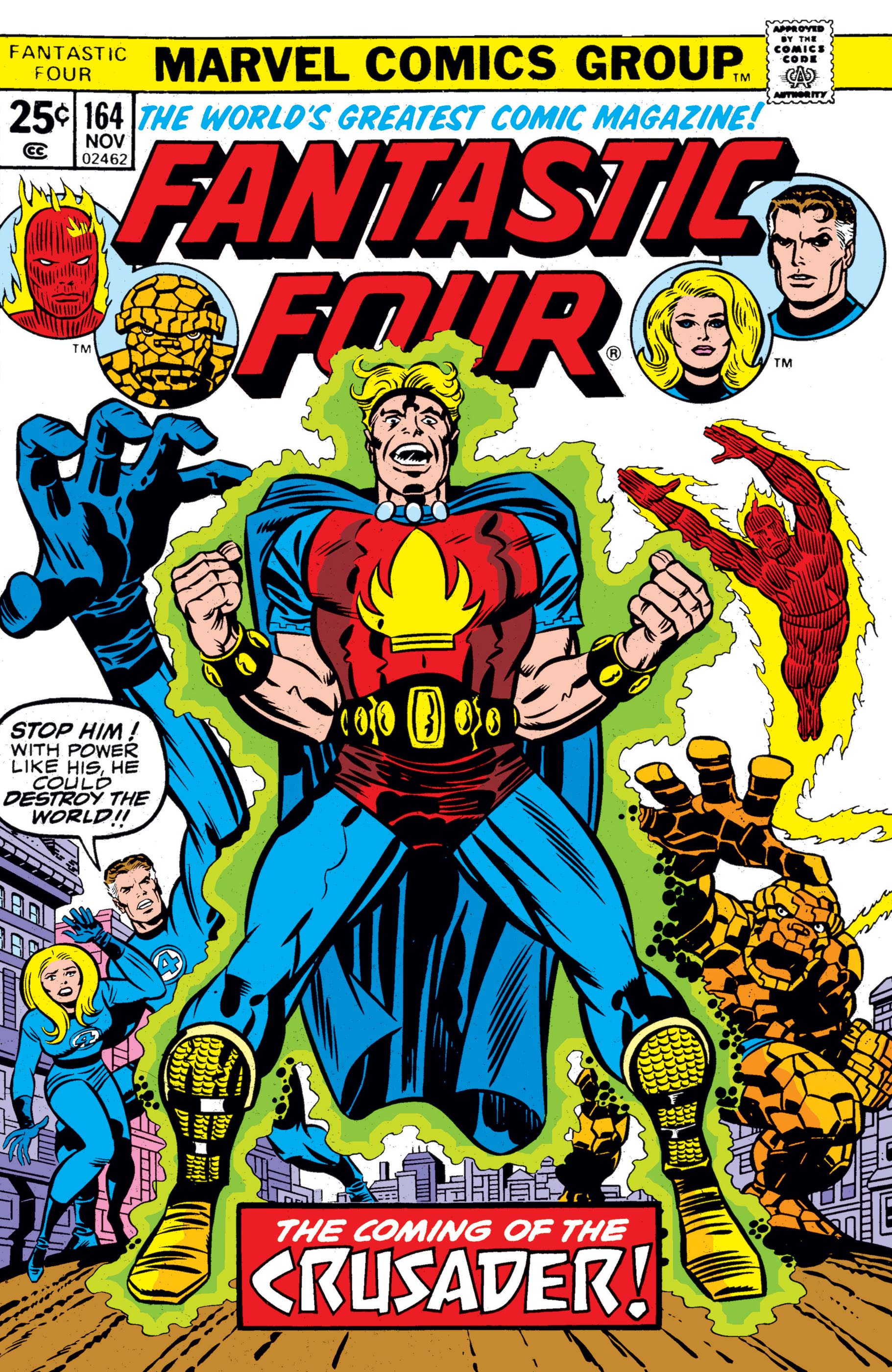
Fantastic Four #164
☆ Be the first to review + Add to your collection — Join freeFantastic Four #164 earns its double-key status by simultaneously introducing two characters whose long shadows still fall across the Marvel Universe today. Frankie Raye makes her debut here as Johnny Storm's new girlfriend — a seemingly ordinary woman hiding a fire-based secret that retroactively ties her to the original android Human Torch through her stepfather, Phineas Horton — and she would eventually evolve into Nova, one of Galactus's most morally complex heralds, years later. The issue also re-introduces the concept of Marvel Boy from the 1950s Atlas era by presenting Thelius, a Uranian Eternal whose altered memories lead him to believe he is the original Robert Grayson, bringing a long-dormant Bronze Age villain back as the Crusader and planting the seed for the Quantum Bands that would eventually pass to Wendell Vaughn and define the hero Quasar. Beyond its character debuts, this issue marks the entry of a 21-year-old George Pérez onto the Fantastic Four title, launching what would become one of the book's most celebrated artistic tenures of the Bronze Age.
In "The Crusader Syndrome!", Johnny Storm’s night out with Frankie Raye takes a sudden turn when New York City comes under attack by the mysterious Crusader. As the Human Torch scrambles to protect the city, Frankie faces a choice: will she still be drawn to him when she learns the truth behind his fiery secret? Written by Roy Thomas and brought to life by George Pérez’s dynamic art and Joe Sinnott’s sharp inks, this 1975 classic features a standout cover by Jack Kirby and Joe Sinnott.
ComicBooks.com Value
Show all 16 grades ▾
This exact issue on ebay
CGC 9.6 ▾ $199–$230 5 listings
CGC 9.4 ▾ $140–$200 4 listings
CGC 9.2 ▾ $98.25–$250 3 listings
CGC 3.5 ▾ $29.99 2 listings
Raw — VF+ ▾ $5–$35.66 5 listings
Raw — FN/VF ▾ $8.99–$20 4 listings
Raw — FN ▾ $9.49–$86.22 11 listings
Raw — VG ▾ $9.3–$25 10 listings
Raw / ungraded ▾ $3.95–$125 49 listings
Read it digitally
Sell my copy
Have this issue — or a whole collection? Get a fair offer from us, skip the marketplace fees and the hassle.
We Buy Collections ▸History
Writer-editor Roy Thomas scripted the issue under the title 'The Crusader Syndrome!' (Part 1 of 2), with Jack Kirby supplying the cover alongside inker Joe Sinnott — a nod to the book's founding legacy — while the interior pages were breakdowns by the young Pérez, whose prior Marvel work had been largely confined to kung-fu and monster titles after he began his career as an assistant to Rich Buckler. Although Pérez was billed only as a 'guest artist' in this issue, he returned for the next two issues as well and remained a recurring presence on the book for several years, ultimately contributing roughly twenty issues including annuals. The issue was published during a turbulent stretch for Marvel that saw six editors-in-chief change hands within five years, lending the era a sense of editorial instability even as individual creative voices like Thomas were producing carefully plotted story arcs.
Trivia · 8 facts
- First appearance of Frankie Raye, created by writer Roy Thomas and artist George Pérez; she would later become Nova, herald of Galactus, beginning in Fantastic Four #244 (July 1982).
- First appearance of the Crusader, whose true identity is Thelius — a Uranian Eternal whose memories were altered to make him believe he was 1950s Marvel Boy Robert Grayson; this is simultaneously the first Bronze Age appearance of the Marvel Boy concept.
- First appearance of the Quantum Bands (called 'Light Bands' in-story), the solar-powered wristbands wielded by the Crusader; after Thelius's death, S.H.I.E.L.D. recovered them and eventually passed them to Wendell Vaughn, who became Quasar.
- George Pérez's debut on the Fantastic Four title, drawn at age 21 as breakdowns finished by veteran inker Joe Sinnott; this issue launched Pérez's multi-year association with the series.
- Cover art by Jack Kirby (pencils) and Joe Sinnott (inks); Kirby had returned to Marvel after DC canceled his Fourth World books and was producing covers for several Marvel titles including his former flagship series.
- The story also advances ongoing sub-plots: Sue Richards's powers are confirmed to have been amplified by the Fifth-Dimensional Thunder Horn (established in FF #159), while Reed Richards's powers are shown fading — a deterioration that began in FF #157 and would continue through FF #178.
- Reprinted in Fantastic Four Visionaries: George Pérez Vol. 1 TPB (Marvel, 2005), which collected FF #164–167, #170, #176–178, and #184–186; also reprinted in Essential Fantastic Four Vol. 8 (2010) in black and white, and included in the Fantastic Four Omnibus Vol. 6 (2025).
- Frankie Raye's pyrophobia introduced in this issue is revealed in FF #238 to stem from hypnosis by her stepfather Phineas Horton, who accidentally doused her in the same chemicals that created the original android Human Torch, giving her suppressed flame powers of her own.
Cast · 11 characters
Full credits
Reprints
↩ Reprints [Marvel Hostess Ads] #3 (1975)
Reprinted in Comic Reader #121 (1975), Fantastic Four #53 (1975), Fantastic Four #54 (1975), Atlantic-serien [Fantastiske Fire] #6/1978 (1978), Atlanticserien #6/1978 (1978), Nova #68 (1983), Fantastic Four Visionaries: George Pérez #1 (2005), Essential Fantastic Four #8 (2010), Atlas: Marvel Boy #[nn] (2010), Fantastic Four: Crusaders & Titans #[nn] (2013), Marvel Masterworks: The Fantastic Four #16 (2014), Fantastic Four Epic Collection #9 (2023), Fantastic Four Omnibus #6 (2025), De Fantastiske Fire #6, I Fantastici Quattro #179, The Complete Fantastic Four #31
Key issues in Fantastic Four
 ★
★ ★
★ ★
★ ★
★ ★
★ ★
★ ★
★ ★
★Variants (1)
Reviews
Reader reviews
No reader reviews yet.