
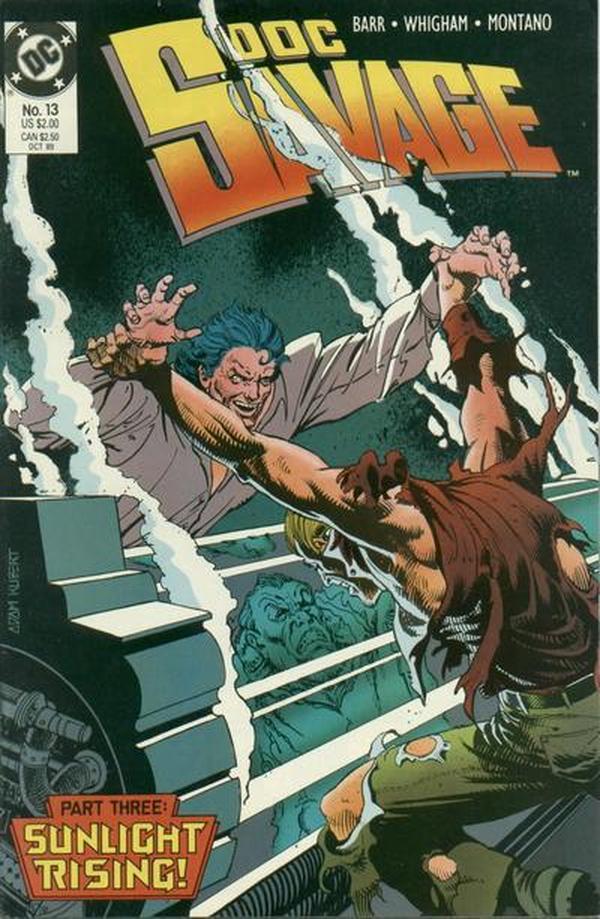
Doc Savage #13
Doc Savage (Vol. 2) #13 sits at the dramatic climax of the 'Sunlight Rising' arc — the comic adaptation of what is widely regarded by fans and critics as the high point of DC's entire 1988–1990 Doc Savage run. The issue escalates writer Mike W. Barr's reintroduction of John Sunlight, the only villain in all of pulp history to appear twice in the original Lester Dent novels, bringing him from hand-to-hand combat at Doc's Arctic Fortress of Solitude all the way into orbital space, where Sunlight commandeers a space station and literally blots out the sun using one of Doc's own stolen superweapons. As the penultimate chapter of a four-part story that reactivated the most storied rivalry in pulp-derived comics, the issue represents DC's most ambitious attempt to transplant classic 1930s pulp mythology into a fully modern, Copper Age idiom.
ComicBooks.com Value
This exact issue on ebay
Raw — MINT ▾ $3.5–$13.84 5 listings
Raw — VF/NM ▾ $3.49–$3.98 2 listings
Raw / ungraded ▾ $1.25–$11.96 15 listings
More listings for this title
Read it digitally
Sell my copy
Have this issue — or a whole collection? Get a fair offer from us, skip the marketplace fees and the hassle.
We Buy Collections ▸History
The ongoing Doc Savage series (Volume 2) launched in November 1988 after a successful 1987 four-issue miniseries, both published by DC under a licensed arrangement; Denny O'Neil scripted the opening arc, but Mike W. Barr took over as regular writer beginning with issue #7, steering the title back toward the classic pulp elements O'Neil had largely sidelined. Barr, a self-described pulp and science-fiction devotee who had previously slipped genre references into Green Lantern scripts, saw the John Sunlight resurrection storyline as his signature contribution, pairing the Man of Bronze against the archnemesis who had defined the character's greatest pulp-era stories. Interior art throughout the 'Sunlight Rising' arc was supplied by the consistent team of penciller Rod Whigham and inker Steve Montano, with Adam Kubert providing the cover for #13. Executive editor Dick Giordano and editor Mike Carlin oversaw the issue within the Copper Age DC 'deluxe format' production framework.
Trivia · 8 facts
- Cover date: October 1989 (published August 1989); DC Comics Vol. 2 ongoing series, issue #13.
- Story title: 'Sunlight Rising! Part 3: Veil Across the Sun!' — the third chapter of a four-part arc spanning issues #11–14.
- Written by Mike W. Barr; interior art by Rod Whigham (pencils) and Steve Montano (inks); cover by Adam Kubert; colors by Anthony Tollin; letters by Bill Oakley.
- John Sunlight — the only villain to appear in two of the original Lester Dent/Kenneth Robeson pulp novels (first in 'Fortress of Solitude,' October 1938, and again in 'The Devil Genghis') — is the central antagonist of the arc and is depicted here turning Doc's own stolen superweapons against the world from orbit.
- The issue's pivotal plot point: Sunlight seizes the space station Icarus and deploys an energy screen — one of Doc's cached weapons — to block the sun from Earth, then demands the world surrender to his rule and hand over Doc Savage.
- The 'Sunlight Rising' arc is the first and most extensive comic-book adaptation of the Sunlight villain since the original pulps; later appearances would follow from Millennium Publications (1991) and DC's First Wave imprint.
- The DC ongoing series ran for 24 issues plus one Annual (1989) and is noted for its unusual continuity device of aging Doc Savage in real time, giving him a grandson ('Chip' Savage) and depicting Doc's original Fabulous Five as elderly — a concept Barr inherited from O'Neil and the Kuberts.
- The series falls firmly in the Copper Age (1984–1991) and was published in DC's 'deluxe format' on higher-quality paper stock, distinguishing it from standard newsprint contemporaries.
Full credits
Reviews
Reader reviews
No reader reviews yet.