
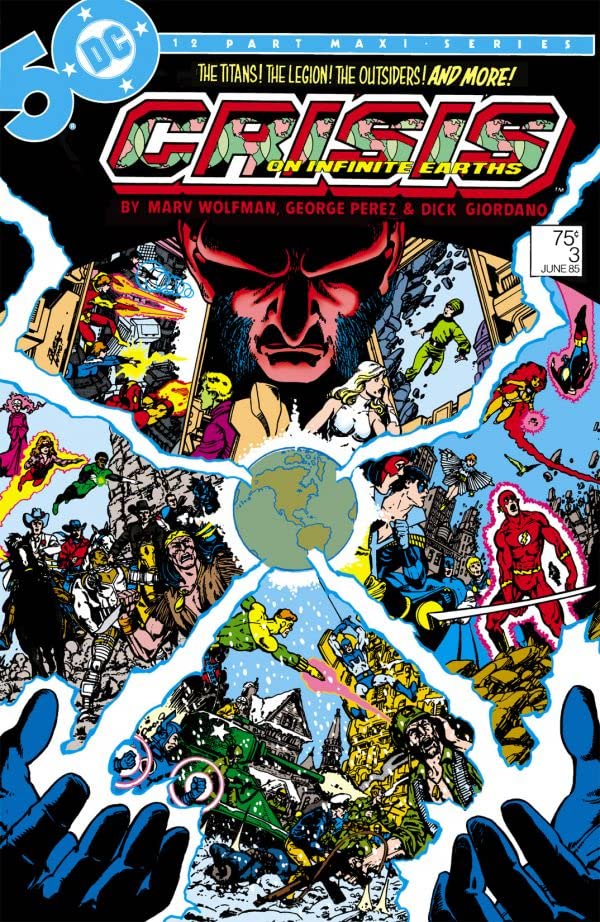
Crisis on Infinite Earths #3
☆ Be the first to review + Add to your collection — Join freeIssue #3 of Crisis on Infinite Earths — titled 'Oblivion Upon Us!' — is the chapter where DC's universe-reshaping event first draws blood on a massive, multiverse-spanning scale, delivering the deaths of Kid Psycho, the Western hero Nighthawk, and all four active Losers (Johnny Cloud, Captain Storm, Gunner, and Sarge) in a single issue, establishing that no corner of DC history — not the Silver Age Legion, not the World War II war books, not the Old West — was safe from the Anti-Monitor's antimatter wave. It is also the issue that crystallizes Alexander Luthor Jr.'s narrative function: the Monitor's discovery that Alex is composed of both positive matter and antimatter marks him as the pivot point around which the entire twelve-issue story will eventually turn. More broadly, the issue exemplifies the structural ambition of the series — Wolfman and Pérez leap across time periods and fictional genres in a single chapter, cross-pollinating characters who had never shared a page, a technique that proved enormously influential on every company-wide crossover that followed.
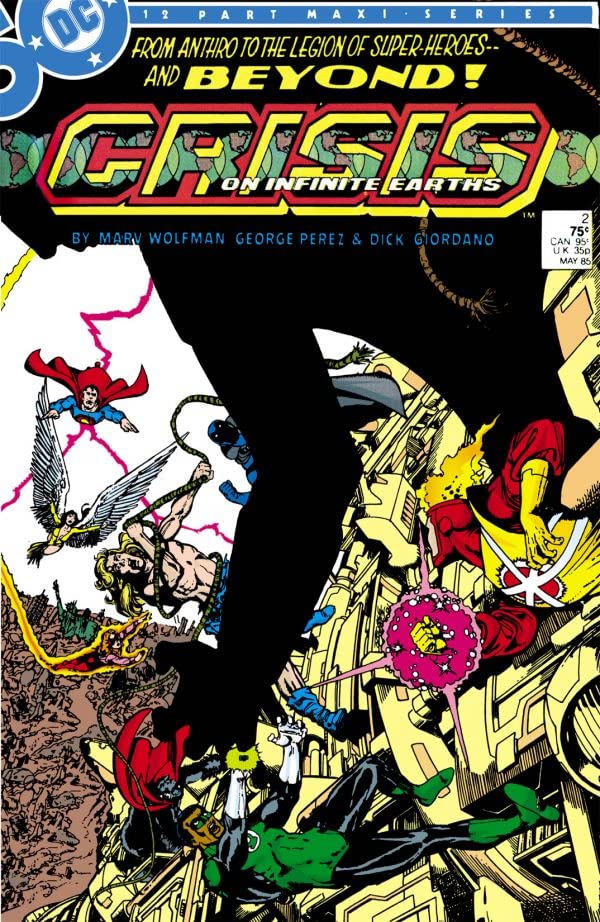
In "Oblivion Upon Us," the escalating chaos of the Multiverse reaches Earth-1 as global storms intensify and shadowy demons assault the heroes defending the Monitor's tuning forks. With the possessed Harbinger turning on the Monitor himself, the fate of reality hangs in the balance. Written by Marv Wolfman and brought to life by George Pérez’s dynamic art—penciled and inked by Pérez, with inks by Dick Giordano and Mike DeCarlo, and colors by Anthony Tollin—this pivotal issue deepens the crisis with haunting intensity. The cover, also by George Pérez, captures the dread of an unraveling universe.
ComicBooks.com Value
Show all 18 grades ▾
This exact issue on ebay
CGC 9.8 ▾ $130–$175 2 listings
Raw — MINT ▾ $5.99–$14.99 2 listings
Raw — VF/NM ▾ $4.95–$9.99 2 listings
Raw — VF ▾ $3.99–$5.4 4 listings
Raw / ungraded ▾ $2.79–$25.35 25 listings
More listings for this title
Read it digitally
Sell my copy
Have this issue — or a whole collection? Get a fair offer from us, skip the marketplace fees and the hassle.
We Buy Collections ▸History
Crisis on Infinite Earths grew out of Marv Wolfman's long-standing conviction that DC's multi-Earth continuity was hostile to new readers; he began seeding the groundwork as early as July 1982 when he introduced the mysterious Monitor in The New Teen Titans. George Pérez, who had originally planned only a pacing role on the series, talked himself into full co-plotter and penciller status after extended conversations with Wolfman — a creative partnership that shaped the dense, character-packed visual storytelling that distinguishes every issue, including #3. The series had been in development and delayed since at least 1981, finally launching in 1985 to coincide with DC's fiftieth anniversary, with the entire editorial apparatus of the company — including president Jenette Kahn, Paul Levitz, and Dick Giordano — coordinating the crossover in weekly meetings that were described as highly unusual for the era. Issue #3 carries interior art credits for both Dick Giordano and Mike DeCarlo as inkers over Pérez's pencils, with Tony Tollin on colors and John Costanza on letters, and Wolfman himself serving as editor.
Trivia · 8 facts
- Published March 7, 1985 (cover date June 1985); written by Marv Wolfman, pencilled by George Pérez, inked by Mike DeCarlo and Dick Giordano, colored by Tony Tollin, lettered by John Costanza.
- Story title: 'Oblivion Upon Us!' — the issue spans four distinct time periods simultaneously: WWII-era Markovia, the Old West of 1879 Texas, Earth-AD (the future post-Great Disaster world of Kamandi), and the 30th-century metropolis of the Legion of Super-Heroes.
- Deaths in this issue: Kid Psycho (Legion of Super-Heroes reservist, killed by the antimatter wave in 30th-century England), Nighthawk (Western hero, consumed by the antimatter wave in 1879 Texas), and the four Losers — Johnny Cloud, Captain Storm, Gunner, and Sarge — killed by Shadow Demons in WWII Markovia. King Solovar also dies of wounds sustained between issues #2 and #3.
- The Flash's mysterious terror-stricken appearance before Batman and the assembled heroes — followed by his instant disappearance — is a pivotal story beat that foreshadows Barry Allen's impending fate later in the series.
- The Monitor's analysis reveals that Alexander Luthor Jr. is composed of both positive matter and antimatter, identifying him as potentially the key to stopping the Crisis; this establishes Alex's role as the series' ultimate narrative linchpin.
- Harbinger, secretly under the Anti-Monitor's influence, confronts the Monitor at the issue's end — a scene complicated in production when panels were given curved corners at the last minute in an attempt to clarify it as a viewscreen image rather than a direct confrontation, an editorial fix widely noted as unsuccessful.
- The issue contains an in-story error: the Easy Company member Farmer Boy is mistakenly referred to as 'Flower'; the Losers' final mission is more fully depicted in the August 1985 one-shot Losers Special #1.
- The series has been collected in trade paperback, hardcover, and Absolute Edition formats; DC released a monthly run of remastered Facsimile Editions beginning April 2024, with issue #3's facsimile published June 18, 2024. A new Absolute Edition remastered from original inks and recolored against the original palette is scheduled for 2026.
Cast · 40 characters
Full credits
Reprints
Reprinted in Super Star Comics #4 (1986), Superamigos #24 (1987), Superman Klassik #5 (1991), Crisis on Infinite Earths #[nn] (1998), JLA - Die neue Gerechtigkeitsliga Sonderband #12 (1999), Crisis on Infinite Earths #[nn] (2001), Crisis on Infinite Earths #1 (2001), Crisis on Infinite Earths #2 (2002), Crisis on Infinite Earths The Absolute Edition #[nn] (2006), DC Comics Graphic Novel Collection Sonderband #2 (2015), Crisis on Infinite Earths Deluxe Edition #[nn] (2015), Crise nas Infinitas Terras #[nn] (2016), DC Comics Graphic Novels – Sagas Definitivas #1 (2018), Crisis on Infinite Earths: 35th Anniversary Deluxe Edition #[nn] (2019), Colección Héroes y Villanos #30 (2022), Crisis on Infinite Earths 3 (Facsimile Edition) #[nn] (2024), DC Finest: Events: Crisis on Infinite Earths Part One #[nn] (2025), Crisis on Infinite Earths #3
Key issues in Crisis on Infinite Earths
Variants (2)
Reviews
Reader reviews
No reader reviews yet.