
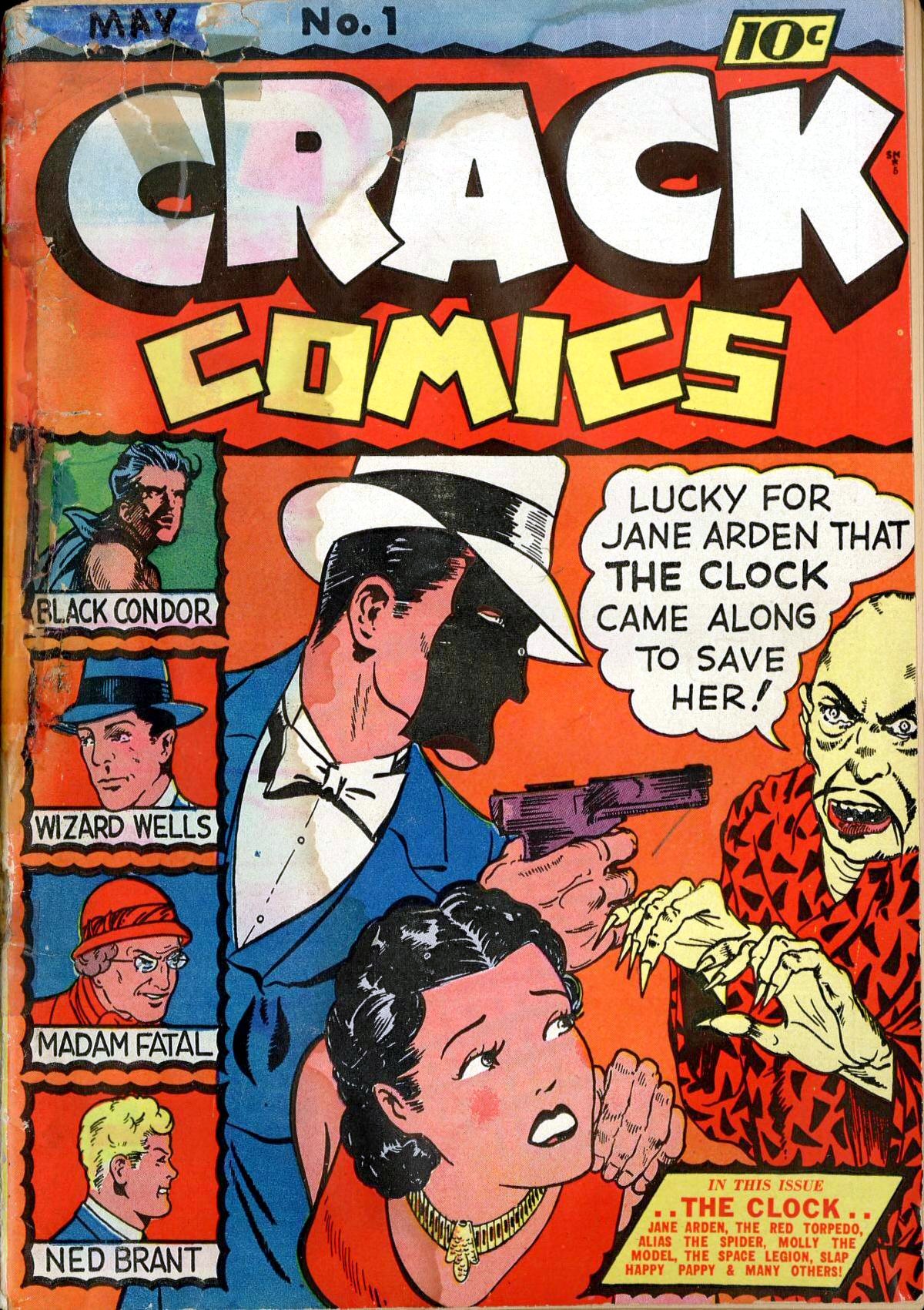
Crack Comics #1
☆ Be the first to review + Add to your collection — Join freeCrack Comics #1 (May 1940) is one of the most densely packed debut issues of the Golden Age, introducing four distinct characters — the Black Condor, the Red Torpedo, Madam Fatal, and Alias the Spider — in a single 68-page anthology. The Black Condor alone, scripted by Will Eisner and rendered by Lou Fine, represents a creative high-water mark for the era: a feral, flight-powered hero whose visual dynamism was so striking that contemporaries described Fine's aerial compositions as surpassing even Superman in grace and physicality. Madam Fatal's debut carries a separate and lasting distinction, standing as comics' first cross-dressing hero — a retired actor who fought crime disguised as an elderly woman — a concept so unusual for 1940 that it remains genuinely singular in the history of the medium. The issue also consolidated the Clock's ongoing adventures under the Quality banner, bringing comics' first fully-masked hero together with an entirely new roster of characters, making this a foundational document of the Quality Comics universe that would eventually be absorbed into DC's continuity as the Freedom Fighters.
"The Story of Pug Brady" in Crack Comics #1 (1940) introduces a young hero raised by condors after his father’s murder, forging a unique bond with the wild and mastering flight through quiet determination. Written by Will Eisner and illustrated with striking detail by Lou Fine—both inks and pencils—this early adventure blends survival, mystery, and a quiet quest for justice. The cover, by Ed Cronin, captures the story’s rugged, mythic tone in a 10-cent comic that stands as a landmark of early superhero storytelling.
In "The Story of Pug Brady," a washed-up ex-boxer and former All-American fullback stumbles into a dangerous web when he tries to steal Brian's watch. When he intervenes to save Brian from Mayor Kozer, the confrontation ends in tragedy—and sets off a chain of events where Brian steps into the shadows to avenge the fallen, disguising himself as the very man they sought to destroy.
In "The Sign of the Cricket," a masked menace known only as the Cricket strikes fear into the city, leaving behind a signature mark at each crime scene—just as the Spider once did. With the Spider already gone, the city's only hope lies in uncovering the truth behind the cricket's calling card before he strikes again.
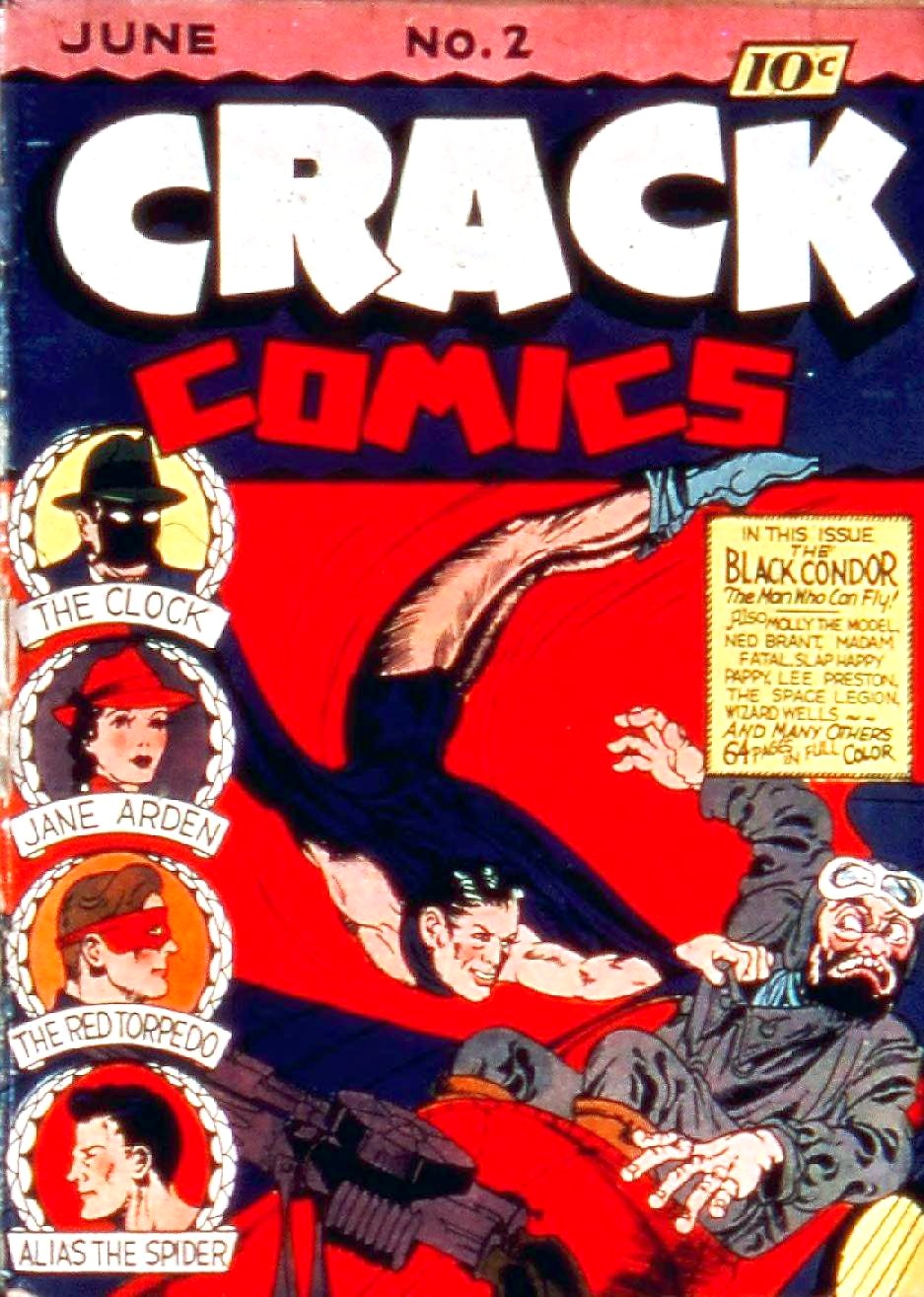
In "The Man Who Can Fly Like a Bird," infant Grey survives a brutal attack that claims his father’s life, only to be raised among condors who nurture him in the wild. As he matures, he learns to mimic their flight, mastering the skies through instinct and study—until a kind monk becomes his last connection to humanity. When that bond is shattered by the villain Gali Khan, Grey vows to protect the innocent, becoming a force of justice in the world he now walks.
ComicBooks.com Value
Show all 16 grades ▾
Find on ebay
Read it digitally
Sell my copy
Have this issue — or a whole collection? Get a fair offer from us, skip the marketplace fees and the hassle.
We Buy Collections ▸History
Crack Comics was Quality Comics' third anthology title, launched in May 1940 by publisher Everett 'Busy' Arnold and edited initially by Ed Cronin. Much of the inaugural issue's content was packaged through the Eisner and Iger Studio, whose stable of talent — including Will Eisner (writing as 'Kenneth Lewis') and artist Lou Fine — supplied the Black Condor feature, while Henry Kiefer (credited as 'Drew Allen') provided the Red Torpedo origin and Art Pinajian created and drew Madam Fatal. The title name itself was chosen to evoke excellence — 'crack' as in 'crack sharpshooter' — and the Clock feature migrated from Quality's own Feature Comics, where it had run since issue #3 (December 1937), making Crack Comics #1 simultaneously a launch platform for new characters and a continuation title for an established one. Quality would not officially put its name on the cover until Crack Comics #5 (September 1940), meaning this debut issue appeared under the earlier 'Comic Magazines' indicia.
Trivia · 8 facts
- Published May 1940 by Quality Comics (under the Comic Magazines imprint); 68 pages, 10 cents.
- First appearance and origin of the Black Condor (Richard Grey, Jr.), scripted by Will Eisner under the pseudonym 'Kenneth Lewis' and drawn by Lou Fine; the character went on to become the lead cover feature of the series through issue #26 and later joined DC's Freedom Fighters.
- First appearance and origin of Madam Fatal (Richard Stanton), created and drawn by Art Pinajian — universally recognized as the first cross-dressing superhero in American comics history; the character ran in the title through issue #22 (March 1942).
- First appearance and origin of the Red Torpedo (Jim Lockhart), a retired U.S. Navy engineer who builds a two-person submarine; created by Henry Kiefer (credited as 'Drew Allen'); ran as a regular feature through issue #20.
- First appearance of Alias the Spider, created and drawn by Paul Gustavson; ran in the title for years and was later revived in Image Comics' 2011 'Next Issue Project' tribute issue.
- The Clock (Brian O'Brien), the first fully-masked hero in American comic books (debuting in 1936), transferred here from Quality's Feature Comics along with his new sidekick Pat 'Pug' Brady — a down-on-his-luck ex-boxer introduced in this very issue — and served as the cover feature, alternating with Black Condor through issue #19.
- The 'Origin of Madam Fatal' story from this issue was reprinted in The Quality Companion (TwoMorrows Publishing, 2011), and Black Condor's origin was later retold in DC's Secret Origins #21 (December 1987).
- In November 2011, Image Comics published a tribute Crack Comics '#63' as part of Erik Larsen's 'Next Issue Project,' featuring new stories of the Clock, the Spider, Red Torpedo, and other characters who debuted in this issue.
Cast · 11 characters
Full credits
Reprints
Reprinted in Special Edition Series #2 (1974), Continuum #4 (2008), Continuum #4bis (2008), The Quality Companion #[nn] (2011), Étranges Aventures #2 (2017), Gwandanaland Comics #2005 (2018), Gwandanaland Comics #419 (2020)
Key issues in Crack Comics
Reviews
Reader reviews
No reader reviews yet.