
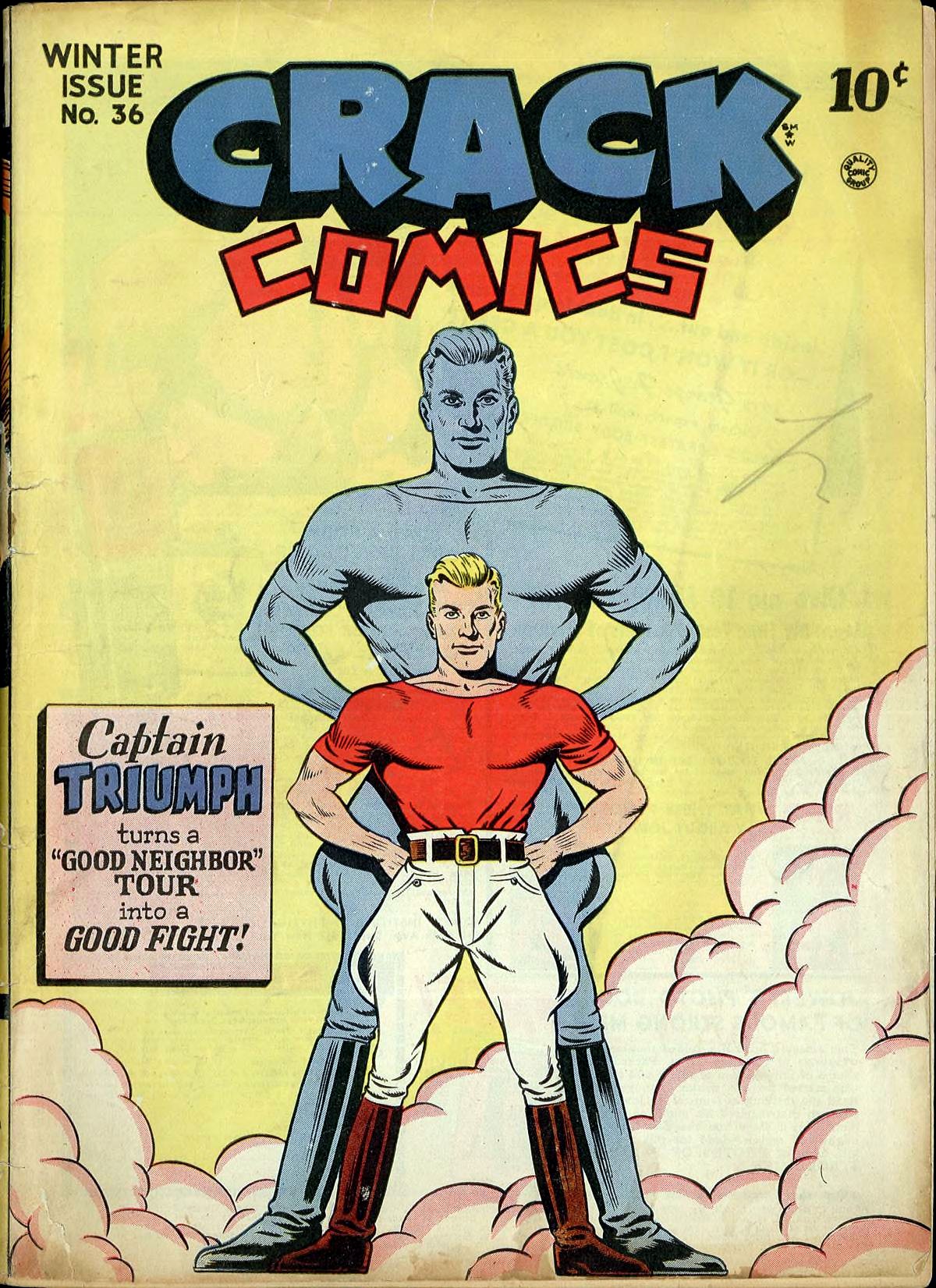
Crack Comics #36
☆ Be the first to review + Add to your collection — Join freeCrack Comics #36 (December 1944) marks a quiet but meaningful turning point in Quality Comics' flagship anthology: it is the first issue to carry Floogy the Fiji in the back-page slot previously held for years by George Brenner's The Clock, whose Golden Age run ended the issue before. That editorial reshuffle — swapping one of the medium's earliest masked-mystery-man features for a jungle-adventure filler — captures in miniature how superhero anthologies were quietly retooling themselves midway through World War II. Meanwhile, Captain Triumph continued his unbroken run as lead feature and cover star, cementing his status as the defining Quality superhero of the war's final years and the title's anchor through its eventual cancellation in 1949.
In "Riddle of the Lucky License," Kim takes on a diplomatic mission as a representative of the Good Neighbor Bureau, traveling to South America to promote goodwill—only to find himself entangled in a web of political intrigue. Captain Triumph’s presence sparks immediate complications, as he’s drawn into a tense situation involving a suspicious scheme. The story unfolds with sharp pacing and period flair, all rendered in bold, expressive art by Ed Dobrotka, who handles both interior and cover work with consistent detail.
In "null," Kim, newly appointed as a goodwill ambassador by the Good Neighbor Bureau, travels to South America—only to find Captain Triumph drawn into a web of political intrigue and a dangerous coup attempt. The story unfolds with sharp tension as diplomacy clashes with action, and heroism takes on a new kind of mission.
Hack O'Hara's luck takes a bad turn when his taxi license number becomes the winning ticket in a numbers racket—one that a cross-eyed printer accidentally set up using his plate instead of an untraceable one. Now the cabby finds himself caught between a vengeful gunman bent on silencing him and the innocent Anzonetti family who just want to collect their winnings in this 1944 adventure from Crack Comics. When the real brains behind the scheme move to eliminate both Hack and the prize money, the tough New York driver has to outfight his way to the truth and justice.
ComicBooks.com Value
Find on ebay
Read it digitally
Sell my copy
Have this issue — or a whole collection? Get a fair offer from us, skip the marketplace fees and the hassle.
We Buy Collections ▸History
By the time issue #36 reached newsstands, Crack Comics was operating in a significantly leaner form: wartime paper shortages had forced the title from monthly to bi-monthly and then, starting with issue #33 (Spring 1944), to a quarterly schedule with a reduced 60-page count. Publisher Everett Arnold had also recently parted ways with the Eisner & Iger studio packager and shifted content production largely in-house, under editor George Brenner — the same cartoonist who had created The Clock. The Captain Triumph lead story was drawn by Ed Dobrotka, who handled the character across much of the mid-run before Reed Crandall took over from issue #46 onward.
Trivia · 7 facts
- First issue of Crack Comics to feature Floogy the Fiji, a jungle-adventure feature that replaced The Clock in the back-page slot and continued through issue #59 (March 1949).
- The Clock — one of comics' earliest costumed mystery men, created by George Brenner — made his final Golden Age appearance the prior issue (#35, Autumn 1944), making #36 the first issue of the title without him.
- Captain Triumph lead story (untitled, art by Ed Dobrotka): Kim Meredith is appointed to the Good Neighbor Bureau and sent as a goodwill ambassador to South America, where Lance Gallant / Captain Triumph becomes entangled in political intrigue and a coup attempt — an unusually topical, geopolitical plot for a Golden Age superhero story.
- Supporting features include a Slap Happy Pappy humor page by Jack Cole, a Pen Miller story scripted and drawn by Klaus Nordling, 'Riddle of the Lucky License' starring Hack O'Hara (art by Jack Alderman), 'Bravo!' starring Inkie (art by Janice Valleau), an untitled Beezy story by Bernard Dibble, and a Rube Goldberg strip.
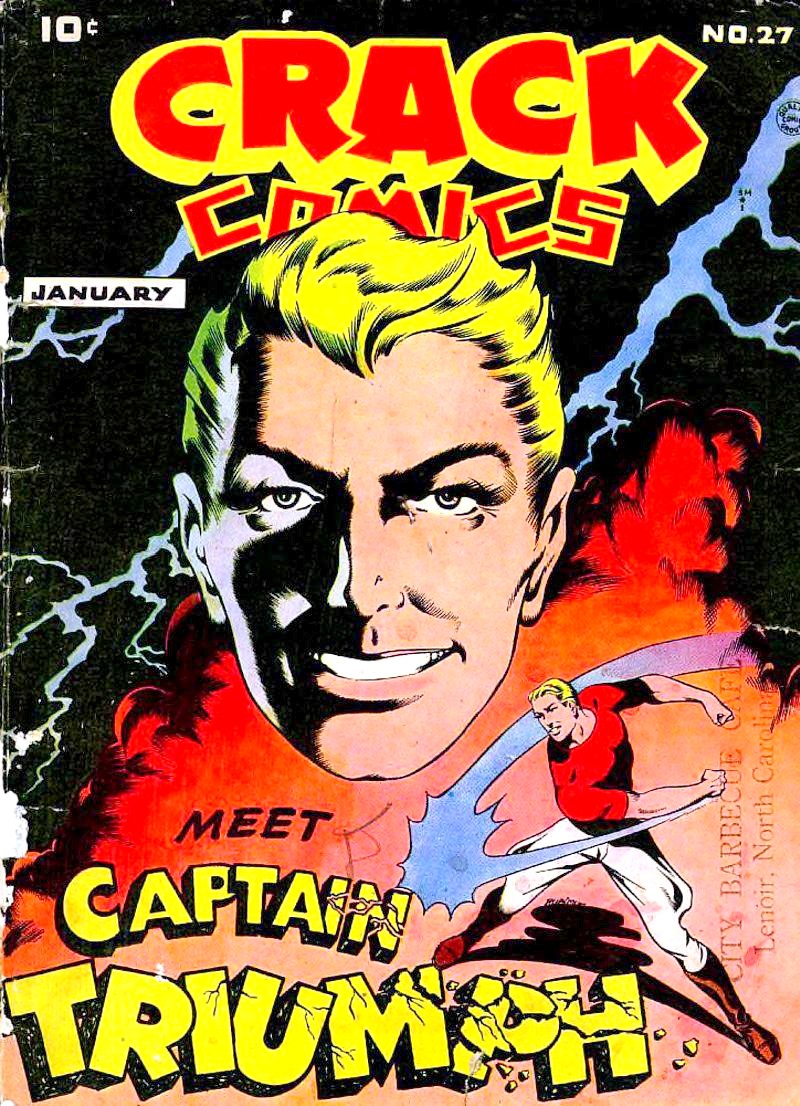
- Captain Triumph appeared as lead feature and cover star of every issue from his debut in #27 through the series' final issue #62 — a 36-issue unbroken run representing his entire Golden Age existence.
- Quality Comics and its characters, including Captain Triumph, were later acquired by DC Comics; Captain Triumph had also lapsed into the public domain by that time, and some of his Golden Age stories were subsequently reprinted by AC Comics in the Men of Mystery anthology.
- Issue #36 was produced during the period when publisher Arnold had dropped Eisner & Iger as a content packager and was generating material in-house under editor George Brenner.
Full credits
Key issues in Crack Comics
Reviews
Reader reviews
No reader reviews yet.