
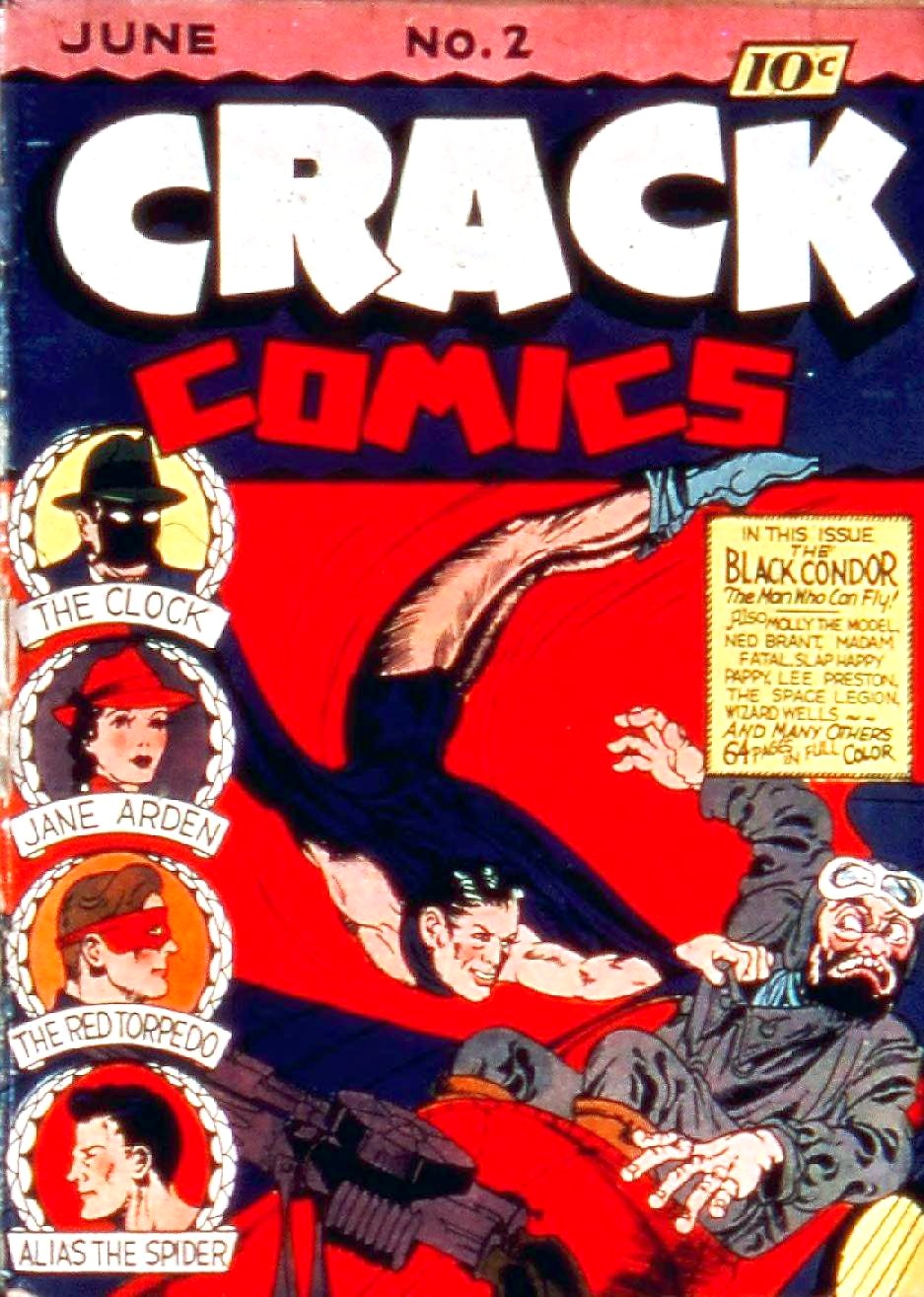
Crack Comics #2
☆ Be the first to review + Add to your collection — Join freeCrack Comics #2 (June 1940) is a pivotal second chapter in Quality Comics' flagship anthology, notable for the first deployment of the Black Condor's signature paralyzing black ray gun — a weapon that would define the character throughout his Golden Age run — as well as the permanent establishment of his iconic black-and-blue costume after his debut issue colored it red. The Red Torpedo story pushes against the boundaries of what American entertainment was willing to say in mid-1940: the villain warship is planned in a 'Chancellory of a powerful dictator' by figures who unmistakably resemble Hitler and Göring, making it one of the earliest explicit anti-Nazi statements in a U.S. superhero comic, published months before the country entered World War II. As the second installment of a title that showcased Lou Fine's aerially dynamic art on Black Condor alongside the earliest work of Will Eisner's studio packaged for publisher Everett 'Busy' Arnold, the issue sits at the intersection of Golden Age craftsmanship and wartime political audacity that made Quality Comics one of the most artistically ambitious publishers of its era.
An anthology issue featuring multiple superhero stories, including a Ned Brant adventure involving a wizard and an ultraviolet machine that controls an alternator, with Ned discovering the wizard's plot and confronting him in his laboratory. The issue also contains stories starring The Clock, Jane Arden, The Red Torpedo, Alias the Spider, and The Black Condor, as advertised on the cover, presenting a collection of action and crime-fighting narratives across 64 pages in full color.
Wizard Wells, the brilliant scientist and inventor, sets an ingenious trap in his penthouse laboratory to expose the feared racketeer Black Morda and free the shopkeepers he's been terrorizing. Using electromagnetic technology and hidden witnesses, Wells creates his "House of Fear" to demonstrate that Morda is far less formidable than his victims believe. As the scheme unfolds, the merchants discover the courage to stand against their oppressor and bring him to justice.
In "The Adventure of Ali Kan," the mysterious Black Condor arrives in the kingdom of Raj to confront the treacherous Ali Kan, who has seized power after a brutal ambush on the Kent siblings. With Andrée Kent held captive and the capital under siege, Black Condor must outwit Ali Kan’s forces, using his aerial prowess and the help of a loyal condor to rescue the princess and restore justice.
ComicBooks.com Value
Show all 17 grades ▾
Find on ebay
Read it digitally
Sell my copy
Have this issue — or a whole collection? Get a fair offer from us, skip the marketplace fees and the hassle.
We Buy Collections ▸History
Crack Comics launched in May 1940 under publisher Everett M. Arnold's Quality Comics imprint, with most of its content packaged by the Eisner & Iger Studio and edited by Ed Cronin. Issue #2, dated June 1940 (on-sale approximately April 1940, per copyright records), continued the monthly anthology format at 68 pages for a dime cover price. Will Eisner wrote the Black Condor feature under the pen name 'Kenneth Lewis,' while Lou Fine — whose fluid, dynamic figure work was already setting the visual standard at Quality — provided the art; the cover itself was handled by Gill Fox. The breadth of the talent roster, which also included Henry Kiefer, Paul Gustavson, Art Pinajian, Bob Powell, George Brenner, and Vernon Henkel, reflects how thoroughly the Eisner & Iger studio operated as a content factory supplying Arnold with a full anthology each month in the earliest months of what would become a nine-year run.
Trivia · 7 facts
- Cover art by Gill Fox, featuring the Black Condor — the character's second cover appearance and the first in his definitive black-and-blue costume, after his debut issue colored him red.
- First use of the Black Condor's signature paralyzing black ray gun, a weapon that became a recurring fixture throughout the character's Golden Age run; no in-story explanation for its acquisition is ever given.
- The Black Condor story was scripted by Will Eisner under the pseudonym 'Kenneth Lewis' and drawn by Lou Fine, who would go on to illustrate the character's first 24 adventures across the series.
- The Red Torpedo story by Henry Kiefer depicts Nazi planning figures resembling Hitler, Göring, and Goebbels plotting a warship attack — an unusually direct anti-Nazi statement for an American comic published in June 1940, when the U.S. was still a noncombatant nation.
- The Clock story, scripted and drawn by George Brenner, introduces the Orchid — a mysterious female ally of the Clock (Brian O'Brien) — as well as new villains Harvey Gibbs and Nick.
- The issue's sprawling creative roster includes Will Eisner, Lou Fine, George Brenner, Gill Fox, Paul Gustavson, Henry Kiefer, Art Pinajian, Bob Powell, Vernon Henkel, Bob Zuppke, Monte Barrett, Russell E. Ross, Joe Devlin, and Rube Goldberg, among others.
- The issue was later partially reprinted in Gwandanaland Comics #2005 — The Golden Age Firsts of Quality Comics: Volume 1 (May 2018), offering modern readers access to the early Black Condor material.
Full credits
Reprints
Reprinted in Collection Fantôme #[24] (1945), Special Edition Series #2 (1974), Continuum #5 (2008), Continuum #6bis (2008), Gwandanaland Comics #2005 (2018)
Key issues in Crack Comics
Reviews
Reader reviews
No reader reviews yet.