
Crack Comics #27
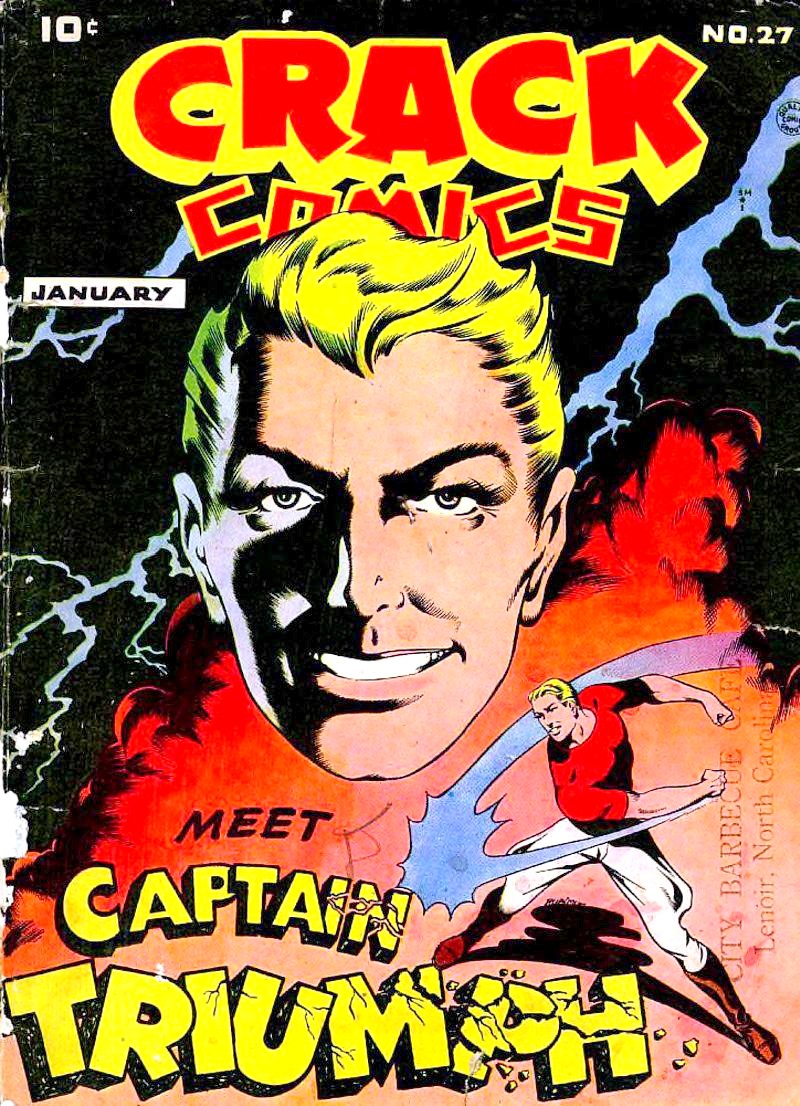
☆ Be the first to review + Add to your collection — Join freeCrack Comics #27 marks the debut of Captain Triumph, one of the most conceptually ambitious superhero characters to emerge from Quality Comics' Golden Age stable. The character's central mechanic — a living twin merging with his dead brother's ghost by touching a shared birthmark, the fusion blessed by the mythic Fates — planted a distinctly noir-tinged, grief-driven origin into a genre that usually favored straightforward power fantasies. As comic historian Don Markstein observed, Captain Triumph's deliberately understated costume reflected the declining superhero tide of 1943, making this debut an inadvertent document of a genre mid-transition. The character went on to anchor Crack Comics through all of its remaining 35 issues and has remained culturally durable enough to be reinterpreted as recently as the 2025 second season of the DC Universe live-action series Peacemaker.
"Introducing Captain Triumph!" sees Lance Gallant honor his brother Michael’s final vow after his death, as Michael’s ghost appears to bind him to a promise of justice. When Lance rubs the birthmark on his arm, the spirit merges with him, forging a new hero. Art by Alfred Andriola, with cover by Ruben Moreira.
In "Introducing Captain Triumph!" from Crack Comics #27 (1943), grieving brother Lance Gallant takes up the mantle of justice after his sibling Michael’s death, only to be haunted by Michael’s ghost—bound to keep his promise. When Lance rubs the birthmark on his arm, the spirit merges with him, forging a heroic fusion of will and memory.
Ex-A.V.G. pilot Tex Adams receives orders to land behind enemy lines in Japanese-held China, delivering medical supplies to Chinese guerrillas—but his mission goes sideways when three Zeros spot his Airacobra and force a desperate dogfight through a canyon. After a crash landing leaves him stranded with a damaged fuel tank, Tex must join forces with the guerrilla leader Tung Ting to execute a daring plan to steal Japanese aviation gasoline and get airborne again.
In "The Secret of the Hills," The Condor teams up with the eccentric Professor Tinker and his peculiar, invisible, and strangely foresighted Do-Bos when a gang of criminals targets the creatures for their mysterious abilities. When Tinker’s laboratory is set ablaze and the Do-Bos are presumed dead, The Condor must uncover the truth behind the attack before the villains claim their prize.
When a phoney spiritualist called the Maharaja of Maraka sets up shop on Park Avenue bilking wealthy clients out of $10,000 apiece for séances, The Spider recognizes him as an old vaudeville con artist and decides to shut down the racket. Infiltrating the fake temple, The Spider battles through the Maharaja's enforcers to uncover a basement operation rigged with props and uncover over $180,000 in ill-gotten gains. It's a high-energy romp of mistaken identities, flying fists, and vintage vigilante justice—with a twist on what happens to the crook when justice is served.
Pen Miller, a cartoonist with a nose for trouble, ventures into the seedy Clancey Street poolroom hunting for story ideas—only to stumble onto a criminal enterprise run by the crooked Dr. Furbish, who's been altering fingerprints for wanted convicts. As Miller gathers evidence and turns the tables on the doc and his gang, his wit and quick thinking prove mightier than their fists in this clever tale of justice served with a side of satire.
In "The House of Horror," the Clock is sent by the Orchid to infiltrate Morgan Manor, a brooding estate where the elusive smuggler Cyrus Vultan holds his sister captive—though the true nature of their bond remains shrouded in mystery. With the house itself seeming to pulse with secrets, the Clock must navigate its eerie halls, where every shadow feels deliberate.
ComicBooks.com Value
Show all 18 grades ▾
Find on ebay
Read it digitally
Sell my copy
Have this issue — or a whole collection? Get a fair offer from us, skip the marketplace fees and the hassle.
We Buy Collections ▸History
Alfred Andriola — a former assistant to Milton Caniff on Terry and the Pirates and the artist behind the Charlie Chan newspaper strip — created the visual identity of Captain Triumph, while the writer of the debut story has never been definitively identified. Andriola's tenure was brief: he left the feature after roughly six months to launch the Kerry Drake newspaper strip, the work for which he is best remembered. The issue was edited by John Beardsley and published under Quality's corporate banner, Comic Magazines, Inc., out of Stamford, Connecticut, as recorded in that year's Catalog of Copyright Entries. Crack Comics itself was already adjusting its publication schedule downward from monthly to bi-monthly at the time of this issue, a wartime paper-shortage reality that would push it to quarterly shortly after Captain Triumph joined the lineup.
Trivia · 8 facts
- First appearance and complete origin of Captain Triumph (Lance and Michael Gallant), Quality Comics' longest-running post-1943 superhero feature, debuting in the lead story titled 'Introducing Captain Triumph!'
- The character's premise: twin brothers Lance (journalist) and Michael (U.S. Army Air Corps pilot) Gallant share a T-shaped birthmark; when Michael is killed by Nazi sabotage, the Fates bind his ghost to Lance so that touching the birthmark merges them into a super-powered composite hero with flight, invulnerability, super-strength, and invisibility.
- Alfred Andriola — former Milton Caniff assistant and Charlie Chan strip artist — is credited as the debut artist; the writer of the inaugural story remains unknown to comics scholarship.
- The cover and Captain Triumph story art were both handled by Ruben Moreira; interior art across the issue's other features was contributed by Bob Powell, Jack Cole, Al McWilliams, Klaus Nordling, Rube Goldberg, and others.
- This issue also marks the final appearance of the Spitfire feature, which had run in prior Crack Comics issues; the Grand Comics Database notes that later Spitfire characters at other publishers are unrelated.
- Supporting characters introduced alongside Captain Triumph: Kim Meredith (Michael's fiancée), Pop Mason (Michael's friend), and villains Otto Ratter and Baron von Bragg — the Nazi saboteurs responsible for Michael's death.
- Captain Triumph ran continuously from this issue (#27) through the series' final issue (#62, September 1949), becoming the book's cover-featured lead for all 36 remaining issues.
- Golden Age Captain Triumph stories were later reprinted by AC Comics in their Men of Mystery anthology; the character was adapted for the Image Comics Next Issue Project's Crack Comics #63 (2011, written and drawn by Alan Weiss); and a reimagined version appeared in Peacemaker Season 2 (2025), portrayed by David Denman.
Full credits
Key issues in Crack Comics
Reviews
Reader reviews
No reader reviews yet.