
Captain America Comics #3
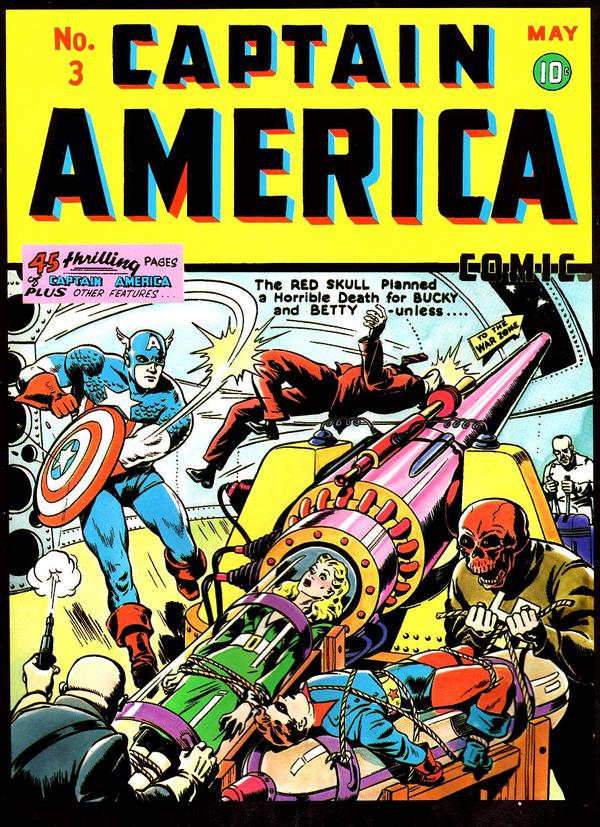
☆ Be the first to review + Add to your collection — Join freeCaptain America Comics #3 holds a singular place in Marvel history as the debut publication of Stan Lee — then a teenage office assistant named Stanley Lieber — whose two-page text story marked the beginning of an eight-decade career that would reshape the industry. The issue also features the final in-continuity appearance of George Maxon, the first man to wear the Red Skull mask, and its cover by Alex Schomburg gave the character his first cover billing, cementing the Red Skull's visual identity before the 'true' Red Skull, Johann Schmidt, had even appeared. As a dense, 68-page anthology from Timely Comics' creative peak under Joe Simon and Jack Kirby, it showcases the full range of Golden Age storytelling that made the Captain America Comics series the flagship superhero title of its era.
In "The Return of the Red Skull," Captain America and Bucky race against time on a Hollywood movie set where a hunchbacked madman uses terror to silence the truth, all while the cameras roll. Written by Joe Simon and Jack Kirby, with art by Jack Kirby and inks by Bernie Klein and George Roussos, this 1941 classic blends wartime suspense with the silver screen’s hidden dangers. The cover by Alex Schomburg captures the eerie tension of a star-studded set gone wrong.
In "The Hunchback of Hollywood and the Movie Murder," Captain America and Bucky race against time on a haunted film set, where a masked hunchback terrorizes the crew with a single, bloody hand—his twisted mission to silence the truth behind the camera's lens. The story unfolds in the glittering shadows of 1941 Hollywood, where every reel hides a secret and every frame could be the last.
In "The Queer Case of the Murdering Butterfly and the Ancient Mummies," the flamboyant criminal known as the Butterfly wreaks havoc by stealing priceless artifacts from a museum, laughing at authority as he vanishes into the shadows—until Captain America and Bucky intercept his latest heist. The story unfolds with a mix of pulp intrigue and wartime flair, blending mystery and heroism in a tale that keeps the stakes high and the identity of the Butterfly shrouded in spectacle.
ComicBooks.com Value
Show all 21 grades ▾
This exact issue on ebay
Raw / ungraded ▾ $3.99–$20 3 listings
More listings for this title
Read it digitally
Sell my copy
Have this issue — or a whole collection? Get a fair offer from us, skip the marketplace fees and the hassle.
We Buy Collections ▸History
Published with a May 1941 cover date and on sale March 17, 1941, the issue was produced at the height of Simon and Kirby's furiously paced early collaboration, with Joe Simon serving as both writer and editor and Kirby handling the bulk of the penciling. The office chaos of cranking out a new issue every month created an opening for their teenage assistant, Stanley Lieber — who used the pen name Stan Lee for the first time here — to contribute a short prose filler piece. The cover was handled by Alex Schomburg, whose bold graphic style made the Red Skull's scarlet face an instant visual threat, while interior backup art was contributed by Mac Raboy on the Tuk feature.
Trivia · 8 facts
- Stan Lee's first-ever published work appears in this issue: a two-page text story titled 'Captain America Foils the Traitor's Revenge,' written under the pen name 'Stan Lee' — the pseudonym Stanley Lieber adopted here and used for the rest of his life.
- The Red Skull (George Maxon) makes his final in-continuity Golden Age appearance in the lead Captain America story; he is apparently killed when Captain America returns a thrown bomb. Maxon's role as a decoy for the true Red Skull, Johann Schmidt, was not established until Tales of Suspense #65 (1965).
- This issue features the first cover appearance of the Red Skull, painted by Alex Schomburg — the character had only appeared in interior stories before this issue.
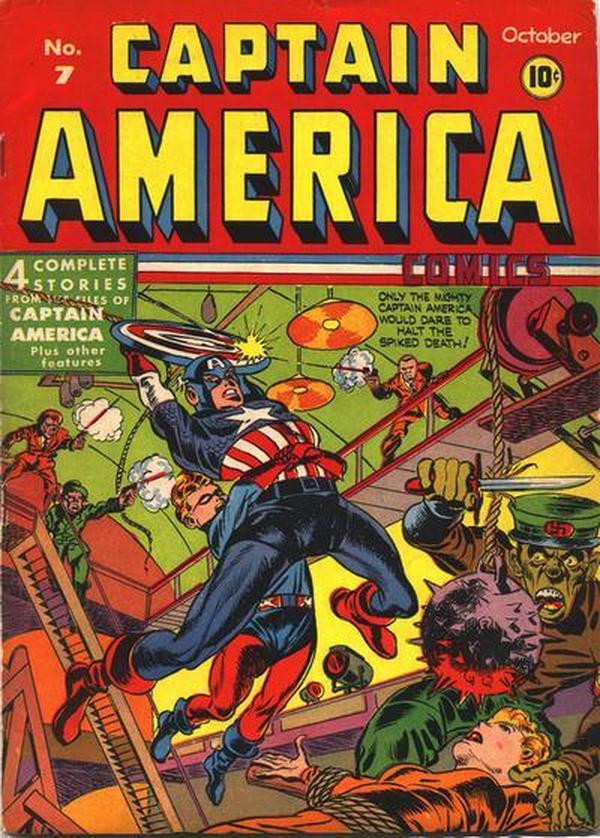
- The George Maxon version of the Red Skull appeared in Captain America Comics #1 and #3 only; the iconic Johann Schmidt version of the character did not debut until Captain America Comics #7 (October 1941).
- Continuing backup features include Hurricane (later retroactively identified as the Eternal Makkari/Mercury) battling subway saboteurs with 'infernal death boxes,' and a Tuk the Cave Boy adventure in which Tuk and Tanir help Princess Eve reclaim her throne in Atlantis, drawn by Mac Raboy.
- Pluto, Hurricane's divine antagonist in the backup strip, was later retconned in Marvel continuity as the Deviant Kro.
- The issue has been reprinted in numerous collections, including Captain America: The Classic Years (1990/1998), Marvel Masterworks: Golden Age Captain America Vol. 1 (2005), the Golden Age Captain America Omnibus (2014), Marvel Visionaries: Stan Lee (2005/2019), and Fantagraphics' Take That, Adolf!: The Fighting Comic Books of the Second World War (2017). Individual stories also appeared in Fantasy Masterpieces #3.
- Human Torch (Jim Hammond) and Toro (Thomas Raymond) appear in this issue in the context of a promotional advertisement rather than as characters in a narrative story; their first shared adventures with Captain America occurred in separate titles.
Cast · 10 characters
Full credits
Reprints
Reprinted in Fantasy Masterpieces #3 (1966), Marvel Super Heroes #1 (1966), Captain America Sentinel of Liberty #[nn] (1979), Captain America: The Classic Years #1 (1990), Captain America: The Classic Years #1 (1998), Marvel Visionaries: Stan Lee #[nn] (2005), Marvel Masterworks: Golden Age Captain America #1 (2005), Marvel Deluxe : Stan Lee #1 (2007), Marvel 70th Anniversary #[nn] (2009), Marvel Masterworks: Golden Age Captain America #1 (2012), Marvel Platinum: The Definitive Captain America Reloaded #[nn] (2014), Golden Age Captain America Omnibus #1 (2014), Marvel 75th Anniversary Celebration #1 (2014), Captain America #5 (2015), Stan Lee Marvel Treasury Edition #[nn] (2016), Take That, Adolf!: The Fighting Comic Books of the Second World War #[nn] (2017), Marvel Visionaries: Stan Lee #[nn] (2019), Timely's Greatest: The Golden Age Simon & Kirby Omnibus #[nn] (2019), The Best Marvel Stories by Stan Lee Omnibus #[nn] (2022)
Key issues in Captain America Comics
Reviews
Reader reviews
No reader reviews yet.