
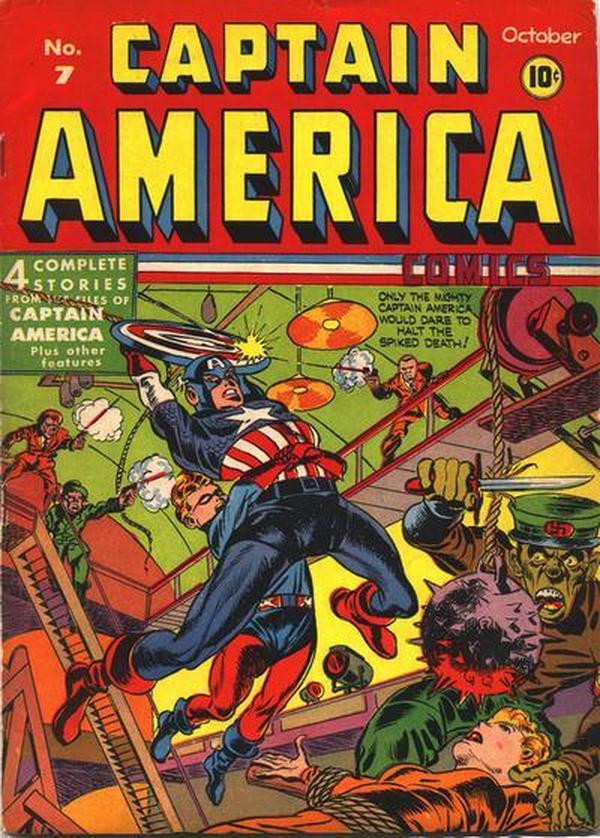
Captain America Comics #7
☆ Be the first to review + Add to your collection — Join freeIn "The Red Skull; An Ear for Music," Captain America uncovers a web of deceit when an American man is falsely accused of murdering a British music star. With the help of his ally Hunter, Steve Rogers traces the conspiracy to the man’s cousin, whose treachery is tied to Nazi interests and a dangerous scheme for profit. The story unfolds with sharp pacing and wartime tension, illustrated with dynamic energy by Jack Kirby and Syd Shores on the cover.
In this 1941 tale from *Captain America Comics #7*, Steve Rogers faces the chilling return of the Red Skull, whose sinister plans are eerily underscored by Chopin’s "Funeral March." With the music itself becoming a weapon, Cap must unravel the mystery behind the Skull’s twisted symphony before it's too late.
In "Death Loads the Bases," Captain America takes the mound for the Brooklyn Badgers, stepping in after two players die under strange circumstances, hoping his presence will expose the killer hiding in plain sight. The story blends wartime suspense with the high stakes of the ballpark, where every pitch could be the final one.
In "Horror Plays the Scales," Captain America confronts a sinister scheme where a seemingly ordinary employment agency serves as a cover for Nazi operatives infiltrating the homes of anti-Nazi senators. With the fate of democracy hanging in the balance, Cap must unravel the deception before the next assassination takes place.
In "Justice Laughs Last," Hurricane teams up with a determined new ally to take down a gang of protection racket thugs, proving that even in the face of danger, justice has a sense of humor—and a partner in the fight.
In "Dust of Destruction," Captain America uncovers a web of betrayal when an American man is wrongfully accused of murdering a British celebrity. With the stakes rising, the hero tracks down the real culprit—his cousin—whose scheme ties treason, greed, and a dangerous alliance with Nazi forces.
In "Race Against Doom," Jo and her allies race to clear Larry Scott’s friend of a heinous crime—accused of hijacking a ship, murdering its crew, and stealing its gold—only for Father Time to uncover a twist: the gold was fake. With time running out and the truth buried beneath deception, the real mystery begins.
ComicBooks.com Value
Show all 21 grades ▾
This exact issue on ebay
Raw / ungraded ▾ $3.99–$9.94 5 listings
More listings for this title
Read it digitally
Sell my copy
Have this issue — or a whole collection? Get a fair offer from us, skip the marketplace fees and the hassle.
We Buy Collections ▸Trivia · 8 facts
- First appearance of Johann Schmidt as the Red Skull (retroactively identified): The Red Skull in this issue was later established in Tales of Suspense #66 as being Johann Schmidt, the true Red Skull, with the earlier George Maxon having been his pawn — making CA Comics #7 Schmidt's formal debut in modern Marvel continuity.
- The lead story, 'The Red Skull: An Ear for Music,' scripted and drawn by Joe Simon and Jack Kirby, features the Red Skull using Chopin's 'Funeral March' as a murder signal — one of the most theatrically memorable villain gimmicks of the Golden Age.
- First appearance of Solidius X. 'Speedy' Scriggles, the adult civilian sidekick acquired by Hurricane in the backup story 'Justice Laughs Last'; Speedy goes on to appear in subsequent issues through at least issue #11.
- Stan Lee scripted multiple backup features in this issue — including the Headline Hunter and Father Time segments — among his earliest professional writing credits at Timely Comics.
- The cover was penciled by Jack Kirby and inked by Syd Shores; interior pencillers across the issue's stories include Kirby and Al Avison, with Ken Bald also credited by Marvel.
- The issue was published on-sale August 4, 1941 (cover-dated October 1941), predating the United States' entry into World War II by roughly four months.
- The lead Red Skull story was reprinted in Fantasy Masterpieces #6 (December 1966) with art alterations to comply with Comics Code restrictions, then again in Captain America: The Classic Years #2 (1990/2000), Marvel Masterworks: Golden Age Captain America Vol. 2 (2008), and the Golden Age Captain America Omnibus (2014).
- The issue includes a character-biography feature, 'A Message from Captain America,' scripted by Stan Lee, which offers in-universe profiles of Betty Ross, Sergeant Duffy, Father Time, Jerry 'Headline' Hunter, and Hurricane — functioning as both reader orientation and early editorial world-building for the anthology format.
Cast · 15 characters
Full credits
Reprints
Reprinted in Fantasy Masterpieces #6 (1966), Fantasy Masterpieces #7 (1967), Fantasy Masterpieces #8 (1967), Captain America: The Classic Years #2 (1990), Marvel Milestone Edition: Captain America Comics #1 #[nn] (1995), Golden Age of Marvel #[nn] (1997), Spider-Man Komplett #34 [4] (2000), Captain America: The Classic Years #2 (2000), Marvel Masterworks: Golden Age Captain America #2 (2008), Captain America Comics 70th Anniversary Special #1 (2009), Golden Age Captain America Omnibus #1 (2014), King-Size Kirby #[nn] (2015), Captain America: The 75th Anniversary Vibranium Collection #[nn] (2016), Timely's Greatest: The Golden Age Simon & Kirby Omnibus #[nn] (2019), Timely's Greatest: The Golden Age Simon & Kirby Omnibus #[nn] (2019), Marvel Origins #10 (2023)
Key issues in Captain America Comics
Reviews
Reader reviews
No reader reviews yet.