
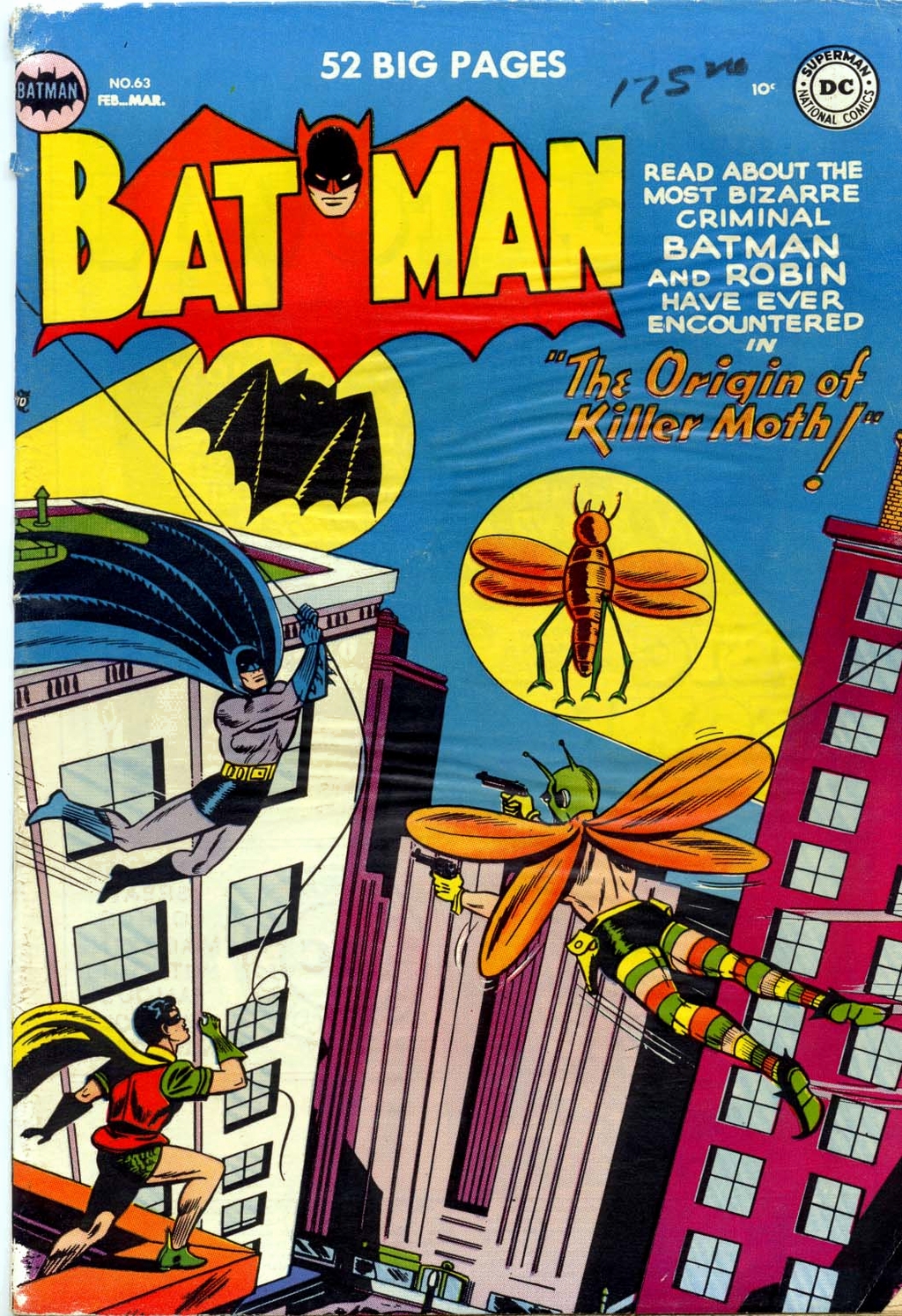
Batman #63
☆ Be the first to review + Add to your collection — Join freeBatman #63 (February–March 1951) is the debut issue of Killer Moth, one of the most conceptually audacious villains of the Golden Age: a former convict who, inspired by newspaper coverage of Batman, systematically reverse-engineered the Dark Knight's entire operation — secret identity, underground lair, custom vehicle, and criminal-signal — to become a for-hire protector of Gotham's underworld. That 'anti-Batman' premise gave the character a structural mirror quality that no prior Bat-villain had explored so explicitly, and it planted a narrative seed that Bat-comics would return to for decades. Killer Moth's long-term significance was cemented when he served as the first villain confronted by Batgirl in Detective Comics #359 (1967), making his origin issue a foundational link in Barbara Gordon's history as well.
In "The Joker's Crime Costumes!", a cunning criminal with a flair for theatrics dons a series of elaborate disguises to challenge Batman and Robin, turning Gotham's underworld upside down. Written by Bill Finger and illustrated by Bob Kane, Lew Sayre Schwartz, and Charles Paris, this 1951 classic features a devious impostor who rises from prison to pose as a philanthropist and rival to Bruce Wayne—only to reveal himself as Killer Moth in a high-stakes showdown on Gotham Bridge. The cover by Bob Kane, Lew Sayre Schwartz, and Charles Paris captures the menace and flair of the masked menace.
In "The Joker's Crime Costumes!", the Clown Prince of Crime takes a delightfully theatrical turn, donning disguises inspired by legendary comedic figures as he orchestrates a series of mischievous crimes. With Batman on his trail, the caped crusader must unravel the joke before the city’s laughter turns to fear.
When a man with two hearts is found after a mysterious accident, Batman and Robin are drawn into a strange case that leads them to suspect an alien presence—uncovering a secret invasion from Saturn, one that could be unfolding right under Gotham’s nose.
ComicBooks.com Value
Show all 19 grades ▾
This exact issue on ebay
Raw / ungraded ▾ $89.99–$600 5 listings
- BamPowComics & Collectibles · Chesterland, OH2 on eBay ↗
- Arcane Comics · Shoreline, WA1 on eBay ↗
- JAF Comics · Bethlehem, PA1 on eBay ↗
Read it digitally
Sell my copy
Have this issue — or a whole collection? Get a fair offer from us, skip the marketplace fees and the hassle.
We Buy Collections ▸History
The issue was produced within DC's standard Golden Age Batman assembly line: writer Bill Finger scripted the Killer Moth lead and the Joker backup, with pencil art on the signature Killer Moth story handled principally by Lew Sayre Schwartz — though Batman and Robin figures were added by Bob Kane under the studio ghost-art arrangement then standard at DC — and Charles Paris on inks throughout. Dick Sprang penciled the Joker story. Editor Whitney Ellsworth oversaw the 52-page package. Subsequent scholarly credit research (documented in the Grand Comics Database) removed earlier blanket Kane pencil attributions from the Killer Moth story, reassigning primary pencil credit to Schwartz as verified by Schwartz himself.
Trivia · 7 facts
- First appearance and origin of Killer Moth (Cameron van Cleer / later Drury Walker), created by Bill Finger, Lew Sayre Schwartz, and Dick Sprang — cover-dated February 1951.
- Killer Moth is introduced as a deliberate 'anti-Batman': a released convict who builds a Mothcave, Mothmobile, infra-red Moth-Signal, and wealthy socialite alias Cameron van Cleer to offer criminal clients protection from police.
- The issue contains three complete stories: 'The Origin of Killer Moth!,' 'The Joker's Crime Costumes!,' and 'The Case of the Flying Saucers' — the last involving a Saturnian invasion plot.
- Art credits: Lew Sayre Schwartz (primary penciler, Killer Moth story), Dick Sprang (penciler, Joker story), Charles Paris (inker throughout), Ira Schnapp (letterer); cover by Bob Kane and Lew Schwartz.
- Killer Moth's premiere story established the character's key equipment suite — Mothmobile, Moth-Signal, utility belt, and Moth-Cave — all modeled directly on Batman's own gear.
- Killer Moth went on to be the first villain Barbara Gordon defeated as Batgirl in Detective Comics #359 (January 1967), making this issue an indirect origin point for Batgirl's costumed career.
- The Killer Moth story from this issue was reprinted in Batman: The Golden Age Omnibus Vol. 7 (DC, August 2019).
Cast · 14 characters
Full credits
Reprints
Reprinted in Läderlappen och Robin #9/1951 (1950), The Greatest Joker Stories Ever Told #[nn] (1988), The Greatest Joker Stories Ever Told #[nn] (1989), The Greatest Joker Stories Ever Told #[nn] (1989), Stacked Deck: The Greatest Joker Stories Ever Told #[nn] (1990), Batman: The Golden Age Omnibus #7 (2019), Batman in the Fifties #[nn] (2021)
Key issues in Batman
 ★
★ ★
★ ★
★ ★
★ ★
★ ★
★ ★
★ ★
★Reviews
Reader reviews
No reader reviews yet.