
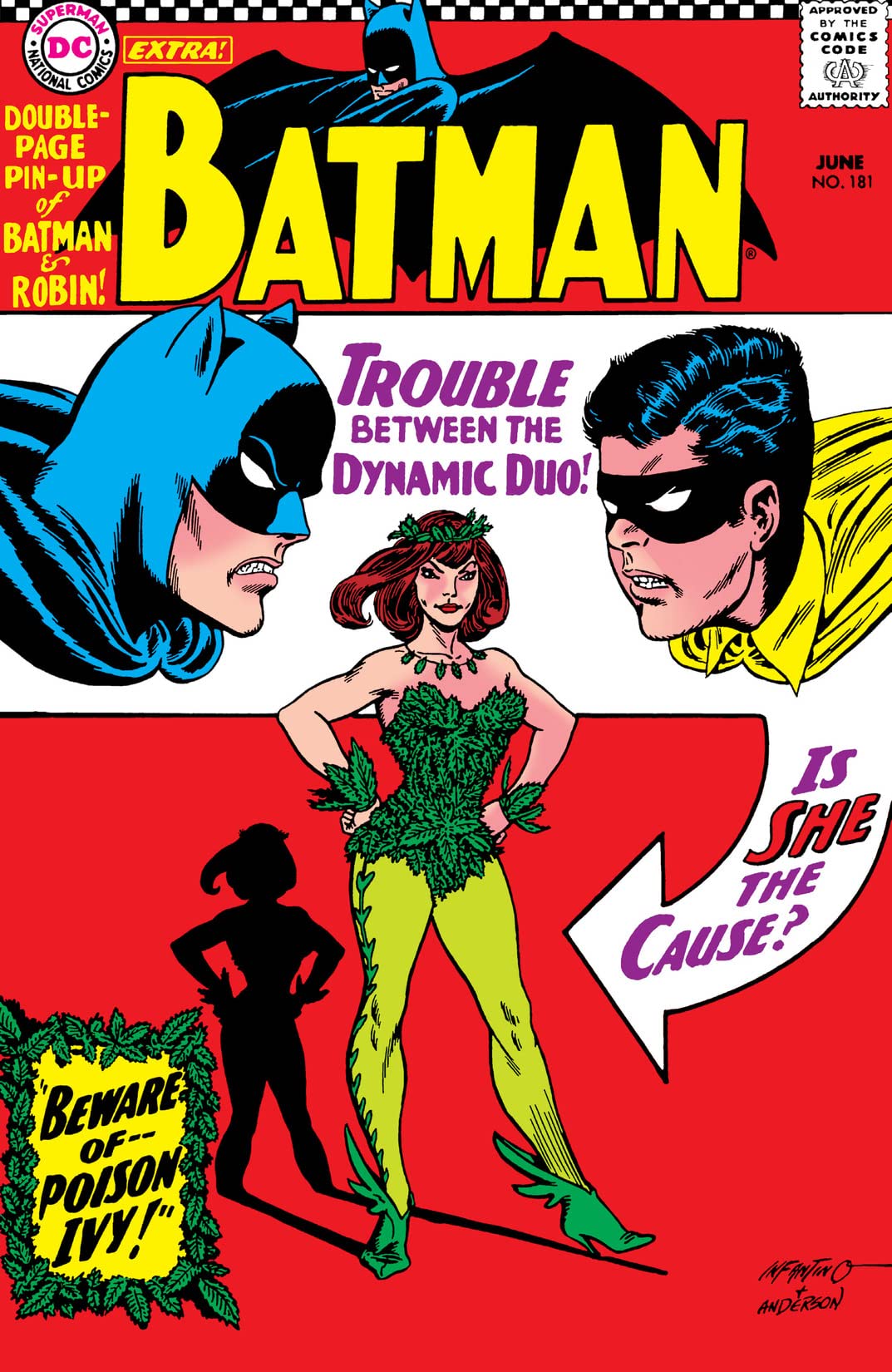
Batman #181
☆ Be the first to review + Add to your collection — Join freeBatman #181 marks the Silver Age debut of Poison Ivy, one of the most enduring and culturally resonant villains in Batman's rogues gallery — a character who has grown from a plant-themed femme fatale into a complex figure exploring ecoterrorism, identity, and autonomy across six decades of comics, animation, and film. Her creation was a direct creative response to the explosion of female-villain interest generated by the 1966 Batman television series, making this issue a document of the moment popular culture and editorial strategy converged to reshape Batman's world. The issue also captures the 'ghost-artist' era of the Batman titles, where Sheldon Moldoff drew the bulk of the interior work under Bob Kane's byline while emerging talents like Carmine Infantino and Murphy Anderson defined the 'New Look' on the cover — a creative tension that characterizes the Silver Age Batman line as a whole. Ivy's debut in these pages planted the seed for a character who would later anchor Neil Gaiman's Secret Origins #36, a starring role in Batman: The Animated Series, a major film appearance, and eventually her own ongoing solo series.
In "Beware of -- Poison Ivy!", Batman grows suspicious during a meeting of the Analysts when Kaye claims she didn’t write her latest book—only to be unnerved by a voice whispering from her brooch. Written by Gardner Fox and illustrated by Chic Stone, with inks by Sid Greene and letters by Gaspar Saladino, this 1966 classic blends suspense and intrigue, all wrapped in Carmine Infantino’s dynamic cover art and Murphy Anderson’s sharp inks.
In "Beware of -- Poison Ivy!" from Batman #181, Bruce Wayne and Dick Grayson find themselves at an art show when a mysterious woman arrives, boldly declaring herself the greatest criminal in Gotham—her presence as striking as the paintings around her. The story unfolds with a mix of intrigue and danger, as the Bat-Family faces a new kind of threat cloaked in elegance and green.
In "The Perfect Crime — Slightly Imperfect!", Batman grows suspicious when Kaye appears at the Analysts' meeting claiming she didn’t write her latest book—only to be unnerved by a voice whispering from her brooch. As the Dark Knight investigates, he begins to wonder if the woman in front of him is truly who she claims to be.
1 copy for sale from collectors
ComicBooks.com Value
Show all 22 grades ▾
More listings for this title
Read it digitally
Sell my copy
Have this issue — or a whole collection? Get a fair offer from us, skip the marketplace fees and the hassle.
We Buy Collections ▸History
The impetus for Poison Ivy's creation came directly from the runaway success of the ABC Batman television series, which premiered in January 1966; Carmine Infantino has stated in interviews that producers wanted more female villains after Catwoman's popularity on the show. Infantino conceived the character as a design sketch, and writer Robert Kanigher — a prolific DC Silver Age scripter — expanded the concept into the debut script, modeling Ivy's look and persona after pin-up icon Bettie Page and drawing thematic inspiration from Nathaniel Hawthorne's short story 'Rappaccini's Daughter.' The interiors were penciled by Sheldon Moldoff, who was ghosting for Bob Kane at the time (with inks by Joe Giella and lettering by Gaspar Saladino), while Infantino and Murphy Anderson supplied the cover under editor Julius Schwartz, who had been steering the Batman titles since his 'New Look' revamp in 1964. The issue also contains a second story, 'The Perfect Crime — Slightly Imperfect!' scripted by Gardner Fox, whose penciling credits remain disputed across reference sources.
Trivia · 8 facts
- First appearance of Poison Ivy (Dr. Pamela Isley), debuting in the lead story 'Beware of — Poison Ivy!' — a character who has become one of Batman's most prominent and long-running adversaries.
- Written by Robert Kanigher with interior pencils by Sheldon Moldoff (under the Bob Kane byline) and inks by Joe Giella; the cover was drawn by Carmine Infantino (pencils) and Murphy Anderson (inks), under editor Julius Schwartz.
- The character was reportedly modeled visually on pin-up model Bettie Page, and the concept drew thematic inspiration from Nathaniel Hawthorne's short story 'Rappaccini's Daughter.'
- In her first appearance, Poison Ivy had no detailed origin; she was presented as a seductive criminal who challenged three other Gotham female villains — Dragon Fly, Silken Spider, and Tiger Moth — for the title of the city's top female criminal, using an electrified lipstick and mesmerizing gas against Batman and Robin.
- The issue includes a notable two-page centerfold pin-up of Batman and Robin by Carmine Infantino and Murphy Anderson; copies missing this insert are considered incomplete.
- Cover date is June 1966; the issue was published (on-sale) on April 19, 1966, and carried a cover price of 12 cents across its 36 pages.
- The lead story has been reprinted in Batman #208 (excerpt), Batman in the Sixties, Batman: A Celebration of 75 Years, Batman Arkham: Poison Ivy, Showcase Presents: Batman Vol. 2, and a DC Facsimile Edition (first issued 2019, with a second facsimile released c. 2023).
- Poison Ivy later received her first retconned origin in World's Finest #252 (1978, by Gerry Conway) and a further revised post-Crisis origin in Neil Gaiman's 'Pavane' in Secret Origins #36 (1988).
Full credits
Reprints
Reprinted in Batman - Lepakkomies #2/1966 (1966), Lynvingen #3/1967 (1967), Lynvingen #4/1967 (1967), Lynvingen #5/1967 (1967), Batman #208 (1969), Batman #260 (1975), Batman #996 (1979), Batman in the Sixties #[nn] (1999), Batman: Cover to Cover #[nn] (2005), Showcase Presents: Batman #2 (2007), Tales of the Batman: Carmine Infantino #[nn] (2014), Batman: A Celebration of 75 Years #[nn] (2014), DC Comics Graphic Novel Collection #19 (2016), Batman Arkham: Poison Ivy #[nn] (2016), Batman 181 (Facsimile Edition) #[nn] (2019), Batman (2ª Série) #79, Läderlappen #13/1966
Key issues in Batman
 ★
★ ★
★ ★
★ ★
★ ★
★ ★
★ ★
★ ★
★Reviews
Reader reviews
No reader reviews yet.