
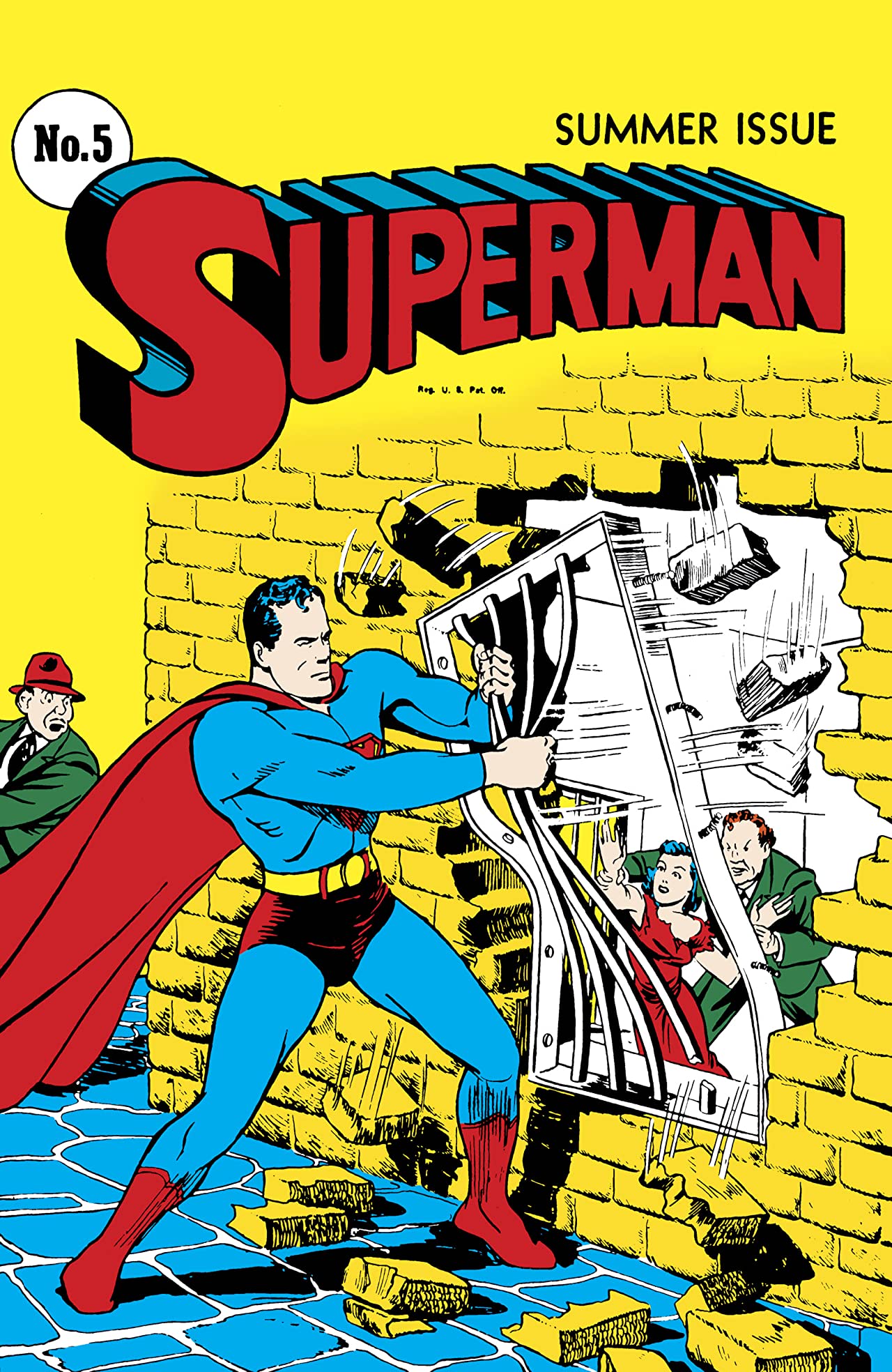
Superman #5
Superman #5 (June 1940) is a pivotal early entry in the Man of Steel's solo title, featuring the fourth overall appearance of Lex Luthor — here depicted with grey hair in transition toward the bald look he would soon famously acquire — in a scheme involving narcotic incense used to enslave the nation's leading financiers. The issue also marks the first time Superman uses his powers to reshape his own facial features, an early demonstration of the writers actively expanding the hero's abilities, while Luthor's apparent death at the story's end exemplifies the era's free-and-loose approach to villain mortality. Beyond the lead stories, the issue's house ads for Batman #1 and All Star Comics #1 make it a remarkable contemporary snapshot of DC's Golden Age superhero line exploding into existence all at once.
In "The Slot Machine Racket," newly minted reporter Bill Harkness stumbles into a startling secret while covering the opening of the State Hospital—where he meets the famed ventriloquist Great Gordon, only to learn the man's son, Johnny, is none other than his own dummy. Written by George Shute and illustrated by Bernard Baily, this 1940 Superman issue blends journalistic curiosity with a chilling twist, all wrapped in the crisp, expressive art of Wayne Boring on the cover.
In "The Slot Machine Racket," Lois and Clark investigate a troubling trend: local shopkeepers using slot machines to lure children, all orchestrated by the menacing "Slug" Kelly and his enforcers. When the reporters are captured and threatened, Superman steps in to dismantle the scheme and put an end to the exploitation.
In "Super Strength: Rules for Summer Living," Superman shares practical advice for staying healthy and strong during the summer months, reminding readers of the importance of getting enough sleep, eating nutritious food, staying active outdoors, and drinking plenty of milk.
In a 1940 tale of power and press, rising politician Alex Evell turns his sights on the Daily Planet, seeking to control the news—and silence Clark Kent—by buying out the paper. With Burt Mason at the helm and Zachary Collum watching from the sidelines, Evell’s campaign against the planet becomes a battle for truth itself.
In "The Wonder Drug Racket," Superman delves into a sinister scheme involving the mysterious serum parabiolene, developed by Professor Carl Grinstead and backed by gangster Carlin. When the drug begins turning prominent figures into mind-controlled servants, Superman must uncover the truth behind the experiment—unraveling the roles of Morton Craig, Dr. Bren, and a web of criminal operatives including Nick Blake, Butch, and Jimmy.
ComicBooks.com Value
Show all 21 grades ▾
Find on ebay
Read it digitally
Sell my copy
Have this issue — or a whole collection? Get a fair offer from us, skip the marketplace fees and the hassle.
We Buy Collections ▸History
The issue went on sale May 10, 1940, under the Superman Inc. publishing imprint, with uncredited editing by Whitney Ellsworth and Murray Boltinoff. All stories were scripted by Jerry Siegel and illustrated by the Shuster studio — with Paul Cassidy and a young Wayne Boring sharing art duties on the lead story, and Boring providing the cover pencils. The issue still carries a hand-lettered Joe Shuster logo on the title; the classic Ira Schnapp logo that readers would associate with the series for decades would not debut until issue #6.
Trivia · 10 facts
- Cover date June 1940; on-sale date May 10, 1940 — published by Superman Inc. under editors Whitney Ellsworth and Murray Boltinoff (both uncredited).
- Fourth overall appearance of Lex Luthor (following Action Comics #23 and two appearances in Superman #4), who in this issue plots to use narcotic incense to enslave prominent financiers and profit from a manufactured economic depression.
- First time in comics Superman uses his powers to physically reshape his own facial features, allowing him to go undercover; this ability is not revisited until Superman #18.
- First mention in a Superman story that Superman's costume is indestructible and that he himself invented the cloth it is made from.
- Superman is described as having a photographic memory in this issue.
- The issue contains half-page house ads for both Batman #1 and All Star Comics #1 — two landmark debuts releasing simultaneously — making it a snapshot of DC's entire Golden Age superhero output converging at a single moment.
- Art credits are split among the Shuster studio: cover and partial story pencils/inks by Wayne Boring, additional pencils and inks by Paul Cassidy, with Joe Shuster also contributing pencils to the Luthor story — all credited under the 'Joe Shuster' house byline.
- This issue is reprinted in Superman Archives Vol. 2 (DC, hardcover) and Superman: The Golden Age Vol. 2 (DC, paperback), both of which collect Superman #4–7 alongside contemporaneous Action Comics material.
- Superman #5 carried an advertisement for the 'Krypto-Raygun,' a gun-shaped toy device that could project images on a wall — one of the earliest Superman-branded merchandise items.
- Joe Shuster hand-drew the Superman title logo through this issue; starting with issue #6, the classic Ira Schnapp logo replaced it.
Cast · 14 characters
Full credits
Reprints
↩ Reprints Batman #1 (1940), All-Star Comics #1 (1940)
Reprinted in Action Comics #25 (1940), Action Comics #26 (1940), Detective Comics #41 (1940), Superman Work Book #[nn] (1945), The Superman Archives #2 (1990), DC Archiv Edition #5 (1999), DC Archiv Edition #7 (2000), The Superman Chronicles #3 (2007), Superman: The Golden Age Omnibus #1 (2013), Superman: The Golden Age #2 (2017), DC Finest: Superman: The First Superhero #[nn] (2025)
Key issues in Superman
Reviews
Reader reviews
No reader reviews yet.