
A complete issue · 68 pages · 1921
Captain Billy's Whiz Bang #19
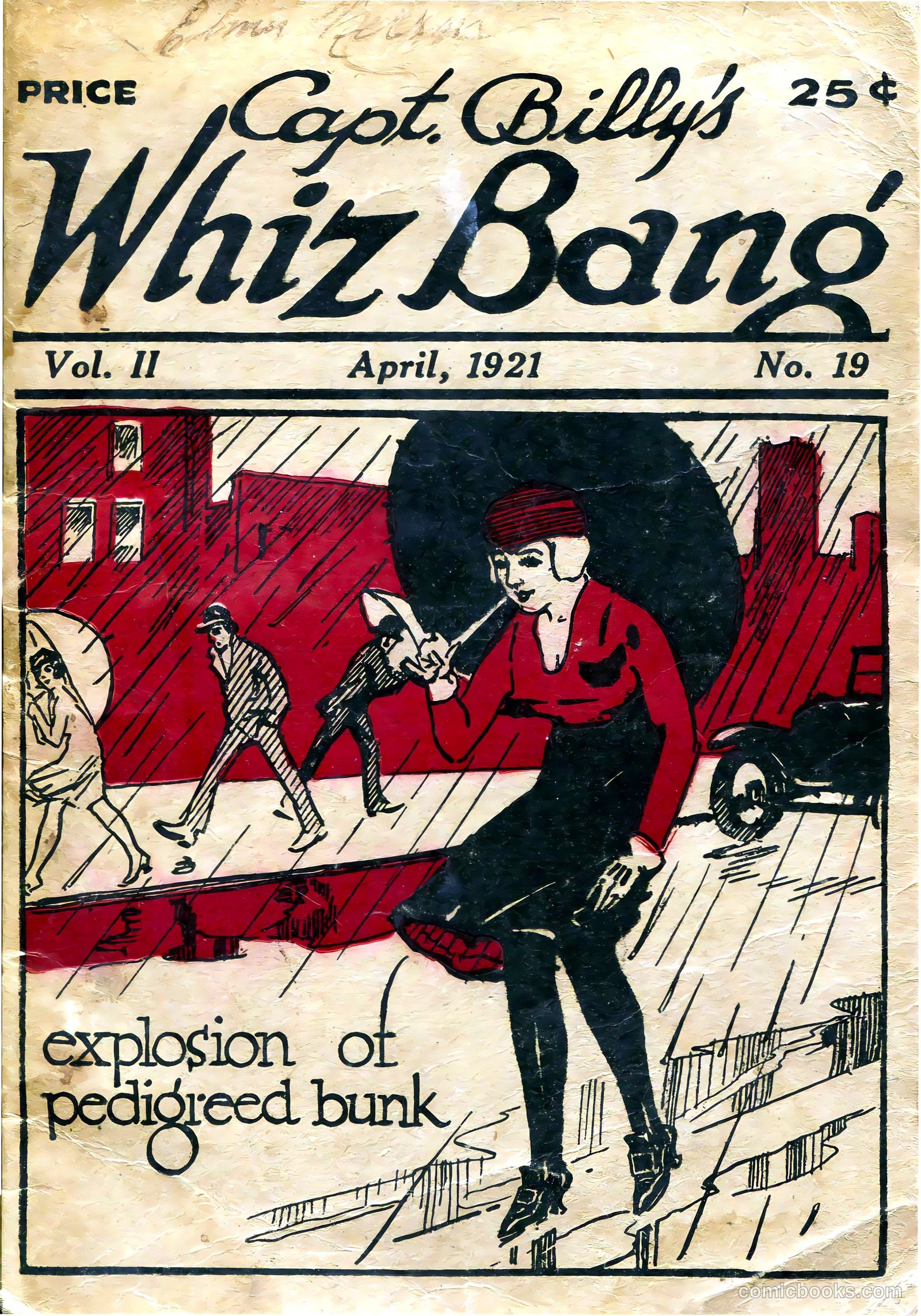
This is the cover of *Capt. Billy's Whiz Bang*, an April 1921 satirical magazine. The illustration depicts a woman in a red dress and black hat holding a large umbrella, appearing to shield herself from something explosive labeled "explosion of pedigreed bunk." "Pedigreed bunk" refers to high-class nonsense or pretentious lies—possibly mocking wealthy or aristocratic society figures spreading falsehoods. The woman's fashionable appearance and protective umbrella suggest she represents either someone caught in scandal or someone who considers themselves above such "common" explosions of truth. The cartoon satirizes 1920s social hypocrisy or the gap between upper-class pretense and reality. The specific target remains unclear without additional context, but it likely referenced contemporary social or political scandals familiar to 1921 readers.
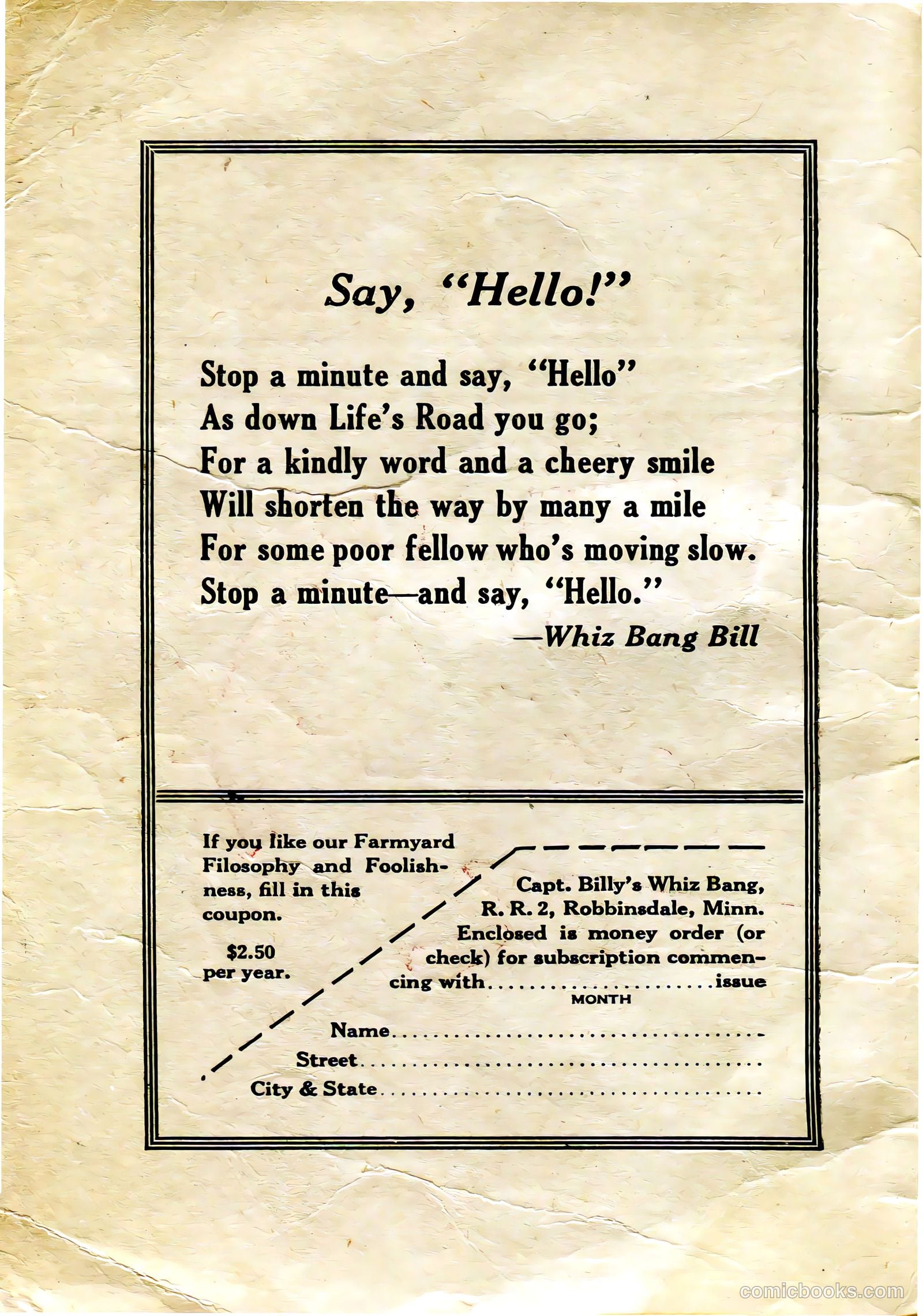
This page is primarily a **subscription advertisement** for *Whiz Bang*, a satirical magazine published by "Capt. Billy's Whiz Bang" from Minnesota. The content is not a political cartoon but rather a motivational poem encouraging kindness and human connection—advocating that simple greetings and friendly gestures ease others' hardships. The poem, attributed to "Whiz Bang Bill," promotes a philosophy of compassion ("Farmyard Philosophy and Foolishness" as the ad describes it). The subscription coupon below invites readers to support the magazine for $2.50 yearly. This appears to reflect *Whiz Bang's* actual editorial stance: mixing lowbrow humor with earnest, folksy wisdom typical of early 20th-century American magazines. The tone suggests the publication positioned itself as entertaining yet morally uplifting—appealing to ordinary readers seeking both comedy and gentle life lessons.
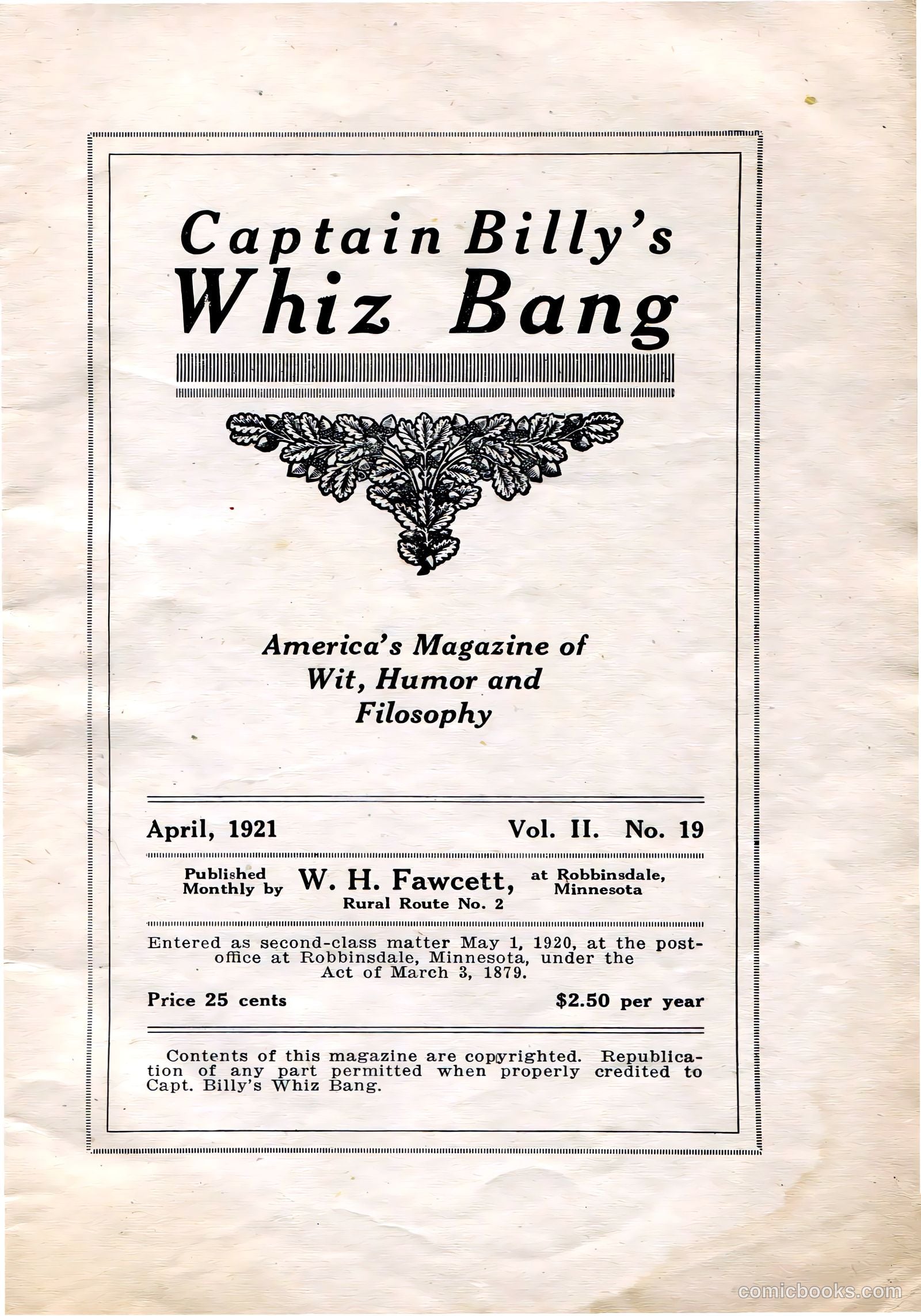
This is the title/contents page of Captain Billy's Whiz Bang, an American humor magazine published from Minnesota. Founded by W.H. Fawcett in 1920, it billed itself as featuring "Wit, Humor and Philosophy." The decorative lace motif and period typography are typical Art Deco design elements of early 1920s magazines. The April 1921 issue cost 25 cents. The magazine had modest reach but genuine cultural significance—it pioneered the risqué joke format and reportedly influenced future American humor traditions. The publication was one of several post-World War I humor magazines catering to returning soldiers seeking irreverent comedy. The copyright notice reflects standard magazine protections of the era. This appears to be a cover/masthead page rather than containing specific cartoons or political commentary to analyze.
This is a title page rather than a cartoon. The Roosevelt quote emphasizes singular patriotic loyalty to "the American People" rather than to any faction, party, or foreign power—likely reflecting post-WWI anxieties about divided loyalties and immigrant communities. Published in 1921 by W.H. Fawcett, this *Whiz-Bang* issue was edited by a Spanish-American War and World War I veteran and dedicated to U.S. fighting forces. The Allied Printing Trades Union label indicates labor affiliation. The timing suggests the publication addresses nationalist concerns during the post-war period, when debates over Americanism, immigration, and internal loyalty were particularly fraught.
This is a **personal essay/column**, not a political cartoon. It's titled "Drippings From the Fawcett"—likely authored by the magazine's editor or owner discussing the publication's modest early success. The piece describes the author using profits from *Whiz Bang* magazine to purchase property in Minnesota. He visits the cabin with hired help and meets the French-Canadian caretaker, Fred La Page. The humor is **conversational and domestic**: the author humorously notes his disappointment at finding no cat on the property, then explains his general dislike of cats stemming from owning a "pedigreed" Persian kitten. La Page's crude comparison—"A cat is like a woman"—that follows (purring when petted, scratching when angry) is the joke: an old-fashioned sexist quip typical of 1920s magazine humor, presented as folksy wisdom from a rustic character. The satire is **gentle**: poking fun at rural attitudes and the author's own cat prejudices rather than making sharp social commentary.
This page contains **no political cartoon**—it's a humorous prose piece about cats. The text tells a whimsical story about a Persian kitten encountering a stray Tom Cat, who encourages her to escape her backyard fence for romantic adventure. The narrator romanticizes their brief affair. The piece includes poetry excerpts, including lines about a cat named "Marigold" (attributed to Richard Garnett), describing a proud feline that intimidates other tom cats. The humor relies on **anthropomorphizing cats** with human romantic sensibilities—treating feline behavior as parallel to human romance and escapades. It's gentle, sentimental comedy typical of Whiz Bang's lighthearted satirical style, with no clear political or social commentary visible.
This page contains humorous anecdotes from the editor rather than visual cartoons. The main content satirizes early 20th-century social stereotypes. The primary joke targets "divan dearies" and "lounge lizards"—period slang for effeminate men and idle, frivolous socialites. The humor derives from a police station encounter where one such man inquires about another's arrest, relieved the charge is merely "flirting" rather than theft. The implication—that these men might be suspected criminals—plays into contemporary prejudices against perceived homosexuality and masculine nonconformity. The final anecdote about the pig appears unrelated, illustrating folk-economics reasoning: the narrator breaks even financially but considers it profitable due to winter pig use. The Shakespeare reference frames these "lounge lizards" as modern versions of Oswald, the servant villain from *King Lear*, suggesting moral judgment of such men.
This page from *Captain Billy's Whiz Bang* (a 1920s-era humor magazine) contains five brief anecdotes showcasing the publication's bawdy, irreverent style. The jokes rely on wordplay and misunderstanding: a lazy hobo expects a wagon wheel to light his match; the Deacon tears up the magazine for fertilizer (insulting its quality); Captain Billy is embarrassed when a young woman's request to "hold my hand" means her playing cards, witnessed by his "storm and strife" (period slang for wife); finally, a crude observation about stockings with double entendre about women's bodies. These pieces exemplify the magazine's lowbrow, anti-establishment humor targeting rural life, preachy neighbors, and respectability. The racial slur in the opening reflects the offensive casual racism common in 1920s American humor. The overall tone is male-centered comedy mocking pretension and social conventions through anecdotal tales.
This is a humorous short story rather than a cartoon, satirizing Irish-Catholic working-class culture in early 20th-century America. The joke centers on Pat, a devout Irish Catholic who accidentally donates a five-dollar gold piece (a substantial sum) instead of a nickel during church collection. After going to Casey's saloon for his customary drink—following church—Pat realizes his mistake. Casey urges him to ask the priest for the money back. The satire targets the tension between Pat's genuine piety and his practical need for drinking money. His internal struggle—repeating "I hate to do this, but I need the money"—then reversing himself with "to hell with it"—mocks the working-class Irish habit of rationalization and the stereotype of prioritizing bars over financial responsibility, while simultaneously presenting his final renunciation as morally righteous. The humor relies on period-specific details: saloon culture, the value of coins, and Irish-Catholic church attendance patterns familiar to *Whiz Bang*'s audience.
This gossip column from *Whiz Bang* magazine discusses Charlie Chaplin's romantic life. The piece reports that Chaplin has moved on from his marriage to Mildred Harris and is now romantically involved with a seventeen-year-old girl named Mary Pickford (identified as "a victim of gossips") who worked on an Anito Loos film production. The column's author, Richmond, sarcastically suggests Chaplin prefers intellectually witty women over "wild women," implying his attraction to the young girl contradicts this claim. The satire mocks both Chaplin's romantic choices and the Hollywood gossip surrounding them—typical of *Whiz Bang*'s irreverent celebrity coverage aimed at exposing the private scandals of entertainment figures.
This is a gossip column about Charlie Chaplin, the famous silent-film comedian. The piece discusses his romantic life—specifically his breakup with someone named Mildred and his new relationship with a modest, non-drinking, non-smoking woman (who "doesn't chew nor swear"). The satire targets Hollywood's culture: the author notes that Chaplin's new girlfriend lacks the "marks" of typical movie starlets—she's unusually demure compared to actresses known for vulgarity and wild behavior. The column suggests that Chaplin, despite his fame and wealth, is actually lonely and isolated by celebrity, unable to trust whether people befriend him for genuine reasons or merely his name and money. The piece employs mock-serious, slightly cynical humor typical of *Whiz Bang*, a humor magazine that trafficked in Hollywood gossip and innuendo. The reference to "Captain Kidd" uses piracy as a metaphor for actresses' aggressive behavior.
This page satirizes both a scandalous silent film and the hypocrisy of film censorship in early 1920s America. **The targets:** Producer William De Mille's *Midsummer Madness*, which depicted infidelity (two married people—not to each other—in a cabin), and the newspapers that praised it as "moral" despite its salacious content. **The joke:** The author mocks the film's contrived "moral lesson" (a wife sees her husband's portrait and resists temptation) and the newspapers' double standards—simultaneously campaigning for film censorship while endorsing this risqué picture. The sarcastic dig about women keeping their eyes "tightly glued" while kissing further ridicules the absurdity of both the film's plot and the press's pretended moral outrage. **Celebrity gossip included:** A brief item about actress Mary Pickford being spotted with her ex-husband Owen Moore, presented as likely tabloid fabrication. The piece exemplifies *Whiz Bang*'s irreverent critique of Hollywood hypocrisy.
This page from the satirical magazine contains **no cartoon or illustration**—it's purely text presenting a gossipy anecdote about Hollywood scandal. The piece recounts an alleged incident involving an unnamed famous film producer and a notable female comedienne from "several years ago." The narrative describes the producer physically assaulting the woman after discovering her with another man (who was himself married), leaving her severely injured. The story emphasizes the producer's power: he used financial incentives to silence her sister and provided a payoff to the victim, avoiding legal consequences. The satire targets **Hollywood's culture of impunity**—wealthy, "nationally known" producers could commit violence with virtual immunity, buying silence and continuing their careers while their victims' prospects were destroyed. The piece suggests this was known gossip among "newspaper folk" but remained unpublished, mocking both the film industry's corruption and the press's complicity in covering it up.
This page contains no illustrations—it's a collection of humorous aphorisms satirizing American social conventions of the 1920s era. The jokes target: **Gender & Romance:** "Man proposes and woman imposes" mocks traditional courtship while suggesting women hold real power. **Economic Reality:** "Home is where the mortgage is" cynically reduces the American dream to debt. **Youth & Morality:** References to "gland days" and girls with "good beginning and a week-end" allude to sexual behavior; "between the cop and the nip" likely references Prohibition-era bootlegging. **Fashion & Propriety:** The knee-length skirt reference reflects 1920s debates over "indecent" hemlines. **Corruption:** The final line directly states politicians are bought by money. The tone is irreverent, deflating bourgeois values and suggesting hypocrisy in American morality and politics—typical of Whiz Bang's satirical approach to post-WWI anxieties and social change.
This page contains no cartoons—only witty aphorisms typical of *Whiz Bang*, a 1920s humor magazine. The jokes satirize everyday social conventions and relationships: The aphorisms mock courtship rituals, marriage troubles, and gender dynamics. References like "glass houses" and "hard-boiled" husbands use domestic metaphors for satirical effect. The "widow" joke warns men that older women expect romantic attention equal to teenagers—mocking both female vanity and male courtship anxiety. The humor targets hypocrisy ("truth is naked"), legal systems ("court" puns), and bureaucracy (office doors). One joke contrasts business efficiency with government inefficiency—reflecting post-WWI American skepticism toward institutions. The "crummy sweetheart/baker" pun is unclear without additional context. Overall, the page reflects 1920s cynicism about love, marriage, and social pretense—humor aimed at young, urban readers familiar with courtship dilemmas.
This page introduces a new column featuring letters from "Sven Peterson" about Hollywood film production camps in California. The text is written in a heavy Swedish-American dialect ("Ay yust," "gude," "faller"), which was a common comedic trope of the era. The humor relies on ethnic stereotyping—portraying a naive Swedish immigrant bewildered by Hollywood's strange practices. Sven describes absurd studio treatment: being paid minimal wages ($3/day) to pose as a Native American, being painted with whitewash and grease as a prop. The satire mocks both Hollywood's exploitative labor practices and the mockery of Native Americans in early cinema productions, though the latter critique is obscured by the dialect comedy that dominates the piece.
This is a humorous letter from "Svens Peterson," a Swedish immigrant character speaking broken English ("Ay" for "I," phonetic Scandinavian accent). He describes his chaotic experience as an extra on a Hollywood film set. The satire mocks both early 1920s filmmaking and immigrant stereotypes. Svens portrays movie production as absurdly violent and incompetent—he's hit with a tomahawk during "rehearsal," accidentally attacks the director when the camera rolls, burns down the set, yet still gets paid and hired for the next picture. The joke suggests Hollywood filmmaking is improvised chaos where anything goes. The character's accent and broken English play on contemporary stereotypes about Scandinavian immigrants, while his naive enthusiasm about becoming a "Star" and starting his own company satirizes the era's Hollywood dreams. The "Post Chips" reader questions at the end maintain the comedic tone, treating Svens as a recurring advice-column character.
This page is primarily text content rather than a cartoon. It's an article by Rev. "Golightly" Morrill (Pastor of People's Church, Minneapolis) describing his visit to a Parisian cabaret called "Le Cabaret du Neant" (The Cabaret of Nothingness). The article describes a death-themed nightclub featuring macabre décor—coffin tables, skull cups, skeleton decorations, and funeral imagery. Morrill uses this exotic Parisian establishment as a metaphor to critique similar American entertainment venues (cabarets, roof gardens, cafés), suggesting American leisure culture shares the same morbid preoccupation with death and decay, albeit less explicitly theatrical. The piece appears to be social commentary on 1920s nightlife excess and moral concerns about modern entertainment.
This page contains moralizing text—no visible cartoon—condemning late-night hedonism and sexual vice, likely from the 1920s Prohibition era. The passage attacks: **Nightlife culture**: "Late hours," masked balls, and carousing that drain vitality and unfitness for respectable duties. **Women**: Described as ruling through scanty costumes and seductive behavior ("Cherubim of hell"), referencing the dissolute lifestyle of flappers and cabaret culture. **Libertinism**: References De Musset (19th-century French author associated with bohemian excess) to frame modern debauchery as spiritually destructive. **Religious/moral warning**: Uses vivid hellfire rhetoric—bodily disease, twisted limbs, literal damnation—to warn against prioritizing pleasure over virtue. The tone is intensely puritanical moralism typical of early 20th-century American religious publications, using satire's shock value to condemn Jazz Age social rebellion and changing sexual mores.
This page reproduces Shakespeare's famous monologue from "As You Like It," presenting life's seven stages: infant, schoolboy, soldier, lover, justice, and (the text cuts off before the final stages). There is **no cartoon or satirical illustration visible**—this appears to be a straightforward literary reprint rather than political satire. The page simply presents Shakespeare's Renaissance meditation on human life's progression, formatted as a standalone text piece within *Whiz Bang* magazine. The inclusion of canonical literature in a satirical magazine suggests *Whiz Bang* balanced humorous content with cultural material, perhaps appealing to readers' intellectual interests alongside comedic fare. Without accompanying illustrations or commentary, this functions as straight dramatic text.
This page contains two distinct literary pieces rather than cartoons. The first concludes a narrative titled "Captain Billy's Whiz Bang," depicting a man's progression through life's stages, ending in infirmity and mental decline—"second childishness and mere oblivion." The second piece, "Gloomy Reflections," is a darkly comic poem about death and burial. It presents a morbid meditation on the inevitable end, describing the funeral process and decomposition in graphic, deliberately crude language ("you'll look like hell"). This reflects *Whiz Bang's* satirical approach: using crude humor and taboo subjects (death, decay) to mock society's pretensions. The piece likely appealed to readers seeking irreverent, "adult" humor that challenged early-20th-century propriety.
This is a short satirical story (not a cartoon) from *Captain Billy's Whiz Bang*, a humor magazine popular in the 1920s. The piece satirizes male infidelity and marital temptation through dramatic irony. A supposedly happily married man describes his wife's beauty in glowing terms, then reveals he's actually obsessed with her younger sister (eighteen years old). He acknowledges the sister is nearly identical to his wife but somehow more attractive—her lips "delicately perfect," her eyes "more expressive," her hair like a "waterfall." The satire mocks the narrator's self-deception: he claims happiness while clearly lusting after a family member, and the story's title ("Such Is Life") suggests this predicament is universally relatable male weakness. The piece targets both masculine hypocrisy and the era's frank acknowledgment of sexual desire within respectable publications.
This page contains two distinct pieces of humor content: 1. **The main narrative** (top): A confessional monologue by a man named Jack describing his passionate attraction to his wife's younger sister. He acknowledges the moral impropriety while romanticizing the forbidden nature of their connection. The piece concludes with his wife interrupting, pragmatically complaining about her mussed hair and suggesting he's had too much "home-brew" (bootleg alcohol—a reference to Prohibition-era drinking). 2. **"She Did Her Best"** (bottom): A brief joke-dialogue between Jackson and Johnson about wives' accomplishments. The humor relies on a wife's modest self-assessment versus her boastful public claims to neighbors. Both pieces target marital dynamics and domestic comedy typical of 1920s-era men's humor magazines, with subtle references to Prohibition.
This is a romantic fiction excerpt from *Captain Billy's Whiz Bang*, a 1920s-era American humor magazine. The piece is a humorous narrative about a young man named Ken Conniston on a moonlit date in a car's back seat. The satire is gentle and period-specific: it mocks the clichéd conventions of romance stories while simultaneously indulging in them. The author, Jane Gaites, playfully acknowledges that heroines in such tales are interchangeable ("no two women...are identically alike," yet all get the same "write-up"), and she jokes that the darkness of moonlight conveniently hides the girl from view—so she'll simply *describe* her instead. The title "He Who Hesitates" suggests the story will concern a man's reluctance or uncertainty in romantic pursuit, contrasting with Ken's confident approach ("the way of a man with a maid"). The humor lies in the knowing, self-aware treatment of hackneyed romantic scenarios that were popular entertainment of the era.
This page contains two satirical fictional pieces rather than political cartoons. The first, "Captain Billy's Whiz Bang," is a brief humorous anecdote about a romantic encounter interrupted by a flea bite—typical of the magazine's bawdy humor aimed at soldiers and working-class readers. The second piece, "The Smith-Crapley Wedding," satirizes newspaper editorial errors. An editor is physically beaten (hence the injuries), apparently by Mr. Smith after the wedding announcement was printed with insulting descriptions—his bride's face changed from "dimpled, shining" to "pimpled, skinny," and his physiognomy from "strong, bold" to "strange, bald." The satire mocks both careless proofreading and violent masculine responses to perceived slights to honor. Both pieces reflect early 20th-century humor conventions.
This page is a humorous advice column rather than a political cartoon. The **Whiz Bang** editors claim they received a dime from an anonymous shy man ("Mr. Fallin Love") requesting help writing a love letter, since he was too bashful to compose one himself. The satire mocks this request by presenting an absurdly flowery, overwrought love speech full of purple prose—comparing the beloved to Normandy chimes, Flanders Field sunshine, and the "rose of Nippon" (Japan). The joke targets two things: the man's extreme bashfulness requiring paid help with romance, and the ridiculous sentimental clichés that pass for romantic expression. It's gentle mockery of romantic earnestness and male emotional awkwardness, typical of **Whiz Bang's** humor style.
This page contains literary excerpts and witticisms rather than cartoons. The main content is "A Chapter on Women"—a collection of cynical, misogynistic quotations attributed to famous writers (Charles Nodier, Chamfort, La Rochefoucauld, Balzac, George Sand, etc.). The satire targets women through negative generalizations: they take excessive time dressing, are fickle, lack merit beyond beauty, and are inherently stupid. The preceding romantic verse about "Rose of the Moon" contrasts sharply with these harsh aphorisms, creating dark humor through juxtaposition. This reflects 1920s satirical magazine conventions—mixing sentimental poetry with cynical social commentary. The "humor" relies on misogyny typical of the era, presenting women as objects of ridicule rather than equal subjects.
This is a dirty joke playing on the phrase "piece of resistance" (a choice dish). A girl claims she fears being overpowered in a lonely ravine, but then helpfully explains *exactly* how the man could restrain himself to kiss her anyway—by securing his encumbrances (kettle, chicken, goat, cane). The man takes her advice and kisses her. The punchline subverts expectations: the girl claims she "let" him kiss her only because *he* threatened to scream—reversing the typical sexual-threat dynamic and suggesting her initial resistance was calculated manipulation rather than genuine fear. The humor relies on implying the girl orchestrated the situation to appear virtuous while getting what she wanted.
This page contains two separate satirical pieces from *Captain Billy's Whiz Bang*, an early 20th-century American humor magazine. **"All in the Name"** is a joke about Prohibition-era smuggling. A Louisville woman claims her suitcase contains only "wearing apparel" but customs officials discover a hidden bottle of illegal whiskey ("Kentucky Dew"). When caught in the lie, she quips that in Kentucky they call whiskey a "nightcap"—a clever play on words suggesting it's sleepwear for the evening. The humor relies on the contradiction between her false statement and the obvious contraband, plus her witty deflection. **"Days of Real Sport"** is a brief, darkly comedic newspaper clipping mocking frontier violence. It reports matter-of-factly that a man faces blindness from a beer-glass injury during a barroom brawl—presenting brutal violence as casual "sport," which satirizes the roughness of early saloon culture. Both pieces mock social contradictions: Prohibition hypocrisy and the casual acceptance of dangerous violence.
This page presents a humorous advice column where "Captain Billy" answers reader questions with jokes and puns. The humor relies on wordplay and absurdist responses rather than political satire: - A question about moonshine's effects gets a dazed non-answer - Stain removal advice quips about using scissors (destroying the evidence) - A naval rank question receives a pun about being "captain of the head" (naval toilet slang) - The final joke offers "Dot" at "the end of this sentence" as an address—a visual pun on the period punctuation mark The page exemplifies *Whiz Bang*'s style: irreverent humor aimed at working-class readers, often featuring double entendres and lowbrow comedy rather than sophisticated satire. No specific political figures or contemporary events appear to be referenced.
This page presents humorous advice-column responses from "Captain Billy" to readers' questions. The humor reflects 1920s social contexts: **Prohibition-era joke**: May Wheat's question about "brave men" references Prohibition (1920-1933), when alcohol was illegal. The answer jokes about drinking bootleg whiskey—common during this period. **Cooking in shared housing**: Percy and Hal's question about hiding cooking odors from a landlady reflects 1920s apartment living, where tenants often cooked in small spaces. **Wordplay and absurdist humor**: The remaining responses use simple puns and definitions (absent-minded man, "shades of night," Salome costume trick). The magazine's humor relies on straightforward jokes rather than sophisticated satire. Overall, this represents typical lowbrow comedic content of the era, playing on contemporary social constraints and everyday situations.
This page contains a humor advice column where "Captain Billy" responds to readers' letters with jokes and witty retorts. The humor is typical of 1920s satirical magazines: - A woman asks if drinking champagne while riding with a young man was improper; Captain Billy implies it wasn't (social commentary on changing women's behavior post-WWI) - A reader asks about "non-essential industries"; the answer jokes about a corkscrew factory (likely referencing Prohibition era debates) - Regarding a Spanish woman's jealousy: advice to "stay away or you might wake up some morning with a stick in your gizzard" (ethnic stereotype humor) - A grass-stain question receives the flip response to "wear a green dress hereafter" The humor relies on crude jokes, ethnic stereotypes, and period-specific references to Prohibition and changing social mores rather than visual cartoons.
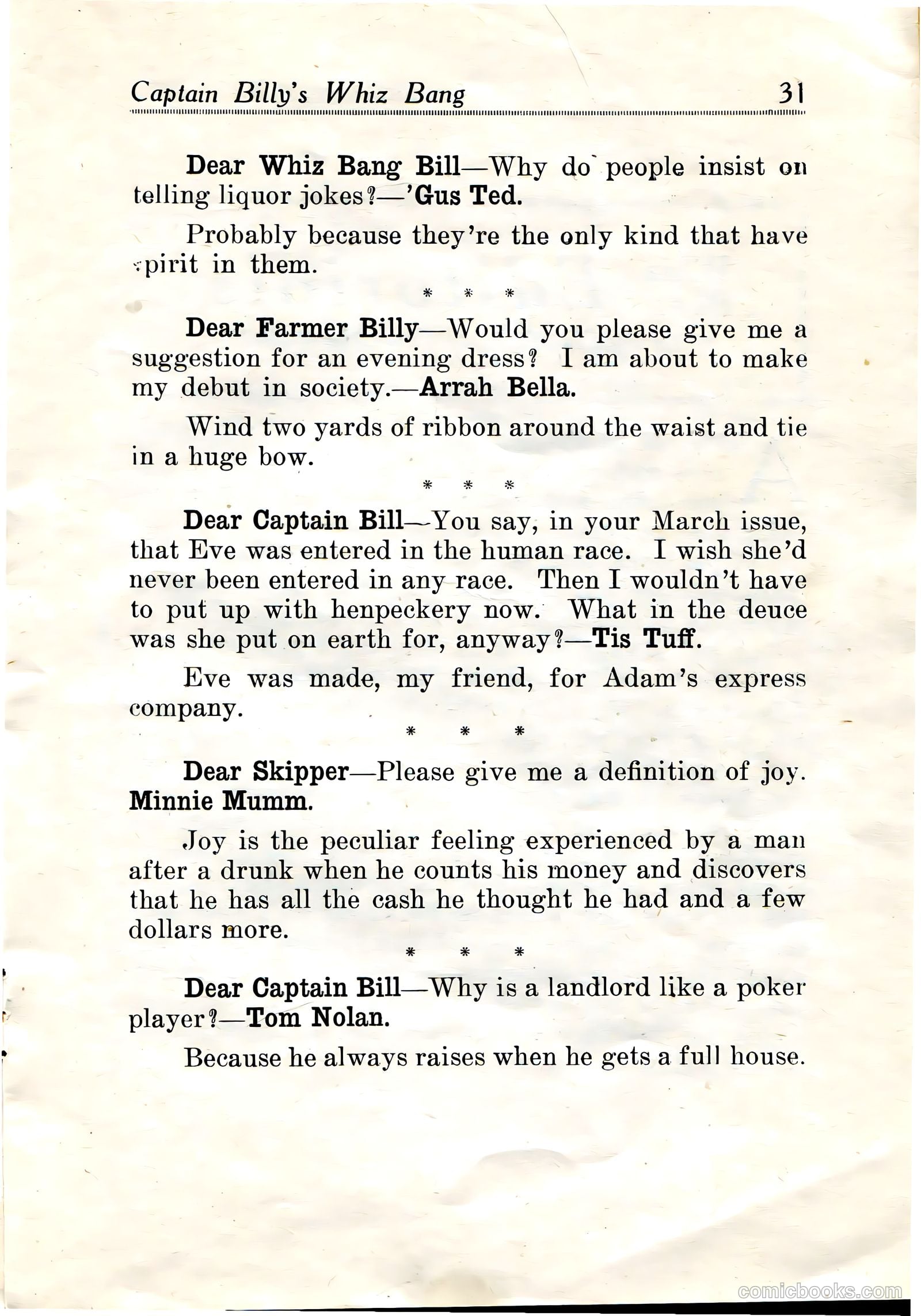
This page contains a humor column of reader letters and responses. The jokes reflect Prohibition-era sensibilities (liquor jokes have "spirit," Eve blamed for mankind's problems, a drunk counting money). The landlord/poker joke plays on double meaning: "raises" refers both to poker betting and rent increases. This satirizes landlords as aggressive profiteers who exploit tenants. The definition of "joy" mocks drunkenness as a fleeting financial delusion—humorous social commentary on drinking culture and poor money management. The fashion advice about ribbon bows and the "debut in society" reference reflect upper-class social conventions being gently mocked for their artificiality and rigid formality. These represent typical early-20th-century satirical humor targeting prohibition, class pretension, and gender stereotypes.
This page contains no cartoon—it's a sentimental editorial essay from *Captain Billy's Whiz Bang*, a post-WWI American humor magazine. The piece celebrates friendship and loyalty using romantic, idealized language. The editorial defines what makes a true "pal" (friend) valuable: understanding without explanation, unconditional support during hardship, honesty, and forgiveness of mistakes. The thrust is that genuine friendship transcends material value and withstands adversity—"the bull is mightier than the bullet" suggests emotional bonds outlast violence. Given the magazine's post-war context, this likely resonated with readers who'd experienced combat camaraderie. The piece romanticizes masculine friendship as something deeper than transactional relationships, emphasizing loyalty and emotional vulnerability disguised as strength. It's essentially propaganda for emotional honesty in male relationships—notable for an era when such sentiment was culturally discouraged.
This page contains **no cartoon or satirical illustration**—it's entirely text content from *Captain Billy's Whiz Bang*, a 1920s American humor magazine. The passage is a sentimental essay about friendship ("A pal"), followed by a literary critique discussing Shakespeare's *Much Ado About Nothing*. The author quotes Benedict's requirements for an ideal wife, arguing that finding a woman combining beauty, wisdom, virtue, and good character is nearly impossible. The "satire" here is mild social commentary: the author mocks contemporary women's artificiality (hair dyes, henna) while using Shakespeare to suggest that no single woman can possess all desirable qualities. It's characteristic of 1920s magazine humor—somewhat cynical about relationships and gender, but presented through literary references rather than visual caricature.
This page contains three separate satirical commentary pieces: 1. **Women's Hemlines**: The author defends shorter skirts against moral critics, arguing that exposing legs doesn't corrupt virtue and that shorter skirts offer health and hygiene benefits (avoiding filthy sidewalks). This reflects 1920s debates over the "flapper" era's rising hemlines. 2. **Debunking Historical Myths**: The piece ridicules scholars who challenge cherished American legends (Pocahontas saving John Smith, Columbus's egg trick, nursery rhyme characters as historical figures). It sarcastically calls for a "Society for the Prevention of Agnostic Historical Writers"—mocking those who apply rational skepticism to national folklore. 3. **Zion City's Leader**: A brief jab at the strict, puritanical ruler of Zion City (appears to reference John Alexander Dowie's theocratic community) for discouraging diamond rings in favor of practical baby buggies—criticizing his joyless pragmatism over romance. The overall tone is irreverent and pro-modernization against conservative moralism.
This page contains two sections: a motivational list titled "Ten Points for the Worker" offering workplace advice (honor leadership, build confidence, tackle difficult tasks first, etc.), and a satirical piece called "What the Missionaries Do." The satire quotes naturalist Ernest Thompson Seton making a provocative argument: that naked African tribes are naturally moral, but become morally corrupt when missionaries force them to wear clothing. The quote absurdly claims modesty in dress causes moral decline. The final line—"Oh, Adam, why did you ever wear that fig leaf?"—delivers the joke: sarcastically blaming Adam for introducing clothing (and thus, the satire implies, sexual shame and hypocrisy) to humanity. This mocks missionary work and Victorian sexual attitudes rather than endorsing Seton's claims.
This page presents literary content rather than political cartoons. It discusses William Ernest Henley's poem "Or Ever the Knightly Years Were Gone," which inspired a picture drama called "Male and Female." The text draws a parallel between biblical punishment of women (Daniel in the lion's den) and contemporary gender dynamics—suggesting modern man now "serves woman" as a reversal of historical power. The page features two poems: one about romantic rejection and divine retribution, and "Toledo Slim," apparently about a violent confrontation on Market Street where the narrator shoots a "traitor" and escapes by train. The "Smokehouse Poetry" section appears to be Whiz Bang's satirical literary feature, likely mocking contemporary poetry and social attitudes about gender relations.
This page contains a poem by Paul Desprez, not a political cartoon. It's a narrative poem about a cowboy and his female companion named Lasca, who rides a mouse-grey mustang. The speaker romanticizes frontier life—preferring action, danger, and open-air freedom to urban conformity ("write reviews," "carry umbrellas," "keep dry shoes"). The poem describes a cattle stampede triggered by a sudden storm. The couple flees on horseback, with Lasca clinging to the narrator as they race ahead of the stampeding herd. The piece celebrates Wild West adventure and romantic companionship amid natural danger—typical early-20th-century American frontier nostalgia literature rather than satire or political commentary.
This page contains two poems rather than cartoons. The first, untitled narrative poem, depicts a tragic romantic story set in Texas near the Rio Grande. A cowboy describes a desperate chase during cattle rustling where his lover Lasca is killed by a stampeding mustang. He buries her and reflects on his grief. The second poem, "It's All in the Game," offers philosophical commentary on life's unpredictability—comparing weddings, rice, and old maids' advice to a game of chance where outcomes are uncertain but one must accept the results gracefully. Both poems are sentimental verses typical of early 20th-century popular literature. There are no visible cartoons or political satire on this page; it's primarily literary content.
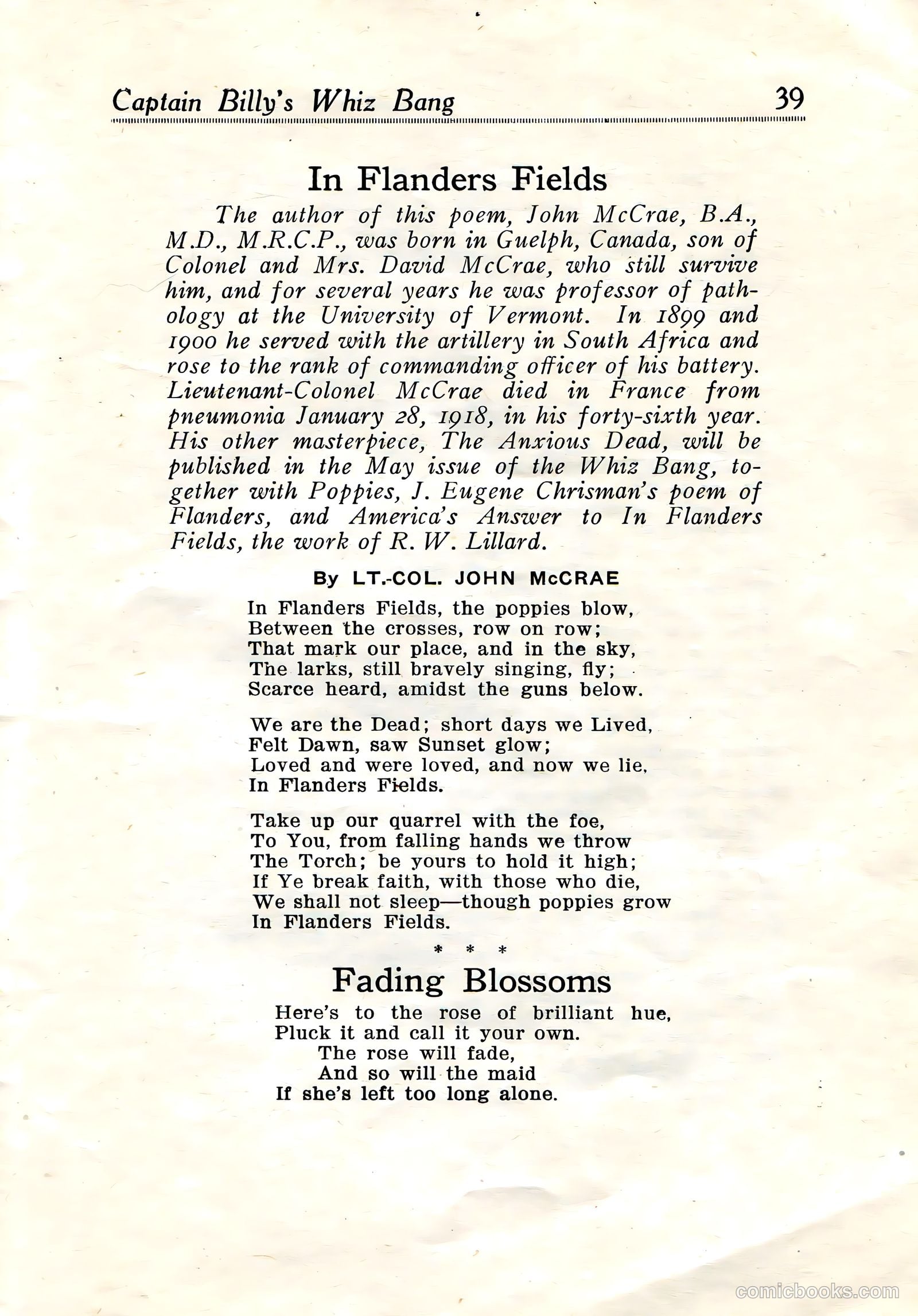
This page contains two poems rather than cartoons or satirical illustrations. **"In Flanders Fields"** is Lt. Col. John McCrae's famous WWI poem, republished here with biographical context noting McCrae's death from pneumonia in France in January 1918. The introductory text indicates this poem will appear alongside other war-related works in an upcoming issue. **"Fading Blossoms"** is a brief, separate poem about a rose and a maid. The page functions as literary content rather than visual satire. The *Whiz Bang* magazine appears to be featuring serious war poetry honoring fallen soldiers, likely capitalizing on post-WWI interest in soldier-authored literature. There is no cartoon or satirical commentary visible on this particular page.
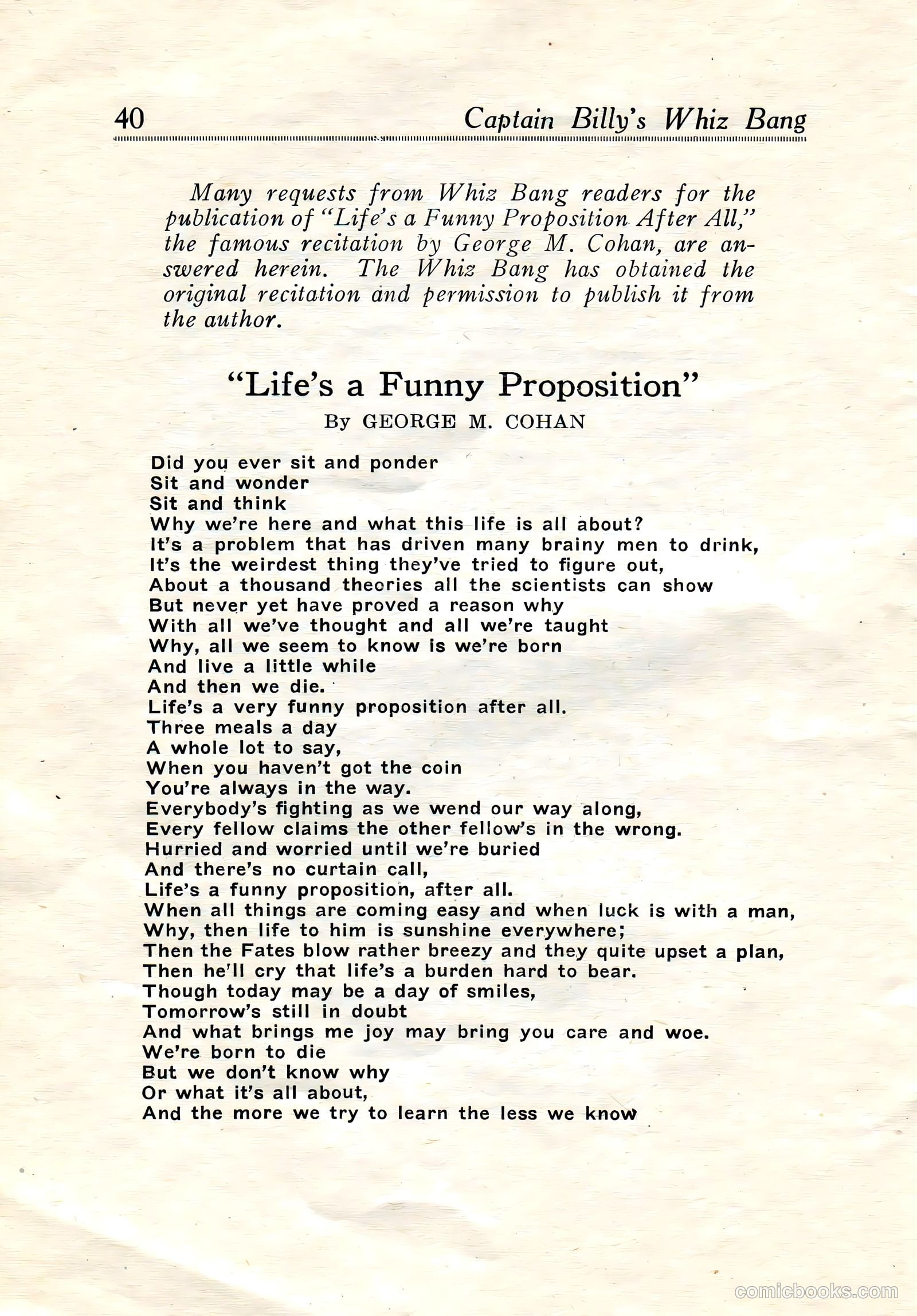
This page contains a complete poem by George M. Cohan, not a political cartoon. The text is a philosophical recitation about life's inherent absurdity and futility. The poem reflects early 20th-century existential humor, presenting life as fundamentally paradoxical: we're born without understanding why, we struggle constantly despite conflicting beliefs, and ultimately we die. Cohan emphasizes life's contradictions—fortune and misfortune are arbitrary, effort yields uncertain results, and increased knowledge brings greater confusion ("the more we try to learn the less we know"). The tone is darkly comedic rather than cynical, treating life's meaninglessness as an amusing "proposition" rather than cause for despair. This represents characteristic Whiz Bang content: accessible philosophical humor reflecting post-WWI American skepticism about grand narratives and traditional values.
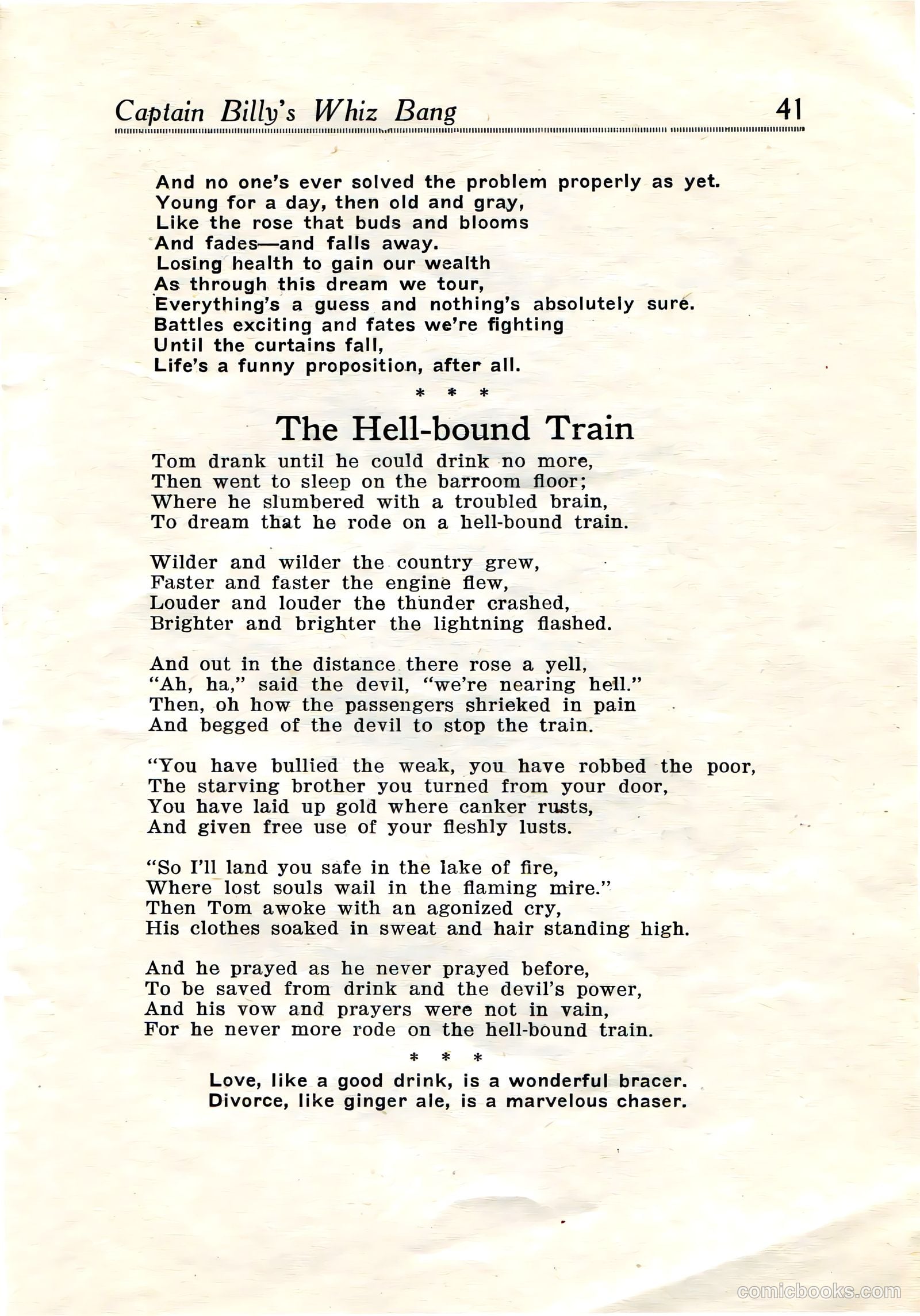
This page contains two poems from *Whiz Bang*, a satirical magazine. "The Hell-bound Train" is a cautionary moral tale in verse about a drunk named Tom who dreams of traveling on a train to hell. A devil-figure condemns Tom for bullying the weak, robbing the poor, and turning away starving people—listing specific sins of moral corruption and cruelty. Tom awakens terrified and vows to reform, renouncing drink and sin. The poem appears to be temperance propaganda using hellfire-and-damnation rhetoric common to early 20th-century moral crusades. The satirical framing—presenting this overwrought morality tale—suggests *Whiz Bang* is mocking such preachy, melodramatic reform messaging rather than endorsing it.
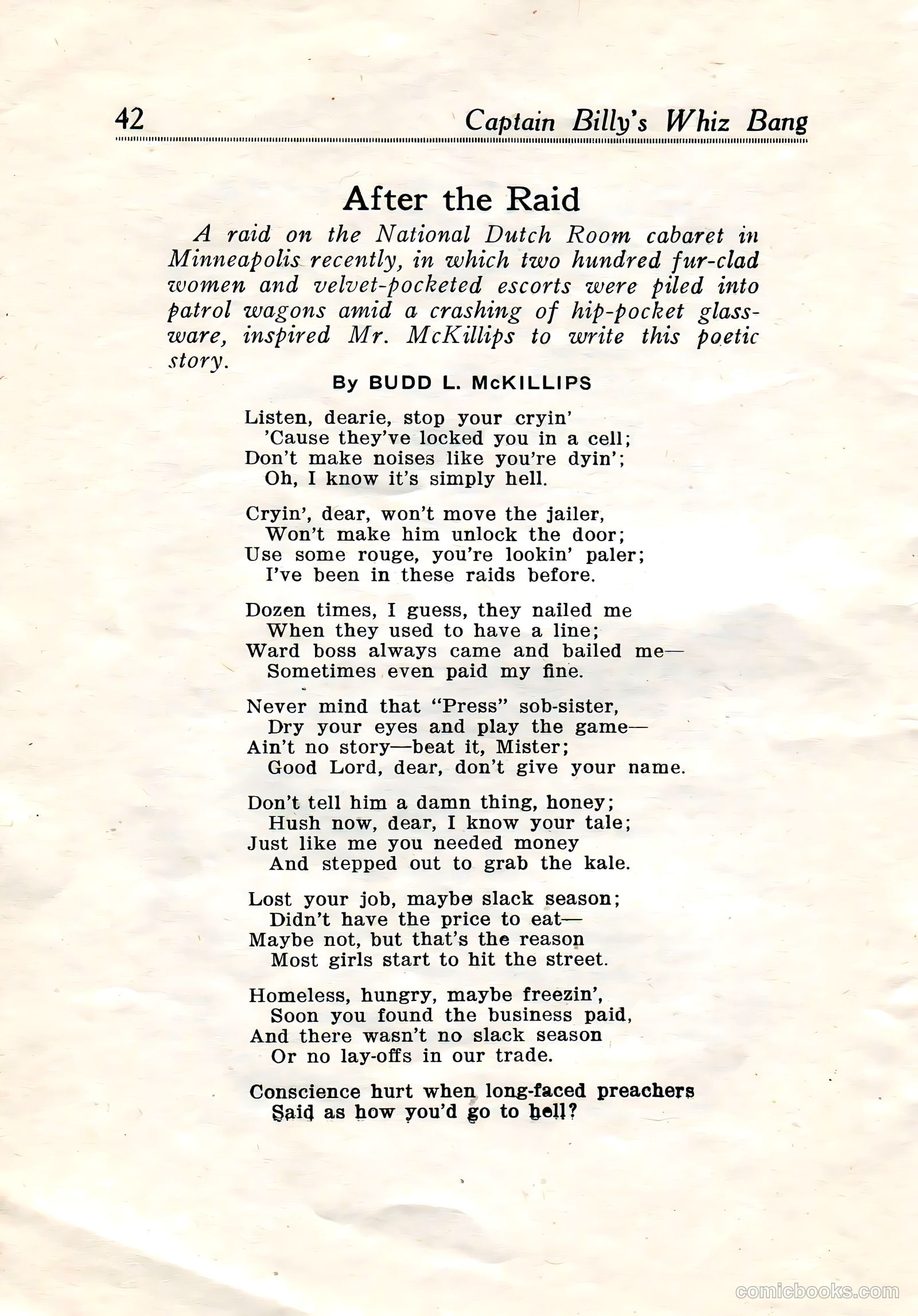
This page contains two satirical poems without accompanying illustrations. The first poem mocks schoolteachers' hypocrisy—they preach morality while their own sons apparently engage in petty crime or misconduct, requiring legal intervention. The second poem, "When Wifie's Away," satirizes male infidelity and moral laxity. It argues that a man's temptation to misbehave when his wife is absent represents the greatest moral danger, more seductive than other vices. The poem includes a narrative example about "young man named Whiteside" who abandons propriety when unsupervised, hearing "cooties" (lice) crawling and making hasty escapes. The satire critiques masculine weakness and hypocrisy regarding marital fidelity and social respectability.
This is a satirical poem criticizing restrictive legislation, likely Prohibition-era laws. "Blue Laws" (actual laws restricting certain activities, especially on Sundays) are personified as a destructive raven, spreading "discontent, dissatisfaction, gloom." The poem attacks: - **Legal overreach**: legislation "undermining Freedom's precepts" - **Moral policing**: bans on dining, drinking, entertainment ("straight-laced styles") - **Religious strictness**: Sunday restrictions ("the Sabbath") - **Social decay**: corruption ("Crooks and Purists pairing"), loss of joy and contentment The final stanza portrays the nation "draped in mourning," with Freedom itself dying. The satire suggests these laws have killed American liberty and happiness, turning the country into a prison of enforced morality—a common anti-Prohibition argument in 1920s magazines.
This page from *Whiz Bang* contains two poems rather than political cartoons. "Interpretative Dancing" satirizes modern avant-garde dance by mocking the disconnect between a dancer's actual movements and their pretentious titles. The speaker repeatedly misinterprets what he sees—a woman doing laundry-inspired movements, another running through wheat—only to learn from the program that these are serious pieces like "Slumber Song" and "A Russian Peasant's Prayer for Bread." The joke targets both experimental modern dance and audience members who accept intellectual-sounding titles uncritically. "Sweet Simplicity of Ye Olden Days" makes light jokes about beer brands and courtship, suggesting nostalgia for simpler times when romance involved casual brewery encounters. Both poems reflect 1920s American humor about contemporary cultural trends.
This page contains three poems rather than cartoons. "A Mother's Prayer" by Nellie Putnam Chapman depicts a mother's anguish over her son imprisoned at court—addressing themes of crime, shame, and maternal concern about keeping her child on the right path. "The Underworld" by Clem Yore uses colloquial language ("square to the underworld," "dog that is down") to express a philosophy of preferring simple honesty and companionship over criminal success or pretense. "We'd Kiss Her, Too" is a flirtatiouslyrical poem exploring hypothetical romantic scenarios through conditional statements and role reversals. All three poems reflect common magazine content of the era addressing morality, crime, family values, and romance—typical themes for *Whiz Bang*, a satirical publication targeting working-class readers.
This page contains three literary pieces rather than cartoons. "The Hooch Cure Blues" by M.V. Sumner is a humorous poem satirizing Prohibition-era drinking culture. The narrator ironically complains about various mishaps (a stormy night at sea, romantic troubles) while maintaining he "never missed a drink." References to "the 'Murray' cure" and being "soused to the gills" suggest speakeasy culture and bootleg alcohol consumption. The brief couplet about spanking appears to reference parental discipline. "All to Myself" by W.D.N. is a sentimental poem about nostalgic memories. The satire targets Prohibition's failure—citizens openly discussing illegal drinking despite the law's intent to eliminate alcohol consumption.
This page contains a collection of brief, unrelated jokes and witticisms rather than a political cartoon. The humor is domestic and lighthearted: - Jokes about maidens' fashion ("brevity is the sole charm of a maiden's skirt") - A husband-wife joke where the wife still makes biscuits despite having a maid - A pun about music and a hat band - A gag about sponges swelling in water - Flirtation and courtship humor - A joke about a new Cadillac and walking distance - A final couplet about living carefree while young The page reflects 1920s-era humor focused on gender roles, marriage dynamics, and consumerism (the Cadillac reference). There are no identifiable political figures or specific social commentary—just period-typical domestic satire aimed at general amusement.
This page contains brief satirical items and jokes rather than formal cartoons. The content includes: **Social Commentary:** - A jab at a Washington woman proposing bachelor taxes, suggesting she reverse her proposal since older bachelors lack value - A quip about Missouri's reputation for "raising democrats, mules and hell" - A Dode Leonard observation comparing near beer to looking through a keyhole with a glass eye (mocking Prohibition-era weak beer) **Humor:** The items use wordplay and social observation typical of 1920s men's humor magazines. They mock women's activism, regional stereotypes, and Prohibition. A "Latest Song Success" concludes the page with a clichéd romantic lament. The tone is irreverent and cynical, targeting contemporary social changes and political movements through brief, punchy jokes rather than sustained satire.
This page from *Captain Billy's Whiz Bang* is a collection of brief, ribald jokes and one-liners rather than political cartoons. The content is typical of the magazine's humor style: The opening item reports Joseph Highland and Zelma Gourley's elopement. Several jokes follow on domestic themes—stocking seams, marriage, divorce, and infidelity—common subjects for this era's satirical magazines. One joke mocks Hindu ascetics ("makes his skindoo"), reflecting early 20th-century attitudes toward non-Western cultures. Others are crude relationship humor about adultery and aging. The final poem toasts heavy drinking and cynicism over romance—the magazine's typical irreverent tone. No specific political figures are caricatured here. This is primarily lowbrow, domestic satire targeting marriage and romance conventions.
This page contains brief humorous quips rather than cartoons. The jokes target various social topics: 1. **"Perfection at the Start"** mocks early talking machines (phonographs), suggesting they were already perfect and unchangeable. 2. **John Barleycorn** reference alludes to Prohibition—the personified "death" of alcohol, though costs continue mounting. 3. A joke about **skirt dances vs. shimmy** reflects 1920s dance trends and generational fashion shifts. 4. **Ethel Worrymore's quip** about cigaroot-smoking women uses crude humor to shame female smokers. 5. **"Our Old One Revamped"** jokes about Prohibition making wives turn their husbands into "likker" (liquor) dealers. 6. **"Purely Political Pot Pourri"** comments on a politician (Mr. Noble) expected to win easily in his constituency. These represent typical Whiz Bang humor—irreverent, topical, and often crude.
This page contains a section titled "Classified Ads" featuring humorous fake advertisements sourced from various American newspapers (Indianapolis News, Mandan Pioneer, Augusta Chronicle, etc.). The jokes play on double meanings and awkward phrasing in genuine classified listings. For example, "Washing the Girlies" advertises "experienced lady cleaners," while "Take a Tip, Horace" features someone asking not to be phoned because "Father is cleaning his gun"—suggesting a protective father scenario. "A Vague Gee-String" mocks confusing fashion terminology from fashion magazines. These are essentially early 20th-century examples of comedy derived from real classified ad mishaps—finding unintentional humor in poorly-worded newspaper advertisements. The format was a common satirical feature in humor magazines of this era.
This page consists entirely of classified personal advertisements and brief news items republished from other newspapers — it is not satirical content or political commentary. The ads include: - A drainage committee meeting notice - A housekeeper job posting - A farmer seeking a housekeeper - A personal correction about a domestic situation - A matrimonial/dating ad from Denver - A housekeeper position wanted ad These appear to be genuine classified listings typical of 1920s-era magazines, likely included as filler content or supplementary material. The page contains no cartoons, caricatures, or satirical commentary — just straight news clippings and want ads presented without editorial commentary or humor.
This is a humorous short story satirizing workplace flirtation and infidelity in the 1920s. The joke follows a man who flirts with his own secretary (kissing her when papers drop), then visits another office where he flirts similarly with Brown's secretary, and finally arrives home to find his wife lounging and swinging her legs—the same pose he's been enjoying with other women. The satire targets the casual sexual dynamics of modern office culture: secretaries who deliberately display their legs and brevity of dress to please employers, and men who take advantage. The punchline—his wife adopting the same suggestive posture—implies she's either mocking his behavior or suggesting universal infidelity. The repeated "swinging legs" motif emphasizes how normalized and casual these flirtations have become. It's pointed social commentary on 1920s morality and workplace conduct.
This page contains three separate humor sections with no illustrations visible: 1. **"Captain Billy's Whiz Bang"**: A domestic humor anecdote about a husband annoyed by his wife swinging her legs while sitting. 2. **"Naughty Coppers"**: A joke referencing a St. Paul police chief who claimed he was "framed" with a patrolman's wife. The anecdote describes Patrolman Snorkins retrieving his coat from home on a cold night, then joking with a colleague about when he became sergeant—implying the colleague suspects the coat-retrieval was a cover story for an affair. 3. **"Mottoes of the Vampire"**: Two cynical one-liners about relationships, presenting darkly humorous observations on romantic attachment and dependency. The page is primarily text-based humor typical of 1920s-era satirical magazines.
This page from *Whiz Bang* contains several brief, satirical observations rather than a cartoon. The humor targets gender relations and social conventions of the era: 1. **The farmer's wail** mocks financial desperation with dark humor about imminent death. 2. **"Sign in Doctor's Office"** satirizes how even educated professionals embrace alcohol as medicine—a reference to Prohibition-era hypocrisy when doctors legally prescribed alcohol for "medicinal" purposes. 3. **Fortune Teller joke** makes cynical commentary on marriage, suggesting women marry poorly and seek advantage through fortune-telling. 4. **"Lingo of the Limpid Lip"** presents gendered communication stereotypes: men's "yes/maybe/no" versus women's opposite meanings, implying dishonesty or incomprehensibility in female speech. The final quip about girls "at twenty" being "dangerous" reflects period anxieties about women's autonomy and sexuality.
This page contains a collection of humorous anecdotes and poems rather than political cartoons. The jokes target universal human foibles: 1. **The bathroom encounter**: A risqué joke about a couple, playing on embarrassment and hypocrisy. 2. **The philosophical poem**: A commentary on human frailty, love's troubles, and wine as an escape—typical saloon-era cynicism. 3. **The "Johnnie and Frankie" correction**: The editor corrects the London Spectator's version of a popular ballad, asserting the "correct" chorus about betrayal in romance. 4. **The gambling flea joke**: A absurdist humor piece about a flea's misfortune. The final line advises checking bedding for fleas—common practical advice for the era. The content reflects 1920s working-class humor: bawdy, cynical, and focused on everyday annoyances and romantic disappointments.
This page contains four brief humorous anecdotes typical of 1920s American satirical magazines: 1. **The camisole/casserole joke** plays on a man's confusion between women's undergarment and cookware—the saleslady's witty reply suggests both can contain poultry, a crude double entendre. 2. **The maid Mary anecdote** relies on misunderstanding: her innocent offer to ensure the master gets his bath is misinterpreted as improper by his wife, creating embarrassment. 3. **The "hooch" story** satirizes marital discord and alcoholism (Prohibition-era context). The wife cleverly turns her husband's drunken degradation into backhanded praise—at least he's not a liar. 4. **The final line** provides moral commentary: marriage ("I will") is a life sentence. The humor targets domestic tensions, class differences, and period anxieties about morality and drinking. The content reflects 1920s sensibilities: bawdy but euphemistic, focused on marital conflict and servants' social position.
This page from the satirical magazine contains three jokes targeting different groups. **"Balaam Gets Sympathy"** references the Biblical story of Balaam's ass (donkey), which miraculously spoke. The joke mocks a stuttering guest whose friend responds to a toast so poorly that witnessing it makes the friend finally sympathize with Balaam's embarrassment at being represented by his donkey. **"Heaven, Hell or Los Angeles"** uses racist dialect humor (common in early 20th-century American comedy) to joke about a Black soldier at Camp Kearney, California, going AWOL to see his girlfriend. The punchline equates Los Angeles with Heaven or Hell—implying it's as important as the afterlife. **The apartment building dialogue** satirizes Prohibition-era "hooch parties" (illegal alcohol gatherings). The joke suggests the partygoers are transient and unimpressed by eviction threats, having been kicked out of better places. All three rely on now-offensive stereotypes and assumptions about social hierarchies common to 1920s American humor.
This page presents humorous letters to "Captain Billy" from rural readers, a common feature in early 20th-century magazines. The responses mock various correspondents: - **Shakespeareson** complains his submitted poem "An Ode to Oblivion" was rejected, receiving a witty reply that it "reached its destination" (meaning oblivion). - **Parliamentarian** is corrected on parliamentary procedure about raising hands before asking questions. - **Ted Mann** gets romantic advice despite poor singing ability. - **Lonesome Jack** receives suggestions for beach inspiration at Miami. The satire targets the predictable concerns of rural America—poetry aspirations, romance, procedure—while the magazine's editors deliver comedic, slightly condescending responses. This reflects early 1900s urban magazine humor aimed at rural audiences.
This page contains two satirical pieces from *Whiz Bang*, a 1920s humor magazine. "Revamping the Vamps" mocks the fashion industry's push for increasingly smaller women's clothing sizes. It satirizes how dressmakers and fashion editors (specifically referencing "Dame Fashion" and Miss Marion Rothschild) are setting impossible body standards—demanding symmetry, slenderness, small hips, and trim ankles—under the guise of what women "naturally" want. The joke is that manufacturers have created artificial demand by simply making clothes smaller, forcing women to shrink themselves to fit. "The Old Maid's Lament" is a brief, cynical joke about unmarried women, playing on period attitudes dismissing spinsterhood as an undesirable fate. Together, these pieces critique fashion industry manipulation and period anxieties about women's roles.
**"Blood vs. Hootch"**: A Scotsman hit by a Ford car hopes the liquid running down his leg is blood rather than the whiskey from his flask he was carrying. The joke plays on Scottish stereotypes about drinking and valuing alcohol. **"A Stew's Lament"**: A husband denies putting the cat out; he tells his wife to do it herself if she doesn't believe him. The humor relies on the double meaning of "put out"—the wife accuses him of evicting the cat, he suggests she stop complaining. **"Sympathy"**: A poor man sees a Humane Society window display of a skinned animal with a placard explaining it was killed for fur coats. He relates to the animal's suffering, having experienced his own poverty and exploitation.
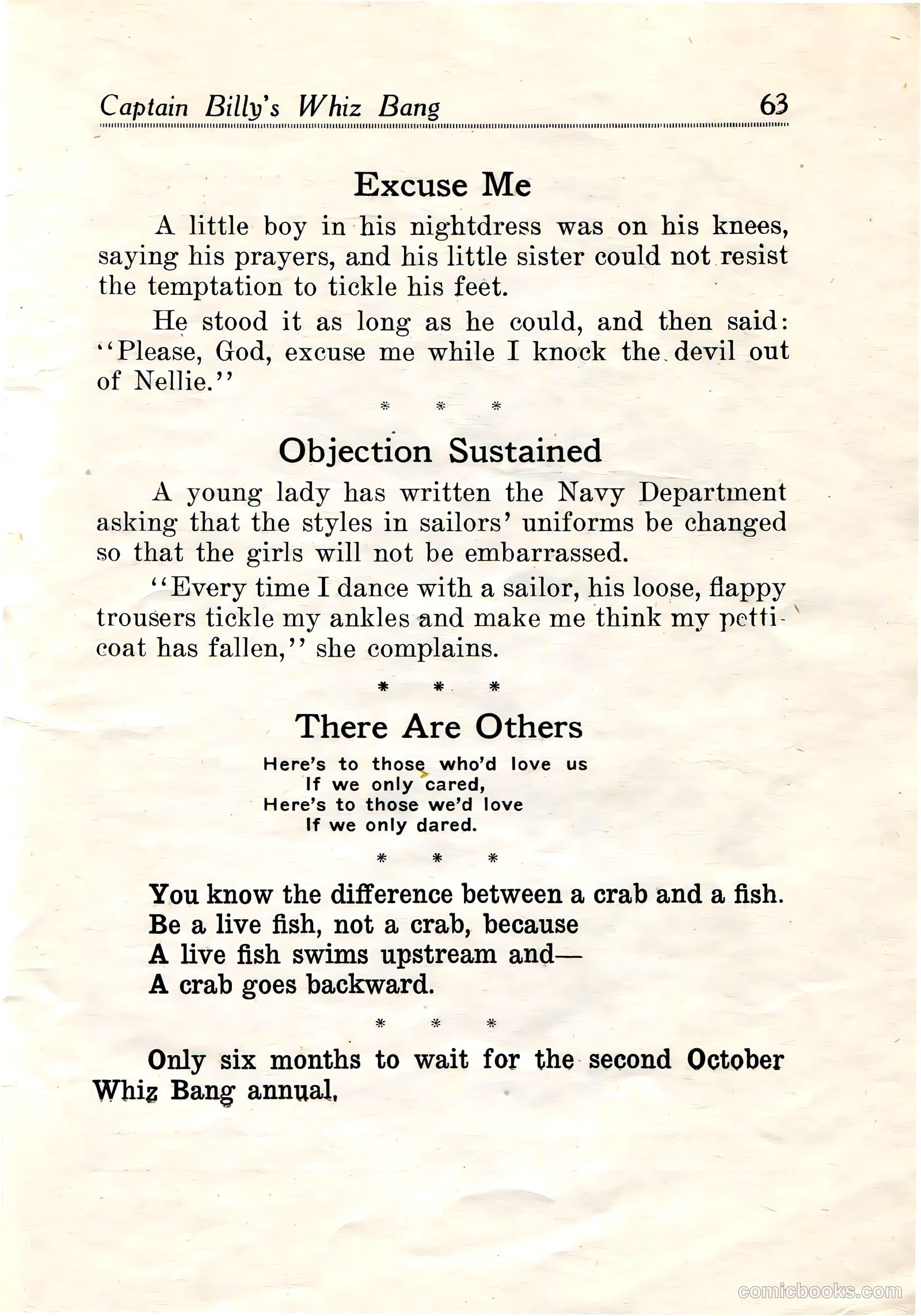
This page contains four humorous short pieces rather than political cartoons: 1. **"Excuse Me"**: A child's prayer interrupted by his sister tickling his feet, leading to his request for divine permission to retaliate—gentle family humor. 2. **"Objection Sustained"**: Satire of Navy uniform styling, where a young woman complains that sailors' loose-fitting trousers tickle her ankles while dancing, requesting uniform redesign. This mocks both overly formal military bureaucracy and the frivolous nature of some civilian complaints. 3. **"There Are Others"**: Sentimental verse about unexpressed love, followed by an aphorism comparing ambition to swimming upstream versus retreating like a crab. 4. A promotional notice for the next issue. The page reflects 1920s social humor, particularly regarding military culture and courtship customs.
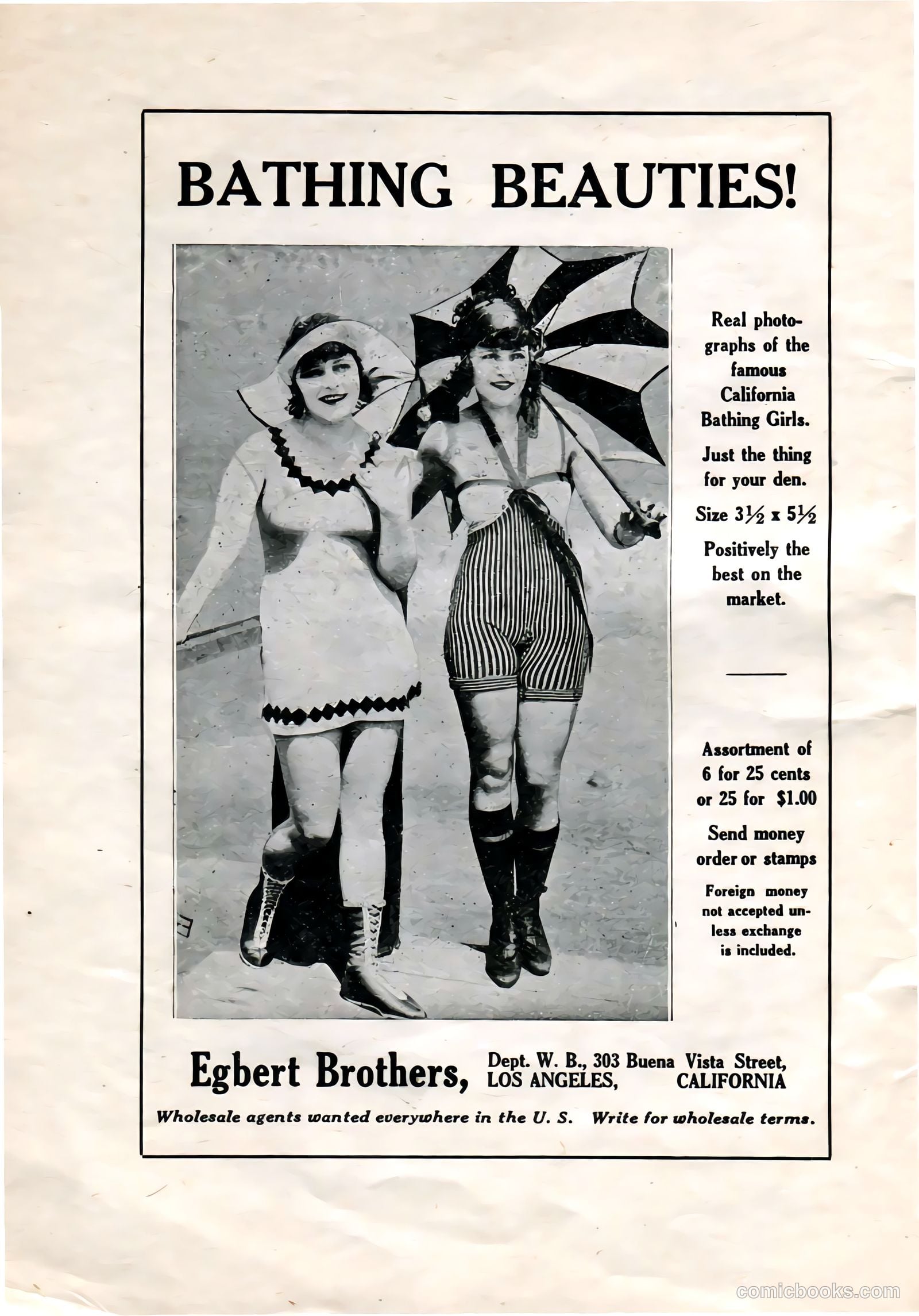
This is primarily **advertising content**, not satire or political commentary. Egbert Brothers is selling photographic postcards of women in 1920s bathing attire—marketed as "California Bathing Girls." The "satire" element, if any, is implicit in the era's fascination with "bathing beauties" as a novelty product. The advertisement targets male consumers ("just the thing for your den"), reflecting early-20th-century cheesecake photography culture. The pricing (6 postcards for 25 cents) and wholesale solicitation suggest this was a mail-order novelty business. The women pictured wear period-appropriate swimwear with decorative elements (umbrellas, headwear), typical of 1920s bathing suit aesthetics. There's no identifiable political message—this is straightforward commerce exploiting public interest in glamorous imagery.
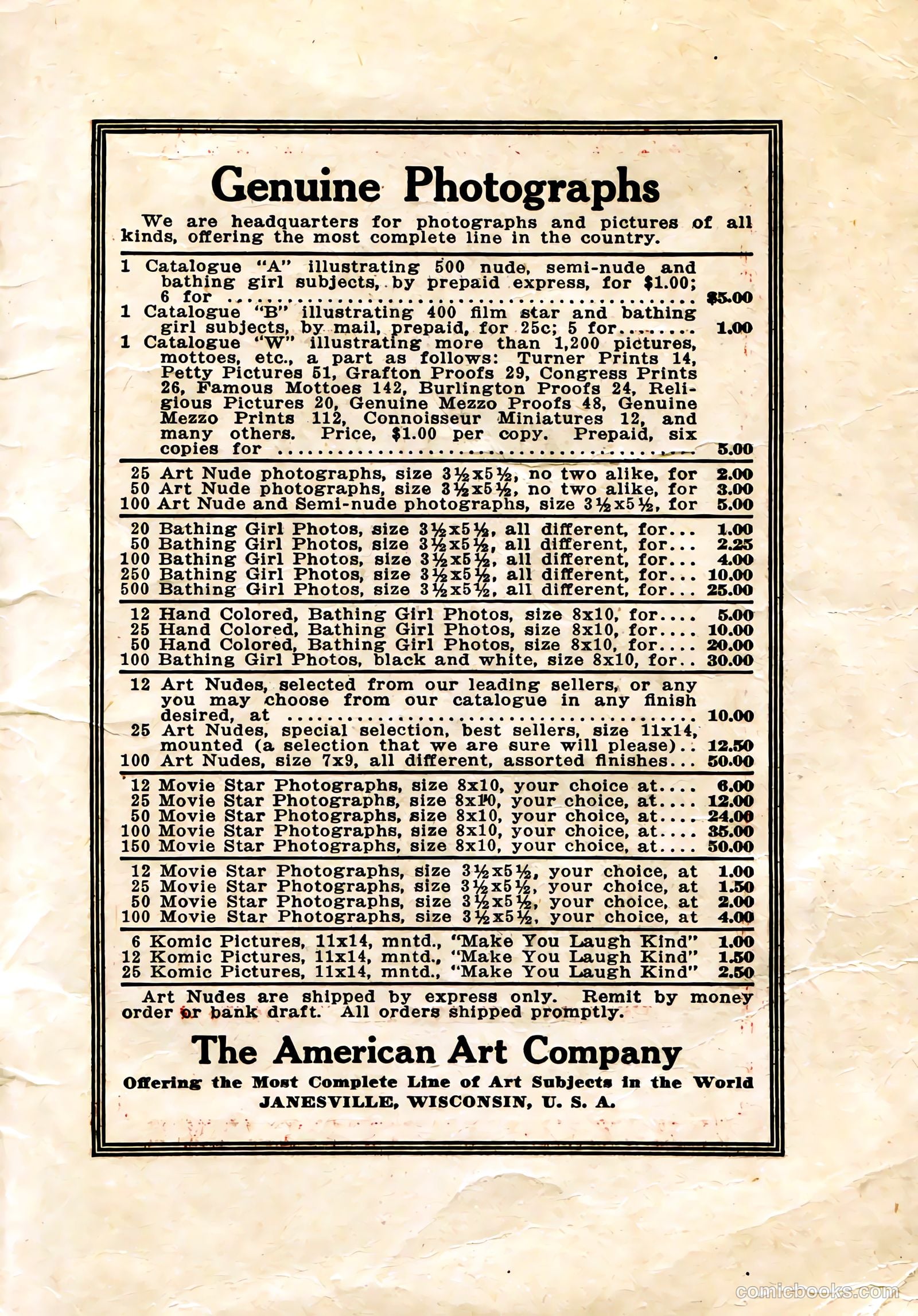
This page is **entirely advertising**, not editorial content or cartoons. It's an advertisement from "The American Art Company" of Janesville, Wisconsin, promoting mail-order photographs. The company sells catalogues and photographs of: - Nude and semi-nude subjects (marketed as "Art Nudes") - "Bathing Girl" photographs - Film star photographs - Hand-colored photographs - "Movie Star Photographs" - Comic pictures The ads emphasize quick delivery "by express" and offer bulk purchases at discounted prices. Payment is requested via money order or bank draft. This represents early 20th-century mail-order commerce in photographs, operating in a legal gray area—marketing artistic nudes and bathing girl images to collectors through catalogues. There is no satirical content or political commentary on this page.
This is a title/advertisement page for *Whiz Bang*, an American satirical magazine. The page announces the publication's availability and pricing across various retail channels—hotels, newsstands, and trains—with a yearly subscription option. The cartoon mascot is a cow wearing what appears to be a military uniform or formal dress, depicted in a humorous, anthropomorphic style. This likely served as the magazine's recurring character or logo. The cow image appears designed to convey comedic absurdity, fitting a satirical publication's tone. The "Everywhere!" headline emphasizes the magazine's broad distribution network, a significant selling point for early 20th-century periodicals competing for readership. The pricing structure reflects typical magazine economics of the era, with bulk annual subscriptions offered at a discount.